Guest post by David Archibald
Robert Hargraves lives in Hanover, New Hampshire. Mr Hargraves believes that “Global warming is harming us all.” Using the temperature – solar cycle length relationship from Friis-Christensen and Lassen theory, for cycles 24 and 25, this is what Nature has in store for Hanover, New Hampshire:

So the coming years will be a severe test of his faith in the State-sponsored belief system.
In the meantime, he has done the World a good service by writing a book which describes why Liquid Flouride Thorium Reactors (LFTRs) are the solution to maintaining a high standard of living when the fossil fuels run out.
He starts the book by describing the basic physics of energy and then goes on to rehash IPCC material on global warming. Sometimes authors let slip, by their pronouncements, that they don’t have a good grip on the physical world. One of the better examples of that in Mr Hargraves’ case is this passage, ”Changes to life in the ocean will also be dire. Ocean life thrives in cold water; Caribbean water is blue and clear because it has less life than temperate and polar oceans.” Brian Fagin is another warmer author who betrays a lack of understanding of the physical world; in a number of his books he has describes arrow heads as weighing 1 kg. At any rate, on reading this sort of thing, the reader is alerted to not take any statement as being necessarily true.
The useful part of the book begins on page 115 with a discussion of the costs of existing energy sources – coal-fired power at 5.6 cents/kWh using coal at $45 per tonne and natural gas-based power at 4.8 cents/kWh using natural gas at $5/MBTU. Wind is far more expensive at 18.4 cents/kWh. Using pumped hydro storage to pacify it for the grid would add at least another 6 cents/kWh. Solar power is much the same cost at 23.5 cents/kWh.
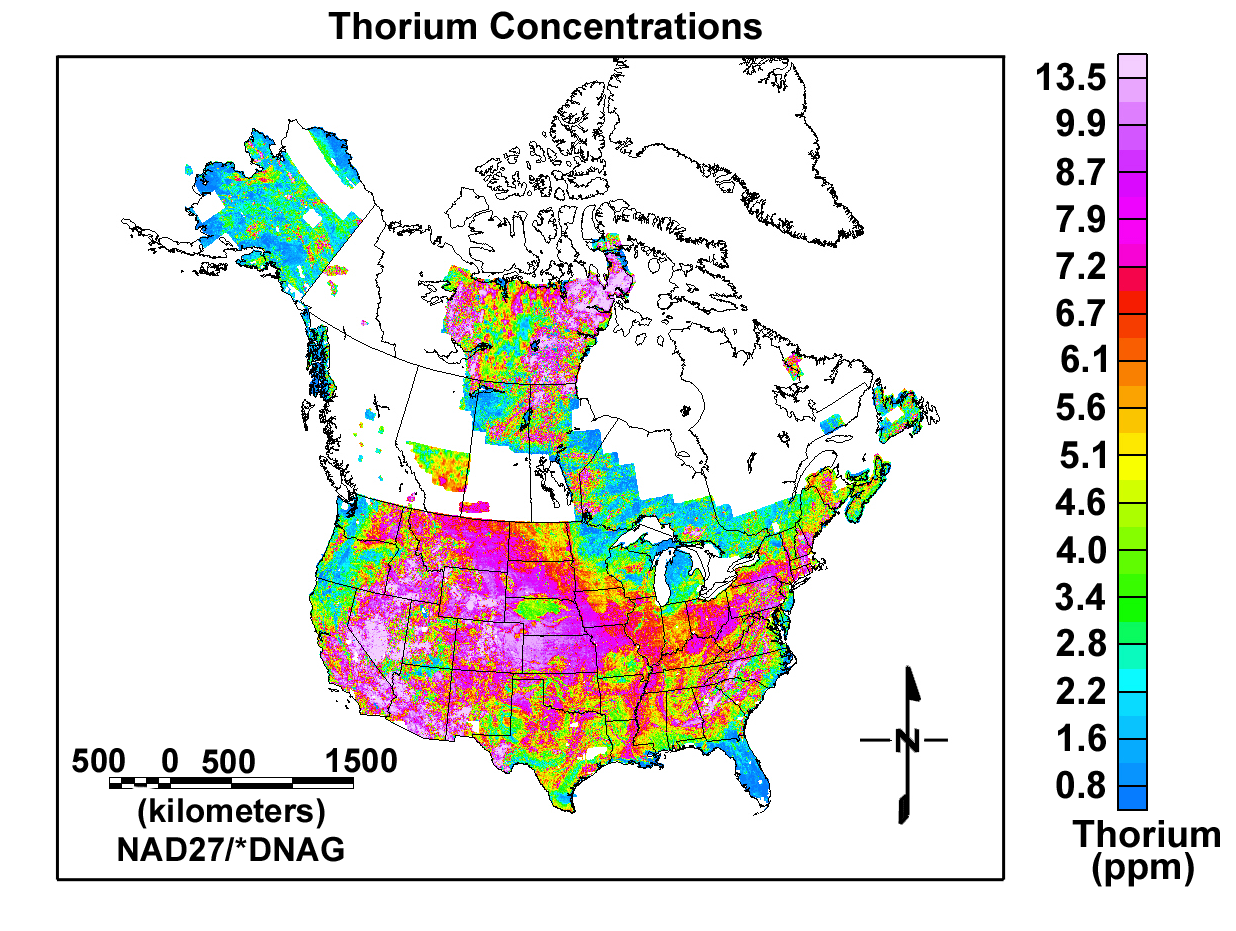
Discussion of nuclear power begins in Chapter 5 on page 176. LFTRs will operate by having neutrons from the reactor core irradiate thorium in a blanket, converting it to fissile U233. That U233 is periodically rinsed from the blanket salt and fed to the core. Power from LFTRs is expected to cost of the order of 3 cents per kWh all up. The LFTRs will need a starter fuel at the rate of 1 kg per MW. The best source of that is the more than 72,000 tonnes of spent fuel rods that has accumulated in the US. That contains at least 648 tonnes of plutonium which is enough to start more than 3,000 200 MW reactors. Those spent fuel rods that have accumulated over the decades are a precious resource.
There is an interesting section on China’s LFTR project starting on page 260. China’s interest was triggered by an article in July 2010 in American Scientist. A delegation visited Oak Ridge National Laboratories where molten salt reactor work was done in the mid-1960s. The Chinese LFTR project was announced at a meeting of the Chinese Academy of Sciences in January 2011. Oak Ridge had 1,894 Chinese visitors in 2011! The project currently employs 432 people, expected to rise to 750 in 2015. A working 2 MW (t) reactor is expected by 2017 and a 10 MW (e) by 2020. The Chinese reaction to that July 2010 article reminds me of John Boyd’s OODA loop. There was a mere six months between reading an article and committing to a major new thrust in nuclear research. The contrast between that and the billions spent in the West on recreating medieval fear and superstition, and calling it climate science, could not be more stark.
This book is also comprehensive. A section on synthetic liquid fuels and how they might be made using nuclear power starts on page 355. It is realised that sources of carbon might become so scarce that the cheapest source might be carbon dioxide extracted from the atmosphere. A scheme to do that is illustrated on page 361. This is ironic in a book that asserts that carbon dioxide is the scourge of Mankind.
King Hubbert, of peak oil fame, realised that Mankind’s fossil fuel use would only be a blip in time and that the future, of necessity, will be nuclear-powered. This is Figure 30 from his 1956 paper “Nuclear Energy and the Fossil Fuels”:

Mr Hargraves’ book has updated that insight and added flesh to the bones of the idea. His book is a useful addition to the comity. He is also to be lauded for self-publishing it. My edition is simply marked “Made in the USA; Lexington, KY; 09 September 2012”. The book’s website is: www.thoriumenergycheaperthancoal.com It can be purchased from Amazon.

===============================================================
Below is a video describing the concept. Long, but informative – Anthony
Flouride won’t work. Flour is dusty and makes people sneeze. Much better to use fluoride, which prevents tooth decay.
http://www.torium.se/res/Documents/124670.pdf
Molten-Salt-Reactor Technology Gaps, Charles W. Forsberg, Oak Ridge National Laboratory
(Session: 3.09 Liquid-Salt-Cooled High-Temperature Reactors-III
2006 International Congress on the Advances in Nuclear Power Plants (ICAPP ‘06)
Embedded Topical in the 2006 American Nuclear Society Annual Meeting
American Nuclear Society June 4–8, 2006 Reno, Nevada)
Pardon my ignorance. Has a working one ever been built?
The Chinese program to develop thorium MSRs is headed the US educated Dr. Jiang Mianheng, the son of the President of the Peoples Republic .China has huge stockpiles of thorium as a byproduct of the rare earth mining to supply all the neodymium for all those wind turbines they export. http://energyfromthorium.com/2011/01/30/china-initiates-tmsr/
What is wrong with the reactors like those used on US Navy ships and submarines. If there is a power failure they are SCRAMed by gravity, the operating experience with the reactors is extensive, and the designs are well understood. Contrast the US Navy reactors with those of Fukashima, which could not be SCRAMed without electric power to operate the pumps and servos that drive the SCRAM rods against gravity (perhaps not so good a design).
After the tsunami that overwhelmed Fukashima the issue of the safety of nuclear power became paramount in peoples minds. For educated non hysterical folks the issue of the differing safety properties of various reactor designs also come into focus. The video
@Tom, not that I know. MSR’s have been built. The most recent, the Japanese Monju has suffered a series of accidents and produced an hour of power at a cost of 10 -T- Trillion Yen.
Liquid Flouride? Fluoride, surely? Though many a flour mill has gone up like a bomb due to a dust explosion.
“Power from LFTRs is expected to cost of the order of 3 cents per kWh all up.”
Ha, Ha, Ha! Cant begin to cover the costs from regulators, enviros and lawyers, lawyers, lawyers!
Tom asks: “Has a working one ever been built?”
To the extent that an experimental one counts as ‘working’, then yes:
http://en.wikipedia.org/wiki/Molten-Salt_Reactor_Experiment
Tom in Worcester says:
October 2, 2012 at 5:07 pm
“Pardon my ignorance. Has a working one ever been built?”
Yes.
The USN HEU PWR have the most experience of all reactor designs. They are fantabulously expensive. As economies are introduced, so are risks.
Chris asks: “What is wrong with the reactors like those used on US Navy ships and submarines?”
In order to generate considerable power in a small package, shipborne reactors use highly enriched Uranium or high concentration Plutonium (80%-90% is not atypical) as their fuel, approaching weapons grade reactivity.
In contrast land-based power reactors use 6%-10% fissible concentrations, well below levels required for nuclear warheads.
Couple of comments.
First the SC25 estimate of temperature should probably be nearer to SC24 because the pSCL-temperature correlation appears to saturate above about 13-14 years cycle length. The Maunder was cold, but not that cold. Other than that I fully agree with David’s temperature expectation.
Second, the problem with LTFR’s is the engineering. As a guy who has direct experience with molten salt systems and many other halide systems they are a source of much engineering angst and failed processes. Very unforgiving. Corrosion and materials of construction issues have a high chance of killing this technology. Also if you get a contamination issue, such as moly or boron, then the whole big bath will be contaminated, whereas individual contaminated fuel elements could be segregated.
I’m concerned that the hype for LTFR will shoot the promise of thorium nuclear energy in the foot. Thorium would do much better as a fuel element or pebble bed design. KISS principle.
USS Seawolf’s S2G reactor was a liquid Sodium cooled reactor. The design was abandoned for PWR.
I used to be a Nuclear Engineer… back in the day. My professional area of interest was reactor shut down and cooling systems for the CANDU 600, heavy water reactor using U235 as the fuel. I was a young engineer back then and have since moved onto other things.
Great reactor by the way. There would be more of them but the Green Peace types lied about nuclear energy in the 1970s and 80s so a moratorium was place on their construction.
Now that nuclear energy is looking good again, Thorium IS a practical alternative to fossil fuels. I don’t see anything wrong with fossil fuels by the way, I just think that we are going to need more and more energy, and in North America we have a well establish grid so put 1000 gigawatt nuclear plants here and there and let the middle east cave in.
I don’t like electric cars, and the battery systems are terrible but some people might like them for short commutes if the electricity was cheap, which it would be if there were more nuclear plants.
I don’t accept that CO2 from man has any effect on the climate that is measurable. That is not a motive in my book.
Nuclear energy is safe, abundant right here, and inexpensive.
I will still need gas for my V8 F250.
.
The thorium cycle (actually U233 is the active fissile product) can be utilized by existing CANDU reactors without major design changes.
And the CANDU is inherently way safer than Fukushima’s boiling light water reactors.
Another good video about LFTR:
Kirk Sorensen (length 1hr 37min)
http://youtu.be/D3rL08J7fDA
Thorium Reactors… I’ll have to wait until I understand a bit more about them to even begin to form an opinion.
What is a CO2 Heating effect? No wait… never mind!
Fukashima was a 1 in 1000 year event where there was 1 in 1000 year earth quake, a 1 in a 1000 year Tsunami and a total failure of the grid to boot. The answer is to increase the safety systems, NOT PUT THE SPENT FUEL IN THE ATTIC like GE did and move on with better systems. France is 80% nuclear.
Temperature records starting in 1835 in Hanover? Robert, does he say where he got them? The earliest records I can find for Hanover go back only to 1895 …
w.
I’ve asked Rod Adams of Adams’ Atomic Engines and Atomic Insights to stop by.
PWR’s have inherently more risks which the nuclear industry didn’t want to discuss, especially compared to the essentially unpressurized Thorium Reactors, aka LFTR’s. Plus LFTR’s don’t produce much useable weapons grade nuclear byproducts. As a result LFTR’s were abandoned. What a shame then… and now an opportunity to use LFTRs!
I work in the nuclear industry. When the “fourth generation” folks give their cost estimates, I always have to choke a bit. They have a couple experimental reactors. They have not gone through the licensing process. In some ways, they are pretty naive about the nature of this process. Design changes to satisfy regulators cost money. Now don’t get me wrong. In nearly every instance I agree with the regulator. But it inflates the cost of nuclear. Right now the fuel costs are, depending on the design, between 1% and 10% of the cost of the electricity. (That’s where the “too cheap to meter” thing came from.)
Now there are several passive safety features in 4th gen. So they hold promise and really should be worked on very vigourously. And Thorium is very attractive for several reasons. Just don’t expect cheaper than coal, at least not right away. Maybe after we built five or ten of them to work out the gnarly bits. So units 11 through 20 might compete on price with coal, and after that we might be very pleased.
Oohh, thorium, fluoride,rinsing fissile U233 out of molten salts from an operating reactor.
Is it even possible to get any farther away from the suplreme engineering principle of KISS? Here obviously is a guy who has never had to design, build and operate something while making a profit in all three stages.
And look, one guy writing a book about some inexplicably overlooked breakthrough complicated technology that will provide all the world’s energy, that all the engineers of the world have missed? If we just get started on his fabulous idea, it will work out great? Sorry, the world just doesn’t work that way.
Costs per KWH are not easily projected for nuke power plants. There’s a factor of two to three difference between Western and Eastern countries. Fuel cost is a small fraction of the total, which is dominated by capital costs. Depending on country, today’s nuke power costs between 4cents/KWH and 10 cents/KWH. In the West, power plants are built by private industry who have to borrow the money, and interest payments are large. Western plant owners also have to add years to construction time to get the many legal battles settled. Lots of well-meaning but stupid people, and people who *want* energy costs to be high, bring legal proceedings to halt construction. http://www.world-nuclear.org/info/inf02.html
Also, in the West, most employees of nuke power plants never enter the reactor buildings. They work next door in the admin offices pushing paper. Manpower costs are not trivial.
In my opinion, the reason to start using Thorium is plentiful supply, not fuel cost. That’s still an excellent reason though.