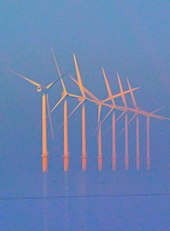
At The Register, Andrew Orlowski attended the talk and has a news article describing Steve McIntyre’s talk at the Institute of Materials, Minerals and Mining, which was an event hosted by the Global Warming Policy Foundation.
McIntyre’s statement on wind power is interesting:
The entire rationale of policy in US and Europe has been to ignore what’s happening in China and India and hope that petty acts of virtuous behaviour in both countries will cure the problem,” he said. “Even if you install windmills you’re not going to change the trend of overall CO2 emissions.”
Actually, it is worse than that. As Bishop Hill reports, it turns out that windmills in the UK at net positive for CO2 emissions. He writes:
Ever since Gordon Hughes’ report noted that wind power was more likely to produce more carbon dioxide emissions than [natural] gas, I have been looking for the figures behind the claim. In the comments, someone has now posted some details that seem to meet the bill. Although these are not Hughes’ own numbers -they were submitted in evidence to Parliament by an engineer – I assume they are similar.
[A]s wind rarely produces more than 25% of its faceplate capacity it needs 75% backup – which due to the necessity of fast response times needs OCGT generation (CCGT can respond quickly but the heat-exchanger systems upon which their increased efficiency relies, cannot – so CCGT behaves like OCGT under these circumstances). CCGT produces 0.4 tonnes of CO2 per MWh, OCGT produces 0.6 tonnes. Thus 0.6 tonnes x 75% = 0.45 tonnes. Conclusion: Wind + OCGT backup produces more 0.05 tonnes of CO2 per MWh than continuous CCGT.
In case you are not familiar with the terms:
OCGT = Open Cycle Gas Turbine

- In a gas turbine, large volumes of filtered air are fed in the compressor section of the engine. In an OCGT the multistage compressor squeezes the air to from normal pressure up to 40 times atmospheric pressure depending on the type of turbine.
- Fuel is distributed to the various combustion chambers surrounding the gas turbine. This then mixes with the compressed air and ignition and combustion takes place.
- The combustion gasses expand rapidly and this energy is transmitted to the axial turbine blades which drive the rotor shaft.
- The rotor torque is transmitted to both the compressor section of the gas turbine and the external electrical generator.
In a combined cycle gas turbine (CCGT), the hot exhaust gases of a gas turbine, or turbines, are used to provide all, or a portion of, the heat source for a heat exchanger (called a heat recovery steam generator) to supply a steam turbine.

So I think the time has come to stop tilting at windmills. End the subsidies that make them temporarily attractive and let shale gas step in and help solve the emissions problem as it has already been doing:
PITTSBURGH (AP) — In a surprising turnaround, the amount of carbon dioxide being released into the atmosphere in the U.S. has fallen dramatically to its lowest level in 20 years, and government officials say the biggest reason is that cheap and plentiful natural gas has led many power plant operators to switch from dirtier-burning coal.
http://news.yahoo.com/ap-impact-co2-emissions-us-drop-20-low-174616030–finance.html
Everyone acts so surprised by this news, but I had it on WUWT over a month ago.
USA CO2 emissions may drop to 1990 levels this year

I predict that in a few years, when the subsidies run out, many wind farms will look like this one in Hawaii, now abandoned because it it too expensive to maintain:

Related, via Jo Nova:
Hydroelectricity produces 16% of the total. But all the vanity renewables bundled together make about 3.5% of total. Wind power is a major global industry but it’s only making 1.4% of total electricity. And solar is so pathetically low that it needs to be bundled with ‘tidal & wave’ power to even rate 0.1% (after rounding up). If world’s solar powered units all broke tonight, it would not dent global electricity production a jot. No one connected to a grid would notice.
UPDATE: Hans Labohm writes in with a supporting study:
Dear Anthony,
In The Netherlands Kees le Pair (Dutchman) has recently completed his
analysis on wind energy over here.
It confirms the conclusions of Hughes.
The English version of his report can be found here:
http://www.clepair.net/statlineanalyse201208.html
FYI.
Best,
Hans H.J. Labohm
“I think that I shall never see” a wind farm with more than 50% of the turbines spinning.
(Apologies to Joyce Kilmer)
“Everyone acts so surprised by this news, but I had it on WUWT over a month ago.”
I saw in in the Netherlands on May 24th. In Dutch language. Try Google translate.
http://fibronot.nl/nieuwsartikel2012-136-schaliegas-drukt-co2-uitstoot-vs/
How can you persuade the IPCC to do engineering-quality testing of its core assumptions with Rajendra Pachauri at the helm and battalions of NGOs controlling the texts and the press releases? And after several years of screaming that “the science is settled, the results are in, we fast approaching the tipping points of climate change if not actually passing them on our way to destruction”?
You can’t.
Reconsideration of core assumptions and rigorous testing of key results are not exactly the strong suits of zealots, to put it mildly.
The IPCC is a toxic combination of politics and scientific hubris.
Close down the IPCC before science itself is reputationally trashed for a generation.
The quickest way to cut CO2 emissions and it would be done at a stroke, not slowly over the years is to generate electricity with gas. The plants are cheap and easy to make and could almost instantly take over from coal.
“…government officials say the biggest reason is that cheap and plentiful natural gas has led many power plant operators to switch from dirtier-burning coal…”
I don’t think it’s the biggest reason, but it did contribute (probably the second biggest). The biggest reason is the decline in energy consumption – even the graph says so (eyeballed). I may be wrong of course.
I’m opposed to wind power as it make no economic sense. But assuming that the 75% of the time wind turbines aren’t operating that the power is replaced by OCGT or CCGT operating in an OC mode doesn’t seem correct. If wind turbines are down for, say 3 days, due to no wind I believe most of the power would be replaced by something other than OCGT.
There is a good analysis of wind turbines from Holland:
http://www.windenergy-the-truth.com/index.html
For the wind turbine supporters a good look at the graph for EON wind supply may help:
http://www.clepair.net/windstroom%20e.html
OK, the graph doesn’t say that and I was wrong. Any reliable data/graphs for USA energy consumption?
its not uncommon for a wind farm to have a 35-50% downed equipment due to vibrations and stress.. yet people refuse to see that constant back up sources must be available in milliseconds. you cant do that unless those plants are UP AND RUNNING…. so the wind farm thing is pointless except for small single home uses where a hybrid system can be employed. and even that is questionable..
The actual analysis is a bit more involved than this, but basically, that’s right. You’d never use a combined cycle generator for peaking and filling in voids, because it’s too expensive and not fast enough responding. So depending on a number of factors, you could end up using more gas to run a wind system than a CC system. This isn’t always going to be the case, but it’s probably going to be true in most cases.
Something is getting stretched here. To say: turbines typically get only 25% of nameplate power therefore the 75% that is unused comes from gas turbines is a big leap. The gas turbines near me turn on during peak demand, and at other times nuclear power would be picking up any slack in the small percentage of power being contributed by wind.
It seems wrongheaded to try do decide whether to turbines are worthwhile based on political considerations. If they pay a return on capital invested then they will be built. It they are uneconomic without advantageous tax treatments, then that’s not good, although there are games that can be played with that analysis too.
“If world’s solar powered units all broke tonight, it would not dent global electricity production a jot. No one connected to a grid would notice.”
If wind and solar all broke, the grid would be in better shape period. It would be more reliable.
Look at the cost per KWH – nuclear is under $.01 per KWH if built without law suit delays. Gas and Coal $ .015 per KWH. Solar is not easy to asses as they include tax credit reductions – but most admit to over $ .30 per KWH and wind has the same issues for accuracy come in at over $ .15 per KWH.
Keep in mind that solar and wind require gas/coal/nuclear base load production capabilities to insure 24/7/365 uninterrupted energy delivery. So, the capital cost of conventional energy production units is there either way.
There is absolutely no logical reason, economic or environmental, to construct wind farms and solar farms or to convert food to biofuel. “Green energy” results in higher carbon dioxide emissions, damage to the environmental, and a net loss of jobs (9 jobs lost for every 4.4 jobs created, in addition to massive deficits.)
How long will this fiasco continue?
http://www.juandemariana.org/pdf/090327-employment-public-aid-renewable.pdf
“…Europe’s current policy and strategy for supporting the so-called “green jobs” or renewable energy dates back to 1997, and has become one of the principal justifications for U.S. “green jobs” proposals. Yet an examination of Europe’s experience reveals these policies to be terribly economically counterproductive.
This study is important for several reasons. First is that the Spanish experience is considered a leading example to be followed by many policy advocates and politicians. This study marks the very first time a critical analysis of the actual performance and impact has been made. Most important, it demonstrates that the Spanish/EU-style “green jobs” agenda now being promoted in the U.S. in fact destroys jobs, detailing this in terms of jobs destroyed per job created and the net destruction per installed MW.
Optimistically treating European Commission partially funded data1, we find that for every renewable energy job that the State manages to finance, Spain’s experience cited by President Obama as a model reveals with high confidence, by two different methods, that the U.S. should expect a loss of at least 2.2 jobs on average, or about 9 jobs lost for every 4 created, to which we have to add those jobs that non-subsidized investments with the same resources would have created. ….”
Extra added bonus pollution from windmills, solar, and hybrid cars comes from rare earth elements (REEs). These are needed to make the magnets in the windmills, solar panels, and multiple components of hybrid cars (as well as many fancy Ipad and Iphone type gizmos). 90% of REEs are mined in China with lax enviro laws and many mining sites are heavily polluted. But why should the US and Europe care, it’s only China.
For those who fervently believe that only open-cycle gas turbine generators can follow a grid’s load, it must be true then that the grid loads were constant before about 1940. Surely, no coal, nor oil, nor gas-fired steam plant could accomplish the task.
“1939: First 4 MW utility power generation gas turbine from BBC Brown, Boveri & Cie. for an emergency power station in Neuchâtel, Switzerland.” (source: Wikipedia)
I have seldom seen such idiocy being passed off as truth.
I fear we have a untested assumption, that being that those promoting all wind power intend to provide the same quality of service. I fear there is an expectation and hope by some that a key to success of using wind power is using “smart meters” to control demand instead of supplying in response to demand.
China is thinking beyond nat gas.
Game changer: The “green” nuclear. Molten salt thorium nuclear reactors. Much cheaper, safer, and cleaner.
Feb 2011
“China has officially announced it will launch a program to develop a thorium-fueled molten-salt nuclear reactor, taking a crucial step towards shifting to nuclear power as a primary energy source.”
“The project was unveiled at the annual Chinese Academy of Sciences conference in Shanghai last week, and reported in the Wen Hui Bao newspaper (Google English translation here).”
“If the reactor works as planned, China may fulfill a long-delayed dream of clean nuclear energy. The United States could conceivably become dependent on China for next-generation nuclear technology. At the least, the United States could fall dramatically behind in developing green energy.”
http://www.wired.com/wiredscience/2011/02/china-thorium-power/
June 2012
“The U.S. Department of Energy is quietly collaborating with China on an alternative nuclear power design known as a molten salt reactor that could run on thorium fuel rather than on more hazardous uranium, SmartPlanet understands.”
“Proponents of thorium MSRs, also known as liquid thorium reactors or sometimes as liquid fluoride thorium reactors (LFTRs), say the devices beat conventional solid fuel uranium reactors in all aspects including safety, efficiency, waste and peaceful implications.”
http://www.smartplanet.com/blog/intelligent-energy/us-partners-with-china-on-new-nuclear/17037
The solution is there. Technology developed in the US in the 60’s. Just needs to be updated. Fortunately the Chinese (who do and will burn the most coal) are on to it. We can all breath easier.
Let’s look at a few numbers to gain some perspective on this … this morning at I type at 10:55 AM local the ERCOT-area load here in Texas is 48,000 MW with predicted peak later today of 54,000 MW. Our peak demand during summer runs in the 65,000 MW (or 65 GW) area.
ERCOT, the system operator in the majority of Texas frequently issues the following message when we approach those 65 GW peaks here in summer indicating ‘spinning reserves’ (actual, rotating generation equipment with summed nameplate capability) are below the preferred ‘reserve’ value of 3000 MW at any given time:
We regularly (seems like every other week or so) lose a generator on the Texas ‘grid’ in the range of 500 to 700 MW capacity and then grid frequency dips; here is one such message issued just today:
[bolding mine]
Given the value of the generator that ‘tripped’, it would appear that a gas peaker (or maybe several peakers) or perhaps a CCGT tripped offline; nuclear plants and coal-fired baseload plants weigh in at generation capabilities of over 750 MW each …
Given the size of the desired ‘spinning reserve’ one can see that the equivalent of a ‘baseload’ generator or three are desired to be in the spinning-but-idle state at any given time, and this equates (in Texas; YMMV in the E and W grids!) to about 4.5% of current system load should be ‘spinning’ (generators turning and synchronized with the grid, but _not_ perhaps significantly generating electric current) as a ‘reserve’ or standby in the event of loss (‘tripping’, of either the generators or transmission lines from the generating station) of other ‘active’ generation equipment …
.
Greenie vanity electricity . . . because I am a Vegan Progressive, I recycle and my poo doesn’t smell.
I am so at one with the university, basking in the glow of my Al Gore wall poster, cherishing the time Michael Mann said hello to me and hoping my application to study Climate Scientology at East Anglia is accepted.
Game changer: The “green” nuclear. Molten salt thorium nuclear reactors. Much cheaper, safer, and cleaner.
Feb 2011
“China has officially announced it will launch a program to develop a thorium-fueled molten-salt nuclear reactor, taking a crucial step towards shifting to nuclear power as a primary energy source.”
“The project was unveiled at the annual Chinese Academy of Sciences conference in Shanghai last week, and reported in the Wen Hui Bao newspaper (Google English translation here).”
“If the reactor works as planned, China may fulfill a long-delayed dream of clean nuclear energy. The United States could conceivably become dependent on China for next-generation nuclear technology. At the least, the United States could fall dramatically behind in developing green energy.”
http://www.wired.com/wiredscience/2011/02/china-thorium-power/
June 2012
“The U.S. Department of Energy is quietly collaborating with China on an alternative nuclear power design known as a molten salt reactor that could run on thorium fuel rather than on more hazardous uranium, SmartPlanet understands.”
“Proponents of thorium MSRs, also known as liquid thorium reactors or sometimes as liquid fluoride thorium reactors (LFTRs), say the devices beat conventional solid fuel uranium reactors in all aspects including safety, efficiency, waste and peaceful implications.”
http://www.smartplanet.com/blog/intelligent-energy/us-partners-with-china-on-new-nuclear/17037
The solution is there. Technology developed in the US in the 60’s. Just needs to be updated. Fortunately the Chinese (who do and will burn the most coal) are on to it. We can all breath easier.
Friends:
The information in the above article deserves wide publicity but it is not new. Indeed, I have been saying everything in the above article for many years.
For example, I fully explained these matters – including the points about different gas-fired power plant types – in posts on the recent WUWT thread at
http://wattsupwiththat.com/2012/08/09/wind-power-not-coming-through-for-california-power-alert-issued-by-the-caiso/
and in this Annual Prestigious Lecture which I had the honour of being asked to provide in 2006
http://www.mininginstitute.org.uk/papers/courtney.html
Richard
Winds turbines are ecofraud beyond belief. Wasteful,polluting,ugly bird grinders bought with borrowed government money.Now Obama has granted wind a “categorical exemption” from environmental protection laws. (This new legal trick allows Obama to exempt his supporters from any legal requirement, whether welfare,immigration,environmental, etc.). While logging in three states was shutdown for an owl, and California agriculture was dried up over a common smelt, wind turbines are allowed to destroy entire populations of birds and bats. With free money and legal exemptions, turbines are popping up like mushrooms after the rain. Our great-grandkids will be paying for these and wondering why there are no eagles in the sky.
The discussion re CO2 seems pretty superficial in assuming gas turbine backup. A more efficient backup (if nuclear was unavailable) might involve some form of stored energy such a pumped hydro facility. I’ll call it a battery because that is how it acts, but in this context battery isn’t to be taken literally.
So, windmill would be used to charge a battery and the battery would supply the energy. The system would be designed so the battery could supply your design needs for some period T even if no wind energy was available. The wind farm would have to be designed with so wind statistics that gave the probably that the battery had sufficient energy that wind outage period longer than T had a low probability (actually that outages would reduce battery below the period T would gave a low probability). The backup might remain off in an outage until battery capacity fell to some threshold, say rT where 0<r<1. Then, the full system would have to be designed that the period rT was sufficient to bring the backup to full power.
This approach could also be used with solar or other intermittent power sources. It sets the gating size for generation as the capacity of your battery (and the statistics of your intermittent energy source).
GoodBusiness:
On the basis of your post at August 18, 2012 at 9:50 am I would not want to invest in any business operated by you. For example, you say;
The main reason for the very high cost of peak power’ is that power plants must operate on standby all the time so they can provide electricity for the little time when ‘peak power’ is needed. The major cost of this is the investment and depreciation costs of generating assets which are only utilised during the short times of ‘peak demand’. Adding wind power to the grid supply reduces the utilisation of these assets. Hence, adoption of wind power causes ‘peak power’ to be even more expensive because those assets get used even less.
Also, additional power plants must be built and operated on spinning standby when windpower contributes more than 20% of the potential electricity supply. This is because of the need to manage risk of supply failures to the grid. I explain this as follows.
Windfarms provide intermittent power. Hence, windfarms increase the risk of supply failures. Indeed, they give the certainty of supply failures when the wind is too strong or not strong enough. This increased risk of supply failures from windfarms is insignificant when there is small contribution of electricity to the grid from windfarms. All the output from the windfarms forces thermal power stations to operate spinning standby or at reduced output that can cope with the risk.
But the problem of managing the risk increases disproportionately as the risk increases.
Electricity is not wanted in the same amounts everywhere, and electricity is lost when it is transmitted over long distances. The additional risk management difficulties require additional spinning standby when the risk of supply failures is very large. Otherwise it would be impossible to match supply with demand throughout the grid when a large supply failure occurred.
Therefore, additional power stations must be built and operated on spinning standby (using their additional fuel and providing their additional emissions) to manage the increased risk of power cuts from supply failures (e.g. of a power station or transmission lines) when windpower contributes more than 20% of the potential electricity supply.
(ref. Laughton, M.A., Renewables and the UK Electricity Grid Supply Infrastructure, Platts Power in Europe. 2002).
Indeed, this limit is the reason why the UK target for ‘renewable’ electricity generation is 20%: the UK generates hydropower (mostly in Scotland) so wind power will not reach the 20% limit if the target is met. The problem is inherent to any grid infrastructure and not only the UK’s grid.
Richard