Guest post by David Archibald
A number of solar parameters are weak, and none is weaker than the Ap Index:

Figure 1: Ap Index 1932 to 2026
Figure 1 shows the Ap Index from 1932 with a projection to the end of Solar Cycle 24 in 2026. The Ap Index has not risen much above the previous floor of activity in the second half of the 20th Century. It is also now far less volatile. With now less than a year to solar maximum in 2013, the Ap Index is now projected to trail off to a new low next decade.

Figure 2: Mean Field, TSI, F10.7 Flux and Sunspot Count from 2008
This figure is from: http://www.leif.org/research/TSI-SORCE-2008-now.png
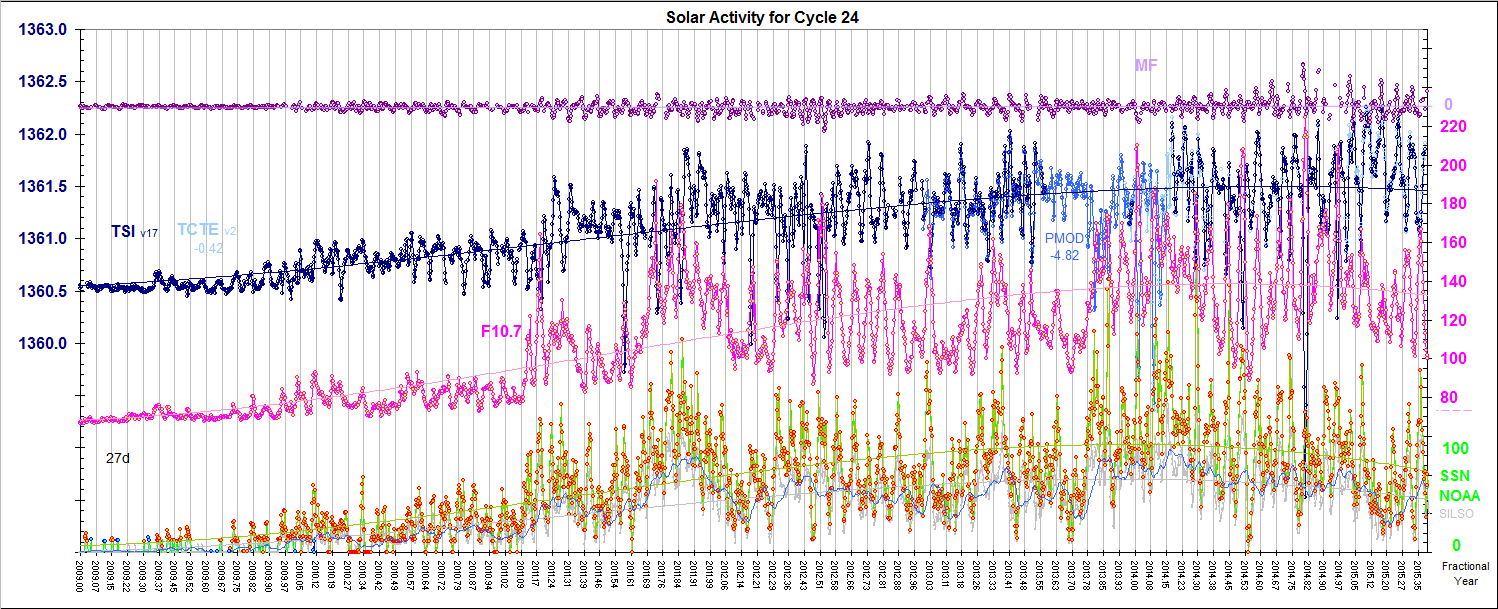
What is evident from Figure 2 is that the spikes down in the F10.7 flux and sunspot count are almost to absolute minimum levels. The underlying level of activity is only a little above that of solar minimum.

Figure 3: Oulu Neutron Count 1964 – 2026
Similar to the Ap Index, activity is only slightly above levels of previous solar minima. The figure includes a projection to the end of Solar Cycle 24 in 2026 which assumes that the neutron count in the next minimum will be similar to that of the 23/24 minimum. Previous cold periods have been associated with significant spikes in Be10 and C14. Perhaps the neutron count might get much higher yet into the 24/25 minimum.

Figure 4: UAH Monthly Temperature versus Low Global Cloud Cover
The cloud cover data for this figure was provided by Professor Ole Humlum. There is a significant relationship between low global cloud cover and global temperature. Assuming that the relationship is linear and remains linear at higher cloud cover percentages, this figure attempts to derive what cloud cover percentage is required to get the temperature decline of 0.9°C predicted by Solheim, Stordahl and Humlum in their paper entitled “The long sunspot cycle 23 predicts a significant temperature decrease in cycle 24” available at: http://arxiv.org/pdf/1202.1954v1.pdf
Figure 4 suggests that the predicted result will be associated with a significant increase in cloudiness.

Figure 5: Low Level Cloud Cover plotted against Oulu Neutron Count
This figure, most likely repeating other people’s work, suggests that there is little correlation between neutron count and cloud cover. Higher neutron counts may be a coincident with colder climate than a significant causative factor. Perhaps EUV, the Ap Index and other factors are more significant in climate change. Also, on a planet with a bistable climate of either ice age or interglacial, it may be that accidents of survival of snowpack over the northern summer are also important.
Perth-based scientist David Archibald is a Visiting Fellow of the Institute of World Politics in Washington where he teaches a course in Strategic Energy Policy.
Paul Vaughan says
The changepoint is ~1997.
If you’re seeing 1994, that’s distorted by QBO & solar.
Henry@Paul
I have made a small mistake in the calculation where I determine the point where maxima started turning to cooling (turn negative). I realize now that I had looked at all the data from the weather stations from 1974 up to and including December of the year 2011. So my reference point is 2012.0
That is also 38 years ago, not 37.
Looking at where y=o (when there was no warming or cooling) in the binominal plot for maxima, (which now has a correlation coefficient of 0.997) , I now get X=16.4 and X=64.96
That means global warming started in 2012-64.96= 1947,0 = 1947
That means global cooling started in 2012-16.4=1995.6 = 1996,
as seen from the energy that we get directly from the sun.
I guess it will hoover around for about a year in any case in the zero area so I am reasonably happy with your 1997. If I look at the Swiss ozone results and I fit those results in a polynominal of the 3 order, I definitely see a bending point at just before 1950 and yours at 1996 or 1997. Amazing.
Does this ring a bell with you?
(I made corrections in my blog, but have not yet updated the tables)