Guest post by David Archibald
A number of solar parameters are weak, and none is weaker than the Ap Index:

Figure 1: Ap Index 1932 to 2026
Figure 1 shows the Ap Index from 1932 with a projection to the end of Solar Cycle 24 in 2026. The Ap Index has not risen much above the previous floor of activity in the second half of the 20th Century. It is also now far less volatile. With now less than a year to solar maximum in 2013, the Ap Index is now projected to trail off to a new low next decade.

Figure 2: Mean Field, TSI, F10.7 Flux and Sunspot Count from 2008
This figure is from: http://www.leif.org/research/TSI-SORCE-2008-now.png
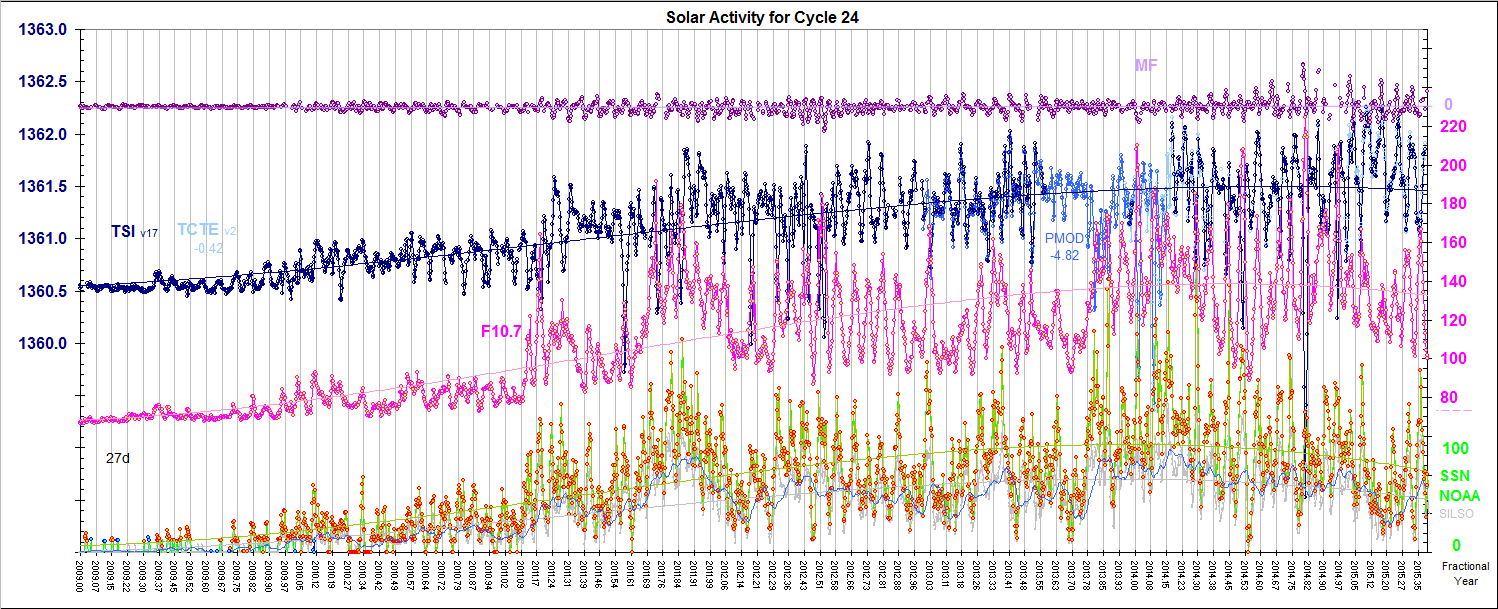
What is evident from Figure 2 is that the spikes down in the F10.7 flux and sunspot count are almost to absolute minimum levels. The underlying level of activity is only a little above that of solar minimum.

Figure 3: Oulu Neutron Count 1964 – 2026
Similar to the Ap Index, activity is only slightly above levels of previous solar minima. The figure includes a projection to the end of Solar Cycle 24 in 2026 which assumes that the neutron count in the next minimum will be similar to that of the 23/24 minimum. Previous cold periods have been associated with significant spikes in Be10 and C14. Perhaps the neutron count might get much higher yet into the 24/25 minimum.

Figure 4: UAH Monthly Temperature versus Low Global Cloud Cover
The cloud cover data for this figure was provided by Professor Ole Humlum. There is a significant relationship between low global cloud cover and global temperature. Assuming that the relationship is linear and remains linear at higher cloud cover percentages, this figure attempts to derive what cloud cover percentage is required to get the temperature decline of 0.9°C predicted by Solheim, Stordahl and Humlum in their paper entitled “The long sunspot cycle 23 predicts a significant temperature decrease in cycle 24” available at: http://arxiv.org/pdf/1202.1954v1.pdf
Figure 4 suggests that the predicted result will be associated with a significant increase in cloudiness.

Figure 5: Low Level Cloud Cover plotted against Oulu Neutron Count
This figure, most likely repeating other people’s work, suggests that there is little correlation between neutron count and cloud cover. Higher neutron counts may be a coincident with colder climate than a significant causative factor. Perhaps EUV, the Ap Index and other factors are more significant in climate change. Also, on a planet with a bistable climate of either ice age or interglacial, it may be that accidents of survival of snowpack over the northern summer are also important.
Perth-based scientist David Archibald is a Visiting Fellow of the Institute of World Politics in Washington where he teaches a course in Strategic Energy Policy.
HenryP says:
July 4, 2012 at 9:55 pm
but do you understand the principle of re-radiation?
there is no such principle. UV is absorbed, heating the stratosphere [that is why temperature doesn’t decrease with altitude there, why there is a stratosphere in the first place]. Some of the absorbed light is re-radiated at a longer wavelength. The notion that Ozone ‘deflects’ all UV back to space is nonsense. You did not tell us what you understood from the paper I directed you to.
Leif says
The notion that Ozone ‘deflects’ all UV back to space is nonsense.
Henry says
I did not say “all”, but I do think most of it is bounced of earth. Some of it will be converted to heat but not all. I think astronauts know this.
I am sure you have been listening to Phil.
For comprehensive proof, that, for example, CO2 is (also) cooling the atmosphere by re-radiating sunshine, see here:
http://www.iop.org/EJ/article/0004-637X/644/1/551/64090.web.pdf?request-id=76e1a830-4451-4c80-aa58-4728c1d646ec
They measured this re-radiation from earth as it bounced back to earth from the moon. So the direction was sun-earth (day)-moon(unlit by sun) -earth (night). Follow the green line in fig. 6, bottom. Note that it already starts at 1.2 um, then one peak at 1.4 um, then various peaks at 1.6 um and 3 big peaks at 2 um. You can see that it all comes back to us via the moon in fig. 6 top & fig. 7. Note that even methane cools the atmosphere by re-radiating in the 2.2 to 2.4 um range.
Now please, do explain to me how we can measure the radiation specific to the absortion spectra of O3, O2, CO2 and others (see fig. 6 bottom) coming back to us, after it bounced back from the moon,
unless it was re-radiated=back radiated=re-emitted=reflected=deflected=mirrored.
Are you nit picking with me over the terms used by me to describe what is happening ?
Henry@Leif
I wonder. Maybe you are Phil.?
HenryP says:
July 4, 2012 at 11:50 pm
I did not say “all”, but I do think most of it is bounced of earth. Some of it will be converted to heat but not all.
If it is absorbed it goes into heat, and all of it is absorbed [nothing reaches the ground]. Now, a hotter gas emits thermal radiation in all directions, but since the stratosphere is so thin not much of that thermal radiation comes down to us]. Ozone does not ‘deflect’ UV. See below about terminology.
I am sure you have been listening to Phil.
Who is Phil?
Now please, do explain to me how we can measure the radiation specific to the absortion spectra of O3, O2, CO2 and others (see fig. 6 bottom) coming back to us, after it bounced back from the moon
Because the Moon reflects some [7% in fact] of the Earthshine falling on it.
Are you nit picking with me over the terms used by me to describe what is happening ?
Using standard, correct terms is important in any communication and demonstrates a certain level of knowledge and understanding.
Leif says:
If it is absorbed it goes into heat, and all of it is absorbed [nothing reaches the ground].
Henry says:
NO!!!
most of it is deflected.
Clearly you do not even understand the definition of the GH effect (causing warming) and the anti GH effect (causing cooling).
Please read it. It is at the top of my blog.
http://www.letterdash.com/HenryP/the-greenhouse-effect-and-the-principle-of-re-radiation-11-Aug-2011
HenryP says:
July 5, 2012 at 12:19 am
NO!!! most of it is deflected.
Define ‘deflected’, here and now. Do you mean ‘reflected’, ‘scattered’, or what?
HenryP says:
July 5, 2012 at 12:19 am
NO!!! most of it is deflected.
To help you out, here is some discussion of the five pathways solar radiation can take when entering the atmosphere: http://geography.about.com/od/physicalgeography/a/solarradiation.htm
Which one is your ‘deflection’?
Leif says
Define ‘deflected’, here and now
Henry says
re-radiated=back-radiated=re-emitted=reflected=deflected=mirrored.
It helps if you actually read my posts.
Henry@Leif
from your quote:
“Absorption is the fourth type of solar radiation pathway and is the conversion of energy from one form into another. For example, when solar radiation is absorbed by water, its energy shifts to the water and raises its temperature. This is common of all absorbing surfaces from a tree’s leaf to asphalt.”
Note that I will agree with this statement as far as water and solid substances is concerned when it is hit by solar radiation in the absorptive region.
But with a molecule of a GHG in the atmosphere, there is little or no mass and most of the neighbouring main gasses (O2 and N2) are “transparent ” over most of the whole spectrum. So when the molecule of a GHG is hit by radiation it fills up in the absorptive regions, is saturated with heat, (cannot absorb more heat because it has no mass), and starts re-emitting the photons in same absorptive region.
I am sure I have explained this many times before.
http://www.letterdash.com/HenryP/the-greenhouse-effect-and-the-principle-of-re-radiation-11-Aug-2011
HenryP says:
July 5, 2012 at 2:00 am
re-radiated=back-radiated=re-emitted=reflected=deflected=mirrored.
It helps if you actually read my posts.
Your post [as also the above] does not make any sense. So, ‘deflected’ may mean ‘reflected’ back in the same general direction where the radiation came from, like in a mirror. So when UV if ‘deflected’ it is simply reflected as UV with the same wavelength. Is that what you mean?
@Leif Svalgaard
You have contradicted yourself by admitting the solar cycle modulates the westerlies (first time you have ever admitted this so far as I am aware) and then turning around and writing this…
Leif Svalgaard (July 4, 2012 at 8:47 pm) wrote:
“[…] committing the elementary error of plotting the extensively smoothed values together with the ragged unsmoothed real solar data.”
The ongoing misunderstanding is a product of a gaping hole in your elementary-level stats foundations. I do not have enough information to diagnose exactly what building block(s) you are missing, but it appears to be related to nonstationarity &/or aggregation criteria. I have enough information to know with certainty that your problem is at the level of fundamentals because you are wrong on absolute logic.
—
Leif Svalgaard (July 4, 2012 at 8:47 pm) wrote:
“Now because of the solar cycle variation of TSI implies a [barely detectable] temperature variation of 0.1C, one would expect some response in atmospheric parameters that depend on temperature. Is that what you think you are seeing?”
Thermal wind is a function of temperature GRADIENTS. You are guilty of protracted ignorance &/or distortion by never emphasizing this.
There’s something grossly suboptimal about the methods you’re using if you’re finding signals “barely detectable”.
—
If you are unable &/or unwilling to be more careful with absolute logic:
a) there’s no basis for communication.
b) trust is fatally undermined.
Paul Vaughan says:
July 5, 2012 at 4:56 am
I have enough information to know with certainty that your problem is at the level of fundamentals because you are wrong on absolute logic.
Tell us the difference between absolute logic and ordinary logic. I have a gaping hole here with the distinction.
And you ducked answering my question.
Leif says
Your post [as also the above] does not make any sense……
Henry says
OK. FAMOUS last words. To a wise guy who obviously feels very superior.
I stand under the (hot) African sun. No wind, no clouds. At a certain time of the day, say 12h00. Humidity is 25% RH. Heat on my skin from IR is (very) hot. Too hot. I have to look for cover soon.
Next day. Humidity is 75% RH. Same time, 12hoo. No wind. No clouds. But….heat on my skin is a lot less. I don’t have to quickly look for cover.
(although I know I should still cover up to protect my skin from UV)
You tell me: what happened, exactly? Why is there less heat on my skin from the sun when there is more GHG in the air?
I want you to understand everything that will explain this observation.
(I have given you many clues now)
HenryP says:
July 5, 2012 at 6:59 am
OK. FAMOUS last words. To a wise guy who obviously feels very superior.
“In the land of the blind, the man with one eye is king”
You simply ignore my specific questions, so I’ll repeat them
1) did you read and understand http://igaco-o3.fmi.fi/ACSO/files/daumont_et_al_1992.pdf ?
2) What does ‘deflection’ mean? Just ‘reflection’ as from a mirror ?
No need to out on a tangent to avoid answering the above.
Leif says
“In the land of the blind, the man with one eye is king”
Henry says
You ignored my question. You keep referring me to all of your papers, but I want don’t want them. I want to teach you to learn to think and understand for yourself what happens when there is more of an GHG in an atmosphere. You must learn to experience it for yourself. No need for textbooks and papers.
Let me give you another example:
how many papers exist that show me that global warming stopped a long time ago?
I know of only one, actually,
http://www.letterdash.com/henryp/global-cooling-is-here
So who do you think that I think are the blind men?
HenryP says:
July 5, 2012 at 8:28 am
You must learn to experience it for yourself. No need for textbooks and papers.
A little knowledge can’t hurt.
But let us try to follow your ‘logic’ [must be akin to the ‘absolute’ logic Paul is ranting about]:
you say that GHGs reflect [‘deflect’] the radiation back where it came from [hence UV does not reach the ground]. Now, the Sun warms the ground [try to walk barefoot on asphalt on a sunny day to verify that] and the hot ground via conduction, convection, and radiation heats the air above it [you can feel the IR radiation from the asphalt by holding your hand a few inches above the ground, and any hot object radiates]. Now, according to you, the upwards radiation is ‘deflected’ back to where it came from [the ground], so according to the re-radiation principle, CO2 [and H2O] works its magic by preventing IR from escaping to space [as it is ‘deflected’ back to earth when trying to escape]. See, without any textbooks or papers, you have a good explanation of the greenhouse effect and global warming, fully in line with the most rabid AGW position.
Henry@Leif
Well, I can give a very simple example of how the GH (warming) effect works. Come here in winter and measure the minimum temperature on a cloudless night. If the next day is cloudy, measure the minimum again, and you will notice that it (the minmum temperature) is a lot higher on a (cloudy night).
Do you understand now why this happens?
Do you know what the infra red spectra of water and water vapor look like?
http://www.letterdash.com/HenryP/the-greenhouse-effect-and-the-principle-of-re-radiation-11-Aug-2011
HenryP says:
July 5, 2012 at 9:06 am
Henry@Leif
Well, I can give a very simple example of how the GH (warming) effect works.
No need to as that is well-known by any competent researcher [and many lay folks too], but how about answering my last post at 8:43 am?
Leif Svalgaard says
…but how about answering my last post at 8:43 am?
Henry says
Actually I did make an interesting observation about this, some time ago.
I have a big aluminium sliding door in one of our sitting rooms. I had the glass mirrored. In the afternoons the sunshine comes in and falls on the (floor) tiles. So I wanted to see what the effect was of the mirroring. Carefully, with an IR thermometer, I measured the temperature at one spot in the middle of a particular tile before I opened the door. It was 27 C. I measured one minute after opening the door. It was 30 C. I measured 5 minutes after I opened the door. It was 30 again.
I measured again after 5 minutes and then 10 minutes.
Temperature of that spot remained at 30 C.
So I figured that what had happened was this:
The mirroring does work, i.e. it sends some radiation back. But the tile (I mean: the molecules of the tile) can only absorb a limited amount of photons that raises its temperature. As soon as its reaches its capacity (which seems pretty soon) it starts re-radiating that same radiation (that increased its temperature from 27 to 30).
Just remember that the molecules of a tile have much more mass then a GHG molecule. So the instant a GHG is hit by radiation, the GHG molecule starts re-radiating, i.e. acting like a little sferical mirror in the absorptive region. The idea that this absorption is continuously converted to heat (only) is completely rediculous.
Yet, such is the state of all the profs and dr’s in our universities (e.g. Phil.)
There is (absolutely) no one who can think for himself.
HenryP says:
July 6, 2012 at 7:36 am
“…but how about answering my last post at 8:43 am?”
Actually I did make an interesting observation about this, some time ago.
No excuses now, I’ll repeat the question:
“But let us try to follow your ‘logic’ [must be akin to the ‘absolute’ logic Paul is ranting about]:
you say that GHGs reflect [‘deflect’] the radiation back where it came from [hence UV does not reach the ground]. Now, the Sun warms the ground [try to walk barefoot on asphalt on a sunny day to verify that] and the hot ground via conduction, convection, and radiation heats the air above it [you can feel the IR radiation from the asphalt by holding your hand a few inches above the ground, and any hot object radiates]. Now, according to you, the upwards radiation is ‘deflected’ back to where it came from [the ground], so according to the re-radiation principle, CO2 [and H2O] works its magic by preventing IR from escaping to space [as it is ‘deflected’ back to earth when trying to escape]. See, without any textbooks or papers, you have a good explanation of the greenhouse effect and global warming, fully in line with the most rabid AGW position.”
Is this the way it works?
Leif Svalgaard says
See, without any textbooks or papers, you have a good explanation of the greenhouse effect (1) and global warming (2), fully in line with the most rabid AGW position. 3)”
Henry says
1) Several times now, I have given you the explanation that GHG’s work both ways: it re-radiates (=deflects, etc.) sunshine 0-5 um (if there is apparent absorption in the spectra of the GHG) causing cooling and it re-radiates earthshine 5-15 um (if there is apparent absorption in the spectra of the GHG) causing warming.
If you want to know what an increase in GHG causes, you have to make up a balance sheet that would show how much W/m2 cooling and warming is caused by the % increase of that GHG,
taking into account that there 12 hours sunshine per day and 24 hours earthshine per day.
http://www.letterdash.com/HenryP/the-greenhouse-effect-and-the-principle-of-re-radiation-11-Aug-2011
2) If you know anything about statistics and probability theory you would know that you can be 99.5% sure from my results on a random sample of 45 weather stations that global warming stopped somewhere in 1994.
http://www.letterdash.com/henryp/global-cooling-is-here
3) the nature of the relationship that I find between the warming and cooling of the earth over the past 37 years is binominal (parabolic), indicating a natural process. At the end of the day, it is clear (to me) that the cooling and warming component caused by an increase/decrease in CO2 /H20 has cancelled each other out.
Whether that natural process involves the sun-UV-ozone factor, is what I am still trying to figure out.
(BTW, by adding a few more weather stations to my sample, I have now ramped up my correlation coefficient for the drop in maxima to 0.996).
HenryP says:
July 6, 2012 at 8:59 am
“See, without any textbooks or papers, you have a good explanation of the greenhouse effect (1) and global warming (2), fully in line with the most rabid AGW position. 3)”
You still did not answer my simple question. Is what I said, how you see it? Yes or no? If no, where do I go wrong?
Obviously, radiation only moves in straight lines. You must know that from the sun shining through a partially open curtain. If it cannot go (further) down it and if no further absorption is possible, i.e. it has to re-radiate, it would (I think) move at opposite incoming and outgoing angles.
But I have to think a bit about that.
HenryP says:
July 6, 2012 at 11:03 am
Obviously, radiation only moves in straight lines. You must know that from the sun shining through a partially open curtain. If it cannot go (further) down it and if no further absorption is possible, i.e. it has to re-radiate, it would (I think) move at opposite incoming and outgoing angles.
But I have to think a bit about that.
Since you can see the sunlit dust particles[or even the floor] in the room lit by light through the partially open curtain even if you are out to the side, the re-radiation [scattering in this case] takes place in all directions, even perpendicular to incoming and outgoing angles…
But, you still have not told me if my description of what I think you are saying is correct.
From my experience I would say that in all cases, whether gas, liquid or solid, re-radiation works spherical in every direction, from each molecule, that re-radiates. It is just that with a gas there is much less heat transfer possible. That means that the heat (=re-radiation) that you feel above the sun-warmed street will try and find its way back out to space and since most of it is of wavelength 5-15 um it will not find much obstacles in the sky, (O2 and N2 are transparent) except if it hits on clouds or water vapor (which is the main GHG) on the way up.