I have reports from the scene, plus also from the NASA/Goddard Space Flight Center

Nearly half of the United States’ airborne fire suppression equipment was operating over Colorado on June 25, 2012, CNN reported, as tens of thousands of acres burned. Fires raged in southwestern Colorado, northeastern Colorado, and multiple locations in between.
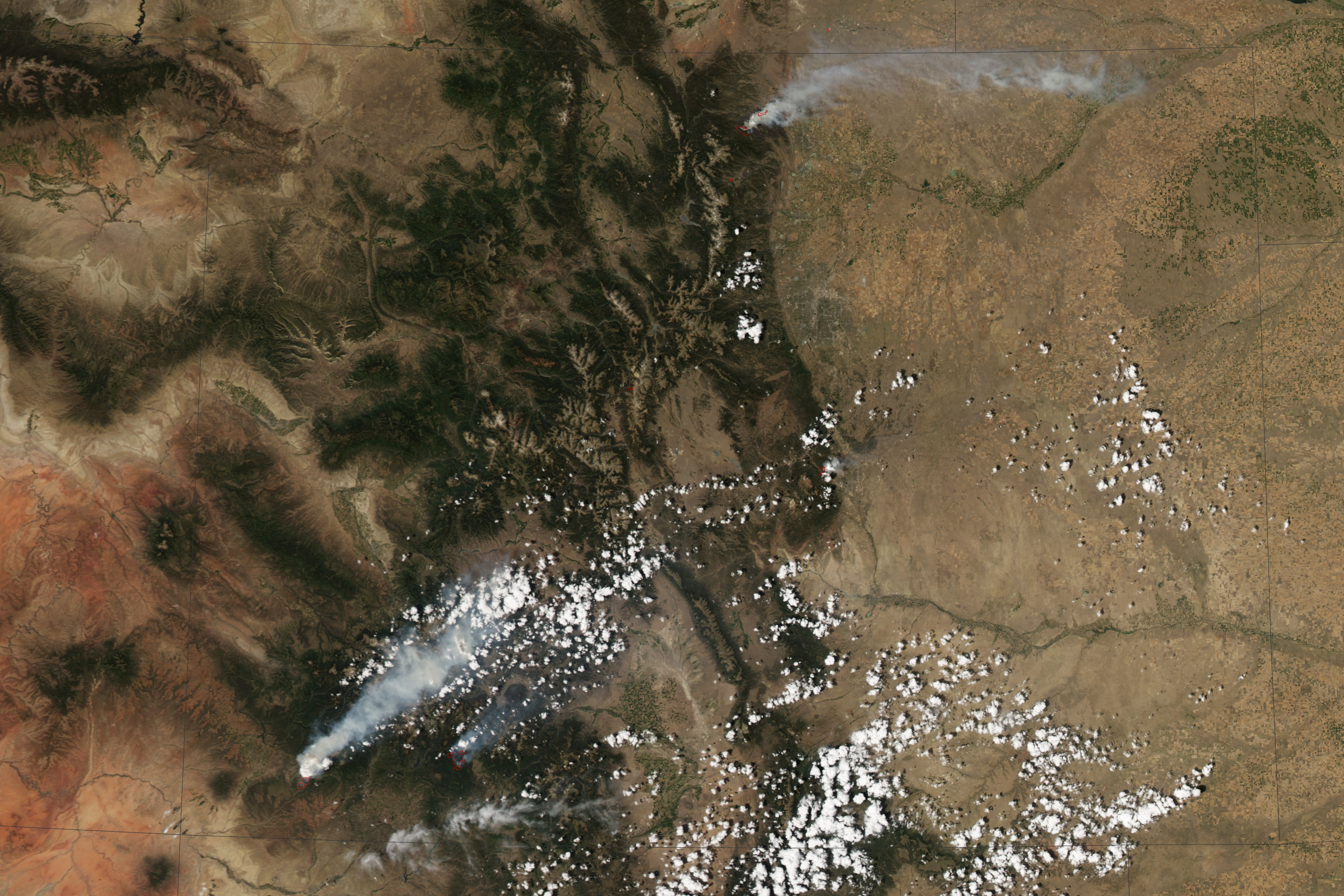
The Moderate Resolution Imaging Spectroradiometer (MODIS) on NASA’s Aqua satellite captured this natural-color image on June 23, 2012. Red outlines approximate the locations of actively burning fires. The High Park and Weber Fires produced the largest plumes of smoke.
The High Park Fire continued to burn west of Fort Collins. Started by lightning on June 9, 2012, this blaze had consumed 83,205 acres (33,672 hectares), making it the second-largest fire in Colorado history, after the Hayman Fire that burned in 2002. As of June 25, more than 2,000 people were fighting the High Park Fire, and firefighters had it 45 percent contained, according to InciWeb. Nevertheless, The Denver Post reported that the fire had destroyed 248 homes, making it the most destructive in Colorado history, even if it was not the largest.
In the opposite corner of the state, the Weber Fire started around 4:15 p.m. on June 22. As of June 25, the fire had burned approximately 8,300 acres (3,400 hectares) and was being fought by 164 personnel. The cause was under investigation. The fire had high growth potential because of possible wind gusts from thunderstorms, InciWeb reported. On the other side of Durango, the Little Sand Fire had been burning for weeks after being started by a lightning strike on May 13. As of June 25, that fire had burned 21,616 acres (8,748 hectares), was being fought by nearly 200 people, and was 31 percent contained.
West of Colorado Springs, the Waldo Canyon Fire forced 11,000 people from their homes, many of them compelled to evacuate in the middle of the night on June 23rd. The fire started around noon on June 23, and by June 25 it had grown to 3,446 acres (1,395 hectares). InciWeb stated that 450 firefighters were battling the blaze, which retained the potential for rapid growth.
The Woodland Heights Fire just west of Estes Park was small but very destructive, consuming 27 acres (11 hectares) and destroying 22 homes, Denver’s Channel 7 News reported. That fire was completely contained by the evening of June 24.
As fires burned, Colorado also coped with extreme heat. The Denver Post reported that Denver endured triple-digit temperatures June 22 through 24, and the National Weather Service forecast temperatures of at least 100 degrees Fahrenheit (38 degrees Celsius) for June 25 and 26, with temperatures in the upper 90s through June 29.
Colorado’s fires have followed a dry spring. Although the state experienced unusually heavy snow in February, little snow followed in March and April, part of a larger pattern of low snowfall. By June 19, 2012, conditions throughout the state ranged from unusually dry to extreme drought, according to the U.S. Drought Monitor.
On June 25, 2012, Tim Mathewson, a fire meteorologist with the Rocky Mountain Area Coordination Center, remarked: “Current conditions are comparable to 2002 fire season, which was the worst in Colorado history. Fires haven’t burned as many acres at this point, but the drought conditions and fuel conditions are right up there with the 2002 season, if not worse.”
For a non-labeled, high resolution image, visit: http://eoimages.gsfc.nasa.gov/images/imagerecords/78000/78367/colorado_amo_2012175_lrg.jpg
=============================================================
Reader Mark Katz submits this story:
Just thought I’d submit a rather serious issue with CO Springs. Storms to the west of the Waldo Canyon fire created drafts that pushed the fire up over the ridge into the city proper. RH in the single digits (as low as 1%) coupled with record high temps five days in a row are only making matters worse.
Homes are now burning on the far west side of the city. Flying W Ranch – an icon here, has burned down, and now I’m reading that Garden of the Gods is threatened. Thousands have evacuated (I have a family of 4 coming to stay with me).
It is a sad day though, thankfully, there are no reported injuries by either residents or firefighters. I know MrPete as well as Steve M’s sister both live here as well as many other WUWT fans and readers.
http://www.gazette.com/articles/fire-140851-highway-waldo.html
I counted over 300 homes IN the city of Colorado Springs within the fire footprint as of 4:39 MDT this afternoon.
An excellent interactive Google Map from Denver Post
https://maps.google.com/?q=http://extras.denverpost.com/media/maps/kml/waldo-canyon-wildfire-20120627aa.kml&msa=0&t=p&output=embed&z=12
Wake up people. There are a significant number of people in the US Forest Service and in various state forestry services such as the California Division of Forestry and Fire Protection who believe in the same Gaia principles as the climatologists and catastrophic warmistas. If the reason for rising numbers of forest fires was fire suppression and forest fire fighting practices, the data could not show that the biggest fire in North America all came before 1920. Look at the list from the 19th and early 20th century. From Forest History.org
http://www.foresthistory.org/Education/Curriculum/activity/activ9/Wildfire%20Timeline.pdf
> October 1825: Maine/Canada Miramichi Fire: After a summer of sparse rain, sporadic wildfires in Maine and the Canadian province of New Brunswick reached disastrous levels. Strong winds spurred the fires, which burned through forests and settlements in Maine and along the Miramichi River in Canada. Among the worst wildfires in North American history, the Miramichi fire burned 3 million acres, killed 160 people and left 15,000 homeless.
> 1849 Siletz River, Oregon Siletz fire burned 800,000 acres
> 1853 Oregon Yaquina Fire burned 484,000 acres
> 1865 Oregon Silverton Fire burned 988,000 acres
> October 1871 Wisconsin/Michigan Peshtigo Fire burned more than 3.7 million acres in Wisconsin and Michigan. Federal authorities estimate at least 1,500 people died in the fire. Eight hundred died in Peshtigo, Wisconsin alone—nearly half the town’s population. Despite the fire’s extensive devastation and the fact that it killed more people than any fire since, the Peshtigo Fire was overshadowed at the time by the Great Chicago Fire, which began the same day.
> September 1881 Michigan Thumb Fire located in the Thumb area of Michigan burned 1,000,000 acres in less than a day; 282 lives were lost; damage estimated at $2,347,000.
> September 1894 Minnesota Hinckley Fire After one of the driest summers on record, small blazes converged to form a firestorm near Hinckley, Minnesota. The flames rushed through the city and surrounded towns in a matter of hours, burning 350,000 acres and killing 418 people.
> September 1902 Washington/Oregon Yacolt Fire The fire burned across more than 1,000,000 acres in Washington and Oregon. 38 lives were lost.
> April 1903 New York AdirondackFire burned 637,000 acres.
> August 1910 Idaho/Montana Great Fire of 1910 Over two days and nights, several small blazes, hurricane-force winds and dry forests combined in Idaho and Montana to form what became known as the Great Fire of 1910. The flames burned about 3 million acres, making it one of the biggest wildfires ever recorded in North America, and killed 86 people. A forester later wrote that the fire was “fanned by a tornadic wind so violent that the flames flattened out ahead, swooping to earth in great darting curves, truly a veritable red demon from hell.”
The US Forest Service decision to fight wild fires was directly based on events and experiences during the ‘Great Fire of 1910’. How did all these huge fires, unmatched in current events, ever get started if the fault lies with practices instituted after the worst fires were long cold? The arguments being put forward are no different in substance from those of the warmists who claim hottest, worst, wettest when the historical record shows quite the opposite.
Houses burn in forest fires because recommended defensible spaces around houses are not created and actively maintained. Because do good policies to save trees do not allow fuel to be removed from around buildings. Because people are stupid enough to build a house in the woods and then cry the blues when the woods catch on fire. Because people don’t think they’ll ever need a foam system because there hasn’t been a fire where they live for 150 years.
While it may be true that slow cool fires are a good thing, there can be no slow cool fires until the forests are cleaned of the fuel load that has accumulated, in part because of the criminal notion that wood burning in the forest is somehow holy, but wood put to use by humans is evil on a scale that rivals the holocaust or the killing fields of Cambodia.
As Dr. Bill Wattenburg put it in a published essay (no current link):
“…the fuel load of brush and excessive small trees on the floor of our forests today is so high that any fire generates flames that ignite the limbs of all big trees. Each big tree on fire becomes an enormous torch that ignites all its neighbors. An unstoppable firestorm soon develops. The flames are so hot that every living thing is destroyed. This is not Nature’s plan.
Many self-anointed “fire ecologists” who have taken over our national parks and forests think this is just great. They stand by and rub their hands with glee as they get orgasmic satisfaction from watching Nature’s most devastating force of fire wipe out our forests. They revel in the thought that man’s past sins for harvesting the forests are being cleansed by the fury of fire. They are never punished for their stupidity. They never pay for the damage to the public’s property. However, their urban cousins who dance a jig behind a fire line and gleefully watch a apartment house burn are called criminal pyromaniacs. Wildfires today kill all living things in the forest, all big trees and all animals. With no vegetation or trees left to hold the topsoil, the rains wash the soil down into the canyons and clog the streams and fisheries with silt. The big trees and the natural forest are gone for hundreds of years.”
Rant off/
Everyone needs to stop with the “believe the expert without critical thought or research” and be as skeptical of the burn down the forests in the name of saving the forest crowd as you are of Mann or Hansen and all the rest.
Larry Ledwick (hotrod) says:
June 27, 2012 at 7:19 pm
It is not only the forest areas that are having fire problems this year.
These fire conditions are not unusual just rare.
Larry, very good comments. Enjoyed them.
Every time I drive I-70 to Glenwood Springs, I shudder when we pass the western side of the approach to the Eisenhower tunnel. There are endless runs of pine beetle killed trees in every direction. I am moved every time, to comment to my wife it is only a matter of time before lightning or a fool sets the whole mountain range on fire. It very well could be this summer. We haven’t even gotten to the hot and dry time of the year.
It is very sad to see what is happening to those neighborhoods in Colorado Springs and Fort Collins.
Last night I was struck at how quickly the Colorado Springs fire got going. At first, I thought the TV reports were commenting on the already existing fires in Boulder and Fort Collins. Up until then, Colorado Springs was just a side show.
There are reports of arsonists in the mountains, which also provides another level of insecurity in the hills. A close friend of mine has been evacuated twice in recent times and people in his area are very anxious.
Jack Simmons,
This may interest you. The Japanese were even planning it in WWII.
What planet does interstellar bill live on? If he has ever been anywhere near a bush fire, as we call them in Australia, he would know that they do rage, extremely so. Feek very sorry for the people of Colorado Springs; it is a beautiful part of the world. Pray god all will be calm soon.
Jim Tierney,
i’ve been reading WUWT for nearly 4 years… this is my first post.
Not sure what to say but that nothing changes in my mind as my home is threatened…
we still don’t have nearly enough data to know anything other than that its really hot this year. As opposed to a few years ago when the winter was so bitterly cold that i didn’t go outside for months in Colorado.
Its always changing. All the time.
regardless of what happens to my home – He has taken far too good care of me and my family, and the climate changes *all* *the* *time*.
i am insanely blessed to live in a place where, even if my home is razed, i know that eventually, everything will be back to normal.
And that is an amazing and comforting realization, is it not?
As noted – the fires burning now – and the recent fires since early 2000’s in the same area – are not “cleansing” or “therapeutic” burns for the forest. Thanks to the abject idiocy of the treethuggers and the protect all the creature-ists – who have gutted all proper forest management practices – these fires are sterilizing fires. They do not encourage new growth as they have so much high quality fuel they burn everything in their path – and with such intensity even the soil is sterilized.
I spent many days in those same exact forests since the early 2000’s. I was literally in the forest – within a short distance of the fire – during the Hayman fire. I spent many years visiting the areas of the Buffalo Creek fires. There was little left after those devastating fires. The Forest Service had to fly in massive crews to literally replant and then apply ground cover to entire mountains. The area of the Buffalo Creek fire was in many places largely a moonscape for year after and did extensive flood damage downstream when it did rain.
These forests need help. They need active regular harvesting to reduce the canopy so the forest can thrive. They need dead timber removed. And they need carefully managed burns – when it is safer to do so – to reduce the risks.
The spotted owl idiots spent decades fighting to “protect” the alleged spotted owl habitat. Preventing any and all management practices in the 100’s of thousands of acres in AZ. And then one day it finally caught fire – and destroyed virtually ALL of the spotted owl habitat.
Yet I imagine not a one of those treehuggers would admit they were wrong – would admit that their actions caused the destruction of, rather than protection of, the habitat they claimed to protect.
Here’s a report from the national director of CoCoRaHS, the Community Collaborative Rain, Hail and Snow Network. I’m sure Nolan won’t mind me posting it here.
While CoCoRaHS was formed in the wake of canyon flooding due to rain that was logged in no NWS rain records, the network can show current disasters from regions of missing daily reports. A new sort of proxy?
Subject: CoCoRaHS — More fire, some rain
From: Nolan Doesken
Date: Wed, 27 Jun 2012 23:26:55 -0600 (Thu 01:26 EDT)
To: CoCoRaHS Mailing List
Dear CoCoRaHS participants + friends and family
Many of you have written this week as news of our Colorado catastrophic
wildfires spreads. Thanks so much for your caring thoughts and
prayers. Here is an update.
Wildfire roared into parts of Colorado Springs yesterday afternoon
(about 100 miles south of here) and the CoCoRaHS family has once again
been directly affected. Comparing the CoCoRaHS maps for El Paso County,
Colorado from yesterday to today, areas of the map north and west from
Colorado Springs have gone blank. We have seen this before — with the
2011 tornadoes and floods and also with fire. When the rainfall maps go
blank we know people are hurting. That hits home for all of us. Over
32,000 area residents in and near Colorado Springs have had to flee the
fires, and plenty more have done so voluntarily. It is likely that some
of our volunteers may have lost homes. Last night, Boulder Colorado was
threatened. Today more fires have ignited. This has been an incredible
nightmare. Some of you have experience this at other times and in other
places.
Here around Fort Collins our huge (nearly 90,000 acres) wild fire has
settled down a bit. It is still burning but now it is higher in the
mountains and threatening fewer homes. Still, hundreds of families
remain evacuated. The Larimer County maps continue to show large blank
areas where observers once reported — just 3 weeks ago. These are
indeed terrible disasters — similar to Texas wildfires last year and
other fires this year and previously. With persisting heat and drought
(parts of Colorado saw temperatures of 110 or higher for the 4-5th day
in a row.) we are not out of the woods. But for our family (back from
our Upper Michigan vacation), we are safe, our home and animals are
fine, and the worst inconvenience has been the periods of smoke, intense
heat and lots of ash in my rain gauge.
Two nights ago I experienced something that is still giving me goose
bumps. I worked late and drove home about sunset. To get to and from
work I have to drive past the Incident Command post for our fire (called
the “High Park fire”). It’s just down the road from our building here
on the foothills campus of Colorado State University. As the fire
spread, firefighting crews increased and the National Guard joined the
effort. The Incident Command post grew to become a huge and noisy tent
city illuminated day and night. It has been hard to concentrate here
with all the activity and with episodes of smoke. Of particular
interest were the large helicopters shuttling back and forth —
hovering while reloading fire retardant and then racing off to protect
nearby homes. Helicopter activity peaked each time the fire approached
residential areas. At last things were quieting down as the active fire
zone moved farther away. Driving home I passed what used to be a large,
open pasture but now it was the heliport, the heavy equipment staging
area, the portable shower and portapotty area, the mess tents and the
security check point. Beyond that were tents set up with t-shirt sales,
refreshments and even portable massage tables to bring some relief to
tired and soar firefighters. Then, to my surprise, the road was lined
with people — young and old — holding up signs and cheering
exuberantly for each truck as it returned from the fire to the camp. As
I drove past, dozens of large trucks were coming back to camp —
responding to the cheers by honking and sounding sirens. It seemed
surreal — a slight taste of what it might have been like when our young
men returning to the U.S. after the end of WW2. I won’t forget this.
The smell of rain — the glorious rainbow
Today, we were surprised by rain. We had thought that nature had
perhaps given up on that part of the hydrologic cycle. Several showers
moved in dropping temperatures from the 90s back into the 70s and
bringing the smell that only fresh rain can bring. The winds then
shifted and blew down from the mountains. Instead of the smell of pines
— it was that smell you get when you douse a camp fire with a bucket of
water. For miles, the forest smelled of wet ashes. The National
Weather Service quickly issued a flash flood warning. Even though
rainfall was light, runoff from recently burned slopes can bring down
ash, mud and much debris. And then, as the day ended, the sun broke
through the clouds and there was the brightest, boldest, beautifulest
rainbow I’ve ever seen.
Speaking of the Hydrologic Cylce
With everything that has been going on, I totally forgot to tell you
about our new CoCoRaHS video about the Water Cycle. I hope you can
spare just 6 minutes to watch this video. Then tell me what you think.
Here is the link
If you like it, tell others — especially teachers in your community
that get to teach kids about the water cycle.
Reporting when it’s dry
I realize that there is no great joy or motivation to get up, measure
and report when there is nothing in your gauge. But as the spreading
drought conditions across much of the country are keenly pointing out,
it is VERY important to know that it did not rain. So I encourage you,
if you can spare those few extra seconds — please report your zeros.
Thanks for Drought Impact Reports
That’s one of the optional data forms we provide. We’re happy to report
that more of you have begun using this report to describe the impacts
you may be observing. These impact reports go directly to the National
Drought Mitigation Center in Lincoln, Nebraska and are used to help
interpret the severity of drought across the country.
http://droughtreporter.unl.edu/ If you are unusually dry in your area
and the dryness is beginning to (or continuing to ) cause problems,
please tell us about it by submitting and impact report. Thank you for
the extra effort. It is appreciated.
Less Drought in Florida
It wasn’t long ago that Florida was also dealing with drought. But now
with two back to back tropical storms this month, drought is a thing of
the past — quickly replaced (in some areas) with excess water.
CoCoRaHS volunteers again came through with excellent reports of
exceptional rains. Hats off to those of you in those storms that had
the presence of mind to go out and empty your gauges midway to make sure
they did not overflow. Yesterday, two of our volunteers in Wakulla
County, FL (southwest of Tallahassee near the the Gulf Coast) each
measured more than 16″ of rain in a day. Some of your reports have even
ended up on CNN, the Weather Channel and other national news. So if you
ever wonder “Is anyone looking at my data?” the answer is always a
resounding “Yes!”
CoCoRaHS Blog
For several years, Chris Spears, a highly motivated CoCoRaHS volunteer
from the Denver area, maintained the CoCoRaHS Blog. After years of
meteorological blogging, Chris is taking a break. But we’ve decided to
keep the blog going. Several people will be helping including our
CoCoRaHS state coordinator in Illinois, Steve Hilberg. We’ll also try
to add some of my e-mails to the blog — and maybe add a few pictures
so you can see our farm, animals, weather etc. So check in
periodically by clicking the little blog icon on our home page.
http://cocorahs.blogspot.com/ New posts will begin soon.
Goslings are more fun than geese
Our motherly hen ended up hatching several goslings — 6 of which
survived. Instead of all hatching at the same time, they were spread
out over a couple of weeks. Now we have big goslings, medium sized and
small — all in the same family. Since the hen hatched them the adult
geese at first were not interested. But gradually they decided that
those youngsters belonged to them. The hen was reluctant at first but
eventually turned over the parenting to the geese. Wow, and I thought
papa goose used to be mean! Now he’ll defend those little guys from
everything. If I so much make a gesture towards touching a gosling, I’m
toast.
Thanks again for your concern
I greatly appreciate all the message of support and the offers to help
in these times of traumatic wildfires in Colorado. We’re doing OK but
it will be a long road to recovery for some of our CoCoRaHS family. If
any of you affected by fire have stories you need to share about your
experiences, please let me know.
Have a great summer. May it rain gently — often enough.
Nolan Doesken
Colorado State University
Here in North central Florida, we had a large fire in the Government maintained lands on the Florida/Georgia border back in April that “raged” for about a month. The issue with fires is almost non-existant on private lands in this state as people maintain their land for the most part. Of course, with the drought over and the fires being a thing of the past for this part of Florida no mention is being made of how this happened or why.
The truth is often easier to see when you just apply common sense. The Government does not maintain federal lands well, and there are plenty of home-owners out west who do not do so because I would hazzard to guess they either own too much land or they can’t handle the land they do own. Forests require maintenance such as getting rid of shrubs, clearing dead trees/limbs, etc.
Of course fires are much more prolific in the west due to that reason…with so much more land and with so fewer people living out there fires are much more common. That is just the way things are. It does not even take that large of a drought when so long has elapsed since the last fire…
But that is besides the point. We have known since the 70’s how to control fires and make them manageable, but the Government is mostly to blame on this score as they do not maintain the large amounts of land under their control properly…
Perhaps it is just the amount of funding they have. Perhaps its the fact they have too much land to maintain. Whatever the case, perhaps its time to sell land to the public in auctions and stop hoarding land they can not even maintain.
Larry Hotrod says: The lodge pole pine which is ubiquitous in this area cannot seed without fire to open the pine cones. Without fire the cones are so heavily resin coated that little seed ever gets a chance to grow new trees.
Wrongo, Larry. Lodgepole pine can and does reproduce without fire. Plenty of Pinus contorta on the coast and all over that generated without fire. That fire-cone myth is Disneyesque. Think about it. The species is 100 million years old. If it needed such special conditions to germinate, lodgepole never would have made it past go, let alone the Ice Ages.
Larry Hotrod says: This is no surprise to anyone who has studied the historical record of wild fire in the high plains and mountains of the west. It has nothing to do with climate change or global warming. It is a natural cycle of renewal that is inevitable in an ecosystem composed of plants that are adapted to fire conditions and “require” periodic burns, to be healthy and to kill off their predators (pine beetles and other biological competitors)
Wrongo, Larry. Everyone (with any discernment) who has studied historical fire in the West has discovered that man, not nature, has been the master of fire during the entire Holocene. Anthropogenic (human-set) fire has been the dominant force shaping vegetation every since the ice melted.
The “natural fire regime” and “fire-adapted plants” rant is another pre-Darwin Disneyesque narrative that has nothing to do with reality.
Man is the caretaker of nature. Man controls fire. It is human choice that led to this and other fire catastrophes. Man chose to let the fuels build up. Man chose to eschew firebreaks. Man chose to be inadequately prepared for eventual holocausts of his own making.
We have become impotent pawns of the watermelons, allowing mythical narratives to supplant our heritage, common sense, and responsible stewardship. Big Brother set aside the landscape to build up fuels because the watermelons whined about how “natural” that would be. But their “natural” is a myth, and the direct result is tragedy on massive scale.
Junk science leads to junk policies leads to extreme disaster. Count on it.
So does that mean Mike is a watemellon?
LA Times actually talked to a forestry expert…
The reason? Modern firefighting technology has meant fewer fires. Fuel to feed massive blazes has built up. And, Fulé said, climate change has brought warming conditions over the last couple of decades — meaning longer fire seasons, starting early in the spring and extending late into the fall.
Even if rain and snow amounts remain the same, he said, warmer temperatures mean more evaporation, drying out the landscape. Individual drought years increase the risk of huge fires: “This winter in Colorado, it was quite dry.”
And the future looks only drier and warmer.
“The predictions climatologists are developing for the 21st century don’t look any better,” Fulé said. With plentiful fuel and warming conditions, super fires likely will continue to ignite.
The fallout will include “loss of life, loss of homes and communities and infrastructure,” as well as long-term effects such as soil erosion, flooding, and the invasion of exotic plant species with the death of native species.
http://www.latimes.com/news/nation/nationnow/la-na-nn-super-fires-20120627,0,2411143.story
Yes and the frequent fires created an ecosystem over thousands of years, that is well adapted to and dependent on fire for its normal life cycle. I never said fire had to be naturally caused!What I said was that the periodic fire regime was the norm in this area and anyone that thinks they can live in the wild land urban interface without dealing with fire is an idiot.
Yes the lodgepole pine family that does have subspecies that drop seed when mature (murrayana ) which is coastal not in the Rockies and do not depend heavily on fire to reseed!
The other subspecies “can” seed without fire but not efficiently.
Please read the whole comment and spend a moment thinking about what is said? I didnot say the lodge pole pine “could not reseed without fire”. I said its seed distribution is very inefficient without fire. Specifically I said:
For those needing translation, that says, that under non-fire conditions only a very small number of seeds ever find their way to a fertile location to take root and grow. Most are eaten by squirrels etc. Occasional random seeds that do fall to the forest floor cannot germinate with a high success rate because the lodge pole pine grows in very dense thickets where the faster growing trees shade out and kill the slower growing trees.
As a result new seedlings even if they germinate will never see sunlight unless by plain stupid luck they happen to fall in an opening caused by blow down or beetle kill or some other random event that forms a small island of sun lit forest floor.
On the contrary after a fire event, the seeding is prolific from the now open cones and the trees grow like grass, hundreds of them growing so close together you can hardly walk between them. Over time some of these trees out compete their neighbors, and the weak trees are shaded and stunted by the faster growing trees that dominate the stand, leaving lots of standing dead wood or wind fall on the forest floor.
See Routt National Forest blow down where a wind storm blew down over 20,000 acres of trees in a single event. http://www.denverpost.com/trailmix/ci_13264053
Please get off you high horse and holster your “attitude problem” it does not wear well, and makes you look like the same sort of zealots you rant against.
Larry
I agree entirely that is exactly what I was saying!
Proper fire management of structures in the urban wild land interface is essential! without it this sort of fire is absolutely unavoidable and inevitable.
We need to return to voluntary thinning of the forests. For example the fire wood permits and Christmas tree cut your own programs, knock off the silliness of no fire roads into the forest, and even blocking temporary used of mechanical equipment in and around the wilderness areas.
Home owners need to be strongly encouraged to get the “pretty trees” away from their houses, build defensible barriers like driveways or concrete walls stone walkways etc. around their property, prohibit use of cedar shake shingles in wild land fire zones, etc.
Larry
Who is this guy – Mike Dubrasich? He sure manages to rant holier than though. Perhaps he’s really a warmist troll sent along just to show us what a bunch of jerks they really are.
Another side note for folks who do not live here in Colorado. Look closely at the burned over neighborhood fire pictures. Part of the problem was not wild fire to structure fire progression but structure to structure fire progression due to very close structure spacing in the neighborhood. The fire break distance in modern housing developments has gotten narrower and narrower as the zoning and builders try to squeeze two or 3 more lots into the development to increase profits/tax base.
Those narrow fire break distances wall to wall on adjacent homes works if a fire response arrives to suppress ignition of the adjacent structure. If the fire is so massive that no active exposure protection is available for the adjacent home, it will with absolute certainty catch fire from the radiant heating from burning house next door.
In older neighborhoods where there is larger spacing between homes a structure fire storm like this is less likely as the natural fire breaks between structures is large enough that only the structures directly ignited by burning vegetation are likely to burn.
Some of these modern developments are built with homes just 10 – 15 foot separation between structures. If the wind is blowing the wrong way, you will have direct flame contact and fire transmission from structure to structure.
The people in those neighborhoods need to hold their zoning people to account for allowing structures built with inadequate fire break separation between structures for this sort of situation where you cannot depend on active fire department intervention to prevent fire propagation.
Larry
Its funny too – because if he’d bother to actually read what Larry is saying – he AGREES with Larry ….
Mike says June 28, 2012 at 2:39 pm — Who is this guy – Mike Dubrasich?
Dear Mike???,
Unlike a lot of drive-by anonymous commenters here, I use my real name. I am not afraid to stand up and express my opinions in public as an adult citizen.
Since you ask, I have been a practicing professional forester in Oregon since 1975. For the last 31 years I have been a private consulting forester specializing in forest biometrics.
I have organized three different consulting firms and served as Oregon Chapter Chair of the Assoc of Consulting Foresters of America. I am author of “A Guide to Innovative Tree Farming in the Pacific Northwest.” In 2007 I founded the Western Institute for Study of the Environment, a non-profit educational website teaching environmental stewardship and caring for the land: http://westinstenv.org
Last month I founded Give Us Our Land Back: http://giveusourlandback.org
Give Us Our Land Back is a civic coalition spearheading the Petition to De-Federalize Oregon Lands. We seek redress of grievances as authorized by the First Amendment to the United States Constitution. Our grievances are:
* Our public lands rightfully belong to the Counties of Oregon,
* We deserve, indeed are Constitutionally guaranteed, the same rights and privileges afforded other States, and
* Federal trusteeship over those lands has failed, damaging our environment, our economy, and our social integrity — including creating the conditions for catastrophic fire and exacerbating those fires through Let It Burn polices.
The redress we seek is transfer of title and jurisdiction of Federal lands to the Counties in which those lands lie.
Only through .local control can we stop the madness of “natural” holocausts which spread from unkempt, unmanaged Federal land onto private land and even into towns and cities. I have fought against junk science and junk policies for decades, including the Global Warming Hoax which is frequently used to justify and excuse wholly preventable disasters such as is occurring in Colorado today.
I suggest that it would be helpful if you stood up, too, used your real name, and expressed your grievances with integrity and courage. Only through the united efforts of adults can we stop the destruction of our watersheds, forests, rangelands, towns and cities, and indeed our nation.
@Larry Cullen Ledewick
You’re not the only one who sees Mike Dubrasich as having an attitude problem. His kind of holier than thou, superior seeming ranting that belittles anyone with different knowledge, even if incorrect, is like watching Christian Bale going off on a production assistant – insufferable.
Looks like a clear case of hubris with severe need of anger management and a lesson in the Golden Rule.
@Mike Dubrasich
I think most of us reading here get it that you seem to know a lot. That does not make you god or the smartest man in the world or even on this subject.
I agree with larry ledwick that you have an attitude problem. There is no need to strike a holier than thou pose when others may have just as much or more knowledge than you.
It bespeaks an inferiority complex, or some other problem relating to others that I hope you get some help for.
In general I see a tendency for some to evince superiority over others with better arguments, more “correct” facts and an attitude of contempt.
How vital, alive and important do feel afterward?
Is “topping” others your life work?
This is so high school, a wolf pack alpha male move. So you know more. So what. Share it with enjoyment and move on. Each of us can learn, each can teach.
Dear Tim,
Thank you for the advice.
I’m sorry if you think that correcting destructive falsehoods perped by progressives is unseemly or betrays an anti-social attitude.
The facts are that bogus science is responsible for massive disaster, and that it is better to correct the bogosity forcefully than to tolerate it.
Mr. Ledwick quoted the Wikipedia. I have worked as a professional in the woods for nearly 40 years and so I know from experience that Wikipedia is wrong.
More importantly, I know from long experience that such phrases as “fire adapted ecosystems” (Mr. Ledwick), “species dependency on fire” (Mr. Ledwick, Mike???), “fire suppression is the cause” (Mike Bromley the Kurd, Mike???, Ms. Ramirez, Mr. Parsons) “global warming causes forest fires” (Mark???, CISS) and similar slogans are part and parcel of the progressive propaganda used to justify massive conflagrations and the destruction of our environment, economy, and social well-being.
When I hear or read those trite pseudoscience phrases, and know too well their source and use, I feel a strong remonstrance is in order.
Would you go up to a homeowner whose home has just burned down and tell him that is just natural, we did it for the lodgepoles, the fire department’s attempt to put the fire out is to blame, from now on we won’t do any fire suppression at all, so don’t even try to rebuild because you’ll be burned out again?
Is it wrong for me to point out the cruel stupidity in such remarks? Does my attitude offend?
Or does the endless spate of catastrophic fires emanating from unkempt, unmanaged public land offend?
Last summer the USFS firebombed 6,600 acres of old-growth spotted owl forest in my watershed in the name of Mother Nature. Dynamite balls launched from helicopters caused a firestorm with 100% mortality. Since Clinton was elected over 110 million acres have burned in the USA, many in Let It Burn fires — by policy, not by nature.
So I do feel under attack. When the helicopters fly over your home dropping dynamite balls on your watershed, I bet you’ll feel under attack, too. When your watershed, forest, home, or town burns down, you might just have some reaction other than psychobabble.
Maybe I can be gentler for you delicate liberals. “I’m so sorry that your contention fails to comport with the real world, but there there, have a cookie. Don’t get your feelings all in a twist. And pretty please, stop firebombing my forests.”
Deconstruct that, Dr. Tim. Your progressive psychobabble is so on point.
JT,
Are you impaired? Am I typing too fast for you?