I have reports from the scene, plus also from the NASA/Goddard Space Flight Center

Nearly half of the United States’ airborne fire suppression equipment was operating over Colorado on June 25, 2012, CNN reported, as tens of thousands of acres burned. Fires raged in southwestern Colorado, northeastern Colorado, and multiple locations in between.
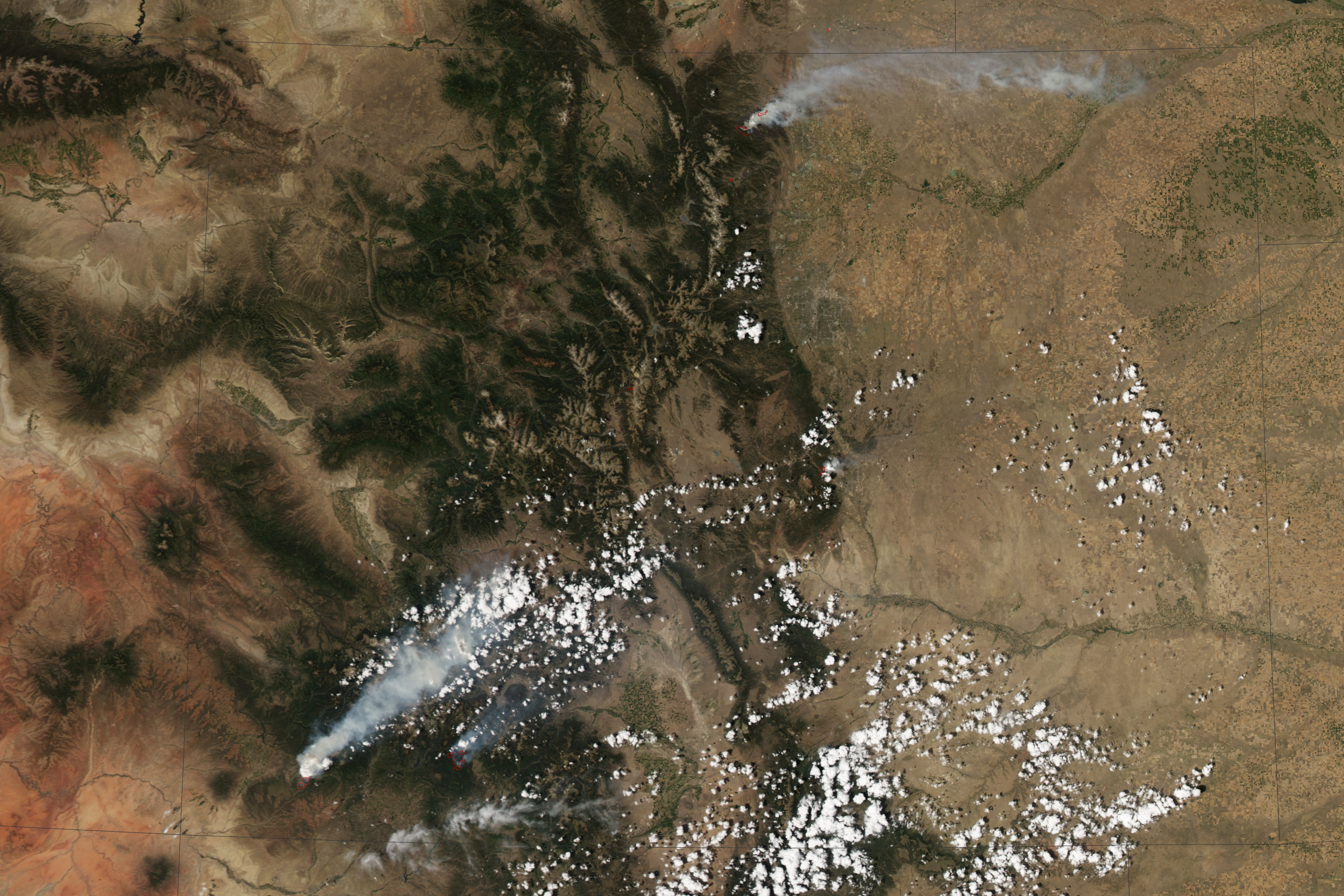
The Moderate Resolution Imaging Spectroradiometer (MODIS) on NASA’s Aqua satellite captured this natural-color image on June 23, 2012. Red outlines approximate the locations of actively burning fires. The High Park and Weber Fires produced the largest plumes of smoke.
The High Park Fire continued to burn west of Fort Collins. Started by lightning on June 9, 2012, this blaze had consumed 83,205 acres (33,672 hectares), making it the second-largest fire in Colorado history, after the Hayman Fire that burned in 2002. As of June 25, more than 2,000 people were fighting the High Park Fire, and firefighters had it 45 percent contained, according to InciWeb. Nevertheless, The Denver Post reported that the fire had destroyed 248 homes, making it the most destructive in Colorado history, even if it was not the largest.
In the opposite corner of the state, the Weber Fire started around 4:15 p.m. on June 22. As of June 25, the fire had burned approximately 8,300 acres (3,400 hectares) and was being fought by 164 personnel. The cause was under investigation. The fire had high growth potential because of possible wind gusts from thunderstorms, InciWeb reported. On the other side of Durango, the Little Sand Fire had been burning for weeks after being started by a lightning strike on May 13. As of June 25, that fire had burned 21,616 acres (8,748 hectares), was being fought by nearly 200 people, and was 31 percent contained.
West of Colorado Springs, the Waldo Canyon Fire forced 11,000 people from their homes, many of them compelled to evacuate in the middle of the night on June 23rd. The fire started around noon on June 23, and by June 25 it had grown to 3,446 acres (1,395 hectares). InciWeb stated that 450 firefighters were battling the blaze, which retained the potential for rapid growth.
The Woodland Heights Fire just west of Estes Park was small but very destructive, consuming 27 acres (11 hectares) and destroying 22 homes, Denver’s Channel 7 News reported. That fire was completely contained by the evening of June 24.
As fires burned, Colorado also coped with extreme heat. The Denver Post reported that Denver endured triple-digit temperatures June 22 through 24, and the National Weather Service forecast temperatures of at least 100 degrees Fahrenheit (38 degrees Celsius) for June 25 and 26, with temperatures in the upper 90s through June 29.
Colorado’s fires have followed a dry spring. Although the state experienced unusually heavy snow in February, little snow followed in March and April, part of a larger pattern of low snowfall. By June 19, 2012, conditions throughout the state ranged from unusually dry to extreme drought, according to the U.S. Drought Monitor.
On June 25, 2012, Tim Mathewson, a fire meteorologist with the Rocky Mountain Area Coordination Center, remarked: “Current conditions are comparable to 2002 fire season, which was the worst in Colorado history. Fires haven’t burned as many acres at this point, but the drought conditions and fuel conditions are right up there with the 2002 season, if not worse.”
For a non-labeled, high resolution image, visit: http://eoimages.gsfc.nasa.gov/images/imagerecords/78000/78367/colorado_amo_2012175_lrg.jpg
=============================================================
Reader Mark Katz submits this story:
Just thought I’d submit a rather serious issue with CO Springs. Storms to the west of the Waldo Canyon fire created drafts that pushed the fire up over the ridge into the city proper. RH in the single digits (as low as 1%) coupled with record high temps five days in a row are only making matters worse.
Homes are now burning on the far west side of the city. Flying W Ranch – an icon here, has burned down, and now I’m reading that Garden of the Gods is threatened. Thousands have evacuated (I have a family of 4 coming to stay with me).
It is a sad day though, thankfully, there are no reported injuries by either residents or firefighters. I know MrPete as well as Steve M’s sister both live here as well as many other WUWT fans and readers.
http://www.gazette.com/articles/fire-140851-highway-waldo.html
Fuel is much less likely to ignite, and it burns much more slowly, when it’s moist, which is not the case here. The area where the fire started IS maintained, albeit not as well as it should. Had we not had the lack of precipitation, wind, high temps, and low humidity, the fire progress may have been slowed if not stopped altogether. Add in the additional fuel from beetle damage and/or lack of clearing in general, and we have the problems we have now.
Note, btw, that the fire was not considered a severe threat to the neighborhoods that burned until the winds suddenly shifted as a result of the storm to the west. It jumped containment lines moved over the ridge into Mountain Shadows quite quickly.
At least all of the people are safe.
Mark
Structure protection is relatively easy in the abstract for fire, storm and flood protection – Don’t build in the hazard zone. Here in Connecticut we have the most trees close to houses and roads of any place in the country. Fire is a low risk but storms take out power on a large scale. Trimming trees away from houses and power lines gets fierce resistance. Adequate preparation for disaster helps as well (access for firefighters, water supplies, etc.)
People still tend to thing of the “100 year” event as one that will not recur for 100 years exactly, so they can forget the lessons learned. After our power outage here last fall, I beefed up my generator set up and emergency supplies, but many neighbors sold their generators.
I moved to Colorado in 1972, to the front range north of Denver. Until sometime in the 90s, one could get a $10 permit from the Forest Service to cut and remove all the dead wood one wanted. Stopping this program certainly added available fuel to the forests here.
We continue to be cold and wet here in NE Oregon (thanks to the oceanic and atmospheric conditions). That means it will be hot and dry somewhere else (IE Colorado). Tonight Oregon will likely be setting record low temps as there is a frost advisory in affect in the high plains of Oregon (again) with the possibility of freezing temps. We have also seen long standing rainfall records being pushed aside for new rainfall records. These conditions were predicted based on analogue years in the past when the same oceanic and atmospheric conditions existed. Noisely, we have been experiencing these Spring and Summer conditions for almost a decade now.
Good point. It isn’t just trees. Anybody who has lived on the plains can speak to the threat of prairie grass fires. Dead grasses and scrub oak could probably carry a fire right through a subdivision like a fuse. Cheat grass – a short grass that “invaded” several hundred years ago – is brown by the end of June under normal conditions. I imagine there are several other taller species that are prettty good tinder right now.
Indeed. Care to have someone competent look at any of your other statements?
Political favoritism seems to drive educated man. Educated in what? Science mastered by politicians? Is it not the quest of WUWT in finding truth? Burn or No Burn is the question. Fire is the rapid oxidation of carbon fuel. Rust is oxidation. Department of Agriculture implies man managing soil and its products. U.S.F.S is part of the Ag business of our Federal Government, or so was during the creation of our Forest Reserves of the late 1890’s, soon to become National Forests. Watershed protection was the origin – that to some degree would require managing the soil-flora growth. In brief, Sustain Yield management.
In the 70’s a narrow purpose study in high altitude Sequoia seed propagation. Ah, discovery that heat-fire augmented the seed release and germination. Oh said some, then let us apply this revelation to the mid altitude flora. Problem solved. Zealot or truth seekers? Burn or No burn. Since that time, adequate verbiage has been added mostly by forest persons that favored some notion of order within a governmental system. Science or Political?
Sustained Yield – in an acre of land naturally via soil properties and weather produce 10 trees (ex) per year in conjunction with the natural shorter sub specie brushes, bushes and grass, flora of all kinds has a terminal-life span. What grows must die. Trees die via nature. Harvesting may with truthful management reduce accumulations of the 10,000-100,000 hour fuels. And at the coincidentally same time modify those geographic convenient logging terrain areas into a modified fuel break. Nature does not create fuel breaks via prescription. Physics drives the natural fire path. Animals and bugs of all sizes are affected immediately by fire. The little ones that do not hide in the 100,000 hour fuels are all consumed in the fire path. The big ones tend to hot foot it elsewhere.
Yellowstone fires of 1988, with no version of sustain yield, was manageable only in the very earliest days of the fire origins. There is a break-over point of No-return within fire management that compounds Logistical considerations of man and his attempt to suppress a very large fire. In these fires the effort by man was to herd a finger or section of a very large fire. Weather suppressed the 88 Yellowstone fires.
An overview of early National Forest and fire by Robert Cermak, “Fire in the Forest, a History of fire control on the National Forests in California 1898-1956” sets part of the stage for current politicalization of forest management. Burn or No burn. Harvest or No harvest. Fire fuel loading is one of the keys on a large fire management key ring. There are fire weather days that man will not be effective in any form..
My son-in-law is in the WY Air National Guard. His unit, the 153rd AW based in Cheyenne, was activated for firefighting in Colorado. The WYANG is one of several in the nation that is trained to use the MAFFS (Modular Airborne Fire Fighting System) system in their C-130’s.
After getting the MAFFS units in the planes (apparently two planes) and checked out, the squadron (AS-187, I have the hat!) deployed to Peterson AFB near Colorado Springs. The planes couldn’t fly on Monday as the winds and smoke were too bad but my son-in-law’s plane got in eight drops on the Waldo Canyon fire near Colorado Springs on Tuesday before their plane broke. Apparently two of the engines need repair; possibly from damage caused by the heat and smoke of the fire. I’ll find out later what happened.
Here’s the story of the unit being activated: http://www.dvidshub.net/news/90517/wyoming-air-guard-maffs-activated-assist-rocky-mountain-area
And here’s some video of the fire retardant drops the planes were making on Tuesday: http://www.dvidshub.net/video/147813/maffs-colorado-june-26-2012
I’m thinking my son-in-law will be busy fighing fires for the rest of the summer and even into the fall.
Don Bennett
Evanston, WY
Interesting read:
http://www.gazette.com/articles/obama-140889-edge-rages.html
The Obama Admin has been working diligently to reduce the ability of the Forrest Service to fight fires.
Think of all the carbon thats beeing created and released, Al Gore should be horified.
The only brightside to this, all the seeds that will be released and the new growth.
In 2008 we had thousands of lighting strikes in N. Cal., and fires all over as a result. Unfortunately, a lot of the forest is classified as “wilderness” which means you can’t use really efficient methods of fire fighting, you can’t construct fire breaks, and the fuel load is tons per acre over what it should be for a healthy forest. Much of the overload is due to lawsuits filed by green groups preventing any kind of harvesting or even thinning of brush. Consequently much of the land was charred with very hot temps to bare earth. I don’t know if the greens have been similarly active in CO, but I would bet they have, with similar results.
Here is a slice of pie why the West burns as Obama fiddles and play another 18 holes.
How Obama bureaucrats fueled Western wildfires
The Obama administration’s neglect of the federal government’s aerial tanker fleet He finally acts: Too little, too late, too fake.
Ten years ago, the feds had a fleet of 44 firefighting planes. Today, the number is down to nine for the entire country.
Last summer, Obama’s National Forest Service cancelled a key federal contract with Sacramento-based Aero Union just as last season’s wildfires were raging. Aero Union had supplied eight vital air tankers to Washington’s dwindling aerial firefighting fleet.
Two weeks later, the company closed down, and 60 employees lost their jobs. Aero Union had been a leader in the business for a half-century.
As California enters into the fire season. Our aerial firefighting fleet is already seriously undercapitalized.” Both the U.S. Government Accountability Office and the Department of Agriculture’s Inspector General have been critical of the Forest Service’s handling of the matter. All of this has been known to the Obama administration since it took the reins in 2009.
Nine months after Lungren’s warning, the deadly High Park fire in Larimer County, Colo., claimed a grandmother’s life, destroyed 189 homes and scorched nearly 60,000 acres. Arizona, New Mexico, Washington and Wyoming also have battled infernos this summer.
After months of dire red flags from a diverse group, President Obama finally signed emergency legislation last week to expedite the contracting process. Obama will borrow planes from Canada and provide $24 million for new aerial tanker contracts.
BUT THE MONEY WONT COME TILL 2013
But the money won’t come until next year, and the dog-and-pony rescue moves will not result in any immediate relief.
“It’s nice, but this problem isn’t fixed with a stroke of the pen,” former Forest Service official and bomber pilot Tony Kern told the Denver Post this week. “You need to have the airplanes available now.”
Veteran wildland firefighter and blogger Bill Gabbert of WildfireToday.com adds: “The USFS should have awarded contracts for at least 20 additional air tankers, not 7.”
Imagine if Obama’s Forest Service had been a private company. White House eco-radicals would be rushing to place their “boots on the necks” of the bureaucrats who made the fateful decision to put an experienced aerial tanker firm out of business as wildfires raged and the available rescue fleet shrunk.
“The Obama administration is scrambling now to help ensure the Forest Service has the air assets it needs to fight the ongoing inferno,” Colorado free-market environmental watchdog Sean Paige reported at MonkeyWrenchingAmerica.com last week. “But the crisis is bound to raise questions not just about whether the cancelled contract created additional weaknesses and vulnerabilities, but about what the administration has been doing over the past three summers to shore-up the service’s air fleet.”
Where there’s smoke swirling over Team Obama there are usually flames of incompetence, cronyism and ideological zealotry at the source. The ultimate rescue mission? Evacuating Obama’s wrecking crew from the White House permanently. November can’t come soon enough.
http://www.humanevents.com/2012/06/20/michelle-malkin-how-obama-bureaucrats-fueled-western-wildfires/
This season is worse that 2002 as we’ve had ten more years to build up fuel. The continuing suppression of the natural fire regime in the forests in the US is the primary cause of these catastrophic fires, not the weather.
I would not doubt that part of the problem is the beetle damage – an epidemic that is purported to be over, that left a whole lot of standing firewood. Of course, I’m sure they can tie the beetle epidemic to GW somehow as well.
If by “they”, you mean people like Jeff Mitton, an evolutionary biologist at the University of Colorado (Boulder) who has studied the mountain pine beetle for more than 30 years, the answer is yes. Warmer winters mean fewer beetles die from the cold; the beetles come out of hibernation 6 weeks to 2 months earlier due to earlier springs and thus consume far more wood. They are also reproducing up to 2x per year, rather than just once.
The epidemic is not over, it’s just that the beetles have killed so much timber that in some areas there is little left for them to attack, since as much as 70% of the trees are dead.
RE: In our arid climate, there are only supposed to be 4-5 Ponderosa pines per acre yet we now have many more.
=======================================
I must wonder the extent to which the flood of transplants has resulted in subtle (or not so subtle) pressure on the Forest Service as well as local wildland management agencies to maintain higher densities? The vast majority of transplants hail from humid climates – the notions of “wildland aesthetics” are based on Eastern forests.
http://www.cleveland.com/nation/index.ssf/2012/06/colorado_wildfires_force_32000.html
Colorado Springs Fire Chief Richard Brown said “many, many homes” were saved by firefighters. And Hickenlooper, who spoke with Homeland Security Secretary Janet Napolitano Tuesday, told anxious residents that “We have all the support of the U.S. government. We have all the support of the state of Colorado. And we want everybody here to know that.”
Whatever happened to the “we don’t want taxes, we don’t want central government”?
Where are the private firefighters? still waiting for the cheque to clear?
Dear CCIS,
What warming????
Check NCDC Climate At A Glance. Average winter temperatures in the Northern Rockies and Plains Region have fallen 0.62°F over the last 20 years. And their data is biased upwards by UHIE and station dropout, so the real (hide the) decline is more than that.
Your boyo hypothesizes that rising temps have caused bark beetle outbreaks. But temps have DECREASED.
That pretty much shoots that hypothesis in the foot. Fatal wound. Hypothesis disproved QED.
Of course, given the wonders of post-normal sigh-ents and heavily subsidized climatosis, it makes perfect cents to ignore the empirical data and leap to a totally illogical conclusion. Algore is smiling under all that lard.
Dear Mike Dubrasich,
Let’s look at actual research on snowpack and temperature in the Rockies rather than average mean temperatures across a large area, shall we? What matters is the temperatures where beetles are an issue, specifically at higher elevations. From a 2005 paper on this topic: “Recent studies have shown substantial declines in snow water equivalent (SWE) over much of the
western United States in the last half century, as well as trends toward earlier spring snowmelt and peak spring streamflows. These trends are influenced both by interannual and decadal-scale climate variability, and also by temperature trends at longer time scales that are generally consistent with observations of global warming over the twentieth century.” A number of other studies with similar conclusions are referenced, summarized as follows: “These studies both show strong downward trends in 1 April SWE over most of the domain from about 1950 onward. Mote et al. (2005) also corroborated observed SWE trends by comparing simulated and observed SWE trends from 1950 to 1997 and used correlations between 1 April SWE and winter
temperatures to show that temperature trends were a major driver of these observed trends, particularly at moderate elevations with relatively warm winter temperatures.”
http://journals.ametsoc.org/doi/pdf/10.1175/JCLI3538.1
Nice try, though. But try to come up with a replacement for the standard vanilla demonizing of Al Gore. That is so 2007.
I am in Denver.
a.t.m., we are getting a much needed dose of rain and I can hear some thunder off in the distance.
Hopefully they are getting the same up near the fires.
I live in Colorado Springs. We only got a few seconds of sprinkles – no real rain so far.
What is burning is mostly scrub and brush which is not what I’ve heard the pine beetle likes. We’re having a fire because someone either set it or was careless. Waldo Canyon and where the fire has gotten to is very rough terrain. The winds have been erratic and the fire has gone in multiple directions. Experienced fire fighters have expressed frustration with this fire’s behavior.
Maybe forrestry policies have made things worse, but given how dry it has been, the question has been more of where will fire break out and not if.
Dear CCIS, if that’s your real name, and if it is you must be a robot from Star Wars,
Citing some warmista nonsense doth not make science, dude. I totally exploded your silly bark beetle warm winter hypothesis, and you have no retort. So you change the subject.
But let’s slash and burn your beetle story again, for fun. Everywhere there are pine trees, there are pine beetles. Everywhere. They go together. Pine trees are found from southern Mexico to northern Canada, across a huge range of climates. So are pine beetles.
You want people to believe a tiny change in winter temps in one place causes an outbreak because beetles are soooooo sensitive. But they aren’t. Otherwise how could they survive and thrive across the length of North America?
And as I pointed out with DATA, winters haven’t gotten warmer. Bang, kapow, your theory bites the dust.
Ain’t real science wonderful.
Now to your new theory, snow water equivalents. The FACT is SWE’s have neither increased or decreased over the last 100 years of measurement in the Northern Rockies, Oregon and Washington Cascades, and the Sierra Nevada according to real studies of the DATA.
You cite Phil Mote et al. That paper has been trashed so often it’s buried deep in the landfill at the gooey level. They cherry-picked the range of years. Why not use them all? Because they pre-concluded what they wanted too, and yamelled the data accordingly. We have had the deepest, longest-lasting snowpacks recently. This year the snow was still 300 inches deep on Mt. Ranier in June! April snotels set records this year. Mote’s alleged trend is a quacking fraud.
And none of that has anything to do with bark beetles, your original warmista claim! Which, btw, has nothing to do with the fire. Dead trees have no crowns, no fine fuels aloft. It’s brush that’s burning. Catch a clue!
Get back jack to your Agenda 21 IPCC SUV-hating Gorecal Rio Stumpit Copenfrozen commune and cry your crocodile tears there. Nobody around here buys your claptrap. This is WUWT, not McKibbenville.
It is not only the forest areas that are having fire problems this year.
These fire conditions are not unusual just rare.
http://www.julesburgadvocate.com/ci_20951016/last-chance-fire-second-largest-colorado-this-summer
If you look at historical records there are frontier time tales of similar plains wild fires running on miles wide fronts for days across the high plains in the 1800’s.
At the time the Flagstaff fire started just west of boulder it was 99 deg F and 8% relative humidity. Later in the after noon we had a brief rain shower which raised the humidity all the way up to 16%.
Folks from the wetter parts of the country simply cannot comprehend how fire fuels behave in those fire conditions. Add a bit of wind and you have an unstoppable fire front, all you can do is find a safe zone and wait for the fire front to pass and defend your safe zone.
In the late 1980’s shortly after the Yellowstone fires I was gathering information on wild fire development for the Colorado Office of Emergency management. At the time the emergency management community knew with absolute certainty that we were due for this sort of fire season it was only a question of when it would happen. At the time I talked to a Forest Ranger in the Golden Office who had done fire studies and he said that the front range areas near Denver burn on average about every 75 – 80 years. I then asked him (about 1990) when they last burned and he responded “about 75-80 years ago”.
This is no surprise to anyone who has studied the historical record of wild fire in the high plains and mountains of the west. It has nothing to do with climate change or global warming. It is a natural cycle of renewal that is inevitable in an ecosystem composed of plants that are adapted to fire conditions and “require” periodic burns, to be healthy and to kill off their predators (pine beetles and other biological competitors).
The lodge pole pine which is ubiquitous in this area cannot seed without fire to open the pine cones. Without fire the cones are so heavily resin coated that little seed ever gets a chance to grow new trees.
https://en.wikipedia.org/wiki/Lodgepole_Pine
This is as natural and predictable as a big earthquake on the San Andreas fault system.
Everyone knows it is going to happen, the only missing info is when.
Larry
I live in Arizona and got to watch the Sunflower progress this spring, it burnt fast and spread rapidly until it got to where past fires had been. Surprise surprise the fire slowed down and it ceased being a problem.
I grew up in and Minnesota right along where eastern forest ended, unlike the western forest in an eastern forest if a tree fall down in a normal eastern climate it quickly rots on the ground. Unlike the western forest where a fallen tree will remain for years as dry fuel. In the western forest, fire is a normal part of the forest, past fire suppression has allowed the fuel to build. On top of that past forestry practices have also made for a perfect storm instead of patches of trees of different ages and density we now have forest over grown and to many trees the same age for miles. When fire comes it has lots of fuel and mile and mile it can go unimpeded. Like it did last year here in Arizona
I also remember my grandfather house which was in a jack pine grove there was only one tree within a hundred feet of his house and the grass was always cut short. He was prepared for a fire even though fire never came.
Sadly – and amazingly – the fire has reached and over run entire neighborhood on the west side of Colorado Springs:
And a wider view:
https://docs.google.com/open?id=0B_26actSzzJJRFdFQTBZY0lrVVk