I have reports from the scene, plus also from the NASA/Goddard Space Flight Center

Nearly half of the United States’ airborne fire suppression equipment was operating over Colorado on June 25, 2012, CNN reported, as tens of thousands of acres burned. Fires raged in southwestern Colorado, northeastern Colorado, and multiple locations in between.
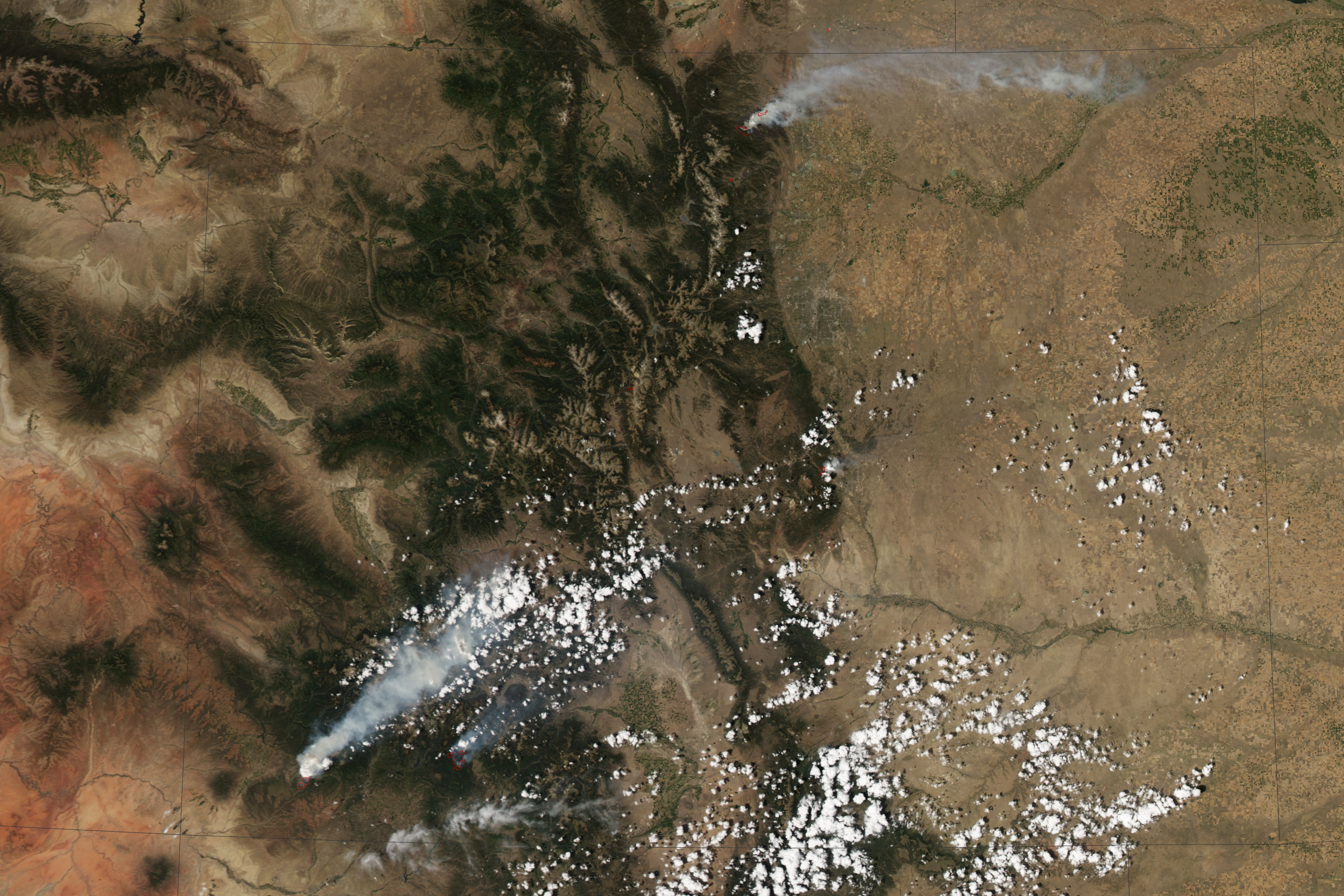
The Moderate Resolution Imaging Spectroradiometer (MODIS) on NASA’s Aqua satellite captured this natural-color image on June 23, 2012. Red outlines approximate the locations of actively burning fires. The High Park and Weber Fires produced the largest plumes of smoke.
The High Park Fire continued to burn west of Fort Collins. Started by lightning on June 9, 2012, this blaze had consumed 83,205 acres (33,672 hectares), making it the second-largest fire in Colorado history, after the Hayman Fire that burned in 2002. As of June 25, more than 2,000 people were fighting the High Park Fire, and firefighters had it 45 percent contained, according to InciWeb. Nevertheless, The Denver Post reported that the fire had destroyed 248 homes, making it the most destructive in Colorado history, even if it was not the largest.
In the opposite corner of the state, the Weber Fire started around 4:15 p.m. on June 22. As of June 25, the fire had burned approximately 8,300 acres (3,400 hectares) and was being fought by 164 personnel. The cause was under investigation. The fire had high growth potential because of possible wind gusts from thunderstorms, InciWeb reported. On the other side of Durango, the Little Sand Fire had been burning for weeks after being started by a lightning strike on May 13. As of June 25, that fire had burned 21,616 acres (8,748 hectares), was being fought by nearly 200 people, and was 31 percent contained.
West of Colorado Springs, the Waldo Canyon Fire forced 11,000 people from their homes, many of them compelled to evacuate in the middle of the night on June 23rd. The fire started around noon on June 23, and by June 25 it had grown to 3,446 acres (1,395 hectares). InciWeb stated that 450 firefighters were battling the blaze, which retained the potential for rapid growth.
The Woodland Heights Fire just west of Estes Park was small but very destructive, consuming 27 acres (11 hectares) and destroying 22 homes, Denver’s Channel 7 News reported. That fire was completely contained by the evening of June 24.
As fires burned, Colorado also coped with extreme heat. The Denver Post reported that Denver endured triple-digit temperatures June 22 through 24, and the National Weather Service forecast temperatures of at least 100 degrees Fahrenheit (38 degrees Celsius) for June 25 and 26, with temperatures in the upper 90s through June 29.
Colorado’s fires have followed a dry spring. Although the state experienced unusually heavy snow in February, little snow followed in March and April, part of a larger pattern of low snowfall. By June 19, 2012, conditions throughout the state ranged from unusually dry to extreme drought, according to the U.S. Drought Monitor.
On June 25, 2012, Tim Mathewson, a fire meteorologist with the Rocky Mountain Area Coordination Center, remarked: “Current conditions are comparable to 2002 fire season, which was the worst in Colorado history. Fires haven’t burned as many acres at this point, but the drought conditions and fuel conditions are right up there with the 2002 season, if not worse.”
For a non-labeled, high resolution image, visit: http://eoimages.gsfc.nasa.gov/images/imagerecords/78000/78367/colorado_amo_2012175_lrg.jpg
=============================================================
Reader Mark Katz submits this story:
Just thought I’d submit a rather serious issue with CO Springs. Storms to the west of the Waldo Canyon fire created drafts that pushed the fire up over the ridge into the city proper. RH in the single digits (as low as 1%) coupled with record high temps five days in a row are only making matters worse.
Homes are now burning on the far west side of the city. Flying W Ranch – an icon here, has burned down, and now I’m reading that Garden of the Gods is threatened. Thousands have evacuated (I have a family of 4 coming to stay with me).
It is a sad day though, thankfully, there are no reported injuries by either residents or firefighters. I know MrPete as well as Steve M’s sister both live here as well as many other WUWT fans and readers.
http://www.gazette.com/articles/fire-140851-highway-waldo.html
Truly frightening consequence of years of fire suppression?
Not to carp but do we always have to use the somewhat over-the-top anthropomorphic metaphor: ‘rage’ when talking about large wildfires.
In all of nature, only mammals exhibit rage behavior, but in truth wildfires never do, nor do tornadoes or hurricanes.
Aren’t scientists supposed to discard misleading metaphors?
I know the media constantly prattles about fires that are ‘raging out of control’ but the thoughtless repetition of that phrase has made it unbearably hackneyed to this grizzled former editor.
Can everybody please never use it again at WUWT?
32,000 are under mandatory evacuation orders tonight. Air Force Academy is threatened.
Putting every forest fire out may seem like a good idea, but it is the opposite of what nature intended. Fire is required to go through forests every 30 – 40 years to help with seed germination, clear space of old dead standing trees for new growth. It’s natural.
When we keep putting them out tinder builds on the forest floor and then when fire takes hold – as it eventually must, the heat is now so intense it kills the trees.
But of course forest management people know best. (If I was an American I would add – ‘sarc’ here, but as i’m a Limey I’ll let you figure it out).
Uh, technically Takatz, not Katz, though my bad for not signing my full name. 🙂
Mark
I live in Colorado Springs and I can say it is frightening to watch the fire on the mountain at night. The smoke today was incredible and many people I know are being evacuated. This will leave a huge mark on the town for years to come. I have heard many people say this is proof of GW. What it is proof of is poor forest management as there is an incredible amount of fuel in this area.
I heard fire fighters as long as 10 Years ago say we were in for a big one someday.
If you saw the fires first hand, rage is the first thought that would come to your mind as a descriptive term. It is truly quite devastating to watch as friends’ homes burn while you can do nothing. I was evacuated myself from one hurricane and nearly evacuated a second time (which ended up worse than the first) when I lived in Florida and the feeling then was nothing compared to this. For whatever reason, fire is frightening.
Mark
I would not doubt that part of the problem is the beetle damage – an epidemic that is purported to be over, that left a whole lot of standing firewood. Of course, I’m sure they can tie the beetle epidemic to GW somehow as well.
I’m pretty safe, so not particularly worried, which is why my friends are coming here. I live at least 10, maybe 15, miles from the fires and on the other side of I-25 (a rather decent fire break nearly a quarter mile across including right-of-ways).
Mark
I thought that the Forestry Service had moved off of the “Jump on every fire” mode and even did controlled burns after those horrible fires of about 15 years ago.
Probably did, but 19% of our normal precip + record temps + 1% rel humidity + high winds creates the perfect storm for fire.
Mark
A fire is burning behind NCAR in Boulder now.
It’s been raining this night, finally, after about six weeks of continuous drought here in South Colorado (suffocating afternoons, desert-cold early mornings). Hopefully, rain will help putting forest fires out. Of course, forest fires are inevitable natural disasters — but disasters nevertheless, painful for some and tiresome for all.
I’ve seen nature in its horrible “glory” in Siberian snows, and in the mountains and deserts of Central Asia — not to mention tornadoes and fires here in America. All I can say about people who worship “Nature” in its primeval, uncontrolled state is: fools.
It’s easy to talk about “beautiful environment” in glitzy kitchens of self-loathing California or while walking in the parks of degenerate European plutocracy. But when you are alone, facing “Nature” and “biodiversity” in their careless, inhuman ugliness… more often than not you’d rather be in your kitchen paving the road to hell with good intentions. Nature worshipers are Death worshipers.
P.S. Yes, fire rages, however trite is the expression. Only one who has never been in a big fire can say it doesn’t. It behaves like an insatiable, unstoppable monster, thousands of monsters attacking every trace of human habitation and everything alive — the analogy is correct.
Rhoda Ramirez says:
June 26, 2012 at 10:09 pm
I thought that the Forestry Service had moved off of the “Jump on every fire” mode and even did controlled burns after those horrible fires of about 15 years ago.
It takes a lot of time and manpower to prep and do a controlled burn properly — the current growth of the federal gummint is all in DC, and the Forestry Service hasn’t even been getting enough folks to replace transfers and retirees.
So many fires simultaneously is a cause for suspicion. Ask the Aussies, they know what it’s like.
Here (in Israel) most of the big fires are deliberately caused by humans – as a kind of terror acts.
We just had a large fire near Jerusalem yesterday with 3 centers lit together .
There are bad people out there.
And in addition to this, the fact that all fires are put out before they consume the extra dry materials in the woods adds to the next fire potential. I beleive a paper was released not long ago saying just that (I saw it somewhere in WUWT).
It’s definitely looking like 2002, just horrible.
It’s interesting that before 1996 and the Buffalo Creek Fire, the largest fire was only 3,000 acres (BC was 12,000 in one day). After 1996, we experienced far larger fires, the BC fire, the largest at the time, is now only 14th.
It really does seem to be a difference of fuels. My dad remembers consistent thinning of the forest and aggressive management of beetle infestations while he was growing up (1940s and on). In our arid climate, there are only supposed to be 4-5 Ponderosa pines per acre yet we now have many more. It used to be managed naturally by fire, but once the area was settled, fires were not allowed to burn. In my lifetime, I can’t remember any thinning of the forests near us. I do remember several smaller fires, maybe a few acres in size. My brother says that Wyoming doesn’t have these large fires because they also aggressively manage their forests.
Of course now there’s still a lot of fuel because no one was allowed to removed the charcoaled trees from past fires, or the beetle-killed trees, and they now cover the forest floor, the perfect fuel, especially with all the grasses coming back.
There are also far more people in the Red Zone of Colorado, most who have no idea of the fire risk. Even in the midst of the current situation, my parents found bikers with a grill and no water along our road. And I can’t even count the number of people who throw cigarette butts out the car window. Anything can start one of these, the 44,100 acre Last Chance fire yesterday was started by a sparks from a tire that came off of a car. 11 families lost their homes and many farmers their crops.
@ur momisugly Mike, June 26, 2012 at 9:35 pm
There is no shortage of people who understand the unintended consequences of fire suppression, but every year, there are more people building their houses in dangerous places. Just as people in wards of New Orleans are willing to live in a house built below sea level, there are folks here who want to live in densely forested areas. It so happens that several front range cities will be poster children for this lifestyle choice. How does this situation happen?
I imagine one sceneario goes something like this: county governments and municipalities generate revenue by encouraging developments in the hinterlands. Realtors sell secluded parcels to people seeking privacy and a more natural lifestyle in remote areas. But people with homes want guarantees of fire prevention from their local two-engine fire department. Ultimately such areas becomes incorporated into townships whose councils profit from fees. City inspectors restrict tree cutting within the city’s boundaries unless a licensed, taxable agency is called in, or a a city crew can be assigned to do it at homeowner’s cost. My suburb requires permits to cut down trees even if they overgrow and threaten a structure. How many people will pay a fee and hire arborists to cut down trees for $500? Bettter to keep the overgrown eyesore. As you point out, combustible material accumulates naturally – it grows and dies. Unless fires are encouraged every so often, the likelihood of a major conlagration continues to increse.
The lack of proper zoning and tree-cutting plans can now be seen along the Colorado front range. I’ve lived here all my life, and I can’t recall seeing anything like this. From high ground in Denver’s suburbs, I can look south, northwest, and north-northwest and see plumes of smoke rising from “uncontained” fires … burning (but not “raging”, if it please Interstellar Bill) in Colorado Springs, Boulder and Fort Collins.
This may not be the “perfect storm” (California’s Santa Anna brushfires may consume more houses, or cause higher dollar damage) but, as I said, it’s the worst I’ve seen up close. The physical factors which made front-range fires almost inevitable this year: an anomalously dry winter and spring, followed by weeks of baking heat with several, record-setting daily high temps within those weeks, unusually strong and persistent winds, humidity in the single digits, burgeoning stands of beetle-killed pine, ample fire-suppressed timber and brush… and of course, more homes than ever built in hazard-prone areas. A dozen lightning strikes, unknown numbers of irresponsible tourists, an arson or two (Google Governor Hickenlooper and “arson”) and you have all the ingredients for people losing their bigggest investments – their homes. No “global warming” policy would help this tragedy – only aggravate it by depleting resources to combat it. Instead, this is combination of just the right physical causes, and a lot of bad decisions made by people who should know better. Topping it off are the news services aided by the entire front range megalopolis aiming hand-held video devices at a spectacle as bizarre and strange as an approaching hurricane. Just so…
This evening’s news shows the fire creeping down the front range west of Colorado Springs, and into one of the subdivisions, where, according to the reporter doing the story, firemen can only conduct “triage” – determine which structures can and should be saved. Several burning houses illuminated the night sky, while the camera panned across the scene.
Dear oh dear. Too many wrong statements to ignore.
MBtheK blames fire suppression of the past. Which past fires would you have let burn? Without fire suppression CO Springs would have burned to the ground 5 times by now. I suggest that you dismantle your local fire suppression system and see how long your home lasts.
In the 1970’s the Gila NF decided to try Let It Burn. Withhold suppression, under the theory that fires would gradually get smaller and benign as time went on. After 50 years of that experiment, the Gila NF just hosted the largest, most destructive fire in New Mexico history. The Whitewater-Baldy Complex Fire burned nearly 300,000 acres.
Whoops. I guess that experiment failed bigtime. Before people repeat armchair wisdom like “fire suppression is the problem” maybe they ought to examine whether such pronouncements are catastrophically stupid.
Mike says putting out fires is the opposite of what nature intended. Channeling Mother Nature again? What did Mother Nature intend for you? A short brutish life eating roots you dug with a stick? Please spare us the reading of entrails from the Temple of Nature. You know you know nothing and yet you persist in blaring it with a trumpet. We get it. You know naught, Druid dude.
David says we knew there were fuels 10 years ago because a firefighter said so. No need to consult any actual expert; you could have seen for yourself rather than rely on hearsay from a high school dropout. Guess what? Fuel is not a static phenomenon. It is biological. Fuel grows. There is even more fuel than there was 10 years ago. News flash, etc.
Mark say the beetles did it. Guess what? Green wood and needles burn too. If anything the beetles reduced the fire hazard by killing and hence stopping (albeit temporarily) fuel growth. The beetle-killed trees turned red and then shed their needles. That reduced fine fuels in the air. After 5 years a beetle-killed forest will not carry a crown fire, because the crowns are gone. After 10 years the fine fuels grow back, closer to the ground but still able to carry a fire fast and furious. Biology is inexorable. Biomass grows!
Rhoda exhibits not a clue who is responsible for the land. What the heck is the “Forestry Service”? If you don’t know the name of the agencies responsible for your landscape, it’s like watching a ball game and not knowing who is playing. Have a hot dog and watch the crowd. The game is not of interest to you. In fact, go home, unless of course your home is burned down because your cluelessness finally caught up to you.
People, please. Take some responsibility for your own lives. Contrary to popular opinion, Big Brother is not watching. If you don’t become engaged in the management your own landscape, from your yard to your watershed, then you deserve whatever catastrophe “nature” throws at you. Passive ignorance is not bliss, it’s deadly. Thank goodness you folks are not my neighbors.
they let the Yellowstone fires of 88 burn naturally at first and got a lot of flack for it, also. Sometimes stuff just happens.
spend billions pruning a wild forest or billions rebuilding, which costs more?
Best wishes to all effected.
Once CO has burned out you will get CO2!
As someone with many years spent in heavily forested areas, and who has spent many hours driving through Colorado, I find it rather telling that most of what is being written concentrates on the weather, with scant mention of the fuel.
Hundreds of thousands of acres of Colorado trees have been suffering from disease and lack of cutting and over zealous fire fighting for decades. The forests are/were dead or dying.
Fires are overdue. If some amount of controlled burn had been done a little at a time, or diseased trees had been logged and cleared, then those fires would not have nearly the power they are exhibiting, since fuel would be far more scarce.
This lack of forestry stewardship can be blamed on the “green” movement. They believe that any removal of trees is bad… I wonder how they deal with the “carbon footprint” of these fires?
Forest-management practices and building homes in the woods are wide of the mark now when talking about the Waldo Canyon fire.
Areas of Colorado Springs that were evacuated yesterday (generally east of Garden of the Gods in particular) aren’t in forest. A house I lived in 24 years ago was in that mandatory evacuation area; it’s on a 10,000 square-foot lot in a suburban tract (Holland Park) in an area built out largely in the 1960s and 1970s.
My (ex-)mother-in-law lives in a house a bit to the south (just off Mesa Rd.), 6 blocks east of the mandatory evacuation. The last I heard, the plan was for her, a son, and a grandson to bug out last night. That neighborhood is a touch more upscale than my old Levittown, but still not forested. (However, there is a great deal of wild grass and scrub that will burn quickly and easily around there, and if the fire gets to that neighborhood, the houses are likely gone.)
Learn to read. I neither stated nor implied “beetles did it.” Wow.
Beetle damage is a contributing factor. Yeah, green wood and needles burn, but standing dead trees that have not been cleared burn even better, and ignite from a simple ember. These trees are equivaltent to accumulated fuel on the ground that has not been cleared, fuel that is normally cleared by natural wildfires but no longer because of poor forest management or .
Try not to sound so smart next time and maybe you’ll sound a little smarter.
Mark
A mind is a terrible thing to waste. Please take responsibility for yours.
Mark
This devastation has more to do with urban sprawl and betting on a house location than anything else. It is newsworthy because homes are burning and is the price paid for the bet. What is the bet? Build a house and surround it with tall trees near a forest boundary. Build a house on a sand spit. Build a house on an unstable hill-side. Live in tornado alley. Build a house near a river or in a flood plain. Some pay the price of the bet. Some don’t. The blame is in the mirror. And I am truly sorry that some have lost the bet.
Why don’t they just hire these guys to make it rain?
http://www.weathermodification.com/