There’s a new paper in PNAS worth having a look at. It seems the authors found some very strong evidence for a comet or asteroid impact during the period known as the Younger Dryas. According to Wikipedia:
The Younger Dryas stadial, also referred to as the Big Freeze, was a geologically brief (1,300 ± 70 years) period of cold climatic conditions and drought which occurred between approximately 12,800 and 11,500 years BP (Before Present). The Younger Dryas stadial is thought to have been caused by the collapse of the North American ice sheets, although rival theories have been proposed.
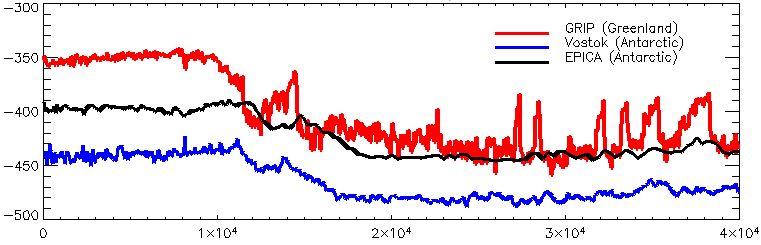
With this new paper, this may be one of those “case closed” moments in science showing that “climate change”/ice sheet collapse itself wasn’t to blame for the cold event, but the climate changed due to the impact event. This rather undoes the claims last year covered on WUWT in the story Sudden Clovis climate death by comet – “bogus”. I’d say it is pretty hard to argue with micro magnetic impact spherules dated to the time.
Evidence from central Mexico supporting the Younger Dryas extraterrestrial impact hypothesis

Abstract
We report the discovery in Lake Cuitzeo in central Mexico of a black, carbon-rich, lacustrine layer, containing nanodiamonds, microspherules, and other unusual materials that date to the early Younger Dryas and are interpreted to result from an extraterrestrial impact. These proxies were found in a 27-m-long core as part of an interdisciplinary effort to extract a paleoclimate record back through the previous interglacial.
Our attention focused early on an anomalous, 10-cm-thick, carbon-rich layer at a depth of 2.8 m that dates to 12.9 ka and coincides with a suite of anomalous coeval environmental and biotic changes independently recognized in other regional lake sequences.
Collectively, these changes have produced the most distinctive boundary layer in the late Quaternary record. This layer contains a diverse, abundant assemblage of impact-related markers, including nanodiamonds, carbon spherules, and magnetic spherules with rapid melting/quenching textures, all reaching synchronous peaks immediately beneath a layer containing the largest peak of charcoal in the core. Analyses by multiple methods demonstrate the presence of three allotropes of nanodiamond: n-diamond, i-carbon, and hexagonal nanodiamond (lonsdaleite), in order of estimated relative abundance.
This nanodiamond-rich layer is consistent with the Younger Dryas boundary layer found at numerous sites across North America, Greenland, and Western Europe. We have examined multiple hypotheses to account for these observations and find the evidence cannot be explained by any known terrestrial mechanism. It is, however, consistent with the Younger Dryas boundary impact hypothesis postulating a major extraterrestrial impact involving multiple airburst(s) and and/or ground impact(s) at 12.9 ka.
…

…
Summary
Synchronous peaks in multiple YDB markers dating to 12.9 ka were previously found at numerous sites across North and South America and in Western Europe. At Lake Cuitzeo, magnetic impact spherules, CSps, and NDs form abundance peaks within a 10 cm layer of sediment that dates to the early part of the YD, beginning at 12.9 ka. These peaks coincide with anomalous environmental, geochemical, and biotic changes evident at Lake Cuitzeo and in other regional records, consistent with the occurrence of an unusual event. Analyses of YDB acid-resistant extracts using STEM, EDS, HRTEM, SAD, FFT, EELS, and EFTEM indicate that Lake Cuitzeo nanoparticles are dominantly crystalline carbon and display d-spacings that match various ND allotropes, including lonsdaleite. These results are consistent with reports of abundant NDs in the YDB in North America and Western Europe.
Although the origin of these YDB markers remains speculative, any viable hypothesis must account for coeval abundance peaks in NDs, magnetic impact spherules, CSps, and charcoal in Lake Cuitzeo, along with apparently synchronous peaks at other sites, spanning a wide area of Earth’s surface. Multiple hypotheses have been proposed to explain these YDB peaks in markers, and all but one can be rejected. For example, the magnetic impact spherules and NDs cannot result from the influx of cosmic material or from any known regular terrestrial mechanism, including wildfires, volcanism, anthropogenesis, or alternatively, misidentification of proxies. Currently, only one known
event, a cosmic impact, can explain the diverse, widely distributed assemblage of proxies. In the entire geologic record, there are only two known continent-wide layers with abundance peaks in NDs, impact spherules, CSps, and aciniform soot, and those
are the KPg impact boundary at 65 Ma and the YDB boundary at 12.9 ka.
If you’re interested, the paper is published with unrestricted access on the PNAS website.
Or, you can read a full PDF copy that’s been mirrored on Dropbox.com at: http://dl.dropbox.com/u/2268163/Mexico%20YD%20Paper.pdf
h/t to reader Dennis Cox
Discover more from Watts Up With That?
Subscribe to get the latest posts sent to your email.

Alexandra Cairns says:
March 13, 2012 at 2:13 pm
==========
You’re welcome Alexandra, glad I could be of some help.
If you run a few searches on WUWT related to specific topics you’ll find a treasure trove of information and references.
I tend to agree, though extraterrestrial impact likely occurred 65 million years ago, see Luis Walter Alvarez 1980 work on the end of the dinosaurs, its difficult to find a smoking gun for the Younger Dryas.
The theory I find most logical for the end of the last ice age is a combination of interrelated events. Milankovitch cycles, the reopening of the Bering Strait (fresh water input to the Arctic circulation and the Atlantic), Natural cycles, and the related changes to the Atlantic currents.
Cyclic Climate Changes and Fish Productivity by L. B. Klyashtorin and A, A, Lyubushin (one of the most logical and pragmatic looks at natural cycles I’ve found so far)
Influence of Bering Strait flow and North Atlantic circulation on glacial sea-level changes by Aixue Hu, Gerald A. Meehl, Bette L. Otto-Bliesner, ClaireWaelbroeck,Weiqing Han, Marie-France Loutre, Kurt Lambeck, Jerry X. Mitrovica and Nan Rosenbloom
“The opening of the Bering Strait may also have wider implications on climate. For example, a recent study23 suggests that abrupt climate change events evident in the Greenland ice core
record between 70 and 11 kyr bp (ref. 30) may be related to the closing of the Bering Strait. Although the Bering Strait itself may not directly control the surface climate change, the effect of the strait on the transport of the fresh Pacific water into the Arctic and North Atlantic does influence the MOC strength, and consequently can modulate Earth’s climate. Therefore, climate changes and the Bering Strait may well have been intimately linked throughout the Late Pleistocene ice age.”
Meteor impacts are common, we get meteor showers every year. Big ones causing Shock metamorphism are not common and leave a signature on impact and a record. A “nanodiamond-rich layer is consistent with the Younger Dryas boundary layer found at numerous sites across North America, Greenland, and Western Europe” is evidence that something occurred but isn’t evidence it caused the Younger Dryas.
The reason, in my opinion, the Younger Dryas is so interesting is because its an abrupt change in direction during the rapid deglaciation at the end of last Ice Age. Why it occurred is still unknown but likely to be a combination of events and not a single cause.
feet2thefire says:
March 13, 2012 at 2:26 pm
And the buttercups that were reported in the Berezovka mammoth’s mouth or stomach – they weren’t shipped air freight.
==========
LMAO — great sense of humor!
It was a very different climate up there due to the Ice Age which is part of the mystery. One can only speculate given the anti-cyclone off Greenland, the snow blower system off the west coast of North America, a highly saline Arctic Ocean due to the lack of Pacific input, Siberia with very dry conditions, Mammoths running around with buttercups hanging out of their mouths, etc.
@Alexandra Cairns 2:13 pm:
“Personally, I think that the problem is that while there is certainly some evidence an impact could have occurred, there is not as much evidence to suggest it induced the YD.”
A valid question. The black mat is the key element at this time. If 10 cm of black mat exists in Holland, Belgium, Mexico and Arizona – and other places – and all the black mats are dated the same, what does that tell us? A common cause? If not, someone has to explain why not. Black mats do not just grow on trees – burning or otherwise.
But so what? There is a black mat. What does it mean? A conflagration? There really seems to be little doubt about that, though some do argue against that. It is the makeup of the black mat, then that tells us something. Certainly stuff burned, but by some of the Holiday/Daulton crowd argue that too, that it is some form of rotted material, but I can’t recall their exact term. There are plenty of markers showing burning went on, including, as I recall the newly discovered graphene. Now what kind of burning happens that stretches from Mexico to Belgium? None that we know of.
We should take this to mean we are out of the box already. A fire that stretches across the Atlantic sounds as incredible as the legnedary country that gave that ocean its name. But the evidence is there, plain to see. One thing I’d like to see is a comparison of the black mat across the different sites. That is something you could do, Alexandr, for your next class project.
If the black mats are considerably different it will complicated things, won’t it? Let’s go for the uncomplicated, though, and assume for the moment that they are all essentially the same. Ho on Earth (literally) could such a fire exist? Cinders over the sea? Burning boats? Multiple impacts? One really BIG impact? Multiple airbursts? One big airburst over a really big area like the N Atlantic?
Some of those have flaws that make them untenable. The one I would suspect most is the multiple airbursts. First ofa all, we have seen a multiple impact on a planet in our lifetimes, so that is possible. Then we have also seen Tunguska’s effects from 104 years ago. So muiple Tunguskasa make some sense. But as Dave Middleton has pointed out, Melott says that the his math on the needed size is one million times (energy-wise) as big as Tunguska.
So, let us ask: Was Tunguska a typical cometary air burst? Was it a big one? A small one?
I go back to the SL/9 impacts on Jupiter. Each impact was only about 1/20th of the size of the orginal comet (19 or 20 fragments). Yet the mushroom clouds – even in Jupiter’s 8G gravity – were as big as our whole planet. Certainly each of those mushroom clouds would have been NO SMALLER if Earth was the victim. I think they would have been much larger, but we will go for the conservative line. We will say they would have been the same size if SL/9 had hit Earth.
Tunguska lit up the sky in St Petersburg about 3,000 miles away. But that is just light. How far out did its ‘mushroom cloud” extend? If we take its reported area of damage (2,150 sq km), it would be about a radius of 16.2 km or a diameter of let’s say 32 miles. The Earth is just under 8,000 miles in diameter, so the blasts from SL/9 represent a blast diameter of about 250 Tunguskas. That is conservative. That would be 2,000 Tunguskas blast diameters if we did a quick equivalent allowing for Jupiter’s gravity.
Now that is only ONE of the SL/9 impactors. There were about 20.
The bottom line is if SL/9 had hit the Earth (WHY hasn’t anyone ever published on that?), we’d have had 20 impacts 2,000 times bigger than Tunguska.
And if the comet – which broke up in Jupiter’s gravity – had not broken up in the lesser gravity of Earth? How big would that airburst have been?
Wow. Think about it. The smallest SL/9 fragment was a “few hundred meters across” while Tunguska is estimated at a few tens of meters across. The largest SL/9 fragment was FIVE THOUSAND meters across.
Melott was doubtful that anything could impact Earth with one million times the energy of Tunguska. I am really rusty on my physics or I’d have given fairly accurate energy values, but any that I plop in here will be wrong.
All I have to say is that it is certain that ONE SL/9 impactor would have a blast radius that would reach around the world, in our light gravity. If not, damned close. But Earth does not have the gravity well to fragment a comet like Jupiter did to SL/9. We would face the whole comet. It wouldn’t break up until it was in our atmosphere – and maybe not even then.
What would that whole comet do to our atmosphere and our climate? Using any Earth-based estimating, we think it is impossible for something to be tremendously bigger than Tunguska. But I don’t think we can use Earth.based thinking. I think we have to take SL/9 – not Tunguska – as a representative body that might impact Earth.
That should give us SOME idea of what we might be facing. If I am ten times too high and the YD impactor was ten times smaller than SL/9, it would still be twice the average size of the SL/9 fragments.
Would it wipe out mammoths? I’d think so. Even on the other side of the Earth? So fast they couldn’t digest their last meal? Something happened, and not just to Darwin’s Siberian mammoths, but to all large mammoths, even on Kotelnoi Island.
Steve Garcia
Clovis man? Unless he was in a cave, and maybe even then. He has to find food afterward.
@Larry Ledwick (hotrod ) 2:40 pm:
Larry, your scenarios sound okay for a single isolated circumstance. I don’t agree that they make sense for multiple mammoth freezings.
Steve Garcia
David Middleton said:
There are two things wrong with that assumption. The first error is the unquestioned assumption that all catastrophic impact events consist of a ballistic impact, and the direct transfer of kinetic energy to the ground. And that the only kind of planetary scarring from impact events involves a resulting crater.
There a quite a few places that would argue against that unfounded assumption. One of them is in the Libyan Desert. And it produced the Libyan Desert Glass without making a crater. The evidence there indicates a very large airburst event was the cause.
See Large Aerial Bursts and the Impact Threat
Or, Impact melt formation of low-altitude airburst processes, evidence from small terrestrial craters and numerical modeling.
Or, The Nature of Airbursts and their Contribution to the Impact Threat
The astronomical model given in the paper is the progressive breakup of the Taurid progenitor. And since as Bill Napier points out “The breakup of comets is now recognized as a common path to their destruction” I might be a good time to see images of heavily fragmented comet like linear Linear or Scwassmann Wachmann-3
You assumption that the event must have been a lone bolide and that it must have made a crater somewhere is almost childishly naïve.
Your second assumptive error is that the object was rich in platinum group elements. When there is no valid reason at all to assume that all ET objects, regardless of composition, are.
But in point of fact the only other stratigraphic horizon that bares any resemblance at all to the YD layer is the KT boundary layer.
Whatever happened back then, it is most certainly something that has never been studied before. And it is becoming more and more obvious that it was something different from anything ever imagined before as well.
Welcome to the outside of the box boys and girls.
.
BTW, everyone, freezing doesn’t explain why mammoths in N.A. died out.
There was a die off, more or less at the same time in both halves of the NH. Having two populations – Siberia and N.A. – die from different causes is maybe the least likely possibility of anything that might be mentioned on this post. So, whatever we assign to Siberia we have to assign to N.A., too. And vice versa. How anyone can assign it to climate change is beyond me – Mexico and Siberia – some of them would have survived. And Clovis man did not kill the mammoths in Siberia.
More empirical evidence is needed. C14 of the Arctic island mammoths would be a start, so we can know if they even made it to 12.9 kya,
Steve Garcia
Joachim Seifert,
Thanks and I completely agree about the graphs. The sea level study made an attempt to define the average change which was interesting. A 1 meter average rise per century helps to isolate the timeframe when the Bering Strait opened although the degree of sea level drop is still in dispute.
Generally, it looks like the Bering Strait reopened around the Younger Dryas. Its impact, during an ice age, implies a global cooling effect so it may have played a role in the Younger Dryas until earth alignments overpowered the trend.
Your point about the flexible self-aligning process of the orbit took about 1,000 years is interesting. Where can I find some additional information?
To John: Please read the most important reply from mate Myrrh, Mar 12, 4,39 pm,
which is further up the page…..and click to the Graham Kendall files……
this is the grand perl of this post….. how the mammoths died with the flowers in
their mouth before the frozen “muck” come down flying on them, they could not even
quickly pull the penis in so quickly came the 150 F cold …….but they breathed a bit
of the flying muck, some was in their lungs but that was the end……
I hope we will do better…..
The paleoclimate problem today still is that, I will call them “Ocean streamlers”,
grabbed the glacial issue as their backyard…..and fight with the greatest Warmist
BS against the cosmic/astronomic truth…. still only guessing/wasting money….
Another case is the STAROGGA event, where 300 km of Norwegian coastline was hit
in 8200 BP…..initiating a 50 m high Tsunami rolling toward Scotlands coast…..
(this was an pure Ice comet as the Siberian comet in 1906….. therefore no remains….)
Here you can see that the Ocean streamlers grabbed this event AS WELL and the
displacement of the planet….is kept under the table and the resulting cooling
is added to the turf (and research funds flowing) into the pockets of the streamlers:
A Agassi lake overflowed in 8200 BP, changed the GULF Stream towards Southpole
(so-called see-saw of the streamler flow -see Warmist Broecker & Dalton)…..all
absolute nonsense and dismantled piecemeal by now, of cause no apologies
(turning of the Golfstream around movie how NY city got frozen)……
…. For literature of the astronomic events: I can calculate every temp spike of
the glacials, found the formulas….. wait 2 more years and you will get the
full paleo- and todays climate picture…..
Cheers
JS
Hi David –
In cometary impact, the PGE concentrations depend on which part(s) of a parent comet hit, and its (their) size(s).
There are a number of astroblemes which have not been dated yet, including Ilturalde Crater and the LLoydminster structure. Others no doubt are yet to be found.
The impactite layer is what it is, and it is global.
The simultaneous extinctions globally are prima facie evidence of a climate collapse caused by that dust load. Its source was not volcanic.
Global death by starvation.
You may want to reexamine the 14C calibrations used for dating remains, as well as the impact record for the earlier period of clustering you mentioned.
I can’t really speak as to nitrate production levels in this event, or in other impact events, at least not at the present time.
feet2thefire says:
March 13, 2012 at 4:21 pm
==========
You’re making a good case but this just occurred to me.
Do the black mat studies include adjusted carbon dating? Are you certain they are in and around exactly the same time frame?
John from CA –
I assume two things: That YD authors do not do their own C14 lab tests, and that the labs they use are using the current calibration curves, which have been from IntCal09 since June of 2009, as far as I know.
I have NOT myself compared the C14 dates of the various black mats, not even as reported. That is something I have not gone into detail about. Good question.
It may be pertinent to show this following from IntCal09, since it mentions the YD. It seems to actually be part of MarineCal09, since it talks of marine dating.
No other YD mentinos are in the standard.
Steve Garcia
Ed and all – This is a pretty lively discussion.
I’d like to invite those interested to drop in and comment at George Howard’s http://www.CosmicTusk.com, which is all about the YD impact event. We could use the input and conversation. Ed Grondine and Dennis Cox are frequent visitors, as well as Rich Murray.
Everyone who has commented here are welcome. Bring your friends, too!
Steve Garcia
Otto Muck solved EVERY single problem listed above. I wish someone would just read his work.
Just a little personal theory about the megafauna – many of them would have drowned as the ice age was ending when they were trying to cross rivers which would have been in massive flood stage throughout the summers (lets say starting May until October).
No megafauna would be able to ford any rivers in the summer which were fed by the melting glaciers (and this includes the Clovis people – they were trapped within river systems throughout much of the year – I imagine they were smart enough to not cross flood-stage rivers 5 times bigger than today’s versions, but they were cut-off).
All year round, nothing was crossing the Mississippi River, for example, which was fed by Lake Agassiz at the time. North America was cut into regions – east-west – floodplain north and forested south-east.
Any area within reach of the glacier melt water would be subject to losing every mature animal every few seasons – that would be enough to take down the Mammoth, for example, since they have low reproduction rate.
The Younger Dyras black mat facies span the entire interstadial. This facies is exhibited in about 2/3 of YD sequences. Black mat formation began before the YD onset and continued beyond the end of the YD. It’s a paleosol indicative of cool-wet conditions and/or elevated water tables (Haynes, 2008). It’s simply bizare that the impact fanatics seem to be calling this an impactite.
Surovell et al., 2009 tested 7 black mat sites, 2 of which were the same sites in Firestone et al., 2007, and found “no distinct peak in magnetic grains or microspherules uniquely associated with the YD.”
Tim Minchin said:
In the world according to Otto Muck, Atlantis was a continent sized landmass straddling the mid ocean ridge. And which was hit by an impact event, and subsequently sank beneath the waves. without a trace.
It’s that “without a trace” part that sinks his assumptions. The imagery, and our understanding of the geomorphology along the mid ocean ridge is getting better all the time. And in spite of countless people looking almost obsessively, there is still no geologic evidence whatsoever that any other landmass besides Greenland has ever straddled the mid ocean ridge.
Phew, read all the posts. No nitrate signal, no crater, no sea level change but we have the layer, the millions of dead mammoths , wrong climate, wrong plants and others and an enigma.
Slow freezing cannot preserve the stomach contents, only maybe seeds and spores.
Also no mention of the muck, which looks like a vast tsunami spoil heap.
Low pressure flash freezing sounds interesting.
Sorry, lol, buttercups in their mouths shows a different climate, sort of reeks of hand waving especially in light of “show us the nitrate spike” demands.
Thus I conclude, a plasma hit, subsequent pole shift, tsunamis and new circulation. The plasma caused a massive pressure drop freeze concomitant with a mega tsunami.
Thats where the evidence points, can it be supported?
Did not the USA think of or have a competition to design a marker for a nuclear waste site that would survive and keep people away for 10,000 years. The efforts and thoughts made in achieving that aim, showed exactly how difficult that is. So the possible marker for this event, the Giza Complex indicates that date and many other mathematical correlations. Pure coincidence!!!!!!!!
It was problems with 14C dating around this period that started Firestone on his quest.
My hypothesis is that protons and neutons are released in hypervelocity impadts. As one example, another spike in 14C occurs at the time of the Barringer Impact.
Thus dating the mat material itself is likely to give misleading results; instead the dates have to be from above or below it.
Bill, while your conjecture about flooding and fording is fascinating, it does not explain the simultaneous global extinctions in the Northern and Southern hemispheres.
PS – Elephants have been observed to swim 10’s of kilometers to get to food.
They use their trunks as snorkels.
Ah, here is some things. Buttercups grow from Alaska & Canada to the Mexican border. Whenever I get time I will be back. Really, really busy.
http://www.yellowstonenationalpark.com/buttercup.htm
http://www.talkorigins.org/faqs/mammoths.html#bishop
http://www.talkorigins.org/faqs/mammoths.html#burns
We should start by asking: what kind of animals were these woolly mammoths which inhabited the Siberian steppes? Were they suited to living in a cold climate?
Yes. We determine this by examining preserved mammoth specimens. We begin by comparing the bodies of mammoths of those of existing members of the Elephantidae (the African Loxodonta and Asian Elephas). In comparison to those of modern elephants,the bodies of mammoths were compressed lengthwise. Mammoth trunks were shorter than those of modern elephants. Mammoth ears were small,even compared to the smaller ears of today Asian elephants (the ears of African Loxodonts are much larger). Mammoth tails were much shorter than those of elephants.
Modern elephants do not have a thick covering of hair. Woolly mammoths were covered with the same kind of double fur coat as we find on other large mammals in northern climates today. The dense insulating inner coat consisted of a fine wool. The long,shaggy outer coat (some hairs as long as 50 cm) was composed of guard hairs. It appears that the mammoth changed its hair at the beginning of summer. This happens in many other arctic mammals today.
In addition to the fur coat,woolly mammoths also possessed a three-inch-thick layer of fat underneath their skin as well as an additional fat reserve stored in a hump above the shoulders.
Most mammoths,including the Siberian varieties,were about the same size as modern elephants or slightly smaller. Some were larger,such as the North American Imperial Mammoth,which reached a height of fourteen to fifteen feet (4.5 to 5 m) at the shoulder. The Siberian mammoths were smaller; about 9 feet (3 m) at the shoulder for males and 7 1/2 feet (2.5 m) for females.
Mammoth tusks also differed from those of modern elephants. Mammoth tusks curved down to form a broad bow close to the ground. This answers the question of how mammoths could break through ice-covered ground to look for forage. Even assuming that the Siberian ground was frozen — it usually was NOT so frozen in the Pleistocene — the mammoth could use its tusks to break through the ice and snow. Is there any evidence that mammoths actually did this? Yes. Wear patterns on mammoth tusks suggest that the mammoths used their tusks as excavation tools.
All of these items indicate that the woolly mammoth was well adapted to surviving in a cold climate. They illustrate adaptation typical of those seen in other mammals which extend their ranges into colder climates. The body increases in bulk while the total amount of exposed body surface decreases (compressed body length of mammoths,short tails and trunks,dense fur coat). There is no reason to doubt that mammoths could live in cold climates as long there was adequate forage.
(Incidentally,even modern Asian elephants tolerate cold fairly well. Elephants lived as far north as the Honan province in China into early historical times (1500 B.C.). Asian elephants also lived in what is now Syria,Iraq,and Iran. African loxodonts used to inhabit the whole of the African continent into historic times.)
Was there adequate forage for animals the size of mammoths in the steppes? The current climate of the subarctic Siberian steppes could not support large herds of mammoths assuming they required a similar volume of food as modern elephants. Much of Siberia today is covered by deeply and permanently frozen ground known as permafrost. The existing tundra vegetation is tough,low,slow-growing,and laced with bitter chemicals. These chemicals may have evolved as a defense against foraging.
However,the Siberian steppes during the last ice age were not covered in ice and snow as they are now,nor was the ground frozen. The reason is that so much of the available water was locked up in the arctic ice pack — primarily in North America — that the subarctic steppes were much drier than today. As a result,the Siberian soil thawed to a greater depth and supported a richer variety of plant life. This included nutritious grasses. The stomach contents of preserved mammoths indicate that they fed on such grasses,as well as mosses,sedges,herbaceous pollens and spores,and fragments of willow and bilberry. Some rare poppies and buttercups have also been found in addition to small amounts of arboreal material such as larch needles,willows,and tree bark. Such variety indicates the mammoths lived in a variety of climates in Siberia. These ranged from dry and steppe-like to slightly wet to swampy to arctic/alpine.
Mammoth trunk tips were bi-lobed,useful for collecting herbaceous food. Relatively little arboreal material has been found in mammoth stomachs. Modern elephants,in contrast,prefer an arboreal diet, and their trunk tips are of unequal size.
The greater abundance and variety of steppe vegetation during the ice ages explains how the steppes could support large grazing animals like mammoths. The mammoths may also have migrated south in the winter and north in the summer. Modern elephants are great travellers,so possibly mammoths were too.
How old are the frozen mammoth remains from Siberia? They fall into two main groups,one dating from about 45,000 BP to 30,000 BP and the other from 14,000 to 11,000 BP. This does not mean that mammoths were not present in Siberia from 30,000 BP to 14,000 BP. Instead,this indicates the climatic conditions were not right for the formation of frozen carcasses. There are plenty of fossil bones of mammoths from 30,000 to 14,000 BP. This was a period of massive glacial advance,resulting in extremely dry conditions in Siberia. In these dry conditions,mammoth carcasses would tend to rot on the surface and/or be eaten by predators. In times of glacial retreat,when the climate was moister, summer mudflows and floods could rapidly cover carcasses. These covered carcasses would then become permanently frozen as the permafrost layer closed in above them during the following winter.
Was the climate warmer or colder in Siberia at the time the mammoths lived there? Well,both. It appears that at some periods the climate was warmer,at others it was colder. This is inferred by comparing the modern ranges of the plants found in mammoth stomachs as well as by astronomical calculations of temperature similar to those presented at various times in the past in this news group. The mammoths thrived in either case. The determinative factor was the decreased moisture so that the ground did not become permanently frozen as it is today. As a result,the “mammoth steppe” biome, comprised of grasses,succulent herbs,and wormwood,thrived. This biome disappeared around 9000 BP except for some small patches. It was replaced by the current boggy tundra vegetation and permafrost. The mammoths,having lost their source of food,disappeared in Siberia at about the same time. It is possible that predation by man was also partly responsible. The earliest human remains in Siberia date from the end of the last ice age.
Hang on folks, no humans inhabited North America until about 11000 years ago maximum. As North American Indians have Asian race genetic pool ancestors, how would you explain how they got there. They didn’t canoe across so had to walk over the Bering Straits, where there was a land bridge. The Toba eruption happened about 70,000 years ago and did bring on a nuclear winter but for how long we can’t say nor what parts of the globe it effected. The common theory was that it almost wiped out humanity who was replaced by humans coming up from Africa. The Hobbit Homo floresiensis, was living in Flores then, they didn’t die out until approx 18,000 BP from a volcanic explosion it seems. Then we have the Neaderthals living in Southern Europe until the wave of immigrants Homo sapien sapien arrived from Africa. The Australian Aborigines have been here for at least 60,000 years. Certainly the sudden deaths of the megafauna or their evolutionary trend to either die out completely or evolve into smaller mammals seems to suggest a progressive and sustaining change in habitat and food availability and breeding cycles, i.e., larger animals have longer gestation periods and single births, this might effect their numbers survival plus habitat changes. In other words, the change occurred over many generations so they adapted or died out. Maybe it was for some species a sudden event but not for all, some lived and adapted. The two frozen Mammoths are interesting, they seemed to have been frozen in situ. They could have been caught in an avalanche that eventually froze over. But why not other animals in the area? Interesting though, keep scribbling.
bushbunny said:
From Wikipedia:
I’ll grant that Wikipedia isn’t the most reliable reference in the world. And you didn’t say what you source for that statement was. But there are Clovis sites that date to well before 12,900 YA
I’m reading an awful lot of back an’ forth about the Carolina Bays in this thread. And, while the mechanism of their formation remains a mystery, and granted it was proposed in the original 2007 Firestone paper that they might be related to whatever the event was that was the trigger for the Younger Dryas cooling, and the megafaunal extinctions 12,900 YA, their possible connection to the Holocene Start Impacts has long since been discounted.
The specific topic of this thread is Evidence from central Mexico supporting the Younger Dryas extraterrestrial impact hypothesis by Isabel Israde-Alcántara et al. And it stands today as the most recent update, or iteration, of the Younger Dryas Impact Hypothesis. It pointedly removes the CB’s from the discussion. So arguments about whether or not they were involved are moot.
Almost all of the arguments of past skeptics have been addressed in this new work as well. Including the shoddy stratigraphic work of Dalton, Pinter, and Scott that was presented in No evidence of nanodiamonds in Younger–Dryas sediments to support an impact event
But regarding the search for any potential planetary scarring; in point of fact, the original paper was not working from a valid astronomical model at all. They pointed out that the assemblage of materials they had found in the stratigraphic record could only have been caused by by an extra-terrestrial event. But they also pointed out that it must have been something far different from anything ever studied before.
That statement that it whatever it was, it was something different from anything ever studied before should have been seen as an invitation to start thinking outside of the box from the very beginning. But since their proposal that it was a 4 mile wide bolide grew out of Toon et al’s work, and the unquestioned mainstream assumption at that all major impact events must the work of a single lone bolide, they were still thinking from ‘inside the box’.
But as Physicist Mark Boslough pointed out, it really is impossible for a four mile wide bolide to have enough time in the atmosphere to break up completely without making a good sized crater somewhere.
Without a valid, and viable, astronomical model to work from, R.B. Firestone et al could only speculate on what that ‘something different’ might have been. And in fact at the time they were just as clueless as anyone else on that score on what could have created the impact layer they had found.
Well, not everyone. Victor Clube, and W. M. Napier had been talking about something they called Coherent Catastrophism since 1982 when they published their book ‘The Cosmic Serpent’. Clube and Napier identified the progenitor of the Taurid complex as a giant comet whose injection into a short-period (about 3.3 year) orbit occurred sometime in the last twenty to thirty thousand years. In that book they also predicted that the effects of the disintegration of the Taurid progenitor object in an Earth-crossing orbit should appear somewhere in the geological and climatological record.
Most folks are still under the impression that this story begins with Firestone et al in 2007. But they were only the first to turn up evidence in the geological record. The astronomers had been already been talking about it for decades. And since this new paper corrects the lack of a viable astronomical model for the Younger Dryas Impact hypothesis by citing W.M. Napier’s Palaeolithic extinctions and the Taurid Complex, now would be a good time for folks to begin reading everything Clube, and Napier have ever written on the subject of the Taurid Complex; beginning with that paper.
If you can describe a beast you have a much better chance of predicting what it’s footprints should look like. And the more people understand just exactly what kind of heavily fragmented beast we’re talking about now, the better it will be for the search for relevant planetary scarring. But it will help to realize that those scars probably don’t consist of craters, or anything else in the standard impact science, or geologic toolbox.
We are looking for something no one has ever studied before.
One of my favorite books is Clube and Napier’s ‘The Cosmic Winter’. But there are some pretty good essays out there too. Here’s a few good links.
An Overview by Bob Kobres
Comets, Catastrophes, and Earth’s History by W. M. Napier
Giant Comets — Messengers of Life and Death by W. M. Napier
And while you’re at it Bob Kobres’s ‘A Nickle Pickle’ is a great read.
As
David Middleton Said:
We are talking about the significance of new data, presented in a new paper, relating to a rapidly evolving hypothesis that’s changing so fast that anything more than two years old is almost outdated. Including the original 2007 Firestone paper that started it all. You are citing a work from 2008. And debating the hypothesis as if nothing has changed since 2007. Did you even bother to read Evidence from central Mexico supporting the Younger Dryas extraterrestrial impact hypothesis?
For a recap here’s the abstract again:
The 10-cm thick, carbon rich layer that’s at the heart of that paper most certainly does not “span the entire interstadial”. And it is “simply bizarre” that impact denialists would suggest that the materials that were found in that layer by Isabel Israde-Alcántara et al could be anything else but an impact layer.
Perhaps Mr Middleton would be so kind as to come out of the past, join as all in present time, discuss the new data from Lake Cuitzeo, and talk about the Younger Dryas impact hypothesis in it’s present state.
Dennis –
I said the same thing to Middleton yesterday. I am certain he either hasn’t read it or can’t get the 2007-2008 Holliday/Paquay/Daulton papers off the pedestal he raised them upon.
The guy doesn’t hear anything that is not Holiday/Paquay/Dalton. He seems to have no idea that anyone else has done any work on the non-anti-YDB side since Firestone 2007.
Here at WUWT folks are familiar with the term “Confirmation bias.” That is when you accept anything your side says and are deaf to anything that doesn’t agree. Middleton has a terminal case of it.
The rest of the people are here to learn some new stuff, to hear what else is out there, and he keeps spewing out the ancient 2008-9 stuff that has been superseded long ago.
Steve Garcia
The more I ponder a significantly larger Taurids core stream. Would it not be possible that it could take many years for Earth orbit to stop repeatedly impacting that collection of larger objects? Possibly explaining the length of the YD?
NASA ADS: Palaeolithic extinctions and the Taurid Complex
http://adsabs.harvard.edu/abs/2010MNRAS.405.1901N
http://adsabs.harvard.edu/full/1991MNRAS.251..632S
http://adsabs.harvard.edu/full/1993MNRAS.264…93A
http://adsabs.harvard.edu/abs/1991PhDT………8A
Wow, well, better to google Taurids Complex, Harvard if you’ve an interest.
Ah, for ‘lost links’….
About 6 months ago I stumbled on a great page that talked about just this proposed impact event. Then I lost the link and have been unable to find it again. ( Three computers and 3 browsers each means a lot of potential bookmarks, if I even remembered to bookmark it…)
Had lots of photos of geography. Traced impacts from Mexico, cross Texas to Canada (where despite mostly hitting ice, there’s an area of ‘scrubbed’ surface rather like one would get from an ice shield being moved). Secondary ejecta from that impact ends up in the Carolina field. All neatly dated, vectors mapped et. al.
IMHO it’s the Taurids. Original large comet broke up some 10s of Thousands of years back. Most of the remnants in an orbit where we drift in and out of the core stream on one periodicity and the “main mass” is on another period. But intersect (main mass and center stream) to give our cyclical DO / Bond Events. Sometimes we hit a larger chunk…. Over time the magnitude drops some, as we’ve had some taken out in prior hits. (Good news is that right now we’re not center of the main density… but soon…)
I suspect that the wallop slightly shifted the rotational pole. (Colder Siberia, warmer Canada, explaining why ice sheets were further south in the USA than in Europe…) Tap a gyro near a pole and it ‘wobbles’ to a new tilt…
Don’t know how the animals got flash frozen. Even ice balls have the power of nukes on impact. That’s a lot of heat. But maybe there’s some way some of the ice gets ejected and not melted… Miles of ice absorb a lot of heat… That Siberia is just a ways over the pole would let a ‘slushy’ super tidal wave deposit quite a load of ice slush… and muck.
Oh, and IMHO it’s why THIS interglacial has a flat top. Most of the others spike higher and warmer, then start an immediate about face to colder. Look like a dunce cap with point on top. Ours is flattened. I think the impact ‘chopped off the peak’ (and possibly allowed civilization in the process…) for about 10,000 years of ‘more stable’. But now we’re back about at the point where the downturn of prior events intersects our time… One can only hope ‘this time is different’…
One other comment:
Our early nuclear bomb testing observation satellites where giving ‘false positives’ a couple of times a year from ‘nuke sized flashes’. They figure out they were rock falls from space… so put in place a filter to look for the unique ‘double flash’ of nukes. So think about it… roughly twice a year, somewhere, a ‘nuke sized event’. But mostly over unpopulated empty and high in the air, so no ground damage. The ocean and ice is big, and mostly empty…
Any explanation of past evolution and climate events that does not allow for rocks falls from space is incomplete.
Oh, and at about the proposed impact site in Canada is one of the largest Platinum mines in the world… A rather geologically odd deposit… Iridium is one of the “Platinum group metals” and the two are often found together… even in meteors…