There’s a new paper in PNAS worth having a look at. It seems the authors found some very strong evidence for a comet or asteroid impact during the period known as the Younger Dryas. According to Wikipedia:
The Younger Dryas stadial, also referred to as the Big Freeze, was a geologically brief (1,300 ± 70 years) period of cold climatic conditions and drought which occurred between approximately 12,800 and 11,500 years BP (Before Present). The Younger Dryas stadial is thought to have been caused by the collapse of the North American ice sheets, although rival theories have been proposed.
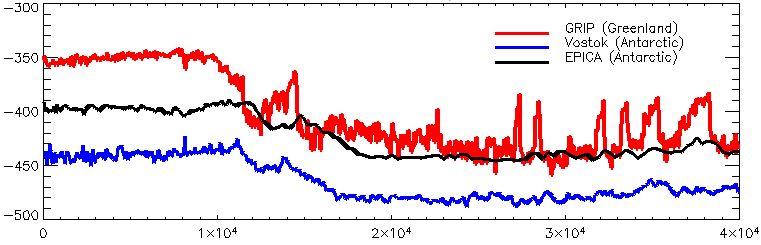
With this new paper, this may be one of those “case closed” moments in science showing that “climate change”/ice sheet collapse itself wasn’t to blame for the cold event, but the climate changed due to the impact event. This rather undoes the claims last year covered on WUWT in the story Sudden Clovis climate death by comet – “bogus”. I’d say it is pretty hard to argue with micro magnetic impact spherules dated to the time.
Evidence from central Mexico supporting the Younger Dryas extraterrestrial impact hypothesis

Abstract
We report the discovery in Lake Cuitzeo in central Mexico of a black, carbon-rich, lacustrine layer, containing nanodiamonds, microspherules, and other unusual materials that date to the early Younger Dryas and are interpreted to result from an extraterrestrial impact. These proxies were found in a 27-m-long core as part of an interdisciplinary effort to extract a paleoclimate record back through the previous interglacial.
Our attention focused early on an anomalous, 10-cm-thick, carbon-rich layer at a depth of 2.8 m that dates to 12.9 ka and coincides with a suite of anomalous coeval environmental and biotic changes independently recognized in other regional lake sequences.
Collectively, these changes have produced the most distinctive boundary layer in the late Quaternary record. This layer contains a diverse, abundant assemblage of impact-related markers, including nanodiamonds, carbon spherules, and magnetic spherules with rapid melting/quenching textures, all reaching synchronous peaks immediately beneath a layer containing the largest peak of charcoal in the core. Analyses by multiple methods demonstrate the presence of three allotropes of nanodiamond: n-diamond, i-carbon, and hexagonal nanodiamond (lonsdaleite), in order of estimated relative abundance.
This nanodiamond-rich layer is consistent with the Younger Dryas boundary layer found at numerous sites across North America, Greenland, and Western Europe. We have examined multiple hypotheses to account for these observations and find the evidence cannot be explained by any known terrestrial mechanism. It is, however, consistent with the Younger Dryas boundary impact hypothesis postulating a major extraterrestrial impact involving multiple airburst(s) and and/or ground impact(s) at 12.9 ka.
…

…
Summary
Synchronous peaks in multiple YDB markers dating to 12.9 ka were previously found at numerous sites across North and South America and in Western Europe. At Lake Cuitzeo, magnetic impact spherules, CSps, and NDs form abundance peaks within a 10 cm layer of sediment that dates to the early part of the YD, beginning at 12.9 ka. These peaks coincide with anomalous environmental, geochemical, and biotic changes evident at Lake Cuitzeo and in other regional records, consistent with the occurrence of an unusual event. Analyses of YDB acid-resistant extracts using STEM, EDS, HRTEM, SAD, FFT, EELS, and EFTEM indicate that Lake Cuitzeo nanoparticles are dominantly crystalline carbon and display d-spacings that match various ND allotropes, including lonsdaleite. These results are consistent with reports of abundant NDs in the YDB in North America and Western Europe.
Although the origin of these YDB markers remains speculative, any viable hypothesis must account for coeval abundance peaks in NDs, magnetic impact spherules, CSps, and charcoal in Lake Cuitzeo, along with apparently synchronous peaks at other sites, spanning a wide area of Earth’s surface. Multiple hypotheses have been proposed to explain these YDB peaks in markers, and all but one can be rejected. For example, the magnetic impact spherules and NDs cannot result from the influx of cosmic material or from any known regular terrestrial mechanism, including wildfires, volcanism, anthropogenesis, or alternatively, misidentification of proxies. Currently, only one known
event, a cosmic impact, can explain the diverse, widely distributed assemblage of proxies. In the entire geologic record, there are only two known continent-wide layers with abundance peaks in NDs, impact spherules, CSps, and aciniform soot, and those
are the KPg impact boundary at 65 Ma and the YDB boundary at 12.9 ka.
If you’re interested, the paper is published with unrestricted access on the PNAS website.
Or, you can read a full PDF copy that’s been mirrored on Dropbox.com at: http://dl.dropbox.com/u/2268163/Mexico%20YD%20Paper.pdf
h/t to reader Dennis Cox
Discover more from Watts Up With That?
Subscribe to get the latest posts sent to your email.

Fair point… I did harp on about the Carolina Bays a bit too much. There’s something about “scientific” assertions that ignore obvious geology that get me going.
The fact remains; there is no geochemical evidence of a major bolide at the onset of the Younger Dryas or any other Pleistocene glacial stadials.
Nanodiamonds and carbonaceous spherules in absence of elevated PGE and other geochemical signatures are not diagnostic of impact events… Particularly when the carbonaceous spherules are identical to fungal spores.
Climatologically, the Younger Dryas is non-unique. It is the last Pleistocene glacial stadial in a sequence of glacial stadials that occurred with almost clockwork regularity in the Pleistocene. If there’s an “anomaly,” it’s the Bølling-Allerød interstadial. Temperatures in Central Greenland during the Bølling-Allerød interstadial may have been nearly as warm as the Little Ice Age.
@beng 5:04 am:
“The NA Drift is an extension of the GS, caused by the sinking water of the Barents Sea “drawing” water northward from the GS. ”
This is another of the impossible aspects of the entire THC hypothesis.
“Drawing” means suction. Anyone who has ever worked with HVAC knows that if you are open on all sides, there is no suction at the entry end of your system. It all depends on static pressure at each point. Each bleed-in (opening) lowers the suction (negative pressure) available to draw from the upstream ductwork. The more openings, the quicker the negative pressure drops to zero. And once it drops to zero, that’s it, folks! There is no more suction.
And what do we have in the North Atlantic? Do we have any closed ductwork? No. We have a column of sinking water that can “draw” in water from all 360° around it. The incoming water, therefore, is as likely to come from the north as from the south – and WILL. The suction will be next to none 100 mile away. (Maybe even 10 miles away.) That 360° open system means suction at the sinking is basically taking in water from all directions. It does take in water from the GS, but that is because the Earth’s rotation has PUSHED it to that area. If there is no other water there, it is because the GS had pushed that water out of the way.
Now, what do we have when we talk of sinking water? What is the motive force? Convection – caused by gravity (a really weak force). THAT force is the only force working when water sinks – but even that force is only the difference between the fresh water and the saline water. The saline water doesn’t just move out of the way on its own – it offers resistance. So we have a resultant gravitational convective force that is supposed to “draw” water north all the way from the Florida coast 4,000 miles away. That force is far too small to “draw” that much water – probably too small by a factor of a billion.
As an engineer, I know no way that system can work in the real world. It loos pretty on a ma, but when you look at what is being said, it simply can’t work.
The motive force for the GS is – as Carl Wunsch said – winds and the rotation of the Earth (causing the NA Gyre via the Coriolis effect). The sinking is not the DRIVER of the system – it is the drain, the tail end of a petered out flow. People who sign on to the THC as a driver or “drawer” of water 4,000 miles away just have no idea that the concept has no possibility of being true.
feet2thefire
===========
I ran down some information on Baron Eduard von Toll, very amazing career. His Polar Expedition of 1900-1903 took him into the Ostrov Bennetta Island area of the East Siberian Sea.
The Islands I was referring to (mined for Mammoth tusks) are in the Kara Sea surrounding Ostrov Pushkareva Island and possibly include Perkatkun Island. These are near to shore, include fresh water from a near by river, and are much closer to the Bering Strait.
However, any chance you have run across a English translation of Toll’s 1900-1903 diaries? Especially the diary recovered from Ostrov Bennetta Island.
PS for Anthony
Baron Eduard von Toll’s Last Expedition: The Russian Polar Expedition, 1900-1903
WILLIAM BARR’
http://pubs.aina.ucalgary.ca/arctic/Arctic34-3-201.pdf
INTRODUCTION
“The opening years of this century witnessed an international flurry of activity in the area of arctic exploration; many of the expeditions involved are among the best known in the history of the Arctic. They include, to name only a few: Roald Amundsen’s successful voyage through the Northwest Passage in Gjoa between 1903 and 1907 (Amundsen, 1908);…”
@E. J. Mohr 8:23 pm:
A good summary of Heinrich events and Dansgaard-Oeschger events.
Correlation does not equal causation. That is a gospel on this climate skeptic site, I can assure you.
It is erroneous to state that “the only new factor was humans,” because the mammoths in Asia went extinct at the same time as the ones in the Americas. Humans were certainly not new to Asia. Another problem in Asia is that the megafauna (which on the New Siberian Islands included not only mammoths but horses, rhinoceroses – yes rhinos – and buffalo) were so far north. HILLS of bones and trees were found there and mined in the 19th and 20th centuries for the ivory. Offshore of those islands were also found megafauna bones. Were humans at 12.9 kya traveling all the way up there with spears and cornering mammoths and rhinos – and then piling them up? And why did the retreating megafauna not circle back to where there was more food? Siberia is damned wide, and it would be easy to circle back south. Obviously that didn’t happen. But there they all are/were. All our speculations end in big question marks. One can’t say Clovis man was new and therefore he killed them all – because he didn’t kill the ones in Asia. Not one Clovis point has been found in Asia. Clovis man was not there. Is it just a coincidence that all the megafauna in Asia happened to die out at the same time as the ones in N.A.? If Clovis man didn’t kill the Asian ones, what did? And if Clovis man didn’t kill the ones in Asia, who can say that Clovis man did it in America? It is much more likely that some other COMMON factor killed them. Clovis man is not a common factor. What is?
Climate? Not likely, when mammoths ranged from Siberia to Mexico, with all the climate zones in between.
If it wasn’t climate and wasn’t Clovis man, what is left? A comet impact/airburst is certainly worth looking into. And with the evidence seeming to support that concept, why not use that as our current understanding – and try to prove it wrong. And try to do that without Dave Middleton’s Confirmation Bias, please…
So far the evidence is making a comet more likely rather than less likely.
Melott – Full text
In modeling Tunguska and YD, Melott et al, assumed “half cometary ice and half rock for both events, but this matters little for atmospheric ionization.”
As Carlson wrote in the same issue of Geology,
The nitrate and ammonium anomalies in the GISP2 ice core at the onset of the YD do not support an impact event any larger than Tunguska.
John from CA 7:47 am:
I don’t have copies, but look these up on Google Scholar:
1. D. Gath Whitley, “The Ivory Islands in the Arctic Ocean,” Journal of the Philosophical Society of Great Britain, XII (1910)
2. J.D. Dana, Manual of Geology (4th ed.; 1894), pg 1007
3. F. Wrangel, Narrative of an Expedition to Siberia and the Polar Sea (1841) [wording may not be quite correct – see following…]
This is the Wrangel for whom the island in the E Arctic Ocean is named, the one with the mini mammoths.
Have fun with that one!
4. G. A. Erman, Travels in Siberia (1848) [that is all I have]
Have fun finding them John!
For explorations, the older the source the better.
Steve Garcia
Mr. Cox, it was 10 years from when the KT impactite layer was discovered until the first of the KT impact craters was discovered.
This impacttite layer in and of itself confirms the accuracy of Aremindian Oral traditions.
The locations of the survival of the different peoples is confirmed by the archaeological record.
The Ilturalde crater and the Lloydminster structure await geological dating.
@David Middleton10:38 am:
You pick out ONE and ignore the rest?
Steve Garcia
ASSINIBOINE (NAKOTA) IMPACT ACCOUNTS
I spent some time reading through Adrienne Mayor’s book “Fossil
Legends of the First Americans” recently. It turns out that the
Assiniboine (Nakota) may have remembered at least one of those floods.
Mayor’s book is pretty good, and she nearly succeeds in spanning the
two worlds, but sadly she did not realize that the peoples remembered
impacts, and thus failed to entirely grasp fundamental concepts like
“uktena” and “tlanwa”. Mayor also retells the traditions with her
intense interest in fossils coloring her retellings, and it is tough
using her book to locate the original traditions as they were first
shared. However, that said, it is a pretty good book.
THE NAKOTA (ASSINIBOINE) ACCOUNTS IN MAYOR’S RETELLING
Fragment 1:
“One Assiniboine name for bones of monstrous size was “Wau-wau-kah”.
This was a “half spirit, half animal” imagined as a great river monster
with long black[?]hair, scales, and horns like trees.
“Myth [tradition – epg] tells of its death by the impact of a
“thunder stone”, a black [“black” due to the ablated surfaces of the
meteorites which the Nakota later collected. – epg], projectile that
came whistling out of the west with “terrible velocity”, “defeaning
noise”, and “a bright flash” – a scenario that seems akin to the modern
theory of an asteroid impact 65 million years ago [Mayor gets very
close here – epg]. “My bones may be found”, warned the Water Monster
Wau-wau-kah, but unless the Assiniboines made offerings to its spirit,
the monster vowed to create disastrous floods and block their trails
with its colossal bones.”
Fragment 2:
“A tale [tradition – epg] of the antagonism between Thunder and Water
Monsters was recounted by an Assiniboine story teller [tradition keeper
– epg] (perhaps Coming Day? – AM) in 1909 at Fort Belknap.
“Long ago, some Sioux and Assiniboines camping at a big lake
witnessed a battle between Thunder Bird and a Water Monster on an
island in the lake.”
The storyteller’s grandmother had told him that: “as the Thunder Bird
drew the writhing monster up from the island, the Indians’ hair and
their horses manes, [a non-temporal insertion – epg] stood on end from
the electricity.
[“electricity” is another non-temporal insertion. Perhaps it may also
be a modern simple telling of a large electrophorenic effect from the
impactors entries. In regards to the “horses manes”, it needs to be
noted that a rider on a horse in the plains is a high point that will
attract lightening, much as a golfer standing on a gold course will,
and thus it was very important to know the signs of an impending
lightening strike.]
“The Thunder Bird’s lightening ignited raging forest fires; then a
long terrible blizzard followed; and still later the lake bed dried up
and many kinds of animals perished there.”
“The raging forest fires” were likely caused by the infrared of
multiple impacts. “the long terrible blizzard” describes the a standard
severe climate collapse caused by atmospheric impact dust loading.
“the Lake” of the Assiniboine is as yet unlocated; but see below.
Why did that lake dry up? Either its ice damn failed (“disastrous
floods”, above), or there was a lack of precipitation due to a cooling
of the temperature of the Pacific Current.
“The many kinds of animals” likely perished due to lack of food, a
famine which appears as a common element in many of the First Peoples’
memories of the Holocene Start Impacts.
WHERE WAS THE LAKE? and
WHO WERE THE ASSINIBOINES’ ANCESTORS?
Here was the problem:
http://uonews.uoregon.edu/archive/news- … -seafaring
“The points and crescents are similar to artifacts found in the Great Basin and Columbia Plateau areas, including pre-Clovis levels at Paisley Caves in eastern Oregon.”
You have maritime cultures moving inland, essentially still living on clams, fish, and marsh birds. The dates are pre-clovis.
(And thus before the Holocene Start Impacts, which are well evidenced by a global distribution of impact products, including impact products distributed by the atmosphere and recovered from glaciers. (currently estimated ca. 10,750 BCE)
Now here’s the Great Basin:
http://en.wikipedia.org/wiki/Great_Basin
And here’s the Columbia Plateau:
http://en.wikipedia.org/wiki/Columbia_Plateau
And here’s Paisley Caves, near one dried up ice age lake:
http://www.donsmaps.com/coproliteevidence.html
Notice the mt A haplogroup (siouxian) and the mt B haplogroup (asian origin, Assiniboine Nakota)? found there:
http://archaeology.about.com/b/2008/04/ … an-dna.htm
Now all I need is a map of all of the western glacial lakes of the late pleistocene, with which I could then compare the distribution of artifacts, if I could get hold of it. But I do not play a geologist on television, nor am I one in real life.
As you can see, if B mt DNA survives among the Nakota, NAGPRA issues immediately come into play.
feet2thefire says:
March 13, 2012 at 10:56 am
================
Thanks!!!
I noticed that Perkatkun Island is also referred to as Wrangel Island and a pygmy species of Mammoth managed to survive until until 4,000 BC. I see why you’re saying have fun with that one and you could very well be correct.
The interesting question is, how did they get there (probable answer, the last ice age) and how did they survive Arctic winters until 4,000 BC if some extraterrestrial impact occurred.
Fascinating mysteries, thanks again for the links!!!
What “rest” am I ignoring?
There may very well have been a significant bolide at the YD onset. The paper that is the subject of this post may very well present evidence of such a bolide in central Mexico at the YD onset. We’ll see if it proves to be repeatable (unlike Firestone et al.).
There just isn’t any evidence of a sufficiently powerful bolide or series of bolides that could have caused the YD stadial. Could such bolides have played a role in the megafaunal extinction? Or the demise of the Clovis culture? Sure. “An absence of evidence is not an evidence of absence.” It’s just an absence of evidence.
Younger Dryas – a super interesting period…..but, today, still much speculation…..
(1) one of the sick aspects of it all is, that, let me call them : “ocean flowlers”, succeeded,
after Dalton and Broecker in the 80’th, to grab the glacial paleotime as an ocean flowler turf
and even succeeded to name glacial temp spikes, which have nothing to do ocean flow,
according to their fellow breed (“Dansgaard” & “Oeschger” events…..).
These regular temp spikes are ASTRONOMICAL cycles– obviously clear — see the exact
calculation method for cycle periods and amplitudes given in “ISBN 978-3-86805-604-4”
on the German Amazon.de. These “events” should therefore be renamed to get the
astronomical cause clear….
(2) Today, we are as well in the midst of an astronomical cycle, because these do not
go away, they permanently stay with us and therefore can be clearly detected today….
The present cycle in force caused global warming to the year 2000, folloowed
thereafter by the present temp plateau as the top spike
from which temps will only go downward after 2060…..
The CYCLE MECHANISM, parameters used and calculation procedures are
all identical for paleotimes as today……whereas CO2-AGW-Warmism only refers
to a minuscule time span of 250 years (1750-2010) …..
(3) To the Younger Dryas: Here, clearly: the astronomic cyclic curves deviates
substantially from field observations….BECAUSE THEY MUST: The dents, hits,
alterations of the harmonic cycle curve shape are clearly a product of other
astronomic events such as ET comet impacts…. just by checking the glacial time
temp distribution curve, one can clearly detect a variety of cosmic impacts in varying
impact strengths….
The Clovis impact one of the strongest, there are some more of the same strength
visible in longer glacial graphs…..
(4) The noticed “Flash cooling” which set in after the impact, has nothing to do
with 4.1: “ocean flowlerdom” and
4.2 “sulfur” in the comet (as in a recent comet IMPACT movie, where
here, not the Flowlers, but the Warmists told the movie-maker that
sulfur in the atmosphere brings about glacial cooling (see the
IMPACT movie yourself and the scare whether there were sulfur on
it (But not: My god, are we lucky….)
Both variants demonstrate nothing less than present Sickness in Science.
——– The truth is different: The flash cooling is again an astronomical
phenomenon: In order that a heavily impacted planet from a sideward hitting
comet does get catapulted out of its orbit, the elliptic orbit shape has to
compensate the impact and the orbit moves within second in its flexible part
(ends of MINOR axis) a substantial distance further from the SUN, thus
producing a flash fall in temps while those poor mammoths did not even
have time to finish their meal and as excavations showed, still had the
flowers hanging out of their mouth….
JS
<Ed Grondine said:
No, it doesn’t. It also doesn’t confirm the ancient biblical accounts of Sodom and Gomorrah, and the other ‘cities of the plain’. being destroyed by a fiery rain of stones.
We are talking about honest to Phd, peer reviewed science here. Not your own subjective opinion of a story you heard from chief ‘Farts-in-his-tent’. You claim to be a without peers. But this is the 21st century after all. And there are many highly educated American Indians nowadays who are Phd level archeologists, who take their tribal histories very seriously, and are more than up to the task of doing so. Why don’t we hear any of them claiming that those stories pertain to impact events more than 13,000 YA?
If you are going to cite those oral traditions, you should also be prepared to quote them verbatim, and cite your peer reviewed sources.
And since you posses no academic credentials whatsoever, I’m afraid your own self published book isn’t going to measure up in that instance.
P.S. It would also help if you checked your spelling before hitting the ‘Post Comment’ button.
Dennis and Ed –
You two behave yourselves here. You each think the other is an idiot, but take your fight elsewhere if you are going to have one. We don’t need you bitching at each other on two sites.
Steve Garcia
“We are talking about honest to Phd, peer reviewed science here.”
Yes, Dennis, and I am simply pointing out that those results match with both the different nations memories and with the hard data of archaeology.
.
Hi David –
What we’re talking about here is a large cometary impact, not an asteroid impact nor a carbonaceous asteroid impact, nor a simple bollide.
The global impactite layer is proven, a global dust layer large enough to cause a climate collapse for several years, which explains the megafauana extinction and the culture changes (by the survivors)..
Impact also neatly explains the peak in mammoth deaths ca. 10,900 BCE (op.cit.)
Hi JH –
Sorry, but your hypothesis as to Earth movement does not survive physics, such as we know it.
The same thing goes for the “Electric Universe) model.
beng says:
March 12, 2012 at 7:10 am
Hard to imagine, but easy to model 🙂
Joachim Seifert says:
March 13, 2012 at 11:52 am
Younger Dryas – a super interesting period…..but, today, still much speculation…..
===========
I completely agree Joachim, still much speculation.
For instance, if an extraterrestrial impact of sufficient size for “earth’s orbit to move within a second in its flexible part (ends of MINOR axis) a substantial distance further from the SUN, thus producing a flash fall in temps while those poor mammoths did not even have time to finish their meal” would have other impacts.
If this occurred, sea level, as a result of the cooling, would drop and instead the rise appears to have accelerated during this period.
Sea level rise: “jumpy” after last ice age
http://wattsupwiththat.com/2010/12/01/sea-level-rise-jumpy-after-last-ice-age/
Their analyses indicate that the gradual rise at an average rate of 1 metre per century was interrupted by two periods with rates of rise up to 2.5 metres per century, between 15 and 13 thousand years ago, and between 11 and 9 thousand years ago.
The first of these jumps in the amount of ice-sheet meltwater entering the world ocean coincides with the beginning of a period of global climate warming called the Bølling-Allerød period. The second jump appears to have happened shortly after the end the ‘big freeze’ called the Younger Dryas that brought the Bølling-Allerød period to an abrupt end.
To John from Cal.:
Good thought to relate the Hiatus temp drop to sea level studies……
The planet got struck and the flexible self-aligning process of the orbit took
about 1,000 years…. if you have the temp values in a good graph you see
an interesting spike upward halfway…..for the rotation mechanism could not
make it up the full height into the Holocene, took a rotation pause, went a bit,
backward, adjusted the orbital geometrics and then moved up the 2 piece toward
10,000 BP…..
To the ocean level: The studies need 100-300 year level accuracy to see
how levels follow GMT,
I hate smallish graphs with 1000 years on half an inch graph length…….
Worst of all are astronomic/climate graphs…..Milankovitch, Milankovitch
…..but which temp spike is caused by Milankovitch? They always
present the smallest temp graphs in literature NEVER indicating in which
of all millenia Milankovitch’s THREE cycles can be detected/followed….
Cheers into the CA cold
JS
Ed Grondine said:
Do they? I don’t believe that for even a minute.
What are your sources? Since you’re a white guy who didn’t grow up on a reservation, who posses no academic credentials whatsoever, and since you can provide no independent reference that recounts those "different nations memories" verbatim for us. Or even a single page of refereed text to support your subjective interpretation of those "memories". And since you don’t even introduce us to the person, or person, who passed those stories on to you, there is no way to confirm, or deny, that the "different nations memories" you speak of are anything more than a figment of your own fertile imagination.
Please be so kind as to back up your claims that oral traditions contain accurate verifiable memories 13,000 years old with valid references to peer reviewed literature.
Joachim Seifert says:
March 13, 2012 at 11:52 am
Younger Dryas – a super interesting period…..but, today, still much speculation…..
=======
Sorry Seifert, I stated that incorrectly. if you click the link and look at the chart you’ll find that at best sea level slightly rose during the Younger Dryas but didn’t fall as one would expect from a deep freeze event. The 2.5 metres per century jump occurred at the end of the Younger Dryas.
Is it possible the Mammoth were Freeze Dried due to an extreme pressure drop instead of Flash Frozen?
John from CA-
Thanks for the papers, they were an interesting read! I’ve been looking at oxygen 18 records and it has been informative to say the least. I’ve enjoyed reading everybodies comments as they are all fascinating speculations. Personally, I think that the problem is that while there is certainly some evidence an impact could have occurred, there is not as much evidence to suggest it induced the YD. There is still, I think, a lot to be understood about the THC, the so called N Atlantic Gyre and how all these affect our climate. Again, I’m not an expert at all I’m just guessing really. I know that lake agassiz has been ruled out of the picture, as have other lakes that could input fresh water. I do have a few questions though. Why is the YD so unique? Is it because of the black mats found, its abruptness and the extinctions that coincide? I’m also still curious about the paleoindians, whether they migrated or became extinct. I realise a large amount megafauna became extinct but what about smaller species? Some became extinct at 14,000 years (I have to confess I can’t remember which article this was in, I’ll try to find it!) Do you think some could have survived an impact and died out later because of the changing climate and their inability to adapt perhaps? Finally, i know evidence of cosmic material was found in Belgium, is anywhere else? Other than the Clovis sites in N. America?
@John from CA2:02 pm:
“Is it possible the Mammoth were Freeze Dried due to an extreme pressure drop instead of Flash Frozen?”
Others here argue that flash freezing was not necessary. Perhaps. James|D. Dana, the American equivalent of Darwin and who wrote the Textbook of Mineralogy, the standard college textbook for over a century, said this in his Manual of Geology (1894) “The encasing in ice of huge elephants, and the perfect preservation of the flesh, shows that the cold finally became suddenly extreme, as of a single winter’s night, and knew no relenting afterward.” [emphasis in the original]
That we can’t figure it out is not surprising. Darwin said that for him the extinction of the mammoths in Siberia was an insoluble problem. (Letter to Sir Henry Howorth, date unknown)
So, people have been speculating on it for about 200 years now, with no solution in sight – unless the YD impact event solves it. Which I honestly think it won’t quite do. It still will not explain what the mammoths were doing up there, John, just like you are puzzling on. And the buttercups that were reported in the Berezovka mammoth’s mouth or stomach – they weren’t shipped air freight.
Steve Garcia
The astronomers’ discussion of the Taurid Complex progenitor has some (Fred Whipple) theorizing a body 50 – 100km across that fragmented a couple tens of thousands of years ago and remained in the inner solar system in an earth-crossing orbit. This significant mass. It is not a single comet or bolide. It is a barrage. Two recent examples are Comet Linear and Comet 73P/Schwassmann-Wachmann. Links to Hubble images follow. Cheers –
http://hubblesite.org/newscenter/archive/releases/2000/27/image/
http://hubblesite.org/newscenter/archive/releases/2006/18/image/
If it was an impact, cometary or otherwise, it would have left a big crater and an obvious and global PGE anomaly.
A bolide of sufficient magnitude to cause the Younger Dryas might not have left a crater; but it would have produced a much larger nitrate anomaly than indicated in the GISP2 ice cores and it should also have left behind an obvious and global PGE anomaly.
There is no “global impactite layer.” And there’s no evidence of a climatic collapse in the Younger Dryas glacial stadial. It was climatologically indistinct from numerous previous glacial stadials.
What “peak in mammoth deaths”? Well-preserved mammoth carcasses fall into two groups. The largest group dates between 45 to 30 kya and a smaller group dates from 14-11 kya. 10,900 BCE and the Younger Dryas fall into the second, smaller, grouping.
I think some are jumping to an unwarranted conclusion when they assert that the mammoths must have been flash frozen. They only needed to be quickly cooled to about 40 deg F or below (refrigerator temperature) then they could have been slowly frozen over hours or days. One core body temperatures chill to near refrigerator temperatures, decomposition slows dramatically to near zero. There is plenty of time for a sudden cold snap or strong cold winds to then freeze the animal in place. If this happens at a time of major climatic change where that location becomes a year around snow field the animal could gradually sink to the bottom of the snow, then over time sink into the underlying muck as the ground undergoes brief partial thawing during the summer melt.
Possible explanations would include, an animal browsing in a wind blown clear area right next to a large snow drift and having the snow drift suddenly slump (small avalanche) instantly burying the animal in soft snow, then the rapidly chilled animal slowly freezing over the next few days as another storm moves in. Wet snow avalanches set like concrete when the snow stops moving, the animal would suffocate in a matter of minutes then freeze.
Similar, to the above the animal browsing near a frozen over melt water pond and breaking through the ice into several feet of ice cold water and muck, to be slowly frozen and buried as the winter progressed.
A browsing animal moving from wind blown clear areas across a deep snow drift with a strong frozen snow crust breaks through the crust and sinks into very deep snow and is instantly buried when his trashing motions cause the snow to collapse in on him.
For similar examples look no further than spring cross country skiers who venture onto unstable slope after a wind storm and trigger a small avalanche to be buried and not found until the spring thaw weeks or months later.
An animal does not need to be buried deeply to be killed by a snow slump. A boy I went to high school with was killed in a small avalanche my junior year, he was knocked down by a small avalanche and buried face down under only 6 inches of snow.
A small child was killed in a small avalanche in his own driveway here in Colorado years ago, while playing when a large pile of snow slumped and buried him.
Lets not look for circumstances that defy logic when very mundane possibilities could easily explain the situation.
Larry