There’s a new paper in PNAS worth having a look at. It seems the authors found some very strong evidence for a comet or asteroid impact during the period known as the Younger Dryas. According to Wikipedia:
The Younger Dryas stadial, also referred to as the Big Freeze, was a geologically brief (1,300 ± 70 years) period of cold climatic conditions and drought which occurred between approximately 12,800 and 11,500 years BP (Before Present). The Younger Dryas stadial is thought to have been caused by the collapse of the North American ice sheets, although rival theories have been proposed.
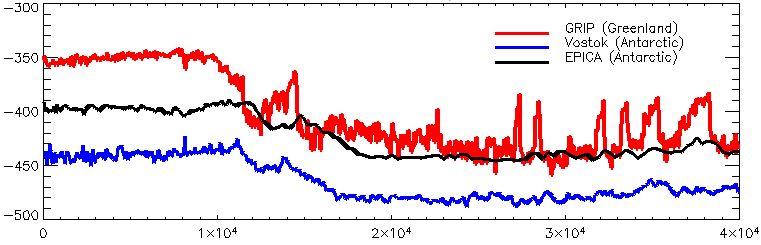
With this new paper, this may be one of those “case closed” moments in science showing that “climate change”/ice sheet collapse itself wasn’t to blame for the cold event, but the climate changed due to the impact event. This rather undoes the claims last year covered on WUWT in the story Sudden Clovis climate death by comet – “bogus”. I’d say it is pretty hard to argue with micro magnetic impact spherules dated to the time.
Evidence from central Mexico supporting the Younger Dryas extraterrestrial impact hypothesis

Abstract
We report the discovery in Lake Cuitzeo in central Mexico of a black, carbon-rich, lacustrine layer, containing nanodiamonds, microspherules, and other unusual materials that date to the early Younger Dryas and are interpreted to result from an extraterrestrial impact. These proxies were found in a 27-m-long core as part of an interdisciplinary effort to extract a paleoclimate record back through the previous interglacial.
Our attention focused early on an anomalous, 10-cm-thick, carbon-rich layer at a depth of 2.8 m that dates to 12.9 ka and coincides with a suite of anomalous coeval environmental and biotic changes independently recognized in other regional lake sequences.
Collectively, these changes have produced the most distinctive boundary layer in the late Quaternary record. This layer contains a diverse, abundant assemblage of impact-related markers, including nanodiamonds, carbon spherules, and magnetic spherules with rapid melting/quenching textures, all reaching synchronous peaks immediately beneath a layer containing the largest peak of charcoal in the core. Analyses by multiple methods demonstrate the presence of three allotropes of nanodiamond: n-diamond, i-carbon, and hexagonal nanodiamond (lonsdaleite), in order of estimated relative abundance.
This nanodiamond-rich layer is consistent with the Younger Dryas boundary layer found at numerous sites across North America, Greenland, and Western Europe. We have examined multiple hypotheses to account for these observations and find the evidence cannot be explained by any known terrestrial mechanism. It is, however, consistent with the Younger Dryas boundary impact hypothesis postulating a major extraterrestrial impact involving multiple airburst(s) and and/or ground impact(s) at 12.9 ka.
…

…
Summary
Synchronous peaks in multiple YDB markers dating to 12.9 ka were previously found at numerous sites across North and South America and in Western Europe. At Lake Cuitzeo, magnetic impact spherules, CSps, and NDs form abundance peaks within a 10 cm layer of sediment that dates to the early part of the YD, beginning at 12.9 ka. These peaks coincide with anomalous environmental, geochemical, and biotic changes evident at Lake Cuitzeo and in other regional records, consistent with the occurrence of an unusual event. Analyses of YDB acid-resistant extracts using STEM, EDS, HRTEM, SAD, FFT, EELS, and EFTEM indicate that Lake Cuitzeo nanoparticles are dominantly crystalline carbon and display d-spacings that match various ND allotropes, including lonsdaleite. These results are consistent with reports of abundant NDs in the YDB in North America and Western Europe.
Although the origin of these YDB markers remains speculative, any viable hypothesis must account for coeval abundance peaks in NDs, magnetic impact spherules, CSps, and charcoal in Lake Cuitzeo, along with apparently synchronous peaks at other sites, spanning a wide area of Earth’s surface. Multiple hypotheses have been proposed to explain these YDB peaks in markers, and all but one can be rejected. For example, the magnetic impact spherules and NDs cannot result from the influx of cosmic material or from any known regular terrestrial mechanism, including wildfires, volcanism, anthropogenesis, or alternatively, misidentification of proxies. Currently, only one known
event, a cosmic impact, can explain the diverse, widely distributed assemblage of proxies. In the entire geologic record, there are only two known continent-wide layers with abundance peaks in NDs, impact spherules, CSps, and aciniform soot, and those
are the KPg impact boundary at 65 Ma and the YDB boundary at 12.9 ka.
If you’re interested, the paper is published with unrestricted access on the PNAS website.
Or, you can read a full PDF copy that’s been mirrored on Dropbox.com at: http://dl.dropbox.com/u/2268163/Mexico%20YD%20Paper.pdf
h/t to reader Dennis Cox
Lars Silen,
I would buy into that Sir, just love photos of Finland, it is not to difficult to find the results ( providing there is a will there is a way ) a seismic survey would show the whats and wherefores, and who knows you might even find oil.
Garacka says:
March 12, 2012 at 5:10 am
Isn’t there also a paper that looked at mammoth bones from that time and found high speed particulate impact pits? I recall comments seemed to be leaning toward it being a stretching of the data.
Here is a reference to that: http://www.universetoday.com/10975/did-a-supernova-kill-the-mammoths/
Jimbo March 12, 2012 at 3:06 am
“…That Wiki graph shows Greenland and Vostok proxies. Funny how both proxies ‘fail’ to show the Medieval Warm Period……”
The trouble is, the MWP and the current warming appear to be very small on the general scale of climate change – We need to get a bit closer, as Anthony did very nicely here:
http://wattsupwiththat.com/2009/12/09/hockey-stick-observed-in-noaa-ice-core-data/
Certainly the dust alone cannot account for the length of the cold spell. However, the kicked up dust could account for the first couple years. Still, dust rains out pretty easily, which could happen as a result of the dust getting kicked up there in the first place. We call it cloudless rain here in NE Oregon.
It is possible that the event could have overlapped with another oscillation that was unrelated. We have so many oscillations on different beats, it seems plausable that they will overlap. Looking for one cause over such a long period seems a bit short sighted.
Uh, Jimbo, the MWP occurred at around the very leftmost tick on that graph. (Each division is 1,000 yrs). The little wobbles you see there are quite “consistent” with an MWP. Trivial natural variation, of course, all of it.
Robert Clemenzi,
“The caption for the first figure is wrong. (Never trust wikipedia!)”
I hope you then took the trouble to correct the error, or at least tagged it. Using Wikipedia implies a certain obligation upon the user to correct errors, that’s the genius of the system. Just remember to cite an authoritative source, and leave a note on the article’s Talk Page to explaining your rational.
And, or course, Wikipedia cannot itself be relied upon to be the authoritative source, its an encyclopedia. In a real way Wikipedia is just another version of what we are doing here, real people with real experience taking a grasp of humanity’s knowledge for the common good – for free.
I devote some of my time and treasure to improving the project in my small way, do you?
Atani
Good paper–worth reading. Especially loved their micrographs and corroborative evidence of nanodiamonds.
Lars Silen
Interesting region. You guys took some heavy hits.
Here are a few Google Earth coords:
Mossala 60.299612° 21.382232°
Angskars 60.471579° 21.016164°
Aland 60.140649° 20.124260°
Siljan 61.046054° 14.899703°
Might have to unzoom a bit to see the crater, especially Siljan and Aland.
Now if we hadn’t had that inconvenient release of CRU emails, who on the team would have been assigned to lean on PNAS to prevent publication, I guess it took quite a while anyway when you look at the date of submission and approval….
Atani – Perhaps some people think that, while you are earnestly trying to improve the Wikipedia ointment, we still cannot ignore the myriad carcasses of dead flies.
The only two major observed impacts in recorded history are the Tunguska, Siberia event & the Shumacher-Levy comet impact on Jupiter. The first was an air-burst of a supposed chondrite meteor, the second a tidally-broken comet-train, producing a “string” of impacts. From this it is hard to imagine that such impact characteristics are unusual — much more likely they are common.
Simple postulate: Approximately 12,900 yrs ago a comet-train impact produced shallowly-angled air-burst(s) with multiple in-line impacts — in this case stretching from central Mexico north north-east (west Texas has evidence too) to near, say, ~500 miles north of Lake Superior directly above, or on the 10,000 ft thick Laurentide ice-sheet . Terratons of ice were vaporized, or on the edges, physically blasted onto the surrounding land and into sub-orbital trajectories. How that would affect areas when it inevitably came back down is hard to imagine — but it would be awesome & incredibly destructive.
The climate change that would occur after this event would also be hard to imagine, but yet perhaps we have the evidence right in front — the YD.
Caleb has provided a very interesting link about wooly mammoths. Thanks.
http://www.grahamkendall.net/Unsorted_files-2/A312-Frozen_Mammoths.txt
Wikipedia_User
Wikipedia is next to useless wherever there is controversy. It is basically a battle of who has the most free time. Since the alarmists have hundreds of millions, billions of dollars in funding for agitprop, they can give communications prizes to fund the spamming of that site.
People get personally invested in their articles. It is like asking a flock of seagulls to decide the proper ownership of a fish.
I just finished downloading and reading the paper – very interesting.
Carolina Bays?? Maybe, probably not.
Evidence proving them to be related to impact events seems to be elusive. In my mind Carolina Bays seem to be a result of a geological self-forming process of some kind, which would tend to explain their persistence in the modern landscape rather than being buried meters under the surface as at Lake Cuitzeo; genuine impact features tend to be subject to erosion, which makes identifying them later difficult.
The new evidence presented in this new paper also tends to argue against the Carolina Bay impact hypothesis:
Since we now have a very good idea of what to look for at the YD boundary, we should expect to find similar beneath the bays, no matter their striking appearance and inexplicable orientations. So far as I know nobody has shown this to be true of the CBs.
Though I could be wrong.
W^3
Or maybe the ice sheet changes caused a large quality of heat to suddenly sink into the deep ocean into Trenberth Hidden Heat deposits which in turn mimicked either an asteroid hit or a major decrease in SUV sales.
In any case, the ice sheet/thermohaline explanation for the Younger Dryas has been incorporated by doctrinal convenience into the Consensus and any findings to the contrary must therefore be dismissed.
Kudos to WUWT:
“This rather undoes the claims last year covered on WUWT story: Sudden Clovis climate death by comet – “bogus””
No drama, no trying to support an indefensible position, simple acknowledgement of a better or supperior analysis or data, the attitude of lets move on and build from this, etc. Kudos. thats how it should be.
Mr. Schilling,
Nobody who actually works on the Wikipedia project is ignoring the issue, it is the central focus of our work, so I would reiterate everything I said above and challenge you to contribute some of your expertise to improving the project in whatever fields interests you.
Massively collaborative projects like Wikipedia, created and maintained by ordinary people, are going to be the way humanity eventually learns to solve its problems – not the UN, not the IPCC, not the World Bank and the IMF, not the Bavarian Illuminati or the Cult of Cthullu either.
History will prove me right on this.
Atani
I am extremely familiar with this issue, and I cannot see why THIS paper has begun to finally convince everyone of the likely validity of the Y-D impact hypothesis. But I am glad something finally did.
And thank you, Anthony, for finally picking up on this study.
Yes, as one of the early comments said, “THIS is science.”
There are other studies that show just as much evidence of the impact materials that are in the “black mat.” I point anyone interested in this to browse through http://www.cosmictusk.com posts for other examples.
I would also point out that 12,900 years ago – the boundary between the Pleistocene and the current Holocene – was well within the time of man. This confutes all that we have been told about the dangers ‘out there’ from relatively small objects wandering around in the nearby solar system.
Now, this all begins to point to the next development in this saga: If we recognize that a major impact within the time of man is supported by enough evidence, then we need to begin thinking about what we should do about it. The particulars can be worked out in time, but we need to begin thinking about the import of this event. This touches on alarmism in its own right, so this will probably not be welcome here at ground zero of anti-big-government-science. Yet if it can be shown that the threat has happened before, then what? Mammoths and sabre-toothed tigers went extinct last time – not to mention Clovis Man in the New World. It is not far different from the phrase “being blown back to the stone age.” (I hope I don’t sound like James Hansen here…)
One more thing: There is ample – if not conclusive – evidence that even more recent impacts have occurred. Much of it is historical, some of it is in the accounts of indigenous peoples (ambiguous when taken singly, but it begins to be persuasive when taken all together, by all the similarities), and at least some of it is scientific. If – and right now it is still a big ‘if’ – those other impacts happened, then we live in a much more active shooting gallery than we have realized.
There are 25 of these rapid cooling events in the record of the last ice age. We would need 25 meteorite strikes.
I think the issue is that it is really difficult to get glaciers all the way down to southern Canada and into the northern US. The solar energy was not much different than today, yet here we are on March 12 and the snow and ice is rapidly melting out now across North America. Even in the ice ages, the Sun is already warm enough at this time of year to start melting back glacial fronts in Chicago for example. How warm does the solar energy get by the summer.
I think, in the ice ages, there are many glacial advance pulses that last for a few thousand years at a time which is then followed by periods of glacial retreat – there are at least 25 of them – the Dansgaard-Oeschger events. The Younger Dryas was just the last in these series of glacial advances.
The following is somewhat circuitous, but is the the point of meteorites, CAGW, Greens and why they are so insistent that we, not the world, are warming the planet:
The posted article supposes that the Younger Dryas some 12-13,000 years ago had a sudden, warming end as the result of a meteorite impact:
Calgary, Alberta lies in the Bow River valley literally at the joining point of the continental glaciers sourced to the east in the Hudson Bay region, and the Rocky Mountain alpine glaciers sourced to the west (obviously in the Rockies). The line of contact is the northeastern edge of the city around Nose Hill, a bulge 200m above downtown Calgary (and the Bow River which cuts the city in two). A glacial lake, Lake Calgary, was formed when the river draining the two at their mutual front, was damed by a westward relative flow of an alpine glacier wedge along what is now the Elbow River. This lake was only one of a series of such ice-barrier bounded lakes on the way to the south perhaps a thousand kilometres, as the general drainage led into Montana, Idaho and across Washington (the state) to the Pacific Ocean.
One raw day, with a west wind blowing an ice dam failed in mid-Alberta several hundred kilometres north of Calgary. A sudden, deep rush of water came moved massive blocks of ice capable of carrying blocks of rock approximately 7m high and 30m long from their original position west of Edson down to glacial Lake Calgary. The lake filled to overflowing, but the time it took allowed the west winds to push smaller blocks of ice with their smaller rocks – the size of Volts – to ground on the east side of Calgary, at the top of Nose Hill. The ice dam then failed and another of a cascading series of ice-dam failures occurred. Lake Calgary drained and the water carried the largest of the blocks to Okotoks and kilometres from the normal drainage path of the glacial meltwaters, where it was stranded (and is now known as the Okotoks Erratic). Others of this rock type, peculiar to its place of origin, dropped out along the way, creating a distinctive Erratic Train to the American-Canadian border. All the erratics, including the ones on the westward facing slopes of Nose Hill, sit on top of the underlying glacial sediment without sediment around them, indicating a rapid stranding without a continued surrounding body of water.
The rush of water was, in its final amount, equal, I’ve read, to that of Lake Erie, draining in about three days. Dry waterfalls, water-cut, smooth drainage channels are present at Sunset Falls in Idaho (I’ve hiked them), looking out-of-place and telling a story of massive but suddenly ending floods. The floods swept across Washington, leaving boulders scattered across the volcanic landscape in an area now known as the Scablands. As I recall, the waters eventually ended in the Columbia River system and exiting into the Pacific (I’m hazy here: I’m in Abu Dhabi right now, thinking rather than researching). This fresh water suddenly entering the Pacific Ocean, would have been part of the similarly timed drainage of Lake Agazziz/Lake Champlain into the Atlantic Ocean that stopped oceanic currents and triggered the Big Freeze.
The point of this story is this: the timing of this catastrophic event is in the 12,250 YBP, the same time as the supposed meteoritic event. While the set up of drainage systems had to be in place, the trigger of the cascading floods has not been known, instead suspected as a threshold event of no significance except for those pale-Indians on the west coast of Washington. I’ve been searching for years for some event that ties in to this after, in 1979 an eccentric geologist thought that Veilikovsky was right, and Venus, in near-missing the Earth, dragged up a 2000m wave from the Gulf of Mexico to the Arctic that, when Cytheria left our planetary space, sloshed back from whence it came (and filling Great Salt Lake in Utah, explaining the salt there in the process).
The catastrophists have long claimed our imagination, but common sense suggested to me that more mundane reasons probably were responsible.
It is ironic that a meteorite impact may be thought of as a “mundane” reason for a heating event that resulted in me plotting the positions of Cambrian Gog Quartzite from the Tonquin Valley area as they were stranded on the hillsides of eastern Calgary. But that is how it is with our planetary life: the evangelical community who think that God drifted along gently for millennia before man, and drifted along gently since man first planted wheat until men and coal-burning power plants twisted His music out of key, seem intellectually unable to accept a universe (or God) who does, at times, Stuff that isn’t man-friendly. Nature, be-it in the form of a pantheistic Gaia, a non-denomimational God or a Large White Man with a Large White Beard (other than Santa Claus), is supposed to be not just benign, but kind. Even polar bears, a determined predator unafraid of men or ice-breakers crashing through nearby, are, in this view, essentially well-intentioned towards the sons of the Earth, herein known as Greens.
I know that religion is not supposed to be part of the CAGW debate, but I cannot but wonder if some of the Greens do not hold their alarmist positions precisely because, in their view, God (the Universe) is neither arbitrary nor unfriendly to its (His) followers. I have read it speculated at the early 20th century desire to get the Jews back to their homeland (Israel) was to further the Second Coming of Christ in this time, as the rules say that Christ will not come back unless/until the Jews are back “home”. George and George W., I understand, are of this belief; if true, it certainly explains why so many Christians in the southern States can be both anti-Semitic and hugely supportive of Israel. Theology, not intellect, rule in the recesses of their mind. Perhaps CAGW is not a religion, though even the English Archbishop of Cantebury has said that is what it appears to be, but an EXPRESSION of a preexisting religious belief. Hansen and Gore: perhaps they ignore evidence that C02 is not responsible for the global warming of late because to do so would be to accept that their Gods/Universe simply doesn’t care about whether they sweat in Washington or freeze in Phoenix.
Logic is often linear. You accept “A”, you accept “B”. To skeptics there appears no moral issue in such connections: they are or are not, simple matters in a neutral universe. The meteorite comes, a large amount of heat is injected into the atmosphere which precipitously melts more water than ice dams can hold, and large blocks of rock end up dotting otherwise flat prairie landscapes. Who could know, who could predict? But if your Universe (or God) has created and is creating a world of promise, hope and security for your benefit, perhaps this opens the possibility that either evil, not good rules, or that … hold the thought …. there are no rules. Or at least no Plan.
Error on the first part:
Jeepers. The Younger Dryas was a COOLING event, not a warming event, that came at the end of something that was warming, and may have been a sudden, catastrophic warming event.
Pamela Gray says:
March 12, 2012 at 6:36 am
—
Possibly the earth was slowly emerging from the ice age, warming very gradually. Then the dust caused much ice to reform, and the ice cooled the earth. Basically setting back the warming by 1000 years. Whatever was causing the original warming was still operational, but had to deal with all this new ice. When the new ice was dealt with, the earth’s temperature then snapped back to where it would have been had the impact never happened.
Just a layman’s WAG.
Otto Muck wrote about this over half a century ago – UNfortunately he titles his book ‘the Secret of Atlantis’ – so it was not considered mainstream – yet if you read it m you’ll realise he was a gifted scientist and knew his stuff. The book is available on Google Books and is highly recommended
This is one of the many reasons I love WUWT. Last year they carry a story about research showing that the YD not being impact related and now more on the opposite side. Science is wonderful when you actually follow the scientific method. Eventually you get a picture of what happened. Like developing a photo used to be. A darkroom was fun as you watched the picture become clearer and clearer.
@Kozlowski 1:07 am: “Any connection to the Carolina Bays?”
Though the CBs were originally thought to be connected, that connection has gotten a bit tenuous lately. It still may turn out to be true, but C14 dates are not for the most part contemporaneous with the 12,900 date.
I myself hold out some hope yet, though. See http://www.cosmictusk.com for more.
Steve Garcia