 Reposted from Jo Nova’s site
Chinese 2485 year tree ring study shows shows sun or ocean controls climate, temps will cool til 2068
A blockbuster Chinese study of Tibetan Tree rings by Lui et al 2011 shows, with detail, that the modern era is a dog-standard normal climate when compared to the last 2500 years. The temperature, the rate of change: it’s all been seen before. Nothing about the current period is “abnormal”, indeed the current warming period in Tibet can be produced through calculation of cycles. Lui et al do a fourier analysis on the underlying cycles and do a brave predictions as well.
In Tibet, it was about the same temperature on at least 4 occasions — back in late Roman times — blame the chariots, then again in the dark ages — blame the collapse of industry; then in the middle ages — blame the vikings; in modern times — blame the rise of industry. Clearly, these climate cycles have nothing to with human civilization. Their team finds natural cycles of many different lengths are at work: 2-3 years, 100 years, 199 years, 800 years, and 1324 year. The cold periods are associated with sunspot cycles. What we are not used to seeing are brave scientists willing to publish exact predictions of future temperatures for 100 years that include rises and falls. Apparently, it will cool til 2068, then warm again, though not to the same warmth as 2006 levels.
On “tree-rings”
Now some will argue that skeptics scoff at tree rings, and we do — sometimes — especially ones based on the wrong kind of tree (like the bristlecone) or ones based on small samples (like Yamal), ones with abberant statistical tricks that produce the same curve regardless of the data, and especially ones that truncate data because it doesn’t agree with thermometers placed near airconditioner outlets and in carparks. Only time will tell if this analysis has nailed it, but, yes, it is worthy of our attention.
Some will also, rightly, point out this is just Tibet, not a global average. True. But the results agree reasonably well with hundreds of other studies from all around the world (from Midieval times, Roman times, the Greenland cores). Why can’t we do good tree-ring analysis like this from many locations?
Jo
Amplitudes, rates, periodicities and causes of temperature variations in the past 2485 years and future trends over the central-eastern Tibetan Plateau [Chinese Sci Bull,]
 Figure 5 Prediction of temperature trends on the central-eastern Tibetan Plateau for the next 120 years. Blue line, initial series; orange line, calibration series, 464 BC–834 AD; purple line, verification series, 835–1980 AD; red line, forecasting series, 1980–2134 AD. (Click to enlarge)
There are beautiful graphs. Have a look at the power spectrum analysis and the cycles below…
ABSTRACT:
Amplitudes, rates, periodicities and causes of temperature variations in the past 2485 years and future trends over the central-eastern Tibetan Plateau
Amplitudes, rates, periodicities, causes and future trends of temperature variations based on tree rings for the past 2485 years on the central-eastern Tibetan Plateau were analyzed. The results showed that extreme climatic events on the Plateau, such as the Medieval Warm Period Little Ice Age and 20th Century Warming appeared synchronously with those in other places worldwide. The largest amplitude and rate of temperature change occurred during the Eastern Jin Event (343–425 AD), and not in the late 20th century. There were significant cycles of 1324 a, 800 a, 199 a, 110 a and 2–3 a in the 2485-year temperature series. The 1324 a, 800 a, 199 a and 110 a cycles are associated with solar activity, which greatly affects the Earth surface temperature. The long-term trends (>1000 a) of temperature were controlled by the millennium-scale cycle, and amplitudes were dominated by multi-century cycles. Moreover, cold intervals corresponded to sunspot minimums. The prediction indicated that the temperature will decrease in the future until to 2068 AD and then increase again.
…
Figure 1 Tree-ring-based temperature reconstruction for the central-eastern Tibetan Plateau during the past 2485 years (gray line), the 40-year moving average (thick black line) and the 40-year running standard deviation (thin black line); the horizontal line is the mean temperature for the 2485 years. (Click to enlarge)
…
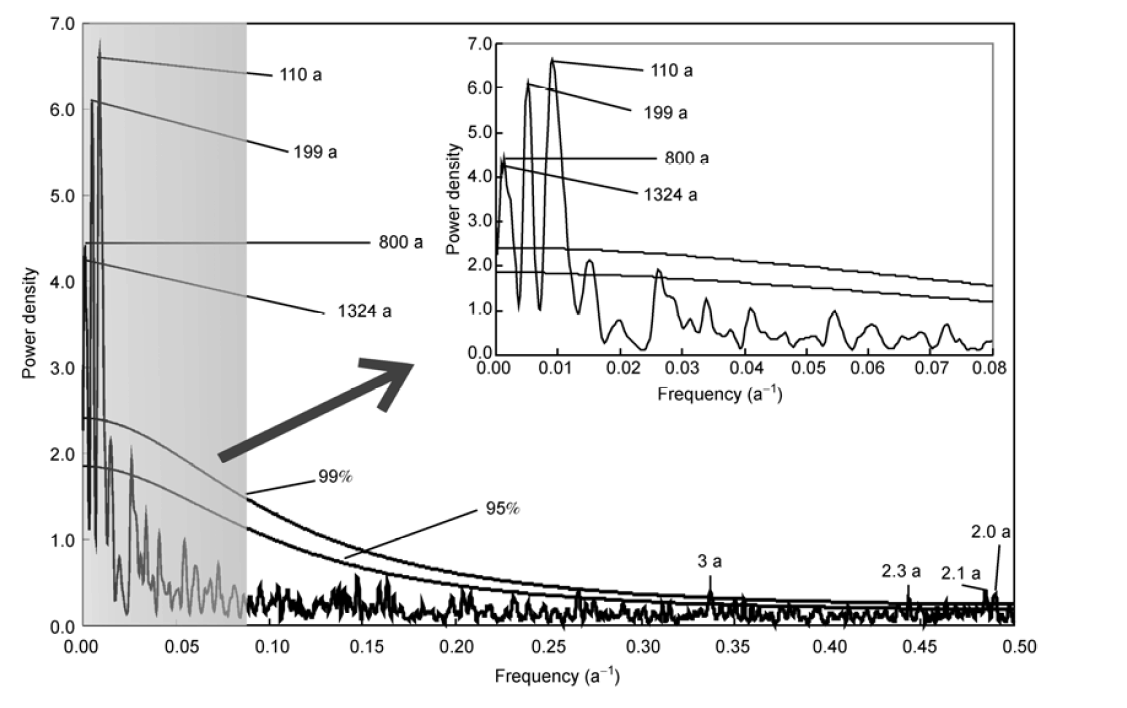 Figure 2 Power spectrum analysis of the 2485-year temperature series. (Click to enlarge)
…
 Figure 3 Millennium-scale cycle in the temperature variation during the last 2485 years. (Click to enlarge)
…
 Figure 4 Decomposition of the main cycles of the 2485-year temperature series on the Tibetan Plateau and periodic function simulation. Top: Gray line,original series; red line, 1324 a cycle; green line, 199 a cycle; blue line, 110 a cycle. Bottom: Three sine functions for different timescales. 1324 a, red dashed line (y = 0.848 sin(0.005 t + 0.23)); 199 a, green line (y = 1.40 sin(0.032 t – 0.369)); 110 a, blue line (y = 1.875 sin(0.057 t + 2.846)); time t is the year from 484 BC to 2000 AD. (Click to enlarge)
…
…
Conclusions
Climate events worldwide, such as the MWP and LIA, were seen in a 2485-year temperature series. The largest Figure 6 Temperature comparison between the forecast and observation data taken from seven stations on the central-eastern Tibetan Plateau (seven stations: Delingha, Dulan, Golmud, Lhasa, Nagqu, Dachaidan and Bange). amplitude and rate of temperature both occurred during the EJE, but not in the late 20th century. The millennium-scale cycle of solar activity determined the long-term temperature variation trends, while century-scale cycles controlled the amplitudes of temperature. Sunspot minimum events were associated with cold periods. The prediction results obtained using caterpillar-SSA showed that the temperature would increase until 2006 AD on the central-eastern Plateau, and then decrease until 2068 AD, and then increase again. The regularity of 600-year temperature increases and 600-year decreases (Figure 3) suggest that the temperature will continue to increase for another 200 years, since it has only been about 400 years since the LIA. However, a decrease in temperature for a short period controlled by century- scale cycles cannot be excluded. Obviously, solar activity has greatly affected temperature on the central-eastern Plateau. However, there are still uncertainties in our understanding of climate change, and the concentration of CO2 affects the climate. Further investigations are thus needed. –
————————–
REFERENCES
Liu Y, Cai Q F, Song H M, et al. Amplitudes, rates, periodicities and causes of temperature variations in the past 2485 years and future trends over the central-eastern Tibetan Plateau. Chinese Sci Bull, 2011, 56: 29862994, doi: 10.1007/s11434-011-4713-7 [ Climate Change over the Past Millennium in China.] … Hat Tip: Geoffrey Gold.
This will either be a resounding blow to AGW or “Chinagate”. We’ll see as the dust clears. This paper will be beaten to a pulp or become an icon or both.
The fact that the SAME pattern emerges from analysis of the CET data and others have found some of the same patterns in yet OTHER data http://hockeyschtick.blogspot.com/2010/04/more-on-60-year-climate-cycle.html says there is something to this.
Can someone run an analysis on the Blue Hill Observatory record?
http://www.bluehill.org/climate/anntemp.gif
The science is unsettled (ing).
The Other Jeff says:
December 8, 2011 at 9:13 am
“But actually, it’s a correct argument. Fourier spectral analysis assumes that the data record for the window size represents a periodic function with mean value c_0. It therefore excludes by assumption the possibility that mean temperature could change to some other value outside that window. It assumes that climate — long term climate — does not change over the window.”
Well said. Surely, one thing everyone should have learned from the Hockey Stick nightmare is that tree ring width is not a linear function of temperature. Yet everyone calling himself a climate scientist proceeds as if it were. Climate science rests on a Uniformitarianism, the assumption that nature is uniform, that has not been practiced by genuine scientists since at least the 18th century.
Pardon me for being very direct, but something very important about statistics needs to be understood by all. You cannot go out and collect measurements of whatever, fail to do the empirical work that shows that the individual measurements are sound, then expect your statistical work to make up for the empirical work that you did not do. The principle is parallel to GIGO. I recommend calling the principle “NEINO” for “non-empirical in non-empirical out.”
Tree rings?
Meh.
Tree rings measure only June/July temperatures. Maybe THOSE peaked in THAT location earlier. A tree ring series in one region can not give a signal for GLOBAL climate, only the climate in that location and only for June and July. There is still room for regional variation due to changes in storm track, etc. Also it could be there was a rainfall anomaly prior to 1000. One thing I have learned is that the ITCZ and monsoon rains tend to also track with the LIA (and MWP). So it could well be that they got increased precipitation in that location before the MWP temperatures peaked. But the fact remains that the SAME signal(s) in those data appear in other data as well.
commieBob says:
“There are lots of proxies. They don’t agree very well. Don’t get your shirt in a knot by trying to read too much into them. Historical evidence and proxies tell us that there probably was a Medieval Warm Period. It may have been warmer than it is now. That’s all we can say with much confidence.”
The medieval warm period cannot be in different periods. Otherwise it isn’t a medieval warm *period*.
If we have one graph with a warm period from 800AD-1000AD and another with a warm period from 1000AD-1200AD they can’t both be cited as supporting a single “medieval warm” period. Yet that’s exactly what the CO2science site does.
crosspatch says” “Tree rings measure only June/July temperatures. Maybe THOSE peaked in THAT location earlier”
What if the two periods simply weren’t warm at the same time? Ie no global medieval warm period.
The same analysis was run on a THERMOMETER series in the UK with the same result. See the link in the early comments … nevermind, I’ll post it here:
http://www.vukcevic.talktalk.net/CET-NVa.htm
crosspatch says:
December 8, 2011 at 11:10 am
……..
Tree rings measure only June/July temperatures. …….
Tree rings do not ‘only measure temperatures’.
All tree rings show is the growth rate of the tree over that year. Provide water, nutrients, sun and a slightly cooler temperature – and you get a nice fat tree ring. Provide drought, low nutrients, obscured sun and hot temperatures – and you get an emaciated tree ring.
A challenge – run the validation experiment I proposed above (http://wattsupwiththat.com/2011/12/07/in-china-there-are-no-hockey-sticks/#comment-822884 ) show that it is possible to quantify the annual average temperatures accurate to 1 degC using tree rings using a double blind protocol. If the experiment shows that it is not possible to quantify temperatures from tree rings, then all papers using tree rings as proxies for temperatures should be withdrawn.
This is what scientists and engineers would do.
crosspatch says:
December 8, 2011 at 11:10 am
…..
Re MWP (pre- and post 1000)
According to Loehle (and Ljungqvist) MWP had two peaks, one around 900 and the other some 100 years later.
http://www.vukcevic.talktalk.net/LL.htm
“Explain that one skeptics”.
But the best thing about climate science is, you don’t have to explain anything!
Cherry picking is also legitimate. Hockey Stick or Tibet, have to think about that one. I asked Ted, our Tibetan terrier, but he went for option 3, the sausage.
If they release their data and source code perhaps that will encourage Phil to have another look on his desk.
I think there’s a cut-and-paste error. Instead of
“The largest Figure 6 Temperature comparison between the forecast and observation data taken from seven stations on the central-eastern Tibetan Plateau (seven stations: Delingha, Dulan, Golmud, Lhasa, Nagqu, Dachaidan and Bange). amplitude and rate of temperature both occurred during the EJE, but not in the late 20th century.”
I think it should read
“Figure 6 Temperature comparison between the forecast and observation data taken from seven stations on the central-eastern Tibetan Plateau (seven stations: Delingha, Dulan, Golmud, Lhasa, Nagqu, Dachaidan and Bange). ”
and
“The largest amplitude and rate of temperature both occurred during the EJE, but not in the late 20th century.“
This analysis was also done with the temperature record from the UK (CET) with the same results. It is not just tree ring data that shows these cycles. See the link early in the comments.
Liking the results is no reason for accepting the logic.
I’m very wary of temperature proxies, especially tree rings. I think that any part of the findings should be regarded with extreme caution unless there is at least a known mechanism and independent corroboration.
Thus, for example, when it says in ‘Conclusions’ : “The millennium-scale cycle of solar activity determined the long-term temperature variation trends, while century-scale cycles controlled the amplitudes of temperature.“, there is I think no known mechanism for either of these cycles, so this conclusion has to be treated with extreme caution. I am not even sure what the last part means (it seems to indicate that the century-scale cycles controlled their own or others’ amplitude. If it simply means that cycles were added together and sometimes their peaks coincided, sometimes not, then to my mind it was worded strangely.)
Alan Clark of Dirty Oil-berta says: “It sets-out to destroy the hockey stick“.
I hope it doesn’t, it should just be trying to find out about historical temperature.
Vukcevic,
Doesn’t look like it to me:
http://img709.imageshack.us/img709/4205/loehle3.jpg
nomnom, there is ample evidence of the MWP and LIA, not just in Europe but also in Africa, the Middle East and even South America. The ONLY people that don’t show one is Mann et al.
The now-discredited “hockey team” are the only people on the planet that DON’T show a MWP, they are the outliers.
And we can point to the temperature response since 2000 to show that the analysis apparently does have some predictive pattern. The tree ring survey does not contain data for those years yet the resulting waveform accurately depicts what we see in actual observations. In other words, unlike the now-discredited hockey stick hypothesis, this output is validated by actual observational data.
Dear nomnom,
Are you trying to defend the accuracy of proxies? Good luck with that.
nomnom says:
December 8, 2011 at 12:27 pm
……….
Nonsense! Graph I linked is directly from Dr. Loehle’s data file. No idea what you graph is.
http://www.vukcevic.talktalk.net/LL.htm
Here is data file I uploaded for you or anyone else, plot it yourself and than come back.
data: http://www.vukcevic.talktalk.net/L.txt
crosspatch says:
“nomnom, there is ample evidence of the MWP and LIA, not just in Europe but also in Africa, the Middle East and even South America. The ONLY people that don’t show one is Mann et al.”
The original hockey stick showed the period 1000AD-1200AD to be about 0.2C warmer than the little ice age and Mann 2008 puts it at about 0.4C, hence it did show a medieval warm period. It just wasn’t as warm as some people wanted/assumed.
nomnom,
Your chart shows global temperature going up a full degree Centigrade in a short time. Where did that chart come from?
Matt says:
December 7, 2011 at 11:48 pm
Does Bull stand for bulletin or bullshit? – I mean, where’s the magic word? Is it peer reviewed, is this a respected publication outside China? You were furious about Muller, obviously, because you didn’t like the conclusion. And now? Obviously, this time you like the conclusion – but what about peer review?
How about using your own brain? And real science. Instead of futilely trying to defend your pre-Enlightenment Postnormal Religion? Muller concludes everything and he concludes nothing, by his own admission. “Perception is reality”, as usual.
Communism never works, Boy. The Chinese know that, or at the least that they shouldn’t use your “fear and trembling” energy scarcity scare to achieve your Dear Leader’s hallowed “sickness unto death” Utopia. Do you need “peer review” to know that?
You are the one who stands for fake. Boy. So the real question is, what are you going to do about it?
I have a suggestion for an experiment.
Run your analysis on CET only to 1990. Now plot the composite wave and continue it past 1990. Now plot on that composite only temperatures AFTER 1990 which were not part of the analysis. That should give some idea of any predictive skill. Now do the same for another record. I suggested the Blue Hill Observatory as it is the longest continuous record and it was done by skilled observers. It would be the record I would put most trust in for accuracy in the US.
Another note about these cycles: depending on what their activation mechanism is, they could show different (or opposite) response depending on their location. Lets imagine there was some correlation with Markowitz Wobble (a roughly 30 year cycle). This would be expected to show up most strongly in records the farther North one goes as it would potentially have more impact on insolation in the North than in the tropics. So the relative strength of the various signals can vary according to region of the planet. If there is movement of weather patterns such as the ITCZ with the 800 year cycle, it might have a profound impact in one area and much less (or opposite) in another.
So the energy distribution among the various cycles found might be different in different regions (or even hemispheres) of the planet and the cycles could be out of phase between locations. This is one reason I do not favor creating ensemble sets where several data sources are added to create a composite. I would rather favor running the analysis on individual data sources and comparing the result. If you create an ensemble and attempt to run the composite signal of that ensemble through a “notch” filter to obtain, say, the 60 year cycle, maybe that doesn’t work if the signal is there but out of phase between members of the ensemble and they cancel. A slight shift of the monsoon can have a rather dramatic impact, particularly in mountainous areas with rather severe “rain shadows”. Growing conditions can suddenly vary considerably between two locations what are not separated by very much geographical distance and would be more of a topographical consequence of the change than anything else. So the same cycle may be there but out of phase. If I attempt to add the two data sets together, the signals might cancel to some extent and suppress the actual manifestation strength of the signal.