 Reposted from Jo Nova’s site
Chinese 2485 year tree ring study shows shows sun or ocean controls climate, temps will cool til 2068
A blockbuster Chinese study of Tibetan Tree rings by Lui et al 2011 shows, with detail, that the modern era is a dog-standard normal climate when compared to the last 2500 years. The temperature, the rate of change: it’s all been seen before. Nothing about the current period is “abnormal”, indeed the current warming period in Tibet can be produced through calculation of cycles. Lui et al do a fourier analysis on the underlying cycles and do a brave predictions as well.
In Tibet, it was about the same temperature on at least 4 occasions — back in late Roman times — blame the chariots, then again in the dark ages — blame the collapse of industry; then in the middle ages — blame the vikings; in modern times — blame the rise of industry. Clearly, these climate cycles have nothing to with human civilization. Their team finds natural cycles of many different lengths are at work: 2-3 years, 100 years, 199 years, 800 years, and 1324 year. The cold periods are associated with sunspot cycles. What we are not used to seeing are brave scientists willing to publish exact predictions of future temperatures for 100 years that include rises and falls. Apparently, it will cool til 2068, then warm again, though not to the same warmth as 2006 levels.
On “tree-rings”
Now some will argue that skeptics scoff at tree rings, and we do — sometimes — especially ones based on the wrong kind of tree (like the bristlecone) or ones based on small samples (like Yamal), ones with abberant statistical tricks that produce the same curve regardless of the data, and especially ones that truncate data because it doesn’t agree with thermometers placed near airconditioner outlets and in carparks. Only time will tell if this analysis has nailed it, but, yes, it is worthy of our attention.
Some will also, rightly, point out this is just Tibet, not a global average. True. But the results agree reasonably well with hundreds of other studies from all around the world (from Midieval times, Roman times, the Greenland cores). Why can’t we do good tree-ring analysis like this from many locations?
Jo
Amplitudes, rates, periodicities and causes of temperature variations in the past 2485 years and future trends over the central-eastern Tibetan Plateau [Chinese Sci Bull,]
 Figure 5 Prediction of temperature trends on the central-eastern Tibetan Plateau for the next 120 years. Blue line, initial series; orange line, calibration series, 464 BC–834 AD; purple line, verification series, 835–1980 AD; red line, forecasting series, 1980–2134 AD. (Click to enlarge)
There are beautiful graphs. Have a look at the power spectrum analysis and the cycles below…
ABSTRACT:
Amplitudes, rates, periodicities and causes of temperature variations in the past 2485 years and future trends over the central-eastern Tibetan Plateau
Amplitudes, rates, periodicities, causes and future trends of temperature variations based on tree rings for the past 2485 years on the central-eastern Tibetan Plateau were analyzed. The results showed that extreme climatic events on the Plateau, such as the Medieval Warm Period Little Ice Age and 20th Century Warming appeared synchronously with those in other places worldwide. The largest amplitude and rate of temperature change occurred during the Eastern Jin Event (343–425 AD), and not in the late 20th century. There were significant cycles of 1324 a, 800 a, 199 a, 110 a and 2–3 a in the 2485-year temperature series. The 1324 a, 800 a, 199 a and 110 a cycles are associated with solar activity, which greatly affects the Earth surface temperature. The long-term trends (>1000 a) of temperature were controlled by the millennium-scale cycle, and amplitudes were dominated by multi-century cycles. Moreover, cold intervals corresponded to sunspot minimums. The prediction indicated that the temperature will decrease in the future until to 2068 AD and then increase again.
…
Figure 1 Tree-ring-based temperature reconstruction for the central-eastern Tibetan Plateau during the past 2485 years (gray line), the 40-year moving average (thick black line) and the 40-year running standard deviation (thin black line); the horizontal line is the mean temperature for the 2485 years. (Click to enlarge)
…
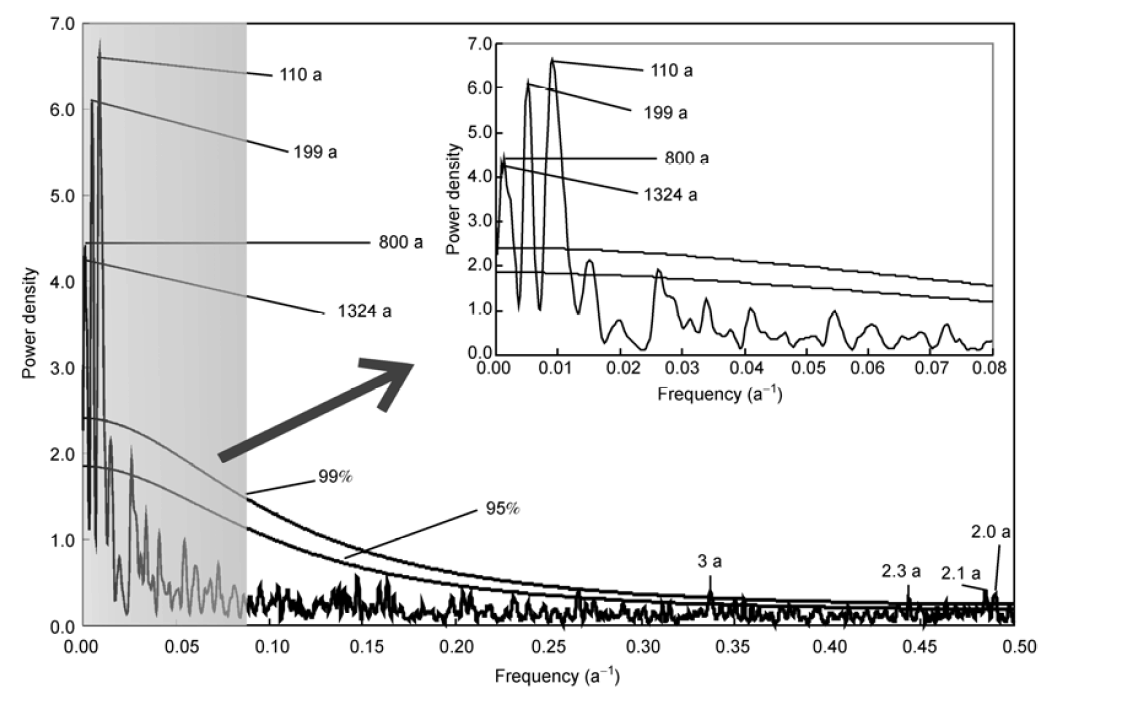 Figure 2 Power spectrum analysis of the 2485-year temperature series. (Click to enlarge)
…
 Figure 3 Millennium-scale cycle in the temperature variation during the last 2485 years. (Click to enlarge)
…
 Figure 4 Decomposition of the main cycles of the 2485-year temperature series on the Tibetan Plateau and periodic function simulation. Top: Gray line,original series; red line, 1324 a cycle; green line, 199 a cycle; blue line, 110 a cycle. Bottom: Three sine functions for different timescales. 1324 a, red dashed line (y = 0.848 sin(0.005 t + 0.23)); 199 a, green line (y = 1.40 sin(0.032 t – 0.369)); 110 a, blue line (y = 1.875 sin(0.057 t + 2.846)); time t is the year from 484 BC to 2000 AD. (Click to enlarge)
…
…
Conclusions
Climate events worldwide, such as the MWP and LIA, were seen in a 2485-year temperature series. The largest Figure 6 Temperature comparison between the forecast and observation data taken from seven stations on the central-eastern Tibetan Plateau (seven stations: Delingha, Dulan, Golmud, Lhasa, Nagqu, Dachaidan and Bange). amplitude and rate of temperature both occurred during the EJE, but not in the late 20th century. The millennium-scale cycle of solar activity determined the long-term temperature variation trends, while century-scale cycles controlled the amplitudes of temperature. Sunspot minimum events were associated with cold periods. The prediction results obtained using caterpillar-SSA showed that the temperature would increase until 2006 AD on the central-eastern Plateau, and then decrease until 2068 AD, and then increase again. The regularity of 600-year temperature increases and 600-year decreases (Figure 3) suggest that the temperature will continue to increase for another 200 years, since it has only been about 400 years since the LIA. However, a decrease in temperature for a short period controlled by century- scale cycles cannot be excluded. Obviously, solar activity has greatly affected temperature on the central-eastern Plateau. However, there are still uncertainties in our understanding of climate change, and the concentration of CO2 affects the climate. Further investigations are thus needed. –
————————–
REFERENCES
Liu Y, Cai Q F, Song H M, et al. Amplitudes, rates, periodicities and causes of temperature variations in the past 2485 years and future trends over the central-eastern Tibetan Plateau. Chinese Sci Bull, 2011, 56: 29862994, doi: 10.1007/s11434-011-4713-7 [ Climate Change over the Past Millennium in China.] … Hat Tip: Geoffrey Gold.
There has just GOT to be better thermometers out there than tree rings.
bill says:
December 8, 2011 at 12:05 am
Why have the Chinese decided to issue this particular set of lies at this particular time?
If you convert the positive trends to 1s and the negative trends to 0s and feed it through an astable trigger and thyristor driving your christmas lights you get a beautiful display!
“I am a scientist, and I know nothing about politics. But the climate- change debate, in my opinion, has more political significance than scientific. Diplomats can sit at negotiating tables talking about carbon caps while scientists have not reached an agreement on the role of carbon dioxide in global warming. But political decisions must be based on sound scientific foundation, or they will be useless, if not dangerous.”
Yup. That does sound like a scientist.
Certainly doesn’t sound remotely like Meltdown Mann.
In the Conclusion: “However, there are still uncertainties in our understanding of climate change, and the concentration of CO2 affects the climate.”
Too bad they felt that they had to mention a trace gas that has every indication of cooling climate rather than warming, if it has any detectable effect at all.
Robert Brown says: “To which I would add that the FT of a 2400 timeseries is going to be dominated by modes with period 2400, 1200, 800, 600, 400… very nearly a priori — you’d have to have a rather special curve (one orthogonal to these modes by construction) in order for this NOT to be so.”
FT would be useless if all it did was “find” subdivisions of the sample length. And the sample length is 2485, not 2400, and the full-length ‘cycle’ is definitely absent. It does contain cycles of 50, 37, and 30 years. Yes, chaotically trending (i.e. not white noise) data will generate false cycles that cease to maintain into the future – hence your stock market remark. The question is then, are these cycles false or are they real cycles being detected? If climate is a combination of both cyclic (e.g. PDO) and non-cyclic (e.g. volcano eruptions) events, then we might expect some of these cycles to be robust to a reanalysis of subsections of the data, whilst others should destabilise. In any event, your warning about the possibility of (but not the necessity of) artifacts is correct, and some of these cycles almost must be artifacts for physical reasons (the existence of non-periodic climate influences). I doubt that the prediction will come true to any degree of precision, although there are other physical reasons to expect some cooling.
Observer says:
December 8, 2011 at 4:25 am
Thanks for posting that fascinating interview, it’s in sharp contrast to Mann’s recent letter in the WSJ. Has anyone seen something similar from Mann where he focuses on or explains the science, and not simply claim he is right?
“Now some will argue that skeptics scoff at tree rings, and we do — sometimes — especially ones based on the wrong kind of tree (like the bristlecone) or ones based on small samples (like Yamal), ones with abberant statistical tricks that produce the same curve regardless of the data, and especially ones that truncate data because it doesn’t agree with thermometers placed near airconditioner outlets and in carparks. Only time will tell if this analysis has nailed it, but, yes, it is worthy of our attention.”
Skeptics would be foolish indeed if they bought the simple minded claim that measuring tree ring width, or any other proxy, can tell us what temperatures have been for thousands of years. The reason is that proxy work has been non-empirical. No one does empirical study on the proxy item to determine how it changes under various environmental conditions. What must be done if proxies are to be used is that experiments must be conducted on individual proxies to determine their rate of change as various important elements of their environment changes. Anything less is non-empirical. Anything less is whistling by the graveyard. Briffa whistled by the graveyard and when his tree rings diverged from what he expected he was left entirely flat footed not knowing what had caused the divergence. Surely, this trap for the non-empirical scientist is clear as crystal and need not be debated again.
Non-empirical proxy studies invite confirmation bias. Some climate scientists justify their claim that their proxies measure only temperature by selecting trees at the treeline of mountains. Then they say that the other variables have been minimized so only temperature is a variable and their study is objective. Is it not obvious that what they have done in fact is select proxies that maximize the impact on the study of the variable that they had predetermined to be most important, temperature, and minimized all other variables. That is confirmation bias writ large.
MOre BBC lies
http://www.bbc.co.uk/news/science-environment-16081214
Male Polar bears always kill errant young ones – similar to lions. There is nothing new here but it fits the disgraceful lies that Polar Bears are threatened.
Pravda or Hitler would be proud.
[Moderator’s Note: Jeremy, this is off-topic for this thread. Next time please submit to Tips and Notes. -REP]
Peter Plail says:
December 8, 2011 at 1:36 am
“Whether or not tree rings are a good proxy for temperature, they are a precise indicator of conditions which are beneficial for tree growth. From this it would not be difficult to conclude that those conditions have a similar impact on other plant growth, including food crop yields.”
Only one is needed. Human management is incredibly beneficial for tree growth and it can be effective even when the climate has turned sour for plant growth in general.
very interesting graph in that it shows the LIA was not a regional phenomenon, but global, as Tibetian trees were effected in some ways. We don’t know if the effect was temps, precipitation, or other, but there was an effect during that period of time. This disproves the “Team” assertion that the LIA was regional and therefore not useful in discussing AGW. Just another nail in the coffin of credibility for the Team.
“Kasuha says:
December 7, 2011 at 10:51 pm
Fourier analysis on time series may be a lot of fun but until physical background of identified cycles is demonstrated it’s not more than just playing with numbers with zero predictive potential.”
I believe you have this backwards. Science historically has predicted based on observation of repeatable cycles long before the cause was known. For example, people learned to predict the cycle of the seasons long before they learned the cause was the orbital tilt of the earth.
Modern science needs to take a lesson from the past. We still don’t know the cause of gravity but we can predict the effects very well. What matters in science is prediction. Only after you have demonstrated that you can predict can you claim to know the cause.
Even then, the cause of any event is subject to debate as new discoveries are made. There are still an infinite number of scientific discoveries waiting to be made. The tilt of the earth’s axis causes our seasons, but why is the axis of the orbit tilted? Isn’t the answer to that question the real cause of our seasons? Or was it the event that caused the event that caused the axis to be titled? Peel back the skin of an onion and you have another onion waiting to be peeled.
“Beesaman says:
December 8, 2011 at 4:28 am
If that is the best that Western science can give us then maybe we deserve the decline in the West that is happening.”
Climate science is not science. It is advocacy, politics and business wrapped in the garments of science. In this case CO2 has been used as a bogey man to frighten the masses into parting with the fruits of their labors to advance the interests of the groups involved. Data that would suggest that CO2 may not be a problem has been actively suppressed, as shown by the climategate emails.
Robert Brown says:
December 8, 2011 at 4:54 am
There is a little-known paper by Demetris Koutsoyiannis called “Nonstationarity vs scaling in hydrology”
==========================
The Koutsoyiannis paper seems to be available here: http://dx.doi.org/10.1016/j.jhydrol.2005.09.022 although the link doesn’t seem to match file name 2005JoHNonStatVsScalingPP.pdf I ended up with. If anyone has trouble, try clicking on the link in the web page at http://itia.ntua.gr/en/docinfo/673/
I haven’t read it all yet, but 30 pages — including graphics — seem to be present
Observer @ur momisugly 4:25 AM.
Thank you very much for the interview with Liu Yu.
=============
JJThoms says:
December 8, 2011 at 4:48 am
Do Chinese tree rings track local temps (unlike Russian ones)?”
What a statement – boils down to: I believe that data – is that data valid !!!!!! all in a couple of lines!
Magically treemometers are accurate in China but just garbage when in Russia.
Wow.. Just Wow!
~~~~~~~~~~~~~~~~~~~~~~~~~~~~~~~~~~~~~~~~~~~~~~~~~~~~
and Observer says: (Quoting an interview…..)
Can tree-ring records tell us anything about the future? Our results show that the temperature continued to increase until 2006, and will now decrease until about 2068. After 2068, the temperature will increase again until 2088.
======================================================
JJ is correct. I take little comfort in treemometers that kinda sorta tell us what we already knew. In our zeal to believe this treemometer reading extraordinaire, someone should actually check the veracity of his statement. Now, I haven’t looked at local Tibetian temps, so maybe that’s what he’s referring towards in his oddly specific prediction/backcast. 2007 was warmer than 2006…… 2010 treemometer data was probably not available…..so, there’s that….
Can anyone tell me how we come to a reasonable assumption of what the low temps were while looking at the tree rings? Is there a negative ring growth which I’m not aware of? You see, when determining a mean like this, you need at least two numbers…. a high value AND A LOW! How does a tree ring determine the difference between 0°F and -40°F? It’s nothing but WAG. And we’re suppose to believe it was precisely 54.3° precisely 720 years ago. Whatever……
All it needs is to be replicable. Show the homework so others can see what was done. You know, …. how science works. Then we go from there.
OB-I think SM and JI would apply the same intellectual rigour to this paper that is extended in all of their endeavours. If you don’t think they are motivated by scientific curiosity and honest intention to extend knowledge then you haven’t not been reading much. If this paper is crap, they will say so.
Boy, China was hit hard by the LIA and it was a long struggle to recover. I would think that nobody would want to see that again. Yet many bemoan and tear at their hair at such climate change. Bizarre! GK
Observer says: December 8, 2011 at 4:25 am
……………..
Do you think your research will help Beijing gain ground in climate negotiations? “I am a scientist, and I know nothing about politics. But the climate- change debate, in my opinion, has more political significance than scientific. Diplomats can sit at negotiating tables talking about carbon caps while scientists have not reached an agreement on the role of carbon dioxide in global warming. But political decisions must be based on sound scientific foundation, or they will be useless, if not dangerous.”
The money quote from Dr. Yu.
Significant in the Chinese finding is that the MWP and LIA were not confined to northern Europe as the hockey team and IPCC have repeatedly claimed.
Just last week I did a thorough study reconstructing CET to 1538 from Historic records and comparing the results to Mann and Lamb.
http://judithcurry.com/2011/12/01/the-long-slow-thaw/
There are many good reasons why tree rings should not be seen as anything more than a general indicator of the growing conditions, including the fact that they only record any sort of signal during the growing season and a mean average accurate to fractions of a degree is impossible to discern.
Just because we want to believe this study doesn’t mean it has any more credibility or accuracy than the Studies by Dr Mann et al.
tonyb
Great story. But:
“do a brave predictions as well.”
Please correct.
This would explain why my kid’s hockey team beat a Chinese team pretty soundly last summer at a Huntington Beach tournament.
All that is needed now is to ring the data through Manniac’s computer model and we will end up with a hockey stick that ends going back in time.
I agree that Fourier Analysis can be quite misleading when you are dealing with something other than a continuous signal. Having said that, their highest amplitude signal has a period of 110 years. It repeats 22 times in the 2500 year window. The second highest amplitude signal is 199 years which repeats 12 times in the window. They probably aren’t spurious.