UPDATE: New graphs from David Archibald added. See below.
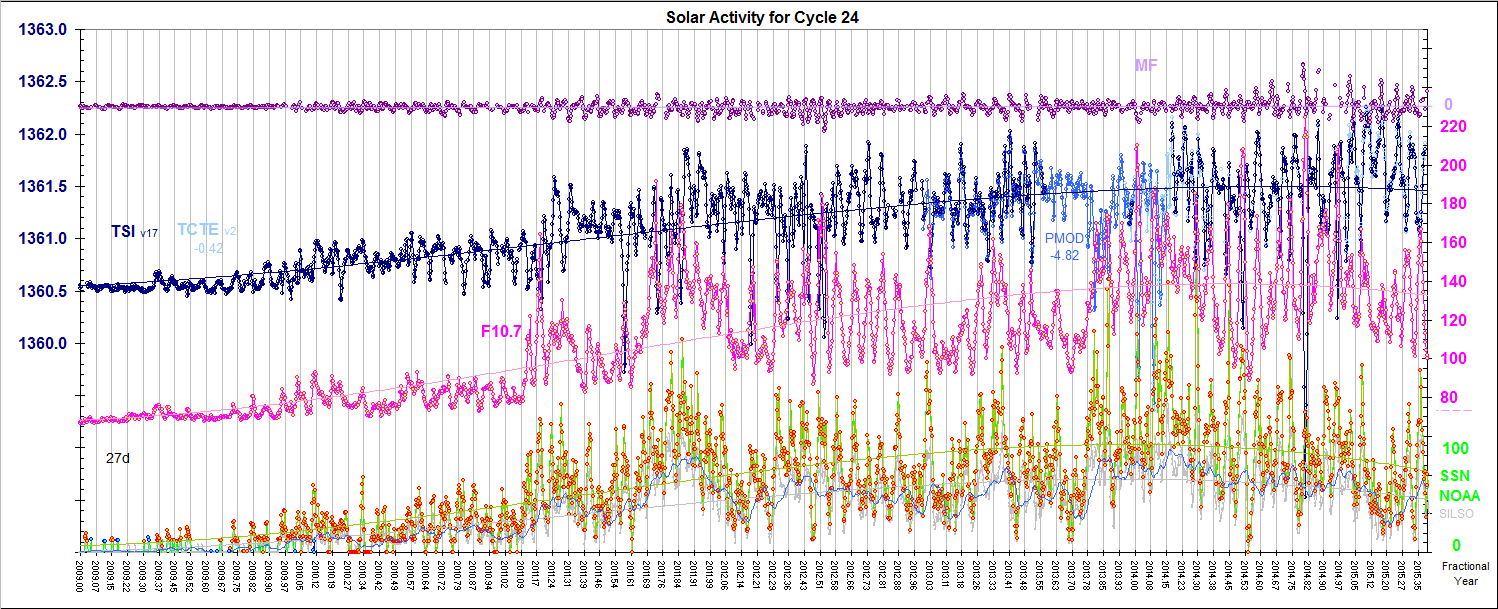
The NOAA Space Weather Prediction Center (SWPC) has released their latest charts on solar activity and the news is not encouraging for solar watchers. Today, the sun has but a couple of anemic “sunspecks”.

Last month I wrote about how May had not continued the advances seen in March and April. Now according the the latest SWPC graphs of the three major metrics of solar activity, June appears to have slipped even further.


I see NASA’s Hathaway making another adjustment to his forecast soon. He wrote on July 1st:
The current prediction for Sunspot Cycle 24 gives a smoothed sunspot number maximum of about 69 in June of 2013. We are currently over two and a half years into Cycle 24. Three consecutive months with average daily sunspot numbers above 40 has raised the predicted maximum above the 64.2 for the Cycle 14 maximum in 1907. The predicted size would make this the smallest sunspot cycle in over 100 years.
More near real-time information on the state of the sun is available on our WUWT solar reference page
UPDATE: My friend in Perth, David Archibald, sends along this information.
Solar Update July 2011
Now that the UK Met Office is half way to admitting that solar activity is the main driver in climate, it is appropriate to check up on how the Sun is going.

Two and a half years after solar minimum, the Ap Index remains below the minima of previous solar cycles.

Dr Svalgaard provides a useful daily update on the F 10.7 flux at http://www.leif.org/research/TSI-SORCE-2008-now.png What the above graph shows is the ramp up of Solar Cycle 24 F 10.7 flux relative to the previous five solar cycles, aligned on the month of minimum. The current cycle has a very flat trajectory.
 Similar to the Ap Index, the Interplanetary Magnetic Field is now up to the levels of previous solar minima.
This chart compares the development of Solar Cycle 24 with the last de Vries cycle event – the Dalton Minimum. The Solar Cycle 24 ramp up in terms of sunspot number is tracking much the same as that of Solar Cycle 5 but about a year ahead of it. All solar activity indications are for a Dalton Minimum repeat. There has been no development that precludes that outcome.

This graph shows the sum of the north and south polar magnetic fields on the Sun. It has yet to get down to the levels of previous maxima, and solar maximum may be still two to three years off.

David Archibald
July 2011
Discover more from Watts Up With That?
Subscribe to get the latest posts sent to your email.
Jimbo says:
July 10, 2011 at 5:23 pm
R. Gates,
The “Maunder type minimum” occured during the Little Ice Age, it did not cause the LIA.
______
How can you be so sure that solar influences didn’t play a causal role in the LIA? Not perhaps the only role, as we know there were volcanic eruptions, but a causal role at some level It seems that even the much beloved Michael Mann and Gavin Schmidt have come to this conclusion (no doubt much to the surprise of many AGW skeptics, who fail to grasp the bigger issues). In a 2001 paper (http://www.sciencemag.org/content/294/5549/2149.full.pdf) they wrote:
“These results provide evidence that relatively
small solar forcing may play a significant
role in century-scale NH winter climate
change. This suggests that colder winter temperatures
over the NH continents during portions
of the 15th through the 17th centuries
(sometimes called the Little Ice Age) and
warmer temperatures during the 12th through
14th centuries (the putative Medieval Warm
Period) may have been influenced by longterm
solar variations.”
Does this surprise some skeptics? I suppose it would if they’d not done their research to understand that solar influences have never been excluded from having an effect on earth’s climate by all climate scientists. The real issue is the point at which anthropogenic factors overwhelm the natural sources of variability such as the sun and even Milankovitch cycles.
rbateman says:
July 10, 2011 at 8:10 pm
jtom says:
July 10, 2011 at 6:07 pm
You misunderstood, my bad. The Sun is only out of the picture for warming the Arctic during Winter.
The question should be: Do we have solid evidence that the Sun is responsible for shoving the Jet Streams toward the Equator?
____
Of course such evidence would be hard to come by but plenty of plausible mechanisms in the effects of high energy UV on stratospheric ozone and the jet stream. This is one excellent source of investigation:
http://www.sciencedirect.com/science/article/pii/S1364682604001798
And of course, high energy UV have a great deal more variability during the course of a solar cycle than other parts of the solar output spectrum.
I’ve been trying to wrap my head around the claim that a warmer MWP means a higher “climate sensitivity” (CS) that supports the CAGW agenda. The SteveF reference helped (thanks, Mosh!), and I understand that for a forcing of known magnitude, the greater the net temperature response the greater the CS.
But for the claim about the MWP to be true,
1. Don’t we have to know the magnitude of all the forcings for the MWP?
2. If so, do we?
BTW, I’m awfully skeptical about calculating CS from history/prehistory, given the uncertainties in temperature and “forcings” reconstructions, but if the alarmists are pushing this point…
Hoser says:
July 9, 2011 at 6:26 pm
SSN 67, SFI 91.
Stephen Wilde says:
July 10, 2011 at 6:38 am
John Finn.
The average global temperature doesn’t change much because the system response is always negative for any forcing whether towards warming or cooling.
I’m not sure how you explain the glacial/interglacial periods then.
John Finn asked:
“I’m not sure how you explain the glacial/interglacial periods then.”
The solar insolation changes from glacial to interglacial epochs are much larger than those seen during an interglacial and so are sufficient to establish a new equilibrium temperature despite the negative system response.That equilibrium temperature is always a function of solar shortwave input to the oceans, atmospheric pressure and the latent heat of vaporisation. However internal ocean cycles will influence the timing of the shift between glaciations and interglacials.
The negative system responses are only able to eliminate/minimise forcing influences other than long term net changes in solar shortwave input to the oceans or changes in atmospheric pressure. The latent heat of vaporisation is always a constant for a specific atmospheric pressure.
Steve Mosher linked to http://rankexploits.com/musings/2011/a-simple-analysis-of-equilibrium-climate-sensitivity/
Steve, that post SteveF points out a few weaknesses in his approach. However he leaves out the biggest one of all which is that sensitivity depends almost completely on the distribution of water vapor. If water vapor is evenly distributed, then sensitivity will be high. If not it will be low (as low as negative feedback to warming). You are SteveF and many other people are hung up on the radiation is fungible concept. It is, but it is irrelevant. The radiative forcing of GHGs as a whole depends on what happens with water vapor.
Mosh, that’s a nice link up above, but unfortunately comments are closed. Here’s one problem, in the thread KAP says “In other words, storms and rainfall are more intense when they happen,
but not necessarily more frequent.” The first statement is supported, the second is not. The reason KAP throws in that unsupported disclaimed is because s/he knows that a world with more frequent (intense or not) precipitation events is a world with negative feedback to CO2 warming. The deciding factor is not “clouds feedback”, KAP’s (and other people’s) red herring. It is the distribution of water vapor. If water vapor is spread out evenly, then that will provide a lot of additional warming over the CO2 warming. If not, it won’t.
R. Gates says:
July 9, 2011 at 11:09 am
on a decade to decade basis, global temps continue to rise.
—
Please let me know when that starts.
But here’s the larger point: Global Climate models, while far from perfect, have accurately predicted some of the earliest effects of increased CO2, namely the decline of Arctic sea ice and general warming of the Arctic.
—
GCM’s haven’t accurately predicted anything.
Let’s hope for the best and prepare for the worst.
Not sure if this has been mentioned.
But I believe that current science does not actually know if the Earth itself is a net heatsink or heat source.
Given the occurence and reality of activty volcanic and other geothermal activity ‘beneath the waves’ of oceans worldwide there might be reason to consider their collective impact on ‘climate’.
Do such volcanoes impact Artic ocean ice, how about general ocean heat? Do we have any appreciable history that reflects this activity (of course not, even with current science it is not possible, especially considering the vastness of all sub-ocean volcano activity – we have no ability to monitor it in any manner beyond one vent here and there).
Just another forcing that I am sure GCMs cannot fully comprehend.
It’s so entertaining watching the climate boffins clutch at reasons for why there’s been no warming since 1998. Aerosol emission by Chinese coal is my favorite so far.
Tracking the area of umbra for SC24: http://www.robertb.darkhorizons.org/TempGr/uSC24vs13_14.GIF
Tracking the butterfly of SC24, with spots containing umbra in red, and those without umbra in blue:
http://www.robertb.darkhorizons.org/TempGr/uvp2324a.PNG
With usual sloppiness, Archibald has an arrow labeled December 2008 pointing to January 2008…