Farm animal disease to increase with climate change
Researchers looked at changes in the behaviour of bluetongue – a viral disease of cattle and sheep – from the 1960s to the present day, as well as what could happen to the transmission of the virus 40 years into the future. They found, for the first time, that an outbreak of a disease could be explained by changes to the climate.
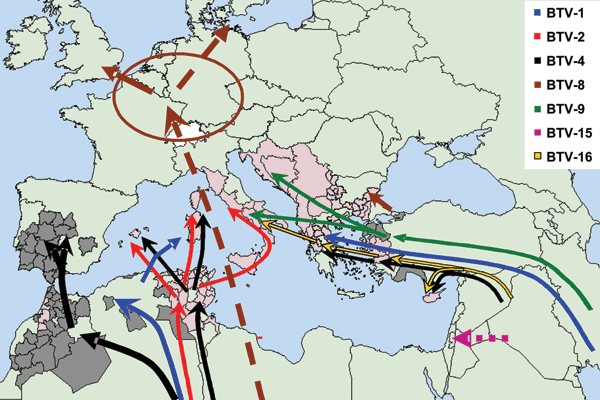
In Europe, more than 80,000 outbreaks of bluetongue were reported to the World Animal Health Organisation between 1998 and 2010, and millions of animals died as a result of the disease. Bluetongue was previously restricted to Africa and Asia, but its emergence in Europe is thought to be linked to increased temperatures, which allows the insects that carry the virus to spread to new regions and transmit the virus more effectively.
Researchers produced a mathematical model that explains how the risk of an outbreak of bluetongue virus in Europe changes under different climate conditions. The team examined the effect of past climate on the risk of the virus over the past 50 years to understand the specific triggers for disease outbreak over time and throughout geographical regions. This model was then driven forwards in time, using predictive climate models, to the year 2050, to show how the disease may react to future climate change.
Using these future projections, researchers found that in northern Europe there could be a 17% increase in incidence of the bluetongue virus, compared to 7% in southern regions, where it is already much warmer.
Professor Matthew Baylis, from the University’s Institute of Infection and Global Health, said: “Previous study suggests that climate change will alter global disease distribution, and although we have significant knowledge of the climate triggers for particular diseases, more research is needed to identify what we think might really happen in the future.
“We have been able to show that the past emergence of a disease can be explained, in both space and time, by changes to recent climate. These results reinforce the belief that future climate change will threaten our health and well-being by causing infection to spread. Looking forward, this could help inform decision making processes on preparing for disease outbreaks and reduce the huge economic impact that farm animal diseases can have on communities.”
The research is published in Proceedings of the Royal Society Interface.
Notes to editors:
1. The University of Liverpool is a member of the Russell Group of leading research-intensive institutions in the UK. It attracts collaborative and contract research commissions from a wide range of national and international organisations valued at more than £110 million annually.
We have allready had BTV outbreak in sweden, in northern europe. Either the insects flew through whole europe and landed in sweden without causing any outbreaks on the way up north or humans brought it here through transports and animals.
I bet a dollar that it was brought here with humans bringing in animals and through transports.
As someone mentioned earlier, the arrows on the map looks just like the paths refugees take to get to europe.
Its really rather scary because this sort of junk gives perfect ammunition for an army of bureaucrats to move in and ‘do something’ or ‘crack-down’ in an effort to justify their jobs/salaries/pensions/comfy offices etc etc – at taxpayer’s expense.
The previous example, of course totally denied by ‘Government,’ was to the Warble Fly.
Admittedly this was a nasty little beast but, the UK Government response forced onto farmers was to dose all cattle with an organo-phosphate insecticide that was absorbed through the animal’s hide. This stuff was/is nerve poison and was (had to be) applied along the animal’s back, all along its spinal cord= where a lot of nerves are and, at a dose that was 20 times the manufacturer’s recommendation then, repeated twice per year (I think – it was slightly ‘before my time’)
Some years later, when those same bureaucrats said it was safe for UK cows to eat the rendered remains of their parents and grandparents, their brains went rotten with Bovine Spongiform Encephalopathy. Surprise!!!!!!!!!!!!!!!!
The response of the Faceless Goons frankly scares the **** out of me, they’re like monkeys with machine guns and this sort of junk is just the ammo they need.
PROPHET: …And the bezan shall be huge and black, and the eyes thereof red with the blood of living creatures, and the whore of Babylon shall ride forth on a three-headed serpent, and throughout the lands, there’ll be a great rubbing of parts. Yeeah…
As a sheep and cattle producer on the south coast of England, I was very worried in 2008 that we would be affected by Bluetongue. It tends to kill sheep dead, pretty well within a few days of infection, but cattle can be infected without showing symptoms or illness. It is cattle which can therefore act as an unseen reservoir of the disease and allows uninfected midges to bite the cattle, pick up the virus and then spread it to other animals. This also allows the virus to “jump” the natural barrier of a harsh winter by residing in a host animal. By 2009 the vaccine manufacturers had got their act together and produced BTV8 vaccine in sufficient quantities to employ a mass vaccination programme for UK farmers. By 2010 the UK had no further outbreaks and this year the UK has been declared a Bluetongue-free zone. Two very cold winters have also helped to kill off reservoirs of over-wintering midges.
The midge which carries the virus is carried on the wind and can therefore jump large natural barriers such as the Meditterranean Sea, the North Sea and the English Channel. Meteorologists therefore play a part in predictions about possible sites of infection (i.e. landing grounds) in south and eastern England, when Bluetongue is present in places like The Netherlands, Belgium, France and northern Germany.
But, as others have already pointed out, there is no direct link between climate change and the change in distribution of the various BTV strains. It is a fact that in Africa, where the disease has been known for a long time, animals’ natural resistance to it is considerable, even amongst sheep. Following classical neo-Darwinist theory, it is therefore an advantage for the virus to evolve (or mutate) to allow it to exploit a naive population. One species of bird that has done this is the Collared Dove, which in the 1920s was unknown outside India. Some time in the 1930’s it jumped the barrier of the Himalayas, and by the early 1950’s arrived to stay in the UK. It is now common in many urban spaces. No-one has so far suggested that this was due to climate change, but give it time and they will, I suppose.
I’ve skimmed the article. I have to admire the authors for making it available to read without hiding it behind a paywall. For which privelege they have had to find £1400. Now, they could have kept it away from skeptics and in the hands of only those in Ivory Towers, but they didn’t, so some credit is due for that.
The model’s weaknesses are several. First of all the vector thrives in mud, so one of the most important climatic variables is going to be rainfall – the when and where of which we don’t know and can’t predict. Second, despite the great complexity of the model (see for example the formula for reproductive ratio under section 2.1 in the article) hides even greater complexity. The midges don’t exist alone in a climate-controlled world, but have predators of their own which might respond in various ways to climate change, as might the dozens of other midge species the vector species compete with. Changes in animal husbandry techniques, & locations where cattle are kept can’t be controlled for.
But the big one is rainfall. I don’t much trust models of temperature change. I have absolutely no doubt that models of rainfall change are as good as a coin toss.
So, hold rainfall steady and put temperature up, isolate the vector from all outside influences, you get a rise in transmission rates. The question is, how realistic is it?
Researcher: Well, what did the computer simulation show?
Assistant: Nothing.
Researcher: Run it again.
Assistant: OK…. again nothing.
Researcher: Run it again.
Assistant: But we’ve run it over 600 times already, all runs showed nothing unusual, there’s almost no parameters left to tweak!
Researcher: Just run it again, do what you are told.
Assistant: OK…. again… huh? Look at this. Run 642 shows a parameter set that correlates to prediction of climate change. 641 runs and nothing, this is the first one that-
Researcher: EXCELLENT! Call the reporters, we’ve got a press release to give them.
“They found, for the first time, that an outbreak of a disease could be explained by changes to the climate.”
Sorta like Preparation H. What happened to Preparations A thru G?
Temperature does not spread a viral problem, in fact viruses are prone to damage with elevated temperature which is why our temperature rises when we catch a cold or flu.
Viruses are spread by increased animal contact. We import animals from Africa, where Blue Tongue is rife, transfer thew virus to our healthy cattle.
The cure is attach the disease in Africa. Everyone then gains.
When it suits them, the alarmists talk of global warming, as if it was going to be an even rise. When it suits them they talk of more extreme weather events. I think this report chooses to ignore the probability that with or without AGW we will still get winters cold enough to kill off the mozzies.
Such has been the warming that Blue Tongue has now been found in Sweden. Must be a stonking model to predict that unless of course the model contains a component of midge transfer by plane, virus transfer by animal movement and survival over winter of the virus by transplacental infection to be found in the blood of newborn stock in the spring and the consequent reinfection of new season midges.
John Marshall: Our temperature rises when we get flu or a cold because inflammation is the first reponse of the immune system to attack from viruses etc. Inflammation is caused by raised levels of blood supply to the site of attack and that is what gives us the raised temperatures. The virus is (hopefully) destroyed by other actions of the immune system which consume the virus.
Bluetongue is not spread by animal to animal contact but by the principal vector which is midges carrying the virus. They bite the animal and the animal is thereby infected.
The UK does not import cattle or sheep from Africa.
Bluetongue is now endemic in Europe as the diagram in the article for this post suggests. Eradicating the virus from Africa, even if that was possible, will do nothing to deal with the disease now that it is established on mainland Europe.
Doug in Seattle @ur momisugly 6.01 pm:
Exactly my reaction.
G*d d*mnit! Those are trade and refugee routes, as others have noted. Gee do you think this is to do with the opening up over the last 20 years of the EU zone to the east, increased refugee migration to Southern Europe and the dropping of internal EU borders for most goods transport??? Or the possible fraction of a degree of nominal temperature change on average over a continent? Let’s take bets…
Great map of bird migration patterns too!
So we stop climate change, we stop disease? that’s a new one.
“Researchers produced a mathematical model that explains…”
As soon as I read this I quit…..After a statement like that starts the lies and fudging of the data.
So the recent, bitterly cold winters did not have much effect?
I call out bollocks on that one.
This research from 2010 blames globalization.
Bluetongue restrictions to be lifted in the UK on 5th July 2011
Link here: http://archive.defra.gov.uk/foodfarm/farmanimal/diseases/atoz/bluetongue/latest/
Global warming spread human diseases to the native Americans – not. We know that certain diseases were introduced by Europeans. WTF!
Patrick Davis says:
June 30, 2011 at 12:37 am
“Derek Sorensen says:
June 29, 2011 at 11:57 pm”
I am stunned there was a study into this when there is a much bigger problem with bees, and that is the bee mite, decimating bee colonies around the world. I believe Australia is the only country not affected.=====
seeing as the govt was about to pullo funding for the eradication of asian bees that have managed to invade nthn areas we may NOT be safe for lomng.
Bayers Imidicloprid was Admitted to be toxic to bees and small mammals, we now use it and the nicotinamides here..
and to the guy who thinks phones or power lines dont affect bees,
mate , I would love to place you near bees under power lines, aggro is a mild descriptor!
placing a phone on a hive, a simple test, the bees DO react.
as for blue tongue, transport of animals hides etc and lousy bio controls at borders if any>..so easy to spread disease.
even with standards Aus got american whitefly here as well as fire ants, so much for security.
MAYBE this might be a problem, if the world were actually getting warmer. Where I live, at the end of June, and we’re struggling to get out of the 60s F.
Global Warming ain’t global.
Well obviously its climate change causing the rise in cases of bluetongue virus because they eliminated all the other possible causes such as as increase in livestock movement from infected regions. Oh wait…
A lesson from the past concerning Malaria.
Canada
Southern Sweden
Malaria epidemics in USSR and Siberia – 1800s – 1900s
Little Ice Age Malaria in England
First, since we have not warmed since 1995 (or 1998’s El Nino event) and have been gently cooling or worse since 2002, how can they make these projections and have any validity?
Second, there are so many other factors out these that affect the spread of disease, if beggars the imagination to think that they can make any sort of meaningful attribution to warming’s effect. It’s particularly meaningless as we are not warming. Attributions are fun; you can make up any numbers you need. ALL of the WHO prognostications of the disease and death that global warming WILL cause are all made by (arbitrary) attribution and then they run the numbers to see what percentage of the deaths can be blamed on warming. A half a degree F is not going to change anything.
Just another alarmist claim!
Jimbo says:
June 30, 2011 at 6:55 am
Global warming spread human diseases to the native Americans – not. We know that certain diseases were introduced by Europeans. WTF!
If we had still been in the depths of the last glacial advance in 1492 the Euros would not have sailed to the New World so ergo climate change spread diseases to native Americans. Please get with the program. 😉