This is an excerpt of a larger document by Tony Brown (Tony B on WUWT and other blogs) that he will be happy to make available. He writes:
Some months ago I passed you a preliminary study of mine into historic temperatures and their accuracy. The latest version is attached. It seems to me that taking an extract from the start to the end of Section 2 would be highly relevant to the debate. I have come to the reluctant conclusion that we can not rely on the historic record for anything other than a general direction of travel (we are probably a little warmer than we were 350 years ago) It is quite impossible to parse the data to tenths of a degree.
As I say, if people would like to read the rest of the document I will email it to them but would be grateful for any comments, especially if they have a particular knowledge of the topic. My address is tonyAtclimatereason dot com.
Part Two-The Rumsfeld factor
“There are known knowns; there are things we know that we know. There are known unknowns; that is to say, there are things that we now know we don’t know. But there are also unknown unknowns; there are things we do not know we don’t know.”
Foreword
Of course, Donald Rumsfeld was not specifically referring to climate science back in 2002, yet there can be few other disciplines so riven with uncertainties from top to bottom that are still able to attract voluble proponents enthusiastically promoting the latest findings as incontrovertible facts, to a world largely unable to question the work of scientists.
This article -the second in a three part series entitled ‘Little Ice Age Thermometers-History and Reliability’-examines some of those many uncertainties in climate science and discusses the means by which our modern temperature records-surface and sea- have come about, as they are a useful proxy for many of the other measurements we are now asked to take for granted-such as sea levels and arctic ice- that will be examined in Part 3 of this series.
This article assumes the reader may have some general knowledge of the subject without being an expert, and hopes they will be prepared to undertake the work necessary to come to a better understanding of this complex subject by examining, with an open mind, some of the referenced material contained here.
To help the reader to understand how we arrived at this stage it would be useful to read Part 1 in this series which dealt with the basics by examining the development of the means of recording weather events. This took us on a journey from the Thermoscope of the Ancient Greeks through to the creation of the Stevenson screen by way of Romans, Russianized Vikings and of 1200 year old Byzantium accounts of great icebergs hitting the walls of Constantinople, with a large dose of contemporary scientific studies mixed in.
http://wattsupwiththat.com/2009/11/14/little-ice-age-thermometers-%e2%80%93-history-and-reliability/
In this second article we re-examine related events concerning the 1850/1880 CRU/Giss temperature records, and then pay particular attention to the reliability of those readings that have become the basis of our modern climate industry, examine those who carried out the original observations, and look at the circumstances under which data was collected.
This should help answer the question as to whether the temperature readings-viewed through the harsh prism of history and context-are a reliable record from which Governments can draw definitive conclusions that will affect global policy.
Section 1 – Unknown Knowns and Known unknowns
There are many factors influencing the production of accurate records, some of the key ones were identified in Part 1 of this series, others will be introduced here for the first time.
Until very recently, following the widespread advent of Automatic weather stations (AWS) in the 1980’s and digital recording some years after, obtaining an accurate manual reading from an instrument was highly problematic, being reliant on numerous variable factors, any of which may cause concern over the reliability of the end result.
The skill and diligence of the observer were of course paramount, as was the quality of the instrumentation and that a consistent methodology was employed, but this did not prevent the numerous variables conspiring to make the end result-an accurate daily temperature reading-very difficult to obtain. Indeed the errors inherent in taking measurements are often greater than the amounts being measured.
Many of these basic concerns can be seen in this contemporary description from a 1903 book which relates how temperature recordings of the time were handled. The “Handbook of Climatology” by Dr Julius von Hann (b. 23 March 1839 d. 1 October 1921) is the sometimes acerbic observations of this Austrian, considered the ‘Father of Meteorology.’
The book touches on many fascinating aspects of the science of climatology at the time, although here we will restrict ourselves to observations on land temperatures. (It can be read in a number of formats shown on the left of the page on the link below).
http://www.archive.org/details/pt1hanhdbookofcli00hannuoft
This material is taken from Chapter 6 which describes how mean daily temperatures are taken;
“If the mean is derived from frequent observations made during the daytime only, as is still often the case, the resulting mean is too high…a station whose mean is obtained in this way seems much warmer with reference to other stations than it really is and erroneous conclusions are therefore drawn on its climate, thus (for example) the mean annual temperature of Rome was given as 16.4c by a seemingly trustworthy Italian authority, while it is really 15.5c.”
That readings should be routinely taken in this manner as late as the 1900’s, even in major European centers, is somewhat surprising.
There are numerous veiled criticisms in this vein;
“…the means derived from the daily extremes (max and min readings) also give values which are somewhat too high, the difference being about 0.4c in the majority of climates throughout the year.”
Other complaints made by Doctor von Hann include this comment, concerning the manner in which temperatures are observed;
“…the combination of (readings at) 8am, 2pm, and 8pm, which has unfortunately become quite generally adopted, is not satisfactory because the mean of 8+2+ 8 divided by 3 is much too high in summer.”
And; “…observation hours which do not vary are always much to be preferred.”
That the British- and presumably those countries influenced by them- had habits of which he did not approve, demonstrate the inconsistency of methodology between countries, cultures and amateurs/professionals.
The book was published more than 20 years after the establishment of the US weather service-the year from which James Hansen commenced his Global Giss records (see Section five)
Dr von Hann seems to have pinpointed the remarkable coincidence-also observed by this author in an article referenced later- whereby Giss started recording just as a sharp down turn in temperatures came about, thereby exaggerating the subsequent upturn. Von Hann observes the reading in Washington DC in January 1880 as being 5.5c and a year later 2.4c.

http://data.giss.nasa.gov/gistemp/graphs/
It seems that Dr von Hann didn’t like the habit of believing that results are so accurate that they can be parsed to fractions of a degree (a practice that continues to this day) and makes the point that even long observations of monthly means are untrustworthy in regions where they vary greatly year by year.
It is on the Urban Heat Island effect (UHI) that his observations become especially pertinent to modern day conditions. UHI is tackled in Section Three, but briefly, he observed that temperatures were routinely around 1 degree C (around 1.8F) higher in cities than in rural areas, and cites the United States where differences of 2.8 to 15 degrees (F) are noted between the voluntary observers in rural areas, and the paid ones in the adjacent cities. He makes the perhaps obvious suggestion that stations would be better placed near cities than in them.
A listing of the many factors likely to affect the accuracy of readings-including UHI- is given in Section Two ‘Compendium of Uncertainties,’ although no doubt to this can be added many as yet ‘unknown unknowns.’
Section Two – Compendium of Uncertainties
This is an appropriate stage to provide a compendium of the various factors that might impact on the accuracy of the basic data-in this case that of the land thermometer reading.
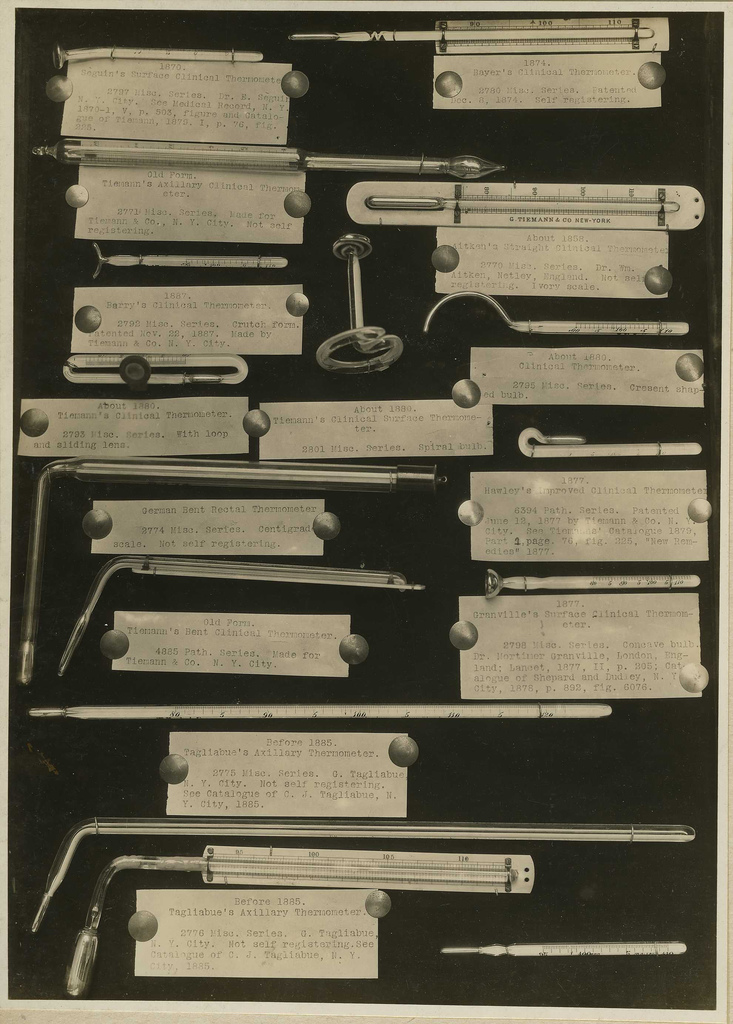
A recognisable thermometer became available in the 1650’s and instrumental records commenced around then in Italy and Britain. The most famous is the series from which Central England Temperature (CET) derives, which commenced in 1659. Thermometers rapidly evolved into an expensive, precision (in the context of its inherent limitations), scientific instrument.
The device spread quickly around the developed world. Monarchs and Universities considered it prestigious (and scientifically valuable) to take temperatures as one of a number of weather parameters, and we have many of their records to this day. Because of the cost and prestige factors, in its early days such instruments were generally used by trained observers.
* The nature of its construction and materials meant that its inherent accuracy is no more than approx. plus or minus 1 degree F. (up to 0.5 degree C) An accuracy concern that prevails until relatively recently (see Note 2)
* The limited accuracy of the instrument can be compounded by the methods by which it was housed and subsequently read. There was a vogue in the early days to place instruments in unheated north facing rooms, and even in metal cages attached to the north wall of a building, often on the first floor. This is far higher-and under very different conditions- than current standards permit, so like for like comparison is not possible without considerable adjustments. ‘Adjustments’ is a favourite word in the Climate Science Dictionary.
* The construction of the magnifying glass, through which the indicator mark of the instrument would be read, was often imperfect and caused distortions.
* Similarly, depending on the coarseness of the graduations of the temperature gauge, exact readings might be compromised.
* Both these last two factors are important considerations, as readings might be rounded up or down to the nearest whole degree.
* The invention of the minimum/maximum thermometer in 1780 by James Six was an important milestone.
http://brunelleschi.imss.fi.it/museum/esim.asp?c=410041
Up to this time measurements were (supposed) to be taken at least three times in a 24 hour period, so until this device became universally adopted neither the actual maximum or minimum temperature would necessarily be recorded, unless coincident to the exact time of the reading. However, measurements were still taken routinely, at various inconsistent times of the day even into the 20th century and mean temperatures calculated in different manners, so in practice the instrument took many years to come into common use. Modern analysis always assumes it was subsequently re-set and one day’s reading was not carried over to the following one.
* The Urban Heat Island effect (UHI) had the potential to greatly distort the readings of individual stations. (See Section Three.)
* The creation of the Stevenson screen in the latter years of the 19th Century helped to standardize the diverse conditions under which readings were taken, but was not in universal use until the first or second decade of the 20th century.
* Methodology remained inconsistent, and various crucial factors such as a standardized height for a properly calibrated and screened instrument are a relatively modern innovation.
* Whilst modern automatic weather stations-introduced from around 1980- have removed many of the human frailties, and its instrumentation has the potential to be generally accurate, to this day problems arise with inappropriate siting, some examples of which can be seen in this site.
http://www.surfacestations.org/odd_sites.htm
and here;
http://wattsupwiththat.com/2011/01/16/the-past-is-not-what-it-used-to-be-gw-tiger-tale/#more-31814
Extract; “Why are the stations so close to artificial heat sources? Well, fifty or more years ago, all the readings were taken manually by volunteer observers once a day. Some volunteers were not about to walk the length of a football field to do so. Even as automatic reporting stations were introduced, the stations had to be close to buildings so the data cable could be run to the display. Even though the originally specified maximum cable distance was 1/4 mile, most automated COOP observer MMTS sensors ended up within 10 meters (33 feet) of the building, mostly due to the inability of the NWS to trench under driveways and sidewalks which acted as barriers to putting the temperature sensor in open spaces.” (So what with Stevenson screens and the AWS, recording devices had a tendency over the years to move closer to buildings-sources of artificial heat).
* The majority of readings were taken in the Northern Hemisphere and records are biased towards this.
* Many records of the time are incomplete for a variety of reasons, of which war, or the death of the incumbent observer are but two, and these data omissions may be ‘interpolated’ (another favourite word of Climate Science) and then ‘adjusted’ many years later by modern computer methods. This is an unfortunate exercise as temperatures can vary greatly day by day and inventing figures does not mean they are the correct invented figures, as Dr von Hann observed over a century ago.
* There are a very small amount of stations worldwide and their numbers and locations continually fluctuate, making like for like comparison difficult.
* Instruments were fixed at inconsistent heights. Readings change considerably even with modest height changes.
* How tall was the observer, were they viewing the instrument straight on or at an angle? Was it an alcohol or mercury instrument where the meniscus curves in opposite directions to each other? How often did the observer change? Were they trained?
* Was there moisture or snow on the instrument?
* Was data ‘invented’ by the observer due to inclement weather or their other duties?
* Were the measurements translated accurately from one scale to another, for example from Reaumur degrees to Fahrenheit then to Centigrade?
* What was the defined accuracy of the thermometer claimed by the manufacturer-(likely to be around plus or minus 1 degree)? Was it subsequently recalibrated to maintain this accuracy level? Were subsequent thermometers at the same location bought from a different maker with different standards?
* Were the thermometers properly screened?
* Was there an adequate free flow of air round the bulb or was it restricted by fixing the instrument to a wall or the screen?
* Was the instrument set above bare ground, grass, tarmac, stone-all of which will affect results?
* Did it subsequently become affected by shade from the growth of trees or removal of an object which allowed more wind or the sun to reach an unscreened thermometer?
* Was the instrument always in the same location? There is a history of them migrating from the micro climate of a field in one part of the city to a warm airport many miles away, representing a completely different micro climate.
* Many of the cities with the longest temperature records- generally in Europe and North America- were industrialising rapidly as the thermometer came into widespread use in the 1700’s. Smog caused by the burning of coal, wood, and later gas, became increasingly widespread. Sunshine levels in the UK are said to be 40% higher now than during the worst years in London that culminated in the 1952 killer smog, which caused the various clean air acts to be enacted fully. Pollutants are said to create a cooling effect and it is easy to understand that foggy urban areas were likely to be substantially cooler than if the sun was shining. Inversions caused by these layers of air would have also helped to create temperatures that were vastly different-mostly lower-than they might otherwise have been. What effect this had on the overall temperature record over the centuries, in the many cities that smog affected to a greater or lesser degree, is impossible to calculate, but it must have been significant.
Perversely, smog became a tourist attraction and many artists flocked to great cities such as London to observe and paint the effects it caused.

Waterloo Bridge London in 1900 by Monet showing chimneys and smog. http://www.artnet.com/Magazine/features/nkarlins/karlins7-7-04.asp
An account of the historical development of smog is mentioned here;
http://en.wikipedia.org/wiki/Pollution
* Dr von Hann also expressed a number of other concerns already cited in the previous section. Blogger Adam Soereg echoes those reservations with his modern day take on those 1903 observations;
“Between 1780 and 1870, Hungarian sites observed the outdoor temperature at 7-14-21h, 6-14-22h or 8-15-22h Local Time, depending on location. How can anyone compare these early readings with contemporary climatological data? (The National Met. Service defines the daily mean temperature as the average of 24-hourly observations) The average annual difference between 7-14-21h LT and 24-hr readings calculated from over a million automatic measurements is -0.283°C. This old technique causes a warm bias, which is most pronounced in early summer (-0.6°c in June) and negligible in late winter/early spring. Monthly adjustments are within 0.0 and -0.6°c. The accuracy of these adjustments are different in each month, 1-sigma standard error varies between 0.109 and 0.182°C. Instead of a single value, we can only define an interval for each historical monthly and annual mean.”
Summary;
Thermometers were only designed to approximately measure the micro climate immediately around them, but the relationship of the readings to its original micro climate often became lost as the decades and centuries passed and thermometers migrated from cool open fields to warm airports many miles away. Throughout the history of instrumental records the growing need for a more consistent methodology can be readily seen that would enable measurements to be compiled on a like for like basis. The invention of the Stevenson screen and the Maximum/Minimum thermometer were arguably the first steps towards the standardisation of readings. However, these events coincided with the thermometer becoming a cheaper mass produced item instead of a scientific precision instrument of such cost and prestige that it was generally only used by a qualified observer.
Consequently, what could previously be considered a ‘scientific’ observation, (with all the numerous caveats) lost part of that status once the great expansion of the weather station network commenced in the 1880’s. Less skilled observers, using a cheaper product in different circumstances, were almost certain to come up with figures inconsistent with those of their predecessors, and comparisons become difficult, even into modern times. As was commented on earlier, full time paid professionals often had different standards to volunteers, or those paid a retainer.
Consistent reliability of readings through quality of instrumentation and methodology-height, screening, correct times of observation etc. – could not be guaranteed until the advent of the Automatic Weather Station in the 1980’s, but even then some of these have arguably been compromised by concerns over siting.
None of this is to say that many original observations were not done with great diligence and skill, just that there are so many variable parameters affecting the accuracy of the reading that a direct comparison to today’s values is impossible. To believe we have a highly accurate data base of even individual records that can be parsed to fractions of a degree is an illusion, and this uncertainty is multiplied many times when considering the accuracy of a ‘global’ temperature.
I will leave it to Dr Floor Anthoni to sum up, in a somewhat tongue in cheek manner, the preceding information, in a short article on Temperature reading errors;
http://www.seafriends.org.nz/issues/global/climate3.htm#Ocean_temperature_measurement
“Suppose we have stations with the finest thermometers inside the most standard Stevenson screens and located in rural areas, away from urban disturbances, then surely, readings must always be accurate? They are not, for various reasons:
Readings are done by humans. It involves going out in the rain, snow and sleet to the remotely placed weather station. There the finely scaled thermometers must be read to within 0.1 degrees, with fogging spectacles and suchlike. The data must be written up with a pen that won’t work on soggy paper, etc. So shortcuts are taken.
-
Let’s skip today because it is much like yesterday and we’ll use those figures instead.
-
John is sick and no-one else can do it today
-
Who will do it during the summer holidays?
-
The broken thermometer has still not been replaced.
- Etc.(Added by Anthony – there are polar bears outside and I don’t want to risk my life for a temperature reading. See: Fabricating Temperatures on the DEW Line)
There can also be a bias caused by the time that the reading is done. Air warms up during the day and is warmest a couple of hours after mid-day. During the night it cools and is coolest just before dawn. So in the morning one reads the maximum of previous day and the minimum of today. Are these two noted down for the same date? In the afternoon the reading shows today’s maximum and today’s minimum.
In addition to these problems, there are more serious ones related to location:
- Temperature decreases with height at the standard lapse rate of 0.6ºC per 100m altitude, but this is not always true.
- Stations located near the sea measure sea temperature during sea winds and land temperature during land winds, with usually a large difference between them. What do we want to measure? Air temperature over land or sea temperature?
The upshot of all this is that a large number of sites and observations are needed to even out reading errors, but one can never truly correct for UHI, altitude and distance to the sea.”
Technical references;
The 1903 book already referenced by Dr von Hann is linked below.
http://www.archive.org/details/pt1hanhdbookofcli00hannuoft
Citing it again provides the opportunity to comment that exactly the same concerns over accuracy and context that he expressed over a century ago are still of great relevance today, as the four subsequent papers demonstrate..
This interesting article with useful illustrations provides a practical tutorial on the accuracy of the thermometer.
http://pugshoes.blogspot.com/2010/10/metrology.html
Extracts and discussions from a new peer reviewed paper on uncertainties in the global record.
http://noconsensus.wordpress.com/2011/01/20/what-evidence-for-unprecedented-warming/#more-11278
This 2005 paper is headed ‘Uncertainty estimates in regional and global observed temperature changes-a new dataset from 1850.’
http://www.cru.uea.ac.uk/cru/data/temperature/HadCRUT3_accepted.pdf
Phil Jones amongst others were involved in this attempt to make comparisons between modern and historic temperature readings
http://www.springerlink.com/content/g111046235jnv572/
It seems to me that what is important is the trend, in other words the slope.
If that is the case, then it doesn’t really matter what the absolute temperature is, or the errors ( as long as they are somewhat consistent).
Mann tried to show that the slope was flat until after the 1960’s, then we had a slope upwards. If Mann’s flat slope for hundreds of years and the upslope of the 80’s was correct, that would prove CO2 induced warming, if there was a direct correlation between CO2 levels and warming.
Conversely if the warming slope in the 30’s was anywhere close to the warming slope in the 80’s that would falsify the CO2 hypothesis. Also the recent flat slope falsifies the CO2 hypothesis.
Obviously the 80’s upward slope is not anomalous or continuing, that proves that there isn’t a correlation between CO2 and warming. Is there any current justification for the CO2 hypothesis?
I am not a climate scientist or a metrologist, computer scientist, mathematician, statistician or any other type of scientist. What I am, for good or ill, is an attorney. In this capacity, I have faced off against any number of “experts” who asserted with absolute confidence (and perhaps even believed) their scientific conclusions. But you don’t need to be a great chef to know good cooking. As with all professions, there is a broad range of skill, diligence, knowledge, independence and bias in the scientific community. And scientists are susceptible to a major hobgoblin of the legal industry, namely, an emotional attachment to your position. Some are better than others at minimizing it or at least recognizing it and compensating for it, but I have yet to meet one lawyer or scientist that is immune to it. This emotional attachment creates a blindness to inconvenient or contradictory information. So I believe that in addition to the measurement margin of error, there is a “scientist” margin of error, which can compound (or, I suppose, cancel out) the measurement margin of error. In any event, juries are remarkably good at spotting someone who is blinded by his science.
But emotional attachments pale in comparison to government funded paychecks and pensions. Those cast a permanent darkness that doesn’t wash off.
Life is just way to short to worry about such things.
“There are known knowns; there are things we know that we know. There are known unknowns; that is to say, there are things that we now know we don’t know. But there are also unknown unknowns; there are things we do not know we don’t know.”
Of course Rummy left out the largest category of all, i.e. “The things that everyone knows for sure which just aren’t true.”
Tony B provides a very useful introduction to the uncertaintainties in temperature measurements and their implications for time series over climatic time scales. I take qualified exception, however, to the idea that absolute measurement accuracy is necessary for analytic studies of temperature variabilty. Consistency of measurement is paramount there, notwithstanding the error in determining the true daily average. Also, near-shore stations always measure the AIR temperature, which can be influenced by SSTs, but are NOT particulary coherent with them even when measured at the same bouy. Nevertheless, this series of posts should open laymen’s eyes to the fragility of claims that we know the “global temperature” variations going back to the mid-1800s.
I think that we will soon have to acknowledge that natural regional climate variability is far greater than anything experienced since 1900.
The sparsity of early observations means that we can have no adequate indication of the extremes that occurred between sites.
The relatively flat handle of the so called ‘hockey stick’ is most likely a wholly misleading indication of the extent of real world natural variability.
Steven Wilde says:
“I think that we will soon have to acknowledge that natural regional climate variability is far greater than anything experienced since 1900.”
If so, it’s going in the wrong direction for the alarmist crowd.
TonyB
Interesting and entertaining read (like part 1).
Max
Excellent work as always, Tony.
Re your section on smog and the effects of air pollution on the clarity of the atmosphere, I’m reminded of a study mentioned in Brian Fagan’s book The Little Ice Age:
“In a fascinatingly esoteric piece of research, Hans Neuberger studied the clouds shown in 6,500 paintings completed between 1400 and 1967 from forty-one art museums in the United States and Europe. His statistical analysis revealed a slow increase in cloudiness between the beginning of the fifteenth and the mid-sixteenth centuries, followed by a sudden jump in cloud cover. Low clouds (as opposed to fair-weather high clouds) increase sharply after 1550 but fall again after 1850. Eighteenth- and early nineteenth-century summer artists regularly painted 50 to 75 percent cloud cover into their summer skies. The English landscape artist John Constable, born in Suffolk in 1776 and a highly successful painter of English country life, on average depicted almost 75 percent cloud cover. His contemporary Joseph Mallord William Turner, who traveled widely painting cathedrals and English scenes, did roughly the same.
After 1850, cloudiness tapers off slightly in Neuberger’s painting sample. But skies are never as blue as in earlier times, a phenomenon Neuberger attributes to both the “hazy” atmospheric effects caused by short brush strokes favored by impressionists and to increased air pollution resulting from the Industrial Revolution, which diminished the blueness of European skies.”
Reference: Hans Neuberger, “Climate in Art”, Weather 25 (2) (1970): 46-56
Brian Fagan: The Little Ice Age, p.201
Thanks Tony.
Great article.
Great to hear some common sense on the subject. I have always been amazed and slightly appalled by the Warmists and their .1 of a degree measurements….
after all, I can get three different temperature readings INSIDE your fridge!
I have little problem with workmanship from centuries past, be they thermometers or violins: http://oi53.tinypic.com/k2kac8.jpg
Anyone purporting to know the “global temperature” to tenths of a degree over the past 1000 years is a snake oil salesman.
To follow up from my previous posting, when I hit send too soon:
We can take a gazillion measurements over 100 years with an accuracy of 5 degrees, average and smooth and get a continuous temperature recrd to an “accutracy” of 0.01 degrees.
This is the fallacy of false precision. Our smoothed average is a product of computation, not of measurement.
Somehow I missed the original post (Part I) back in Nov 2009.
In reading it and looking at the graphics in Part I (good thing they give us pictures, so we can comprehend!…lol), I noticed that Figure 3 seemed to have as much constancy to its periods as, say the sunspot cycles. In looking at the white band at the bottom, the blue lines seem to demarcate minima – quite like we do for sunspots, even, to mark the beginning of sunspot cycles.
For what it is worth, it looks like there are 21 minima marked from about 1490 to about 1947. 467 years divided by 21 cycles = 22.23 yrs. Whether just coincidental or meaningful, that is quite close to the length of two average sunspot cycles.
The sunspot cycles are just about as erratic as the periods shown in Figure 3. Some sunspot cycles were pushing 17 years (as I read them) and some less than 10 years. Figure 3 shows that one with the dashed line, which seems to represent a minima that never minimized. If that is considered a real minima, then the longest cycle shown seems to be about 30 years (1891-1921), and there are three that are about 12 years long. It is nothing exact, but the magnitude of the variability is fairly close.
I’m just sayin’…
Thanks Tony, very interesting.
I remember reading Mark Coopers blog article on T reading errors before, but lost the link, so I am glad you provided it here. At the end he says……
…….very sobering.
I rather like the idea of the Max/Min T’s pioneered by James Six that you mentioned. Although manually read, the markers, assuming that they do not move, would provide a relief from the meniscus error in alcohol and mercury types, and, if read at say 9 am, they would have recorded the previous days Tmax and the overnight Tmin. At that time they could be rest. An ‘accurate’ Max and Min, whenever it occurred (hopefully before 9am) and one reading/reset per day.
The earth is warming out of an ice age.
CO2 increasing may or may not be aiding, it should.
There are more people on earth.
Ice and snow are melting providing more fresh water.
Improved farming is increasing our food source.
More land is opening up for expansion.
Our species is evolving and living longer.
Technology improves lives everyday.
Why would anyone want to upset this?
Sounds to me like the system is working.
Alexjc38, a very interesting comment. Constable’s cloudscapes were widely and admiringly commented on by contemporary country-dwellers, who were much impressed by Constable’s observational accuracy. I have maintained for many years that the painterly effect known somewhat romantically as ‘aerial perspective’ in which the middle ground becomes indistinct and the background dissolves in a lovely haze and said to be a device for imparting an impression of the depth of feild in a painting was, in fact, honest and quite literal depictions of the air quality, air which carried the smoke and residue from fires burning charcoal, wood, peat or dried animal droppings in the eras prior to extensive mining of coal, remembering that those fuels, along with water and animal and human muscle were the only sources of energy. Once coal mining and industrialisation were truly underway in the UK, contemporary paintings of industrialised areas had a hellish aspect imparted by the lowering black cloudscapes lit from underneath by the fires of industrial processes.
“Unknown knowns”, huh? Like, “Jeez, I didn’t know I knew that!”
“My mind is going, Frank. I can feel it.”
Oops, an unknown unknown slipped in there. It’s “I’m afraid, Dave. Dave, my mind is going. I can feel it. I can feel it. My mind is going. There is no question about it. I can feel it. …”
So we know exactly the climate within the Stevenson Screen but nothing about global climate. (sarc)
Excuse my sarcasm. Excellent article by one who knows what he is talking about.
Thanks for everyones comments.
As regards painting as a proxy of climate, I definitely think there is something in it. Brian Fagan goes into this in some detail in his book as does Hubert Lamb. Trying to sort out artistic licence, smog and reality does need some work though. The old illustrations of ice fairs and paintings of hard winters-both referenced in my works- then need to be set beside bucolic paintings of early harvest-which could be evidenced by crop records. We can start to draw some interesting conclusions when combined with temperature records-observational and instrumental.
Trouble is that these are usually dismissed as ‘anecdotal’ whilst computer models using dubious data are considered sciemtific and factual.
tonyb
Tony B, your point that paintings are classed as ‘anecdotal evidence’ but the products of inaccurate computer models are classed as ‘scientifically acceptable’ proves that Scientific Man is incredibly gullible, but only within a narrow range, of course! 🙂
AlexanderK
Ah, but that narrow range is robust 🙂
tonyb