I have been asked to present this for review by readers here, and to solicit critical comments for the purpose of improving the presentation. Moderators please remove any off-topic comments and commenters please stick to the issues of review. – Anthony
[…]
Now, about the climate science:
‘‘It’s unchallengeable that CO2 traps heat and warms the Earth and that burning fossil fuels shoves billions of tonnes of CO2 into the atmosphere,”
“But where you can get challenges is on the speed of change.”
— Professor John Beddington
The British government’s chief scientific adviser, John Beddington, has called for more openness in the global warming debate. He said climate scientists should be less hostile to sceptics who questioned man-made global warming. He condemned scientists who refused to publish the data underpinning their reports. He also said public confidence in climate science would be improved if there were more openness about its uncertainties, even if that meant admitting that sceptics had been right on some hotly disputed issues.
“I don’t think it’s healthy to dismiss proper scepticism. Science grows and improves in the light of criticism. There is a fundamental uncertainty about climate change prediction that can’t be changed.” [As reported in The Australian“i. Other reports were similar.]
I would like [the two speakers] to address the specific issue of the deleted data in reconstructed temperature graphs.
The issue is as follows: In their third report (“TAR”), the IPCC published the following graphii:

This is a graph of several temperature proxies, with the instrumental temperature record from around 1900 added. What it shows is that temperatures had been declining fairly steadily for nearly 1000 years, but then suddenly shot up in the 20th century.
It has now been discovered that some of the data series had been truncated in the graph. The result of these truncations was to make the data series look more consistent and therefore convincing. (NB. I make no statement about intent.). If the data series had not been truncated, the end result would have been very differentiii:

The two red segments are the truncated data. These two segments and the dotted curve connecting them are a single data series “Briffa-2000”1. Note that the first downward segment of the black graph (instrumental temperature) has also been deleted in the version used by the IPCC.
The extreme divergence between the “Briffa-2000” proxy and the instrumental temperature record shows that this proxy is completely unreliable (the “divergence problem”). To delete segments from the graph – especially without a prominent explanation – is bad scientific practice. Contrary to claims by various climate scientists, the deletions were not disclosed in the TAR. Nor was the “divergence problem” discussediv. As Professor Richard A Muller of University of California, Berkeley, has said “You’re Not Allowed to Do This in Science“v.
Was the “Briffa-2000” data series the only unreliable proxy data series? It seems not. Phil Jones’ 1999 “Climategate” email indicated that other proxy data series had been truncated to “hide the decline“vi.
It has been argued that this “hide the decline” graph (aka the hockey-stick) is not important in the overall scheme of things, ie. in climate science as a whole. Gavin Schmidt put it this way on RealClimate.com, “if cherry-picked out-of-context phrases from stolen personal emails is the only response to the weight of the scientific evidence for the human influence on climate change, then there probably isn’t much to it.“vii.
Unfortunately, the “hide the decline” graph is much more important than that. In the fourth IPCC report (“AR4”), the effect of solar variation on climate is discussed. Theories such as Henrik Svensmark’s are dismissed as “controversial” and then ignoredviii. Consequently, solar variation is included in the climate models purely as the direct climate forcing from total solar irradiation (TSI). Since variations in TSI are quite small, in percentage terms, the climate models allow only for small temperature changes from TSI changes.
Such small temperature changes are quite consistent with the “hide the decline” graph, because that graph shows only small temperature changes prior to the 20th century. If the IPCC had persisted with their original estimate of earlier temperatureix …

… then the climate models would have been unable to replicate the temperature changes in either the MWP or the LIA, because the total effect of all natural factors (including TSI variation) allowed for in the models is far too small. If the climate models were unable to replicate the MWP and LIA, then they would lack credibility, and any scientific conclusions based on the models could be disregarded.
But it gets worse.
With the “hide the decline” graph representing global temperature, the climate modellers had only one factor which could give a sudden upward movement in temperature in the 20th century – CO2. This was the only factor whose pattern changed significantly then and only then. The IPCC analysis is based on “equilibrium climate sensitivity” (ECS), which is defined as the equilibrium change in the annual mean global surface temperature following a doubling of the atmospheric equivalent carbon dioxide concentrationx. The way ECS was arrived at was to map the 20th-century temperature rise to the increase in CO2 concentration : “Estimates of the climate sensitivity are now better constrained by observations.“xi.
The IPCC and the climate modellers still had a problem: the scientific studies on CO2, and the physical mechanism by which it warmed the atmosphere, gave an ECS which was far too low. But the discrepancy was explained by climate feedbacks. A climate feedback is defined as follows: “An interaction mechanism between processes in the climate system is called a climate feedback when the result of an initial process triggers changes in a second process that in turn influences the initial one. A positive feedback intensifies the original process, and a negative feedback reduces it.“xii
This leads us to clouds. The IPCC state repeatedly that they do not understand clouds, and that clouds are a major source of uncertainty. For example: “Large uncertainties remain about how clouds might respond to global climate change.“xiii There are many statements along these lines in the IPCC report. Now simple logic would lead one to think that clouds would be a negative feedback:- as CO2 warms the oceans, the oceans release more water vapour, which forms clouds, which have a net cooling effect (“In the current climate, clouds exert a cooling effect on climate (the global mean CRF [cloud radiative forcing] is negative).“xiv).
But the IPCC report claims that clouds are a massive positive feedback: “Using feedback parameters from Figure 8.14, it can be estimated that in the presence of water vapour, lapse rate and surface albedo feedbacks, but in the absence of cloud feedbacks, current GCMs would predict a climate sensitivity (±1 standard deviation) of roughly 1.9°C ± 0.15°C (ignoring spread from radiative forcing differences). The mean and standard deviation of climate sensitivity estimates derived from current GCMs are larger (3.2°C ± 0.7°C) essentially because the GCMs all predict a positive cloud feedback (Figure 8.14) but strongly disagree on its magnitude.“xv.
The IPCC provide no mechanism, no scientific paper, to support this claim. It comes in some unspecified way from the climate models themselves, yet it is acknowledged that the models “strongly disagree on its magnitude“.
So, to sum up, the situation is that the “hide the decline” graph leads to nearly all of the 20th-century warming being attributed to CO2, thanks to a factor (clouds) which is not understood, is not explained, and comes from computer models which strongly disagree with each other. The inevitable conclusion is that without the “hide the decline” graph, the clouds “feedback” as described in the IPCC report would not have existed.
Now, returning to Gavin Schmidt’s comment. When he talks about “the weight of the scientific evidence for the human influence on climate change“, a very large part of that evidence is the IPCC report and everything that references it. But as I have just shown, the IPCC report itself relies for its credibility on the “hide the decline” graph. In other words, the entire structure of mainstream climate science depends on a single work which is itself based on methods which are “not allowed” in science.
So of course there are, in Professor Beddington’s words, challenges on the speed of change. If the MWP, which was of course completely natural, was about as warm as today, then it is entirely reasonable to suppose that natural factors are largely responsible for today’s warm temperatures too, and that the speed of change from CO2 has been grossly overstated by the IPCC.
Mike Jonas
References:
1 There are number of different versions of this graph, in the various IPCC reports and elsewhere, where different versions of the proxy data have been used.
viii http://www.ipcc.ch/pdf/assessment-report/ar4/wg1/ar4-wg1-chapter2.pdf para 2.7.1.3
ix http://climateaudit.files.wordpress.com/2008/05/lambh23.jpg (I could not provide a link to this graph in an IPCC web page, because earlier IPCC reports are no longer linked there. http://www.ipcc.ch/publications_and_data/publications_and_data_reports.shtml)
xi http://www.ipcc.ch/pdf/assessment-report/ar4/wg1/ar4-wg1-chapter9.pdf Executive Summary.
xiii http://www.ipcc.ch/pdf/assessment-report/ar4/wg1/ar4-wg1-ts.pdf para TS.6.4.2
old construction worker:
March 28, 2011 at 9:59 pm
You need to go back to your sources and tell them they are wrong. High clouds don’t do much overall because their longwave and shortwave effects oppose each other. It is low cloud cover that has a cooling effect, so their loss is a positive cloud feedback.
Mike Jonas says:
March 29, 2011 at 1:29 pm
P. Solar – to clarify: Yes the models give recent temperatures most importance, but they need to fit past temperatures reasonably well in order to have credibility. That’s where having no MWP is so important. Because they downplay all natural factors, the models can’t fit a warm MWP. So I have to establish that (a) the hockey-stick is shaky and (b) the way they fit recent temperatures is shaky. Everything else flows from that. I haven’t explained things well, but I’m still working on it. Everyone here has helped.
Your paper shows a rough graph of the Central England Temperature, which you mistakenly imply was a graph of Northern Hemisphere or global temperature. This error is often made by so called “skeptics” and has been corrected repeatedly.
http://www.skepticalscience.com/print.php?r=338
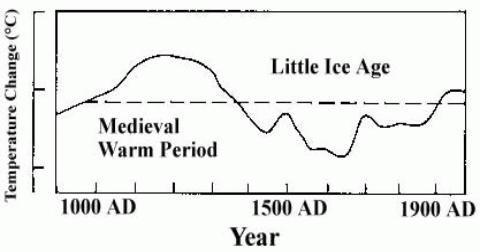
The myth that the Intergovernmental Panel on Climate Change (IPCC) “disappeared” the Medieval Warm Period (MWP) seems to be based on Figure 7.1c from the IPCC First Assessment Report (FAR):
As you can see, IPCC FAR Figure 7.1c appears to sho
w the MWP quite prominently, and warmer than the temperature as the end of the graph. But it’s a rather strange figure – the temperature axis doesn’t even have any numbers, and it looks hand-drawn. Where did it come from?
…
Jones et al. trace the schematic diagram back to a series used by H.H. Lamb, representative of central England, last published by Lamb (1982). However, Lamb is plotting 50-year averages here, and the final data point appears to be 1950. Jones et al. superimpose IPCC FAR Figure 7.1c (black) with Lamb’s central England temperature (red) and added the Central England Temperature data up to 2007 (blue):
Central England temperatures have risen by over 1°C since Lamb’s last measurement. Jones et al. also note about Lamb’s schematic:
……
“At no place in any of the Lamb publications is there any discussion of an explicit calibration against instrumental data, just Lamb’s qualitative judgement and interpretation of what he refers to as the ‘evidence’….Greater amounts of documentary data (than available to Lamb in the early 1970s) were collected and used in the Climatic Research Unit in the 1980s. These studies suggest that the sources used and the techniques employed by Lamb were not very robust (see, eg, Ogilvie and Farmer, 1997).”
…
In short, Figure 7.1c from the IPCC FAR was based on Lamb’s approximation of the central England temperature. It was intended only as a schematic diagram, and known not to accurately reflect the global average temperature. ..
If the models calculating global or Northern Hemisphere past temperatures fit the graph that you showed, they would be in error.
I showed that models do produce a something close to the MWP, as best we can tell it, in my above post. I showed only one example of papers that model the MWP based on proxies.
http://www.geos.ed.ac.uk/homes/tcrowley/crowley_science2000.pdf
There are other examples that can be found using Google.
If that graph is the basis of your paper as you claim, the whole paper is one big mistake.
I’m pretty close to a final version, I think.
http://members.westnet.com.au/jonas1/Question1ForReview.pdf
In any case, I have to send it off soon.
I’ll post reactions here.
eadler – I looked at the Crowley paper you posted. It maps to the hockey-stick.
Jim D says:
March 29, 2011 at 5:06 pm
old construction worker:
March 28, 2011 at 9:59 pm
You need to go back to your sources and tell them they are wrong. High clouds don’t do much overall because their longwave and shortwave effects oppose each other. It is low cloud cover that has a cooling effect, so their loss is a positive cloud feedback.’
So the lack of clouds are a positive “cloud” feedback? You may want to consult some guy at MIT, Richard Landzen, about the Iris effect.
SteveE says:
March 29, 2011 at 5:39 am
Don K says:
March 27, 2011 at 11:46 pm
I think it’s relevant to ask about ice core data. If I understand it correctly, it has become more and more clear over the past decade or so that Antarctic and Greenland ice data shows that CO2 and temperature to track reasonably well, but the CO2 concentration lags the temperature by 600 years or so.
“When the Earth comes out of an ice age, the warming is not initiated by CO2 but by changes in the Earth’s orbit. The warming causes the oceans to give up CO2. The CO2 amplifies the warming and mixes through the atmosphere, spreading warming throughout the planet. So CO2 causes warming AND rising temperature causes CO2 rise.”
The same can be said about water vapor but It wouldn’t have a “600 year lag time”
old construction worker:
March 29, 2011 at 6:45 pm
That 2001 iris theory has not stood the test of time. Dessler 2010 finds the opposite regarding El Ninos and the sign of cloud feedback by also accounting for low clouds, which are more important.
As a matter of routine, I hereby confess that I am an old retired bureaucrat in a field only remotely related to climate, with minimal qualifications and only half a mind.
Re Mike Jones Mar 29 2011 1.12pm.
Many thanks for the explanation. Hope the presentation goes well.
This post might go a way to understanding why UV is fighting release of the Mann data under FOI.
It appears to me that tree-ring proxy graphs should not be mixed with temperature graphs. There are plenty of trees from 1960-2010 that can be analyzed. To stop using trees in 1960 and replacing it with a thermometer so you can get the blade on the hockey stick is dishonest. Use trees all the way up to 2010. If you can still show your hockey stick temperature graph you might start to convert a few skeptics. But, to use one technique to obtain a temperature series for a thousand years and then replacing the last 50 years with a new technique to get a pre-desired result is not good science.
Even in Mann’s other paper referenced by R. Gates has exactly the same problem. The last 50 years to get the blade are thermometer temps again. He can’t get the blade using the proxy data alone.
“Jim D says:
March 29, 2011 at 7:44 pm
old construction worker:
March 29, 2011 at 6:45 pm
That 2001 iris theory has not stood the test of time. Dessler 2010 finds the opposite regarding El Ninos and the sign of cloud feedback by also accounting for low clouds, which are more important.”
Are you talking about “lack of clouds positive feedback” or negative clouds feedback?
Mike Jonas says:
March 29, 2011 at 6:21 pm
I’m pretty close to a final version, I think.
http://members.westnet.com.au/jonas1/Question1ForReview.pdf
In any case, I have to send it off soon.
I’ll post reactions here.
eadler – I looked at the Crowley paper you posted. It maps to the hockey-stick.
My point is that your claim, that the Lamb graph that you provided, as a record of Northern Hemisphere or Global average temperature, needs to be matched by models, is dead wrong. The original Hockey Stick graph, which was ground breaking work in 2000, has been updated and corrected many times since it was published, and a slightly higher MWP temperature with more uncertainty has been is the consensus of the results, but nothing like the Lamb Graph for Central England, which you claim erroneously is a global or Northern Hemisphere graph.
It is true that the Crowley paper published in 2000, matched up with the original Hockey Stick paper of Mann et. al. 200 . As I mentioned, other papers have been published on this subject, including the YIN et. al, published in 2007,
http://www.scichina.com:8080/kxtbe/fileup/PDF/07ky1545.pdf
which looks at a number of proxy reconstructions, including Moberg 2005, which has a more pronounced MWP than the original Mann 2000. They have a detailed graph of solar and volcanic forcings which they input into the models that they use. There is of course uncertainty in these forcings as there is in proxies. The models in this paper do reproduce the MWP, contrary to your claim.
Alcheson says:
“Use trees all the way up to 2010. If you can still show your hockey stick temperature graph you might start to convert a few skeptics.”
___
There seems to be a great deal of confusion on this issue. Even if you take all tree-ring data out of the proxies, throughout the entire last 2,000 year period, and only include other proxies such as ice, corals, and even stalactites, you still get the infamous “hockey stick” graph. The hockey stick was not created just because some of the tree-ring data was truncated– it would show up in the other proxies anyway. Some of the tree-ring data was truncated because it was in obvious error (for reasons we’ve discussed at length here, and were also discussed in the 4th IPCC assessment). If you want to look at what I feel is the most accurate chart of the last 1,200 years of at temperature (with emphasis on spatial extent), I feel this is the best current chart:
http://www.ncdc.noaa.gov/paleo/pubs/osborn2006/osborn2006.html
Note: There is still a hockey stick looking shape, with a bulge in temps in the 20th century, but it is a “fatter” hockey stick with more uncertainty indicated and even, what I feel is a more honest representation of the MWP.
Mike Jonas,
I am looking at your new version and it doesn’t seem any better than the original.
It is wrong to base your analysis on the Mann 2000 Hockey Stick paper.
As has been pointed out many times, there have been many updates, including Mann 2008, which answers all of the McIntyre criticisms. There are versions without tree rings, and without the use of PCA’s. In addition, it has been shown that using centered PCA’s correctly, rather than the mistaken application that McIntyre made, gets the same Hockey Stick from the Mann database as the less conventional non centered PCA . You ignore all literature except for Mann 2000 and what McIntyre says. This is unbelievably poor scholarship.
You still incorrectly use the Lamb Graph, a free hand drawing of Central England Temperatures, to make a point about the climate models not showing the MWP period for global or NH simulations accurately. There is no reason to require climate models of the globe or the NH to reproduce this graph.
Cloud feedback has been found to be positive on short time scales by radiation measurements. There are a lot of papers on this.
None of the points you have made are correct. You have this far not acknowledged or refuted any of the criticisms I have made. the so called “skeptics” may nod their heads, (can’t use the D-word here) but are you really making a positive contribution to knowledge with this paper, when there is so much published work contrary to your case, which you are ignoring?
Jim D says:
March 29, 2011 at 5:06 pm
“It is low cloud cover that has a cooling effect, so their loss is a positive cloud feedback.”
Bollocks!
If rising temps lead to increased cloud cover which has a cooling effect, that’s called negative feedback because the output acts in opposition to the input. Reversing the terminology by introducing the concept of a negative cloud only fulfills a pathetic psychological need to claim a positive feedback. It does NOT make the feedback positive. You wouldn’t get away with that BS in any other field, so why is climatology cursed with such avid crapologists?
R Gates – I can’t tell from your linked Osborn document, which proxy series he was using. However, some time ago, Willis Eschenbach analysed all 95 series used by Mann 2008, and found that in every one of them the hockey-stick shape was spurious.
I really do think it’s about time you gave up on the hockey-stick. An enormous amount of effort and obfuscation has gone into protecting it – including refusal of access to data and methods – but luckily for us Steve McIntyre and others have put an even greater amount of effort and expertise into unravelling the mess. Every time they dig a bit further, the hockey-stick comes up smelling even worse than it did before.
http://climateaudit.org/2008/11/23/cant-see-the-signal-for-the-trees/
ABSTRACT: A new method is proposed for determining if a group of datasets contain a signal in common. The method, which I call Correlation Distribution Analysis (CDA), is shown to be able to detect common signals down to a signal:noise ratio of 1:10. In addition, the method reveals how much of the common signal is contained by each proxy. I applied the method to the Mann et al. 2008 (hereinafter M2008) proxies. I analysed all (N=95) of the M008 proxies which contain data from 1001 to 1980. These contain a clear hockeystick shaped signal. CDA shows that the hockeystick shape is entirely due to Tiljander proxies plus high-altitude southwestern US “stripbark” pines (bristlecones, foxtails, etc). When these are removed, the hockeystick shape disappears entirely.
Slacko and Jim D – we can all argue about clouds, cloud feedback, water vapour, relative humidity, etc, until we’re blue in the face, but the simple facts are these:
The IPCC say they don’t understand clouds – “Large uncertainties remain about how clouds might respond to global climate change” (IPCC report para TS.6.4.2) – for the full set see http://members.westnet.com.au/jonas1/IPCCOnClouds.pdf it’s pretty convincing!
The IPCC claim that 40%+ of the warming from CO2 comes through cloud feedback.
If they don’t know how clouds respond to global climate change (the definition of “feedback”), they cannot credibly claim that these same clouds provide such a massive positive feedback. But they do implicitly claim it, and confidently – see the summary for policymakers and technical summary and the confidence levels they use.
All the debate about whether cloud feedback is positive or negative uses arguments which seem at best able to deliver only a very small amount of feedback, whether positive or negative. The negative feedback found by Roy Spencer was, I think, quite small.
What is lost in all the arguments, and is not considered at all by the IPCC, is whether cloud cover changes can occur in ways which are not a reaction to temperature change – but that is another topic altogether.
R Gates
quote
other proxies such as ice, corals, and even stalactites
unquote
“Andy Baker1, Frank McDermott2, Peter Rowe3 & Stein-Erik Lauritzen4
Department of Geography, University of Newcastle, UK
Department of Geology, University College Dublin, Eire
Environmental Sciences, University of East Anglia, UK
Department of Geology, University of Bergen, Norway
THE SITES
The three sites to be discussed in detail are those of:
Uamh an Tartair, Assynt, NW Scotland (Proctor et al., 2000, 2002; Baker et al, in press): using annual
lamina width and lamina doublets as proxies
Crag Cave, SW Ireland (McDermott et al, 1999; 2001): using 18O of calcite as a proxy
SØylegrotta, Mo i Rana, N Norway (Lauritzen and Lundberg, 1999): using 18O of calcite as a proxy.
A USEFUL STARTING POINT FOR SPELEOTHEM CLIMATE RECONSTRUCTION
IS TO ASSUME THAT:
every sample has a different response to climate, and that even two stalagmites ten cm apart in the
same cave will have different climate signals.
· that non-linear responses should be expected due to the inherently non-linear hydrology of karst
· deeper, slower dripping samples will show more linear responses, but will also be lagged and
maybe even have no response to surface climate. In contrast, shallow and fast dripping stalagmites will be
very responsive to climate but will be more difficult to calibrate and understand.
· Most climate proxies preserved in stalagmites are a complex mixture of soil, vegetation, rainfall,
evaporation, hydrological and geological processes.”
Or, put another way, if the signals vary enough then a little bit of cherry picking will give you any shape you want.
So, corals and ice. Don’t they use isotopes as proxies in ice? Which also respond to precipitation changes, just like tree rings. And, come to think of it, I bet speleotherms do too.
One. How do they use corals as a temperature proxy again?
JF
Mike Jonas says:
March 30, 2011 at 11:36 am
“I really do think it’s about time you gave up on the hockey-stick.”
____
You’ll have to yank the hockey-stick out of my cold dead hands!
(sarcasm off)
Okay AGW skeptics, please provide me a link, or several links, to graphs that you feel show the best temperature reconstruction over the past 2,000 years, if the hockey-stick (or any derivation thereof) just ain’t doin’ it for you. I’ll be glad to look at any scientifically reviewed research and paper, with ample notes of course as to how this data was derived, with all work of course, undergoing a thorough peer review.
Mike Jonas says:
I really do think it’s about time you gave up on the hockey-stick. An enormous amount of effort and obfuscation has gone into protecting it – including refusal of access to data and methods – but luckily for us Steve McIntyre and others have put an even greater amount of effort and expertise into unravelling the mess. Every time they dig a bit further, the hockey-stick comes up smelling even worse than it did before.
In fact many of McIntyre’s criticisms have been shown to be wrong. His analysis of non centered PCA’s creating the hockey stick out of noise was nonsense. His contention that the Tijander mud proxy was upside down and invalid was also wrong. Here is a reply to McIntyre’s criticisms of Mann 2008 by Mann:
http://docs.google.com/viewer?a=v&q=cache:sKMY4e-PXqAJ:www.meteo.psu.edu/~mann/shared/articles/MMReplyPNAS09.pdf+mann+2008+proxies&hl=en&gl=us&pid=bl&srcid=ADGEESgbvcWDD_ZfFZ8OmYrGm_sgZplqMM5QOuHEmw_r5SbGDyG7agm4MOS4sKqaZfvSBnsvaqAMcM70FzVQ0DsV82otM-uSWuRb9tOTo-W-rrBloz4R5t1icwoI-GLW8zoXDIFkVp4x&sig=AHIEtbR8DoDRKq4MqSkXQXneBH_hBcvZ3A
Also the data and methods are publicly available, so the claim of concealment is nonsense.
Finally, the following citation:
http://climateaudit.org/2008/11/23/cant-see-the-signal-for-the-trees/
ABSTRACT: A new method is proposed for determining if a group of datasets contain a signal in common. The method, which I call Correlation Distribution Analysis (CDA), is shown to be able to detect common signals down to a signal:noise ratio of 1:10. In addition, the method reveals how much of the common signal is contained by each proxy. I applied the method to the Mann et al. 2008 (hereinafter M2008) proxies. I analysed all (N=95) of the M008 proxies which contain data from 1001 to 1980. These contain a clear hockeystick shaped signal. CDA shows that the hockeystick shape is entirely due to Tiljander proxies plus high-altitude southwestern US “stripbark” pines (bristlecones, foxtails, etc). When these are removed, the hockeystick shape disappears entirely.
is not actually a peer reviewed paper, although the use of the heading abstract would make it seem so.
The Hockey Stick is actually alive and well, contrary to the so called “skeptic” criticisms of it.
http://www.logicalscience.com/skeptic_arguments/fakeddata.html
Gates says:
“I’ll be glad to look at any scientifically reviewed research and paper, with ample notes of course as to how this data was derived, with all work of course, undergoing a thorough peer review.”
Well, that’s the central problem, isn’t it? Without the supporting information, there can be no legitimate peer review, can there? Michael Mann still refuses to disclose his Hokey Stick notes, data, methodologies, metadata and code that went into his fabricated MBH98/99 pseudo-science, after thirteen years of continuous requests.
Yet you unquestioningly accept Mann’s Hokey Stick because your belief system requires it. You’re operating on religious belief, my friend, not science. The scientific method requires transparency – the one thing the alarmist clique refuses to allow. How do you explain that? I’d like to hear an official apologist tell us why Mann and subsequent hokey stick fabricators can dispense with essential transparency and the scientific method.
eadler says:
“The Hockey Stick is actually alive and well, contrary to the so called “skeptic” criticisms of it.”
Another blatant falsehood by eadler. Nature was forced to issue a Corrigendum due to the debunking of Mann’s Hockey Stick by McIntyre & McKittrick. Mann’s hockey stick has been officially discredited by one of the leading science journals.
Note that a Corrigendum is extremely serious, and very rarely issued. From the link:
In other words, Mann surruptitiously cherry-picked data to fabricate his hockey stick graph. He deliberately engaged in scientific misconduct.
This is a recurring trait of Michael Mann. The Tiljander sediment proxy was known by Mann to be corrupted before he published his ’08 paper, which was based on the Tiljander proxy [those interested in Mann’s deliberate shenanigans can click on Climate Audit on the right sidebar, and do a search for “Tiljander”]. Yet he published anyway, and it was hand-waved through pal review by Mann’s sycophant [or lazy] referees.
Michael Mann deceptively hid the data that would have made his hockey stick shape disappear from the graph. He buried the data in an obscure ftp file labeled “censored.” You can see that if Mann had used the “censored” data – which was from a much better series of proxies – his hockey stick graph would have gone in the opposite direction. So he hid the data in order to fabricate his subsequently debunked hockey stick.
A.W. Montford’s book, The Hockey Stick Illusion shows conclusively that Mann deviously misrepresented the data he used. Nature was forced into issuing its Corrigendum, tainting Mann as using fraudulent methods to acheive a bogus result.
I am really getting irked at eadler’s deliberate misrepresentations and his fact-free apologia for the Mann climate clique. IMHO his spin is dishonest, and he appears to be the main conduit between the propaganda of the Skeptical Pseudo-Science blog and WUWT. I am tired of his lying to promote his alarmist agenda. I think it is deliberate, and that he is a troll. That is my opinion, and I stand by it.
In a corrigendum published on 1 July 2004, Mann, Bradley and Hughes acknowledged that McIntyre and McKitrick had pointed out errors in proxy data that had been included as supplementary information to MBH98, and supplied a full corrected listing of the data. They included an archive of all the data used in MBH98, and expanded details of their methods. They stated that “None of these errors affect our previously published results.”[52]
Smokey says:
March 30, 2011 at 5:51 pm
eadler says:
“The Hockey Stick is actually alive and well, contrary to the so called “skeptic” criticisms of it.”
Another blatant falsehood by eadler. Nature was forced to issue a Corrigendum due to the debunking of Mann’s Hockey Stick by McIntyre & McKittrick. Mann’s hockey stick has been officially discredited by one of the leading science journals.
Note that a Corrigendum is extremely serious, and very rarely issued. From the link:
The Mann correction was not published as an Addendum, which, according to Nature’s published policy, is done when “Authors inadvertently omitted significant information available to them at the time” but which does “not contradict the original publication.” Nature publishes Corrigenda only “if the scientific accuracy or reproducibility of the original paper is compromised.” Nature’s designation of the correction as a corridengum contradicts the article authors’ [Mann’s] claim that the errors in the original paper did not affect the published results. [my emphasis]
In other words, Mann surruptitiously cherry-picked data to fabricate his hockey stick graph. He deliberately engaged in scientific misconduct.
The correction could not be not designated as an addendum, because nothing was left out of the original paper. For a change in data, the designation had to be corrigendum. This was a correction to the supplementary data, but did not change the actual published paper according to Mann. Since the corrigendum is behind a paywall, I did not get to see it, so it is McIntyre’s word against his in the article. There were some errors in the original paper, and according to the NAS report, the statistical uncertainty in his original paper was understated especially for the MWP. This was corrected in later papers by Mann and others.
McIntyre’s claim that non centered PCA would create a hockey stick from noise was shown to be wrong long ago.
Making and correcting an error in a paper which develops a new methodology is not proof of misconduct.
This is a recurring trait of Michael Mann. The Tiljander sediment proxy was known by Mann to be corrupted before he published his ’08 paper, which was based on the Tiljander proxy [those interested in Mann’s deliberate shenanigans can click on Climate Audit on the right sidebar, and do a search for “Tiljander”]. Yet he published anyway, and it was hand-waved through pal review by Mann’s sycophant [or lazy] referees.
Michael Mann deceptively hid the data that would have made his hockey stick shape disappear from the graph. He buried the data in an obscure ftp file labeled “censored.” You can see that if Mann had used the “censored” data – which was from a much better series of proxies – his hockey stick graph would have gone in the opposite direction. So he hid the data in order to fabricate his subsequently debunked hockey stick.
Sorry but Mann replied to McIntyre’s claim about the use of Tijander proxies.
http://www.pnas.org/content/106/6/E11.full
A.W. Montford’s book, The Hockey Stick Illusion shows conclusively that Mann deviously misrepresented the data he used. Nature was forced into issuing its Corrigendum, tainting Mann as using fraudulent methods to acheive a bogus result.
The Montford book has been thoroughly debunked and is a mass of errors.
http://www.realclimate.org/index.php/archives/2010/07/the-montford-delusion/
I am really getting irked at eadler’s deliberate misrepresentations and his fact-free apologia for the Mann climate clique. IMHO his spin is dishonest, and he appears to be the main conduit between the propaganda of the Skeptical Pseudo-Science blog and WUWT. I am tired of his lying to promote his alarmist agenda. I think it is deliberate, and that he is a troll. That is my opinion, and I stand by it.
You are entitled to your own opinion, but not to fabricate your own facts. I think your personal attacks on scientists and posters who disagree with you are shameful, and reflect poorly on you.
There is nothing wrong with calling out liars and miscreants:
If you believe that saying:
is somehow libel compared to:
then you are the denier.
Mann is a liar, documented over and over again. He is a fifth rate scientist catapulted to prominence due to coincidence and politics. He deserves no respect, no deference, no pay, and no job.
e adler wrote:
quote
Sorry but Mann replied to McIntyre’s claim about the use of Tijander proxies.
http://www.pnas.org/content/106/6/E11.full
unquote
No, this assertion is either stupid, mendacious or naive. Mann’s ‘reply’ was: a flat-out denial that the use of a proxy upside down matters; a claim that even if it were used wrongly it didn’t affect the result (in typical fashion ignoring the fact that the result relied then on another dubious proxy, the Graybill bristlecones which have been shown by Ababneh’s attempt to replicate them to be non-reproducible by an honest PhD student); hand-waving appeals to authority.
Mr Adler, you must know this. Why then do you produce it here as proof that Mann is right? Tomorrow morning, when you have a shave, ask your reflection this: ‘Am I using my life wisely defending a man whose work is so obviously dependent on dubious science? Am I wise to nail my flag so firmly to the mast of a ship captained by such a man? Am I naive? Am I mendacious? Am I being stupid?’
Then come the big ones: ‘why am I prepared to be all three? What is it about the threat of climate change that appeals so deeply to my psyche?’
HTH.
JF
eadler says: “In a corrigendum published on 1 July 2004, Mann, Bradley and Hughes acknowledged that McIntyre and McKitrick had pointed out errors in proxy data that had been included as supplementary information to MBH98, and supplied a full corrected listing of the data. They included an archive of all the data used in MBH98, and expanded details of their methods. They stated that “None of these errors affect our previously published results.””
Maybe not as full and corrected as you make out.
http://climateaudit.org/2006/01/11/ammann-at-agu-2/
Steve McIntyre, posted on Jan 11, 2006
“I’m going to give a fairly brief account of previous attempts to get the residual series and/or cross-validation R2 from Mann, including inquiries to Mann, N.S.F., through Nature, by Climatic Change, by Natuurwetenschap & Techniek and by the House Energy and Commerce Committee. As you will see, no one has been able to get Mann to disclose the information – even with a very direct question by the House Committee.
Do residuals and cross-validation statistics “matter” and should Mann have to disclose them? Well, they are vital to consideration of any statistical model. […] On December 17, 2003, I requested the residual series from Mann […] After being rebuffed by Mann in the request for residuals, on Dec. 17, 2003, we added this request to our existing Materials Complaint to Nature […] Nature promised to seek “external independent advice” on these matters, but failed to do so as is evident in the correspondence file. […] In February 2004 […] [Nature] advised me that they would require a Corrigendum […] they said “The authors have assured us that the data sets and methods are revealed completely and accurately, and we are confident that they are as keen as yourself to resolve the matter. ” [..] We saw the draft SI only in June 2004 […] We noticed that the requested information on cross-validation statistics and residuals was not in the draft SI and immediately notified Nature […] On August 10, 2004, we re-iterated our longstanding requests for the residuals and source code. These were referred to the Editor himself. On Sep. 7, 2004, the tortuous process reached a dead end”
There’s a lot more in this and other posts on ClimateAudit.com – in fact, after the “dead end” reported above. M&M found another serious problem. It has been a long drawn out saga of blocking and obfuscation by Mann & co, and surely not the actions of people confident in the quality of their work.