I have been asked to present this for review by readers here, and to solicit critical comments for the purpose of improving the presentation. Moderators please remove any off-topic comments and commenters please stick to the issues of review. – Anthony
[…]
Now, about the climate science:
‘‘It’s unchallengeable that CO2 traps heat and warms the Earth and that burning fossil fuels shoves billions of tonnes of CO2 into the atmosphere,”
“But where you can get challenges is on the speed of change.”
— Professor John Beddington
The British government’s chief scientific adviser, John Beddington, has called for more openness in the global warming debate. He said climate scientists should be less hostile to sceptics who questioned man-made global warming. He condemned scientists who refused to publish the data underpinning their reports. He also said public confidence in climate science would be improved if there were more openness about its uncertainties, even if that meant admitting that sceptics had been right on some hotly disputed issues.
“I don’t think it’s healthy to dismiss proper scepticism. Science grows and improves in the light of criticism. There is a fundamental uncertainty about climate change prediction that can’t be changed.” [As reported in The Australian“i. Other reports were similar.]
I would like [the two speakers] to address the specific issue of the deleted data in reconstructed temperature graphs.
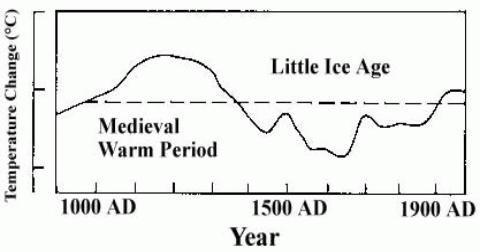
The issue is as follows: In their third report (“TAR”), the IPCC published the following graphii:

This is a graph of several temperature proxies, with the instrumental temperature record from around 1900 added. What it shows is that temperatures had been declining fairly steadily for nearly 1000 years, but then suddenly shot up in the 20th century.
It has now been discovered that some of the data series had been truncated in the graph. The result of these truncations was to make the data series look more consistent and therefore convincing. (NB. I make no statement about intent.). If the data series had not been truncated, the end result would have been very differentiii:

The two red segments are the truncated data. These two segments and the dotted curve connecting them are a single data series “Briffa-2000”1. Note that the first downward segment of the black graph (instrumental temperature) has also been deleted in the version used by the IPCC.
The extreme divergence between the “Briffa-2000” proxy and the instrumental temperature record shows that this proxy is completely unreliable (the “divergence problem”). To delete segments from the graph – especially without a prominent explanation – is bad scientific practice. Contrary to claims by various climate scientists, the deletions were not disclosed in the TAR. Nor was the “divergence problem” discussediv. As Professor Richard A Muller of University of California, Berkeley, has said “You’re Not Allowed to Do This in Science“v.
Was the “Briffa-2000” data series the only unreliable proxy data series? It seems not. Phil Jones’ 1999 “Climategate” email indicated that other proxy data series had been truncated to “hide the decline“vi.
It has been argued that this “hide the decline” graph (aka the hockey-stick) is not important in the overall scheme of things, ie. in climate science as a whole. Gavin Schmidt put it this way on RealClimate.com, “if cherry-picked out-of-context phrases from stolen personal emails is the only response to the weight of the scientific evidence for the human influence on climate change, then there probably isn’t much to it.“vii.
Unfortunately, the “hide the decline” graph is much more important than that. In the fourth IPCC report (“AR4”), the effect of solar variation on climate is discussed. Theories such as Henrik Svensmark’s are dismissed as “controversial” and then ignoredviii. Consequently, solar variation is included in the climate models purely as the direct climate forcing from total solar irradiation (TSI). Since variations in TSI are quite small, in percentage terms, the climate models allow only for small temperature changes from TSI changes.
Such small temperature changes are quite consistent with the “hide the decline” graph, because that graph shows only small temperature changes prior to the 20th century. If the IPCC had persisted with their original estimate of earlier temperatureix …

… then the climate models would have been unable to replicate the temperature changes in either the MWP or the LIA, because the total effect of all natural factors (including TSI variation) allowed for in the models is far too small. If the climate models were unable to replicate the MWP and LIA, then they would lack credibility, and any scientific conclusions based on the models could be disregarded.
But it gets worse.
With the “hide the decline” graph representing global temperature, the climate modellers had only one factor which could give a sudden upward movement in temperature in the 20th century – CO2. This was the only factor whose pattern changed significantly then and only then. The IPCC analysis is based on “equilibrium climate sensitivity” (ECS), which is defined as the equilibrium change in the annual mean global surface temperature following a doubling of the atmospheric equivalent carbon dioxide concentrationx. The way ECS was arrived at was to map the 20th-century temperature rise to the increase in CO2 concentration : “Estimates of the climate sensitivity are now better constrained by observations.“xi.
The IPCC and the climate modellers still had a problem: the scientific studies on CO2, and the physical mechanism by which it warmed the atmosphere, gave an ECS which was far too low. But the discrepancy was explained by climate feedbacks. A climate feedback is defined as follows: “An interaction mechanism between processes in the climate system is called a climate feedback when the result of an initial process triggers changes in a second process that in turn influences the initial one. A positive feedback intensifies the original process, and a negative feedback reduces it.“xii
This leads us to clouds. The IPCC state repeatedly that they do not understand clouds, and that clouds are a major source of uncertainty. For example: “Large uncertainties remain about how clouds might respond to global climate change.“xiii There are many statements along these lines in the IPCC report. Now simple logic would lead one to think that clouds would be a negative feedback:- as CO2 warms the oceans, the oceans release more water vapour, which forms clouds, which have a net cooling effect (“In the current climate, clouds exert a cooling effect on climate (the global mean CRF [cloud radiative forcing] is negative).“xiv).
But the IPCC report claims that clouds are a massive positive feedback: “Using feedback parameters from Figure 8.14, it can be estimated that in the presence of water vapour, lapse rate and surface albedo feedbacks, but in the absence of cloud feedbacks, current GCMs would predict a climate sensitivity (±1 standard deviation) of roughly 1.9°C ± 0.15°C (ignoring spread from radiative forcing differences). The mean and standard deviation of climate sensitivity estimates derived from current GCMs are larger (3.2°C ± 0.7°C) essentially because the GCMs all predict a positive cloud feedback (Figure 8.14) but strongly disagree on its magnitude.“xv.
The IPCC provide no mechanism, no scientific paper, to support this claim. It comes in some unspecified way from the climate models themselves, yet it is acknowledged that the models “strongly disagree on its magnitude“.
So, to sum up, the situation is that the “hide the decline” graph leads to nearly all of the 20th-century warming being attributed to CO2, thanks to a factor (clouds) which is not understood, is not explained, and comes from computer models which strongly disagree with each other. The inevitable conclusion is that without the “hide the decline” graph, the clouds “feedback” as described in the IPCC report would not have existed.
Now, returning to Gavin Schmidt’s comment. When he talks about “the weight of the scientific evidence for the human influence on climate change“, a very large part of that evidence is the IPCC report and everything that references it. But as I have just shown, the IPCC report itself relies for its credibility on the “hide the decline” graph. In other words, the entire structure of mainstream climate science depends on a single work which is itself based on methods which are “not allowed” in science.
So of course there are, in Professor Beddington’s words, challenges on the speed of change. If the MWP, which was of course completely natural, was about as warm as today, then it is entirely reasonable to suppose that natural factors are largely responsible for today’s warm temperatures too, and that the speed of change from CO2 has been grossly overstated by the IPCC.
Mike Jonas
References:
1 There are number of different versions of this graph, in the various IPCC reports and elsewhere, where different versions of the proxy data have been used.
viii http://www.ipcc.ch/pdf/assessment-report/ar4/wg1/ar4-wg1-chapter2.pdf para 2.7.1.3
ix http://climateaudit.files.wordpress.com/2008/05/lambh23.jpg (I could not provide a link to this graph in an IPCC web page, because earlier IPCC reports are no longer linked there. http://www.ipcc.ch/publications_and_data/publications_and_data_reports.shtml)
xi http://www.ipcc.ch/pdf/assessment-report/ar4/wg1/ar4-wg1-chapter9.pdf Executive Summary.
xiii http://www.ipcc.ch/pdf/assessment-report/ar4/wg1/ar4-wg1-ts.pdf para TS.6.4.2
The removed data around 1500 would certainly have changed the size of the error bars. The graph itself, showing a maximum error of +/- 0.4C 1000 years ago spell BS .
You would be hard pressed to measure the average temp of the earth today with any degree of certainty to within 0.4 C, there is too much regional and seasonal variability to simply assume the errors with “average out”.
RGates, please post where in AR4 is the validity of deleting data very robustly discussed? Was the graph also used in the summary for policy makers? If so please also show where this deletion of data was discussed.
I have seen that same line repeated a dozen times but not one person has actually stated where it is discussed, much less what was actually said.
All I see on the links you gave are hand waving by people saying that because no other proxy varies that much in the past from each other then it must unpresidented and a modern phenomena. Well it is either that or an artifact of the methods that created the graph.
Also, be honest with yourself. Pick another scientific field and rationalize the deletion of information becuase it might be possible that something else was causing a change in a part of the period that what you want to study. For instance, medical science. Is it ok to delete the adverse data from a graph that a drug helped people because it may be possible it was not your drugs fault that some people died while on it? No, you would be sued.
Unless you can show exactly why what the trees are doing recently is absolutly not possibly linked to what you are measuring (it is only a modern problem and no previous conditions could have happened that would cause a similar result), THEN you can change the color/line style of the graph to show a change or plot a second showing it removed. Otherwise you should show the graph as the data is produced or refrain from using that data to begin with.
Once again with feeling, if you delete data because you think it may, possibly, is likely to be wrong, you are cherry picking and that is not an ok method for scientists to use.
R. Gates; says 9.56
“Obviously, there was something wrong with the accuracy of what the tree-rings were showing, and so the data was, quite justifiably truncated…..”
No mention of the data removed from the 1500’s.
I’ve kept records of the growth of my great dane since it was a puppy and when I compare this with the growth rate of other animals there is a large correlation with other animals if I remove the beginning and ends of the data.
Does this mean that my great dane is a goat/sheep/calf? No it doesn”t, and therefore the tree ring data (all of it) cannot be used scientifically as a proxy unless the differences can be explained.
How Can be Changed The Climate Today ?
http://lluvias.unlugar.com/weather.html
[This guy has a future at the EPA. Check out his website. ~ Dave]
“‘‘It’s unchallengeable that CO2 traps heat and warms the Earth and that burning fossil fuels shoves billions of tonnes of CO2 into the atmosphere,””
Sure is unchallengeable as a statement of physical claptrap – a gas behaving like a capacitor, storing energy that Brownian motion can’t dissipate. What utter drivel.
Stilgar says:
March 28, 2011 at 2:46 pm
RGates, please post where in AR4 is the validity of deleting data very robustly discussed?
_____
Directly from AR4:
“This ‘divergence’ is apparently restricted to some northern, high-latitude regions, but it is certainly not ubiquitous even there. In their large-scale reconstructions based on tree ring density data, Briffa et al. (2001) specifically excluded the post-1960 data in their calibration against instrumental records, to avoid biasing the estimation of the earlier reconstructions (hence they are not shown in Figure 6.10), implicitly assuming that the ‘divergence’ was a uniquely recent phenomenon, as has also been argued by Cook et al. (2004a). Others, however, argue for a breakdown in the assumed linear tree growth response to continued warming, invoking a possible threshold exceedance beyond which moisture stress now limits further growth (D’Arrigo et al., 2004). If true, this would imply a similar limit on the potential to reconstruct possible warm periods in earlier times at such sites. At this time there is no consensus on these issues (for further references see NRC, 2006) and the possibility of investigating them further is restricted by the lack of recent tree ring data at most of the sites from which tree ring data discussed in this chapter were acquired.”
Many of you have, but some of you would be interested in the full section of the AR4 report dealing with this divergence issue (and many other fascinating temperature proxy issues). This section can be found at:
http://www.ipcc.ch/publications_and_data/ar4/wg1/en/ch6s6-6.html
Also discussed in the above referenced section is the whole notion of the uncertainty involved in the proxy data, and of course a whole discussion about the MWP period as well. Very important reading for anyone, skeptic or warmist alike, and since I’m a bit of both, I find it doubly interesting!
As far as getting into this kind of scientific detail in an executive summary– that’s not the place for such details. Where do you draw the line on what details to leave in and what to leave out then in such a “summary” report? The excutive summary is meant to be broad brush, and if they want it, the policymakers have the full report available to them, along with their scientific advisors, (who darn well better be reading the full report cover to cover).
The take away from this is that there was never an attempt to “hide” any valid data, and that divergence was fully discussed in detail, along with uncertainty in proxy reconstructions.
Leif Svalgaard says:
March 28, 2011 at 12:06 pm
“Scientists are not blind men, and do try to use all available data that are deemed good enough. This latter point is the crux of the matter. If too much of the data had to be deleted, better delete all of it in order to avoid confirmation bias [‘keeping what fits’].”
I agree with Leif’s intuitions. There are three things to consider: the known divergence, the fact that Briffa collected the data in the later years, and the fact that Briffa has published that he does not know why the divergence has taken place.
We now have fifty years in which the tree ring data has diverged from temperature data. Clearly, during those fifty years, tree rings have proved to be unreliable as proxies for temperature. Fifty years of divergence is reason enough to ask if the tree ring data was ever reliable. My guess is that the only information from the past is a record of tree ring dimensions with little or no information about the actual trees such as their condition, a description of the environment, and so on. With nothing more than a series of measurements, there is nothing in the record itself to speak for its reliability. So, the fact that fifty years has shown unreliability should cast doubt on what came before. But this is not the end of the story.
Briffa collected or was in charge of collecting the data for the last twenty or thirty years. Surely, he is confident in his own data collection techniques. Yet he has no specific reason to trust an older series of numbers handed down to him. So, he should extend his own findings to the testimony from the past. Unless.
Unless he knows what happened to the trees that explains the change. In his articles on the matter, he says he does not know the explanation. So, he cannot identify something that would explain the change. That is another reason for doubting the past testimony.
In summary, Briffa’s own work over a long period of time gives reason to doubt the reliability of tree rings as proxies for temperature. What he has from the past is just testimony about tree ring measurements and contains no metadata that would give reason to trust the old record. So, the doubt should affect both Briffa’s data the data collected before 1960. All of it should be tossed.
Cementafriend says: “It is amazing that no commenter here have read Dr Noor Van Andel paper …”
Unfortunately, I can’t make much use of use that paper, or any other like it. One of the intensely frustrating things about AGW, is that no matter how many papers such as Dr Van Andel’s that one may quote, the stock response is that that is only one paper and the great weight of evidence says otherwise.
The only way that I can see of dealing with this, is to show where the IPCC report – the great weight of evidence – goes wrong. Or at least, is on very shaky ground.
Jeff Alberts – yes I would like to ask them about tree-rings too, and a million other things. Hopefully someone else will.
R. Gates – I can’t act on your post-1960 assertions until you deal satisfactorily with the pre-1550 proxies and the pre-1900 instrumental record. You say that 1) Truncating both these periods was scientifically justified 2) AR4 discussed this truncation“. You will need to (a) explain how it is scientifically justifiable to truncate both ends of that data series while retaining the middle, (b) explain why the start of the instrumental record was also truncated, and (c) provide paragraph numbers or equivalent to the places in AR4 where all three truncations are discussed.
Sam Parsons says: “jeez is a troll peddling a pro-AGW, pro-IPCC snake oil…..“. Wow, that is some ad hominem. The point in science is that it does not matter who says something, what matters is whether what they say is supported by the evidence. I am happy to take jeez’s and anyone else’s comments on their merits.
TedK – “I apologize if the criticisms are blunt and seem harsh“. Absolutely not a problem. I need them to improve my document. I am acting on a number of your points. I’ll comment here on three, though:
TedK – “I fail to understand why you include a quote from Gavin Schmidt“. I made a statement that needed to be supported.
TedK – “modelers(sp)“. I try to use English.
TedK – ““Large uncertainties remain about how clouds might respond to global climate change.“xiii” – Fact. e.g.4, “There are many statements along these lines” Allusion; turn this statement into facts by identifying the many statements with references.“. Too bulky: http://members.westnet.com.au/jonas1/IPCCOnClouds.pdf
The iceman cometh says:
March 28, 2011 at 2:18 pm
“@ur momisugly Charles Higley – now that is a really interesting thought! What if all those Victorian chemists analysing bottle of gas were right, and the carbon dioxide concentration really was >400ppm?”
By the way, the only records of these early concentrations of CO2 are Phil Jones’ records, and the same is true for the early temperature records. Given what we know about Jones’ data handling abilities, all those records should be tossed.
Mike Jonas says:
March 28, 2011 at 12:53 pm
Leif Svalgaard – deleting the one proxy record doesn’t quite solve the problem. As I said, “Phil Jones’ 1999 “Climategate” email indicated that other proxy data series had been truncated to “hide the decline[reference]“.“.
“The referenced email said “I’ve just completed Mike’s Nature trick of adding in the real temps to each series for the last 20 years (ie from 1981 onwards) amd from 1961 for Keith’s to hide the decline.“. It seems that “each series” had the problem.”
Obviously, this is critically important. After Briffa’s graph is tossed, there should be investigations that would toss the other graphs. We could have done this a year ago if Climategaters and their Whitewashers were not acting like Bulldogs and resisting critics ferociously. If they would just begin practicing science, we would be at the bottom of this in a matter of weeks.
Mike Jonas says:
March 28, 2011 at 3:52 pm
“Sam Parsons says: “jeez is a troll peddling a pro-AGW, pro-IPCC snake oil…..“. Wow, that is some ad hominem. The point in science is that it does not matter who says something, what matters is whether what they say is supported by the evidence. I am happy to take jeez’s and anyone else’s comments on their merits.”
You do not know what an ad hominem is. In an ad hominem fallacy, someone responds to an argument by changing the subject and changing it to the speaker who stated the argument. If the ad hominem abuses the person who gave the argument then it is an abusive ad hominem. The fallacy occurs in changing the subject, not in abusing the speaker.
Some people are provably stupid. If you are giving actual reasons why a particular person should be judged as stupid then you are not engaging in any sort of fallacy at all. And if the person is provably stupid then arguing that he is so is not abuse but accurate description.
jeez advocates taking seriously the bulk of IPCC publications. All that stuff is past history. Your paper contains some main issues that need to be discussed now. The hockey stick is important and cloud forcings are important. But they need no support by reference to IPCC publications.
You just lowered my ranking of your paper to 1 on a scale of 1 to 10.
This is not a review, so moderators please feel free to delete.
I like to look at a scientific theory, which is presented as proven, from the point of view of the wonderfully poetic Nobel physicist, Niels Bohr, who said to his students:
“Every sentence that I utter should be regarded by you not as an assertion but as a question.”
As we know even the purity of Bohr’s models of atoms and molecules eventually started to be questioned as physicists realised that they still did not explain atomic structure.
The Parable of the Invisible Gardner (see Wiki) as told by John Wisdom seems to beautifully illustrate the CAGW argument:
‘It is often used to illustrate the perceived differences between assertions based on faith and assertions based on scientific evidence, and the problems associated with unfalsifiable beliefs. The tale runs as follows:
“Two people return to their long neglected garden and find, among the weeds, that a few of the old plants are surprisingly vigorous.
One says to the other, ‘It must be that a gardener has been coming and doing something about these weeds.’
The other disagrees and an argument ensues. They pitch their tents and set a watch. No gardener is ever seen.
The believer wonders if there is an invisible gardener, so they patrol with bloodhounds but the bloodhounds never give a cry.
Yet the believer remains unconvinced, and insists that the gardener is invisible, has no scent and gives no sound.
The skeptic doesn’t agree, and asks how a so-called invisible, intangible, elusive gardener differs from an imaginary gardener, or even no gardener at all.”
It is not the influence of man. Nature happened all on its own.
Some reference to temperature reconstructions using NO TREE-RING proxies at all would seem to be of interest here. Try:
http://www.meteo.psu.edu/~mann/shared/articles/MannetalPNAS08.pdf
Of course I know how many of you here dearly love Michael Mann, so some of you would probably just as well skip this report.
I can hear the trees falling in the forest of lies! Just an outstanding presentation. Just excellent! The author and all of should be mindfull, however, as this issue was never a scientific matter at all. It was a political scheme from stem to stern. As such, the propaganda icons like the phony ‘hockey stick’ will be defended despite the facts in the arena of public opinion.
An excellent presentation of the facts as stated so brilliantly above, still may not cut through the volume of noise created by the defenders of the faith.
Paul Krugman of the NYTs is out again claiming no impropriety in the “climategate emails.” (Krugman: No ‘Scientific Impropriety’ in ClimateGate – ‘Hide the Decline’ an ‘Effective Graphical Presentation’ http://newsbusters.org/blogs/noel-sheppard/2011/03/28/krugman-no-scientific-impropriety-climategate-hide-decline-effective- )
Tom Freidman of the NYTs has a vested interest in selling his Hot, Flat, and Stupid book, for example. Remember that the propagandists behind the hoax spent billions on the term “global warming” to sell the scam. The last 13 years of cooling have not helped their cause. Now we hear the loud voices of the faith claiming that a warming planet means a cooling planet.
So the faithfull followers of the globalony cult will continue undeterred and unabated. They have loud megaphones and access to media, and they pull the party line.
All that said, I do hear the trees crashing in the forest of lies. What must concern all of us is that excellent papers such as Mr Jonas’ are heard on all media and everywhere. Google has a gaggle of paid propogandists, Anthony Watts has us.
After all, if a tree falls in the forest, and no one hears it fall, did it make any noise in the first place?
Bravo Mike Jonas! Now it is up to the all of us to spread the good word!
Tony G,
The chart you asked about is from here.
‘‘It’s unchallengeable that CO2 traps heat and warms the Earth and that burning fossil fuels shoves billions of tonnes of CO2 into the atmosphere,” is false.
CO2 traps heat if the CO2 itself is trapped, but there seems to be no physical explanation why it would do so in the atmosphere.
It is however unchallengeable that the temperature lapse rate in the troposphere is due to pressurization by gravity.
@ur momisugly R.S.Brown March 28, 2011 at 9:37 am & Theo Goodwin March 28, 2011 at 3:54 pm
Please look at this site http://www.biomind.de/realCO2/realCO2-1.htm then go to papers where you can download a couple of peer reviewed papers. If you go to literature you will find a large number of references some of which you can download. Under history you will find an Excel file of data actually used in the paper concerning 180yrs of gas analyses. Unlike the hockey stick temperature curve and the hockey stick CO2 curve the data (ie real measured data not proxies or adjusted data) is there for all to see and make their own conclusions.
Leif Svalgaard says:
March 28, 2011 at 11:16 am
If you throw away as much as they did, you can have little confidence in any of it, and are better served by throwing it all out.
Leif, your comments are always apropos, so I wonder if you could give me your thoughts on a couple of things?
(1) It appears to me, studying the IPCC graph, that you could erase all the lines except the black Mann et al 1999 and have all the information. From the beginning of the graph until around 1600, if one were to shift the black line up and down about 0.4 degrees, one would map the uncertainty almost perfectly. After 1600 up until 1900 one only need to shift it around +/- 0.25 degrees. After 1900, who knows, but around 1925 it appears that the the anomaly was known with almost no uncertainty. Question: Why would the uncertainty band match the Mann line so well?
(2) Looking at the graph after 1600 – is it possible for the values of the red and green lines to be outside the uncertainty band for the same data?
I know I am probably just ignorant, so I thank you for your thoughts in advance.
Rob
Am I the only one not impressed with this paper? A scientific paper should present something new or a different take on something already out there. This is a light commentary on old stuff thst could have been compiled from wuwt posts on these proxy topics. I see no valuable contribution to the literature on climate science here, although this sadly seems to meet the specifictions demanded these days. The tree ring proxies have proven to be like using an elastic band for a ruler. Eventhough it seems a shame to abandon a discipline with the evocative title of dendrochronology which also graces entire academic departments and gives its name to proud dendrochronologists, it must be done. The rear guard action to preserve it (acknowledging but not explaining divergence etc) will fail as it did for alchemy, phrenology, geography and other previously august employments. Am I too harsh?
R. Gates quotes:
March 28, 2011 at 3:38 pm
Directly from AR4:
“This ‘divergence’ is apparently restricted to some northern, high-latitude regions, but it is certainly not ubiquitous even there. In their large-scale reconstructions based on tree ring density data, Briffa et al. (2001) specifically excluded the post-1960 data in their calibration against instrumental records, to avoid biasing the estimation of the earlier reconstructions (hence they are not shown in Figure 6.10), implicitly assuming that the ‘divergence’ was a uniquely recent phenomenon, as has also been argued by Cook et al. (2004a).”
The operative phrase is “to avoid biasing” the earlier work. Now, what could that possibly mean except that they had chosen not to reveal the recent work THAT HAD BEEN DONE BY THEIR OWN HANDS in deference to work by someone they do not know. Why does Briffa have such intense and overweaning self-doubt? He did not trust his own work? Did he ever offer some reason not to trust his recent work. It staggers the imagination that you can read the words you quote and not realize that the only possible reason for not showing his own work is to protect the older work because it supports the global warming narrative. I dare you to find some rational reason in Briffa’s work which could possibly explain why he mistrusted his own work. You cannot. So Briffa’s decision is inexplicable except for his desire to support the global warming narrative.
Briffa had twenty or thirty years to investigate these matters. But the last line of your quoted material says that he was “implicitly assuming that the ‘divergence’ was a uniquely recent phenomenon, as has also been argued by Cook et al. (2004a).” Implicitly assuming? What the heck is that? Could he not figure it out? Has he figured it out since then? I don’t think so. But the big point is this: while he has not figured it out, he has a duty as a scientist to report all the evidence. He did not report this evidence; that is, it did not show up in the important places such as in the hockey stick or Gore’s movie. If he knew about “hiding the decline” and let it pass, he is no less guilty of moral wrong than Jones and Mann.
At some point, you really should become embarrassed that you are here shilling for Climategaters and the IPCC. If all you are going to do is celebrate each and every decision that they made and do so in the face of obvious questions about the decision, then you show no interest in criticism whatsoever.
Cementafriend says:
March 28, 2011 at 5:36 pm
“Unlike the hockey stick temperature curve and the hockey stick CO2 curve the data (ie real measured data not proxies or adjusted data) is there for all to see and make their own conclusions.”
What makes you believe that this data was not assembled under the guidance of Phil Jones?
R. Gates says:
March 28, 2011 at 11:07 am
“Again, I think the most important point is WHY did the N. Latitude tree-ring data diverge so much when temperatures stared to rise (either pre-1550 or post-1960)? This is far more interesting a topic than looking at the actual obvious and scientifically justified need for “hiding the decline” of this proxy data which would have skewed the entire record for these periods.”
Would you please stop trying to change the topic? The topic is what Jones, Mann, Briffa, and The Team did in creating the hockey stick that they foisted upon an unsuspecting world. There is a subtopic about the tree ring data. That subtopic is: what did Briffa do as he rejected his own data in permitting the creation of the hockey stick? Briffa has never explained his behavior. Focus on that.
I haven’t checked all the comments, but I didn’t notice anyone picking up the error of the assumption that increased water vapor leads to increased clouds. There is only an obvious relation between clouds and relative humidity, not water vapor content. Unless relative humidity is sustained, cloud cover will decrease leading to a positive feedback. Many assume RH stays constant, but I believe that is an equilibrium state, and in the current state of oceans warming less than land, RH may decrease at first even as water vapor increases globally.
I think Dessler’s 2010 study is observational proof of a positive cloud feedback that was omitted here, and should be mentioned in a review of the subject so as not to look like cherry-picking.
Theo Goodwin says: “You do not know what an ad hominem is. In an ad hominem fallacy, someone responds to an argument by changing the subject and changing it to the speaker who stated the argument.”
As I read it, jeez made a comment, whereupon Sam Parsons said “jeez is a troll …”. That seems to fit your definition of ad hominem.
Theo Goodwin says: “You just lowered my ranking of your paper to 1 on a scale of 1 to 10.“. Excellent – an ad hominem implementation.
R Gates – I don’t think Mann 2008 is much help: “ABSTRACT: A new method is proposed for determining if a group of datasets contain a signal in common. The method, which I call Correlation Distribution Analysis (CDA), is shown to be able to detect common signals down to a signal:noise ratio of 1:10. In addition, the method reveals how much of the common signal is contained by each proxy. I applied the method to the Mann et al. 2008 (hereinafter M2008) proxies. I analysed all (N=95) of the M008 proxies which contain data from 1001 to 1980. These contain a clear hockeystick shaped signal. CDA shows that the hockeystick shape is entirely due to Tiljander proxies plus high-altitude southwestern US “stripbark” pines (bristlecones, foxtails, etc). When these are removed, the hockeystick shape disappears entirely.” http://climateaudit.org/2008/11/23/cant-see-the-signal-for-the-trees/
AussieDan,
As you can see Sam Parsons makes my point dramatically, why it can be so disheartening to try and raise the level of discourse here. It’s gratifying that Mike Jonas can see my point even if some the commenters do not have the reading comprehension skills required for online discussions.
Sam Parsons, many people here know who I am as my identity has been revealed multiple times. To call me a troll is quite humorous.
From reading all the comments, I’m reminded of the CRU email by dendro king Ed Cook which he sent to Briffa back in September 2003. At the end he summarizes, crudely (bad words partially sanitized by me):
Obviously Ed can’t bring himself to say such a thing publicly, because that would dilute the message, and the gravy train. This is the crux of the issue for me. The reconstructionists don’t even believe what they’re telling us. Why should I?