
By Joseph D’Aleo, CCM, AMS Fellow
INTRODUCTION
The US congress sub-committee on Energy and Commerce Committee held hearings on whether to restrict in some way the EPA’s regulatory authority relative to greenhouse gas emissions.
There were 7 scientists invited to testify. Three of the four who argued not to restrict the EPA played a key role in the last IPCC report (and will also in the next one) and generally started with the position that IPCC science was sound and there was a consensus of all real scientists.
In the attached analysis we take a look at the IPCC based science. We are going to ignore all the many ‘gates’ that were uncovered like the Himalayan glaciers, Amazon rain forests, how many real scientists there were who authored the key summaries and all the issues as to whether the summaries truly reflected the scientific information in the chapters and despite claims to the contrary, how a significant percentage of citations were not peer reviewed.
We will not attempt to address the issues of sensitivity for CO2 or solar and cloud and water vapor feedbacks relative to the models. We will also ignore the many model shortcomings – like inability to forecast regional patterns, ocean oscillations, etc. Each of these alone discredit the consensus ‘settled science claim.
We will focus on how actual data compares to the consensus science, model based virtual world view of climate.
We will look at some of the major findings, assessments or model predictions from the IPCC and other national climate centers and NGOs, that we believe have failed and let you decide then whether or not the their science and model projections should be the bedrock onto which we build public policy.
The ten issues:
1. Warming is said to be unprecedented and accelerating. It is neither.
2. Global warming is not GLOBAL
3. Winters would grow increasingly warm
4. The entire Northern Hemisphere would experience less snow and snowcover
5. The arctic oscillation (AO) would become increasingly positive, aiding in the warming
6. Global warming would lead to a permanent or semi-permanent El Nino
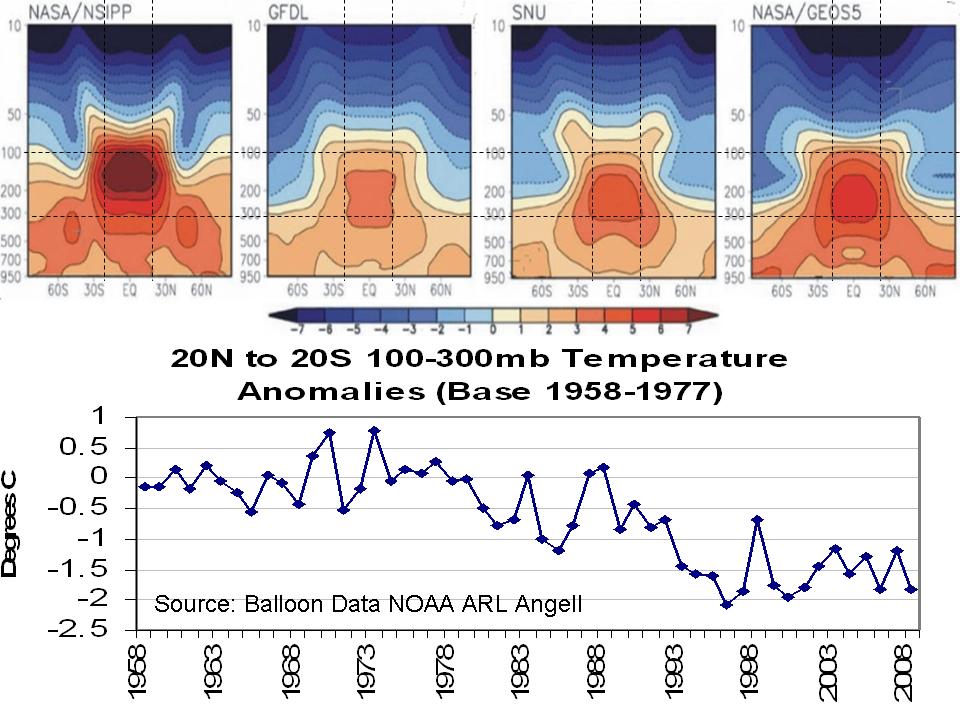
7. Atmosphere will warm faster than surface (because that is where the heat trapping gases are).

Enlarged. Balloon data for actual 100-300 mb from 20S-20N from NOAA ARL Angell (anomalies relative to base period 1968-1977) compared to models forecasts of warming 20S-20N 100-300mb. Note the cooling observed where models suggest most GHG warming. This is similar to depictions from Singer etal NIPCC 2007 and others.
8. Record highs and heat waves are increasing
9. Sea levels are rising at an increasing, alarming rate
10. Droughts and floods will worsen
We have actually made a list of 30 such ‘failures’ or ‘shortcomings’, but decided to focus on the first ten.
See the analysis part 1 and part 2.
R. Gates says:
March 22, 2011 at 7:14 am
“What is pretty certain is that we’ll see an ice free summer Arctic this century and equally as certain that the cause will be due to the 40% increase in CO2 since the 1700’s. Polar amplification of the AGW is one of the consistent forecasts as seen in the GCM’s, and we’ve seen it, and will continue to see it.”
Your terminology is improving. You used the word ‘forecast’ rather than ‘predict’. However, forecasts are extrapolated from the simulations not seen in them. As regards your use of the word ’cause’, I am afraid that is unjustified. If you know that CO2 causes a particular effect then you have the physical hypotheses that can be used to predict that effect. Do you have them?
Crispin in Waterloo says:
March 22, 2011 at 12:03 pm
“So what caused the ice-free Arctic in the years 900-1100 when the Siberian Inuit people moved rapidly East across the northern edge of Canada, wiping out the Clovis Culture and established fishing settlements on the north shore of Greenland?”
____
Much of what you wrote is pure gobble-dee-gook, but this bit about the Inuit’s wiping out the Clovis culture in 900-1100 is very interesting considering the Clovis culture died out during the Younger Dryas period about 11,000 years before the date you gave.
See: http://en.wikipedia.org/wiki/Clovis_culture
Other gooble-dee-gook points you made (which didn’t happen):
There was never a totally ice free Arctic that the Viking’s sailed. Yes, there as a period of lower ice extent and milder temperatures, but the first ice free Arctic ocean during the time that humans have been humans is coming up in the next 20-80 years…so stay tuned for that.
It is highly questionable the the Vikings even were able to completely circumnavigate Greenland, even though the temperatures were warmer for a period. See:
http://www.pbs.org/wgbh/nova/vinland/
If the waters entering the Arctic are now the warmest in 2,000 years, that would mean they are warmer than the time the Vikings were travelling there. Specifically, it appears the waters have warmed greatly these past two decades.
http://www.sciencedaily.com/releases/2011/01/110127141659.htm
Where’s all this warmth coming from if things are supposed to be cooling over these past 10-15 years?
Consensus is the rule and ignorance is abound. Nothing new.
Scientific instrumentation awarded to the lowest bidder in turn produces inferior equipment resulting in erroneous data. Erroneous data is then manipulated and poorly developed algorithms are applied. Data is used as evidence in order to propagate ideology.
In other words, “garbage in, garbage out”. Is this type of information important? Put it into perspective.
Observation, hypothesis, testing, and proof. This leads to Truth!
A falsifiable claim that has been proven to be accurate…
Have You Heard The Awesome News? Judgment begins May 21, 2011. In fact, the Bible guarantees it! http://bit.ly/aHmn99
Joseph D’Aleo,
I am greatly impressed with the energy you pour into the discussion. Many, including me, are re-vitalized.
Thanks for the article; it has caused a good discussion here.
John
Steven Mosher says:
“I will note that you have abandoned your argument about C02 and its effect on temperatures.”
I don’t know how you assumed that, but it’s not correct. As I wrote in my post above yours: “I have never stated that CO2 has no effect on temperature. My position has always been that the effect has been greatly exaggerated.” Maybe you missed that part.
And the central question must be whether CO2 will cause global damage, as has been repeatedly predicted, or whether the putative danger has been vastly overstated and hyped to support a political agenda.
So far, the lack of evidence of any global harm from CO2 indicates that it is a harmless trace gas. So unless and until the rise in CO2 is shown – with testable, measurable evidence – that it is actually a problem, then funding for the endless climate “studies” of global warming needs to be eliminated:
With $6 – 7 billion being wasted every year on global warming grants, studies, and Muslim outreach, NASA doesn’t even have the spare change to fund the Kepler space telescope for one more year.
Orbiting telescope Kepler is 1.4 metres in diameter, and in only 3 years it has discovered 68 Earth-sized planets around nearby stars, 54 of them in habitable orbits, plus hundreds more. But NASA doesn’t have $16 – 20 million to spare to keep Kepler operating for a fourth year. That is just one of the many failures of valuable science projects that results from the ongoing, evidence-free, money burning CAGW scam.
Now I know why I am still amused at this site. D’Aleo trying to find fault with scientists! What a travesty.
That was a good post, R. Gates and thoroughly debunks any “scepticism.” I don’t really think that you have any scepticism on this question. That was all put to rest a decade ago but a few deniers – they are not sceptics – still profit from their misrepresentations.
As for the criticism of your post that it takes only one failed prediction to make it wrong; it does not. And the reality is that there are no failed predictions. All ten are garbage and the product of a fevered mind.
If the committee had listened to the scientists instead of the fakes (they are fakes) there would not be any discussion of this at all.
Hired guns are not credible.
REPLY: and who pray tell, are the “hired guns” you speak of? – Anthony
Once again, I must ask R. Gates for clarification as to his statement regarding “cumulative”. What is cumulative? The heat? The anthropogenic CO2? What is cumulative? Your contention has mathematical correlates. Your statement can be tested. What is your mathematical equation for this accumulation?
Amused. says:
March 22, 2011 at 8:43 pm
Please accept my wonderment for having posting the most incredible dribble I have ever read on WUWT.
Pamela Gray says:
March 22, 2011 at 9:27 pm
Once again, I must ask R. Gates for clarification as to his statement regarding “cumulative”. What is cumulative? The heat? The anthropogenic CO2? What is cumulative? Your contention has mathematical correlates. Your statement can be tested. What is your mathematical equation for this accumulation?
______
Pamela,
Your question has come up often, and though I’ve answered before, I respect your inquiry and will attempt a simple explanation. One first has to start with the notion that the climate and weather both exhibit spatio-temporal chaos. They are, in the final analysis chaotic in nature. One has to understand that chaos does not mean random, but I’m sure you know this.
At any rate, we know, from ice-core data that the climate system is capable of going through very rapid changes with seemingly the slightest nudge. This is fairly new thinking (less than 20 years) as it used to be assumed that it took long periods of gradual changes to move the climate. We now know this is not the case.
But now, with this groundwork, let’s look at the how the cummulative effects of CO2 could cause a change in climate. I’ve used the analogy of a sandpile before when talking about a rapid change in climate and cumulative effects, and I think it is quite appropriate. You could use this sandpile analogy with the slow astronomical changes seen in Milankovitch cycles or with the slow anthropogenic increases in CO2– either one is appropriate as they both are effective because of cumulative changes, but because we are dealing with a chaotic system, those cumulative effects can happen rather suddenly. So in the sandpile analogy to look at these sudden changes brought about by cumulative effects, imagine you’re building a sandpile one grain at a time– slowly the pile starts to grow and everything seems fairly static. Then, at some point, with just the addition of one single grain, the sandpile collapses. This is because you reach a tipping point where the cumulative systematic friction of the entire pile is overcome by the delicate balance with gravity. So too, the earth’s climate can change with a cumulative effect over time suddenly changing the entire system to a new energy regime. CO2, as a GH gas, added each year by human activity is like a small grain of sand added to the pile. Some tipping point will inevitably be reached with CO2, and really, the only question is where that tipping point is– i.e. how sensitive is the climate to the addition of CO2 that humans are creating.
Really kind of points up the relationship between “hysteresis” and “hysterical,” doesn’t it?
Amused says:
“That was a good post, R. Gates and thoroughly debunks any ‘scepticism.’ ”
“Amused” doesn’t understand the scientific method. Skepticism is a requirement of the scientific method; it cannot be “debunked.” It can only be overcome with observation and evidence. The fact that there is no evidence showing any global harm due to CO2 confirms the scientific skeptics’ position that CO2 is a harmless trace gas.
Next, R Gates says:
“Some tipping point will inevitably be reached with CO2, and really, the only question is where that tipping point is…”
The black cat fallacy again. Gates is convinced that there is a black cat in his dark bedroom. But when he turns on the light… there is no cat.
There is zero evidence of any CAGW “tipping point” occurring. But that doesn’t stop the endless predictions of a mythical tipping point waiting right around the corner. Baseless predictions of tipping points keep the alarmist crowd all wound up. It’s their version of “This time it’s different.”
Smokey,
You’d do well to understand the quote:
“The dose makes the poison.”
As we’ve repeated over and over and over and over again, CO2 WITHIN A RANGE is just fine, both within your bloodstream and in the atmosphere. Go outside that range, and things that are not so friendly to current ecosystems (or the health of your body) will begin to happen.
Next, you apparently really still don’t understand how chaotic systems work, or grasp the fact that from Milankovitch cycles (which are gradual changes that bring about big changes) or CO2 levels, little tiny changes keep adding up eventually come to a point where suddenly the system tips and jumps to an entirely new energy regime. Ice Core data proves this is the case for our climate. Now using the image of a sandpile where you are adding one grain at a time to the pile and you do this for a long time until suddenly, you add just one grain and the pile collapses as the systematic and interrelated frictional forces are nudged just enough in the right direction by that one additional grain that the system begins to move rapidly into an entirely new state. The tiny increases in CO2 over the past few hundred years are like these grains of sand in the sandpile. And no model, and no currently (or perhaps ever) available math can predict when a simple sandpile will collapse– only that it WILL eventually if you keep adding grains of sand, and so to, no GCM can predict exactly when some tipping point will be crossed by adding CO2…only that eventually it will change the climate and warming is one of the ways.
By the way, a little side note that may interest some here– I keep using the metaphor of a sandpile and grains of sand when speaking about CO2 increases in the atmosphere over the past few hundred years, and it is interesting to note that in both the increasing frictional forces between grains of sand in a sandpile as the pile grows, and with the GH effects of CO2, the effects are logarithmic. Some have used the notion of the logarithmic effect of CO2 as “proof” that some maximum point of warming will be reach, but what they are not considering is the idea of the system reaching some threashold or tipping point where that smooth logarithmic rise suddenly jumps to a new level. We see this in all chaotic systems, with the problem being that there is no mathematical way to predict where that jump will occur. My point is, that something being logarithmic in effect, is not in and of itself indicative of the relationshiop of that effect to the bigger system or the possibility of tipping points if the system is chaotic.
Except in the south.
>>
R. Gates says:
March 22, 2011 at 11:59 am
Your argument fails on a logical basis. We don’t have to know all possible cause and effects of everything regarding earth’s climate to understand a specific chain of cause and effect that AGW is concerned with. The same effect can be produced by multiple causes, so you don’t have to understand all those causes to study the effects of just one potential cause. Specifically, we know that CO2 is a GH gas, and we know that humans have caused it to increase to levels 40% higher than they’ve been in the past 800,000 years. This is the only cause we need to concern ourselves with in asking the essential question of the entire AGW debate: How sensitive is the earth’s climate to the 40% increase in CO2 since the 1700′s?
<<
(I disagree with your 800,000 year statement, however . . . .) One effect that has to happen is the warming of the atmosphere. GHGs absorb energy–that’s how they work. Everything in the universe that absorbs radiant energy gets warmer, except the Earth’s atmosphere. If the atmosphere doesn’t get warmer, then it can’t heat the surface. It’s basic physics. Why the atmosphere doesn’t get warmer when GHGs are increasing is an interesting question that needs an answer.
If action A causes action B and action B causes action C, then we can say with confidence that action A causes action C. If increasing GHGs are action A, atmospheric warming is action B, and surface warming is action C, then there is no way to claim action A causes action C, because you don’t have action B. “Your argument fails on a logical basis,” to quote from someone you may agree with.
The models don’t give you any leeway in this matter. If the atmospheric warming isn’t at least 120% of the surface warming (my model says it’s more like 130% to 160%), then GHGs aren’t the culprit.
Jim
Jack Greer says:
March 22, 2011 at 8:27 am
steven mosher said March 21, 2011 at 9:54 pm”
“‘So, lets take a look at the actual evidence for the past 15 years.”
Steven, given the inherent characteristics/variability of the temperature data sets, can you please share your opinion as to the validity of using a 15 year time line to establish a trend, regardless?
##################
The document refered to a LACK OF WARMING IN THE PAST 15 YEARS
consequently, I looked to see if they backed up their claim. IN the first case they presented 15 years of data with no trendline. That is wrong. So I corrected that. When you look at the trend it is positive. The second chart showed 8 years of data. 8 years of data does not support a claim made about 15 years. So I corrected that. Again, we see a positive trend.
The question you have is entirely different. My question was “did these guys do a good job presenting their case?” Answer? No. The failed to cite a source that established the claim they were refuting and they failed to support the claim they were making.
Now, acknowledge those mistakes. When you do, then I will know that we can have a conversation.
To your question about 15 year trends.
“Steven, given the inherent characteristics/variability of the temperature data sets, can you please share your opinion as to the validity of using a 15 year time line to establish a trend, regardless?”
You can use any time period you like, provided you account for the uncertainties. A 15 year trend is a 15 year trend, plus or minus an uncertainty. The uncertainty will be higher than the one you get for 30 years. There is no mystery in this. There is a different question and that question is this: what does AGW predict for trends?
The trends are small enough ( .2C decade) and the noise and weather variability is high enough, that looking at short terms trends will not give you much insight. Sorry, thats the math. It will give you insight IF and ONLY IF the short term observed trend is wildly out of bounds. Currently, the short term trends ( say the past 10 years or so) are bordering on being “out of bounds” with prediction, that is outside a 95% CI. If the current temps hold or decrease, then we will have a couple of choices:
1. Find those elements of the system that are not being modelled correctly
2. Call it a rare event.
Nobody is happy with #2, but rare events ( rare warming or rare cooling) do occur.
Why? dunno.. that drives you back to #1.
So if the current trajectory continues or it gets cooler, then the solution or the approach will be to understand the problem better. It could any number of adjustments need to be made to models. If I build a model of car and I predict that slamming on the brakes will stop the car in 65.75 feet, and I test that and find that
the car stopped in 72 feet. I do NOT conclude that slamming on the brakes doesnt stop cars. I look at way I modelled tires.. did I account properly for the friction? for the way the friction changes due to increased temperatures? to the way the tire patch changes as I brake? I refine my model.. I get 67.75 feet. Brakes still stop cars. The heat of the tires still matters… Did I consider the wind? argg I have to go model that.
So you get the idea. Models are always wrong. because they are not reality. And controlled tests… are always limited.
Jim Masterson
” If the atmosphere doesn’t get warmer, then it can’t heat the surface. It’s basic physics. Why the atmosphere doesn’t get warmer when GHGs are increasing is an interesting question that needs an answer.”
that is not how the effect works. Energy is returned to space in one and only one way:
Radiation. The same way it came it. When we add GHGs to the atmosphere we make it optically “thicker”. The energy which wants to return to space via radiation has to fight through a finer and finer mesh of “windows”. This results in a delay in surface cooling.
The thicker the atmosphere, the longer the delay. The longer the delay, the less cool the surface can become. The surface isnt warmed, its cooling is delayed. You see that when you look at changes in the diurnal range.
>>
steven mosher says:
March 24, 2011 at 1:25 pm
that is not how the effect works. Energy is returned to space in one and only one way:
Radiation. The same way it came it. When we add GHGs to the atmosphere we make it optically “thicker”. The energy which wants to return to space via radiation has to fight through a finer and finer mesh of “windows”. This results in a delay in surface cooling.
The thicker the atmosphere, the longer the delay. The longer the delay, the less cool the surface can become. The surface isnt warmed, its cooling is delayed. You see that when you look at changes in the diurnal range.
<<
Then you disagree with Kiehl and Trenberth 1997? KT 97 is the basic GHG model. The atmosphere returns energy to the surface. It has to, or the surface can’t supply that 390 W/m². If delay makes it easier for you to understand, then fine. GHGs narrow the atmospheric window. In return, the atmosphere absorbs more outgoing radiation. It then radiates both upward and downward–but more downward. The downward radiation adds to the surface energy total which raises its temperature. If you have a different model, then please describe it for us.
One definition of optical depth is -ln(direct radiated/surface radiated).
For KT 97 it is -ln((40 W/m²)/(390 W/m²)) = 2.277.
Does that agree with your numbers?
Jim
This post reminds me of Michael Crichton’s novel, State of Fear, which I just finished reading. At the end of the Kindle edition are several talks he gave on the subject. I found them to be as interesting and entertaining as the book itself. Here are some quotes from those:
“I regard consensus science as an extremely pernicious development that ought to be stopped cold in its tracks. Historically, the claim of consensus has been the first refuge of scoundrels; it is a way to avoid debate by claiming that the matter is already settled. Whenever you hear the consensus of scientists agrees on something or other, reach for your wallet, because you’re being had.”
“Let’s be clear: the work of science has nothing whatever to do with consensus. Consensus is the business of politics.”
“There is no such thing as consensus science. If it is consensus, it isn’t science. If it is science, it isn’t consensus. Period.”
“Today, one of the most powerful religions in the Western World is environmentalism. Environmentalism seems to be the religion of choice for urban atheists. Why do I say its a religion? Well, if you look carefully at the core beliefs, you will see that environmentalism is in fact a perfect 21st century remapping of traditional Judeo-Christian beliefs and myths.”
“The fact is, an environmental movement is not very effective if it is conducted as a religion. Religions think they know it all, but the unhappy truth of the environment is that we are dealing with incredibly complex, evolving systems, and we usually are not certain how best to proceed. Those who are certain are demonstrating their personality type, or their belief system, not their state of knowledge.”