UPDATE: for those visiting here via links, see my recent letter regarding Dr. Richard Muller and BEST.
I have some quiet time this Sunday morning in my hotel room after a hectic week on the road, so it seems like a good time and place to bring up statistician William Briggs’ recent essay and to add some thoughts of my own. Briggs has taken a look at what he thinks will be going on with the Berekeley Earth Surface Temperature project (BEST). He points out the work of David Brillinger whom I met with for about an hour during my visit. Briggs isn’t far off.

Brillinger, another affable Canadian from Toronto, with an office covered in posters to remind him of his roots, has not even a hint of the arrogance and advance certainty that we’ve seen from people like Dr. Kevin Trenberth. He’s much more like Steve McIntyre in his demeanor and approach. In fact, the entire team seems dedicated to providing an open source, fully transparent, and replicable method no matter whether their new metric shows a trend of warming, cooling, or no trend at all, which is how it should be. I’ve seen some of the methodology, and I’m pleased to say that their design handles many of the issues skeptics have raised and has done so in ways that are unique to the problem.
Mind you, these scientists at LBNL (Lawrence Berkeley National Labs) are used to working with huge particle accelerator datasets to find minute signals in the midst of seas of noise. Another person on the team, Dr. Robert Jacobsen, is an expert in analysis of large data sets. His expertise in managing reams of noisy data is being applied to the problem of the very noisy and very sporadic station data. The approaches that I’ve seen during my visit give me far more confidence than the “homogenization solves all” claims from NOAA and NASA GISS, and that the BEST result will be closer to the ground truth that anything we’ve seen.
But as the famous saying goes, “there’s more than one way to skin a cat”. Different methods yield different results. In science, sometimes methods are tried, published, and then discarded when superior methods become known and accepted. I think, based on what I’ve seen, that BEST has a superior method. Of course that is just my opinion, with all of it’s baggage; it remains to be seen how the rest of the scientific community will react when they publish.
In the meantime, never mind the yipping from climate chihuahuas like Joe Romm over at Climate Progress who are trying to destroy the credibility of the project before it even produces a result (hmmm, where have we seen that before?) , it is simply the modus operandi of the fearful, who don’t want anything to compete with the “certainty” of climate change they have been pushing courtesy NOAA and GISS results.
One thing Romm won’t tell you, but I will, is that one of the team members is a serious AGW proponent, one who yields some very great influence because his work has been seen by millions. Yet many people don’t know of him, so I’ll introduce him by his work.
We’ve all seen this:
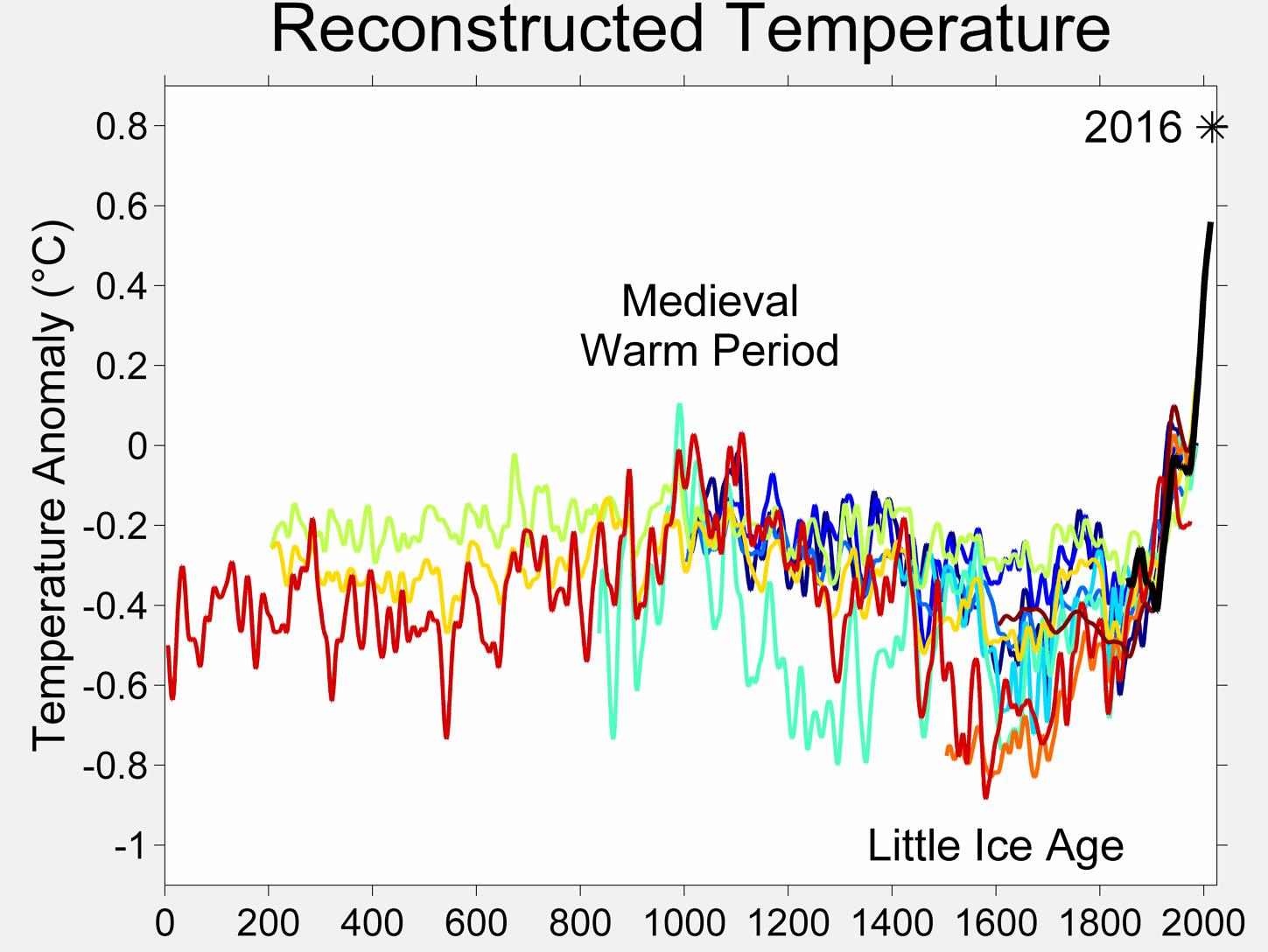
It’s one of the many works of global warming art that pervade Wikipedia. In the description page for this graph we have this:
The original version of this figure was prepared by Robert A. Rohde from publicly available data, and is incorporated into the Global Warming Art project.
And who is the lead scientist for BEST? One and the same. Now contrast Rohde with Dr. Muller who has gone on record as saying that he disagrees with some of the methods seen in previous science related to the issue. We have what some would call a “warmist” and a “skeptic” both leading a project. When has that ever happened in Climate Science?
Other than making a lot of graphical art that represents the data at hand, Rohde hasn’t been very outspoken, which is why few people have heard of him. I met with him and I can say that Mann, Hansen, Jones, or Trenberth he isn’t. What struck me most about Rohde, besides his quiet demeanor, was the fact that is was he who came up with a method to deal with one of the greatest problems in the surface temperature record that skeptics have been discussing. His method, which I’ve been given in confidence and agreed not to discuss, gave me me one of those “Gee whiz, why didn’t I think of that?” moments. So, the fact that he was willing to look at the problem fresh, and come up with a solution that speaks to skeptical concerns, gives me greater confidence that he isn’t just another Hansen and Jones re-run.
But here’s the thing: I have no certainty nor expectations in the results. Like them, I have no idea whether it will show more warming, about the same, no change, or cooling in the land surface temperature record they are analyzing. Neither do they, as they have not run the full data set, only small test runs on certain areas to evaluate the code. However, I can say that having examined the method, on the surface it seems to be a novel approach that handles many of the issues that have been raised.
As a reflection of my increased confidence, I have provided them with my surfacestations.org dataset to allow them to use it to run a comparisons against their data. The only caveat being that they won’t release my data publicly until our upcoming paper and the supplemental info (SI) has been published. Unlike NCDC and Menne et al, they respect my right to first publication of my own data and have agreed.
And, I’m prepared to accept whatever result they produce, even if it proves my premise wrong. I’m taking this bold step because the method has promise. So let’s not pay attention to the little yippers who want to tear it down before they even see the results. I haven’t seen the global result, nobody has, not even the home team, but the method isn’t the madness that we’ve seen from NOAA, NCDC, GISS, and CRU, and, there aren’t any monetary strings attached to the result that I can tell. If the project was terminated tomorrow, nobody loses jobs, no large government programs get shut down, and no dependent programs crash either. That lack of strings attached to funding, plus the broad mix of people involved especially those who have previous experience in handling large data sets gives me greater confidence in the result being closer to a bona fide ground truth than anything we’ve seen yet. Dr. Fred Singer also gives a tentative endorsement of the methods.
My gut feeling? The possibility that we may get the elusive “grand unified temperature” for the planet is higher than ever before. Let’s give it a chance.
I’ve already said way too much, but it was finally a moment of peace where I could put my thoughts about BEST to print. Climate related website owners, I give you carte blanche to repost this.
I’ll let William Briggs have a say now, excerpts from his article:
=============================================================
Word is going round that Richard Muller is leading a group of physicists, statisticians, and climatologists to re-estimate the yearly global average temperature, from which we can say such things like this year was warmer than last but not warmer than three years ago. Muller’s project is a good idea, and his named team are certainly up to it.
The statistician on Muller’s team is David Brillinger, an expert in time series, which is just the right genre to attack the global-temperature-average problem. Dr Brillinger certainly knows what I am about to show, but many of the climatologists who have used statistics before do not. It is for their benefit that I present this brief primer on how not to display the eventual estimate. I only want to make one major point here: that the common statistical methods produce estimates that are too certain.
…

We are much more certain of where the parameter lies: the peak is in about the same spot, but the variability is much smaller. Obviously, if we were to continue increasing the number of stations the uncertainty in the parameter would disappear. That is, we would have a picture which looked like a spike over the true value (here 0.3). We could then confidently announce to the world that we know the parameter which estimates global average temperature with near certainty.
Are we done? Not hardly.
Read the full article here
Eadler wrote:
“The fact is that AGW implies a larger increase in minimum night time temperatures, than daytime temperatures, because at that time, the downwelling radiation is the only factor sending energy to the earth’s surface since the sun is absent.”
And the anti-AGW counter-theory in fact implies that increase in nighttime temperatures is likely due to increase in concrete/asphalt jungle in surrounding areas, and reduction in impervious cover that reduces evaporative cooling. As result of lower albedo of pavement and associated increase in thermal mass, improved surfaces accumulate more heat during daytime, and cool off slowly at night increasing min readings. I am sure you must be familiar with this counter-argument.
eadler says:
March 7, 2011 at 5:26 am
sHx says:
March 6, 2011 at 10:41 pm
“It would make sense for Dr Menne to be a reviewer of the paper. It would improve the quality, assuming the editor is fair minded. In the case of the O’donnell the editor ended up publishing an improved version.”
Classic case of a conflict of interest. The concept is beyond eadler’s understanding.
“If you one attacks the institutions of science in the blogosphere, and then attempts to publish something, one should expect to get worked over a little. Scientists are only human. Turnabout is fair play.”
Humans are humans. Scientists are scientists. They are judged on different standards. Opposing the author of the paper that you are reviewing is not just a blow against another human, it is a blow against scientific method. For the latter, a scientist will pay for the rest of his life, the length of his reputation, and to the depth of his conscience. I hope someone keeps eadler away from younger students; otherwise, he will lead them straight to Hell.
Theo Goodwin says:
March 7, 2011 at 2:32 pm
“I hope someone keeps eadler away from younger students; otherwise, he will lead them straight to Hell.”
And he’ll do so instantly–on a radiative beam. Anyone who argues that “The fact is that AGW implies a larger increase in minimum night time temperatures, than daytime temperatures, because at that time, the downwelling radiation is the only factor sending energy to the earth’s surface since the sun is absent” should not be allowed to have any students, for he confuses radiative exhange with net thermal energy transfer. There is, of course, measurable LWIR backradiation from the night sky as part of that exchange, but the energy transfer is in the opposite direction. The unilluminated hemisphere invariably cools at night.
Bob Tisdale says:
March 7, 2011 at 10:05 am
eadler (March 6, 2011 at 4:33 pm): You provided a link to my post on the revised monthly OHC data and a link to an annual GISTEMP LOTI curve and you somehow call them similar. Have you actually scaled one and compared them? Do you know if the two curves are in fact similar, other than having positive trends?
Both having positive trends, to me, constitutes similar . It makes sense. The ocean is 70% of the earth’s surface and the heat capacity of the ocean is quite high. The surface temperature of the oceans even control the climate of the land. If the ocean is getting warmer , since warm water rises, the warming will be concentrated near the surface, where solar energy is absorbed. Ocean currents and oscillations will redistribute some of the ocean heat, so we won’t get the anomalies to scale exactly, but so what?
The advantage of ocean heat as an index is that there is no argument about records being influenced by the UHI.
Al Tekhasski says:
March 7, 2011 at 2:30 pm
Eadler wrote:
“The fact is that AGW implies a larger increase in minimum night time temperatures, than daytime temperatures, because at that time, the downwelling radiation is the only factor sending energy to the earth’s surface since the sun is absent.”
And the anti-AGW counter-theory in fact implies that increase in nighttime temperatures is likely due to increase in concrete/asphalt jungle in surrounding areas, and reduction in impervious cover that reduces evaporative cooling. As result of lower albedo of pavement and associated increase in thermal mass, improved surfaces accumulate more heat during daytime, and cool off slowly at night increasing min readings. I am sure you must be familiar with this counter-argument.
Comparison of rural only temperature data base, with the larger data base, shows that the temperature trends are the same. A number of papers have studied the UHI and found that it is not an important factor in explaining the increase in global average temperature.
http://www.fact-index.com/u/ur/urban_heat_island.html
* land, sea and borehole records are in reasonable agreement over the last century. [1]
* the trends in urban stations for 1951 to 1989 (0.10oC/decade) are not greatly more than those for all land stations (0.09 oC/decade)
* simlarly the rural trend is 0.70 oC/century from 1880 to 1998, which is actually larger than the full station trend (0.65 oC/century) (Peterson et al., GRL, 1999)
* the differences in trend between rural and all stations are also virtually unaffected by elimination of areas of largest temperature change, like Siberia, because such areas are well represented in both sets of stations.
A recent paper (“Assessment of urban versus rural in situ surface temperatures in the contiguous United States: No difference found”; J climate; Peterson; 2003) indicates that the effects of the urban heat island may have been overstated, finding that “Contrary to generally accepted wisdom, no statistically significant impact of urbanization could be found in annual temperatures.”. This was does by using satellite-based night-light detection of urban areas, and more thorough homogenisation of the time series (with corrections, for example, for the tendency of surrounding rural stations to be slightly higher, and thus cooler, than urban areas). As the paper says, if its conclusion is accepted, then it is necessary to “unravel the mystery of how a global temperature time series created partly from urban in-situ stations could show no contamination from urban warming”. The main conclusion is that micro- and local-scale impacts dominate the meso-scale impact of the urban heat island: many sections of towns may be warmer than rural sites, but meteorological observations are likely to be made in park “cool islands”
Theo Goodwin says:
March 7, 2011 at 2:32 pm
eadler says:
March 7, 2011 at 5:26 am
sHx says:
March 6, 2011 at 10:41 pm
“It would make sense for Dr Menne to be a reviewer of the paper. It would improve the quality, assuming the editor is fair minded. In the case of the O’donnell the editor ended up publishing an improved version.”
Classic case of a conflict of interest. The concept is beyond eadler’s understanding.
That would not be a conflict of interest. It is use of a person with expertise and a differing view to vet the paper, and improve the quality of the analysis and data, assuming the editor is doing his job properly.
A conflict of interest implies a monetary or personal motive which interferes with a person’s ability to be an impartial judge.
http://en.wikipedia.org/wiki/Conflict_of_interest
It would be undue bias if the editor who makes the decision, decides not to publish the paper because of personal animosity, or some other motive not related to the merits of the paper. It is OK if the reviewer has an opinion, if the editor can be impartial, and assigns multiple reviewers, which is normally the case with scientific papers.
eadler says:
March 7, 2011 at 4:55 pm
“Comparison of rural only temperature data base, with the larger data base, shows that the temperature trends are the same.”
Nonsense! One has to manufacture a data sausage spiced with an assortment of “adjustments” and “homogenizations” to get anywhere the same “trends.” But such cavalier mistreatment of actual measurements by the data-base keepers is what the AGW game–now in its second, spicier version–is all about.
@-Squidly says:
March 7, 2011 at 4:59 am
“…I no longer believe that CO2, or any other “greenhouse” gas can do as you claim. I no longer believe there is such a thing as a “greenhouse” gas, as a gas cannot A) trap anything, or B) back-radiate (which would be required).”
Your belief, or lack of it has absolutely zero effect on the empirically measured back-radiation from watwer vapour and CO2 that is monitered by this crowd…
http://www.bsrn.awi.de/
Note that their data includes clear spectra of the emitting molecules, H2O and CO2.
“…There is no evidence to support your point, either empirically or experimentally. This point also happens to be the very lynch pin of the entire AGW argument, for which again, there is absolutely no empirical evidence to support.”
Actually its the ‘lynch pin of the explanation of why the Earth is ~30degC warmer than it would be without an atmosphere. The physics is old, the theory of the (ill named) ‘greenhouse’ effect is around a century old and has not been refuted yet.
Certainly no alternative explanation has appeared which explains the surface warming of the Earth and Venus from the absorption of IR radiation by the atmosphere keeping the surface warmer than it would otherwise be.
The evidence for the atmospheric warming effect is widespread and easily accessed with modern media, your claim that there is ‘no evidence’ would seem to be the result of a lack or knowledge rather than a lack of evidence.
@izen:
And that ~30 C warmer was the same factor when we were “iceball earth” with higher CO2 levels and a temperature about 15 C colder than now? And that worked how again?
I think you have a problem trying to use dynamic data as a static proof (or: If you have a 1/3 or more error band on your “constant” it isn’t very constant… which implies the physics has an issue.)
Or would you like to rephrase that ~30 C to ~15C during Glacials (some of which have had higher CO2 than now…)
http://en.wikipedia.org/wiki/File:Vostok_Petit_data.svg
@-sky says:
March 7, 2011 at 3:54 pm
“There is, of course, measurable LWIR backradiation from the night sky as part of that exchange, but the energy transfer is in the opposite direction. The unilluminated hemisphere invariably cools at night.”
Yes, the NET energy exchange is from ground to space at night.
But the increased LWIR backradiation from the increased CO2 means the NET energy transfer is smaller than it would be without that radiative source.
Therefore the backradiation keeps the surface warmer than it would be without that extra ‘coat’.
Dave Springer says:
I’ll eat my hat if the BEST result isn’t essentially in agreement with NOAA and GISS.
I think you might want to make it a chocolate hat 😉
I’ve gotten an early description (i.e. not seen actual docs) of the approach and it looks reasonably clean to me. Many of the “icky” bits in GISS are not done as they are describing it. ( I was told not to share, so sorry, I can’t say specifics).
The biggest thing, for me, was the notion of “open source” and “close to the raw data” so we don’t get this jungle of who did what how many times in a row… and with more stations. ( I don’t know how many more, just that they intend a more stable approach to stations and splicing / homogenizing them). The list of ‘problems’ being addressed covers many of the ones that worry me the most ( so I hope they address them well) including the “station count” issue.
Basically, even from the little I’ve seen, I’m willing to wait and see what the data say.
FWIW, I expect they will find warming in line with GISS at the stations in the GHCN and find that other stations do not have that trend (though perhaps still warming, but much more slowly and with some cooling). Why? Because that is what I see when I sample the data directly. I’ve looked at a LOAD of individual stations. And that’s what you find.
http://chiefio.wordpress.com/2011/02/18/comparison-temperatures/
http://chiefio.wordpress.com/2011/02/18/fun-data-temperature-site/
jorgekafkazar says:
If it’s really science, then let the chips fall where they may.
It is. They will. If they fall ‘against my bias’, so be it. These folks are being open and honest.
However, I distrust temperature analysis as a means of determining whether the Earth as a whole is heating, cooling, or remaining the same.
Aye, now there’s the rub. How to get HEAT information out of TEMPERATURES while ingnoring things like mass, specific heat, dew points and vaporizations, etc. Also how do you average intensive variables and not lose meaning…
The challenge we face is measuring a very tiny putative drift in a widely-ranging signal with a high degree of chaos, superimposed on an ice-age rebound trend along with multidecadal swings and random volcanic spurts of largely unknown effect.
Yup. That whole 4 or 6 nested cycles all of them longer than 20 years problem…
My favorite “long cycle” is Bond Events. Cold excursions every 1470 +/- a bunch. One was in 2200 BC. The next about 800-900 BC. Then about 500 AD. Ought to be getting the next one just about, oh, now… So you measure from the bottom of one Bond Event and you get warming for about 1400 years. Is that a “trend” or a “cherry pick”? And any segment of that cherry pick is?…
BTW, there are “warming spikes” that come just before the equivalent of Bond Events during glacials (where they are recorded in ice better, so we see them). So might our recent past have been one of those?
http://en.wikipedia.org/wiki/Heinrich_event
And perhaps more importantly, how do you know?
http://chiefio.wordpress.com/2011/02/22/intermediate-period-half-bond-events/
But as the famous saying goes, “there’s more than one way to skin a cat”. Different methods yield different results.
Yes and putting a price on carbon is still the cat!
****
eadler says:
March 7, 2011 at 1:58 pm
Beng,
The fact is that AGW implies a larger increase in minimum night time temperatures, than daytime temperatures, because at that time, the downwelling radiation is the only factor sending energy to the earth’s surface since the sun is absent. In fact 2/3 of the increase in average temperature observed recently is because of increase in the nighttime minimum temperature.
If you desire to deny the AGW exists, then you clearly the best thing to do is to ignore the increase in the nighttime minimum temperature.
*****
eadler, you’re smarter than RPSr? Okay…..
Have you read & understood his papers? If you haven’t, let me explain them to you.
Nighttime lows, unlike daytime highs, are very sensitive to temp inversions (when winds are calm), which are highly influenced by the immediate surroundings. Simple changes like nearby buildings, trees, windbreaks, shrubs all can break-up the inversions to the extent of changing the nighttime low by many degrees (RPSr has the experimental setups that demonstrate it). This can happen even at locations w/no otherwise apparent urban development (and obviously can occur at any sites). The effects are difficult to even qualify, let alone quantify, even with a detailed analysis — the data to do so would have to be extensive, including pics of the site in time-succession and detailed wind records. Pretty much no stations have data of this quality. And moving the station makes this even more problematic.
Bottom line is since the daytime highs are not subject to this additional & unqualifiable bias — they are more accurate. Those unqualifiables in the nighttime lows simply make them less accurate. Your statement about how much GHG effect occurs night vs day is irrelevant — the most accurate record is what we’re after.
@-E.M.Smith says:
March 8, 2011 at 2:57 am
“And that ~30 C warmer was the same factor when we were “iceball earth” with higher CO2 levels and a temperature about 15 C colder than now? And that worked how again?”
If you mean the Ordovician ‘iceball earth’ era then you also have a much weaker solar output, the effect of ice albedo and good geological evidence that it wasn’t until CO2 levels increased that warming and the breakup of the ice cover happened.
“I think you have a problem trying to use dynamic data as a static proof (or: If you have a 1/3 or more error band on your “constant” it isn’t very constant… which implies the physics has an issue.) ”
I think you have a problem if you believe that a dynamic climate refutes the existence of the atmospheric effect of LWIR energy fluxes. There is nothing static about the effect of absorption mechanisms that transfer a proportion of the energy radiated from the surface into thermal energy of the atmosphere. The ‘greenhouse(sic)’ effect is not defined as a static effect, it is a dynamic process and part of the energy flux that shapes the climate.
There are no inherent constants implied. The three factors that mold the surface conditions are the input from the sun, the albedo of the earth/clouds/atmosphere exposed to the sun and the output of energy into space.
The first is independent of the other two. The second and third are shaped by the first, and interact with each other. None of this dynamic system complexity alters the role of the atmosphere in changing the emissivity of the earth. That inevitably alters surface conditions.
Otherwise we would have a climate like the moon…..
“Or would you like to rephrase that ~30 C to ~15C during Glacials (some of which have had higher CO2 than now…)”
None of the glacials in the 400,000 years covered by the graphs at the link you gave had higher CO2 than at the present. The last value for CO2 on the graph is from the vostok core, not present levels.
Perhaps you were thinking of much older events when solar output, land/ocean distribution and albedo feedbacks where very different.
Given the obvious correlation between the rise in temperature and the rise in CO2 and the knowledge that physical processes provide a mechanism for each to influence the other, does it not seem at least credible that CO2 had a role in the rapid warming from glacial periods rather than a refutation of the deduction?
eadler says:
March 7, 2011 at 5:11 pm
Theo Goodwin says:
March 7, 2011 at 2:32 pm
“A conflict of interest implies a monetary or personal motive which interferes with a person’s ability to be an impartial judge.”
It appears that English is not eadler’s native language nor Earth is native planet. Eadler, the author of a scientific article has powerful monetary and personal interests in preventing criticisms of his work from being published. In the case of Michael Mann, he cries for his mother whenever criticism of his work is suggested.
Eadler, if you have a monetary or personal motive that criticisms of your paper not be published then those motives render you incapable of being an impartial judge. Please return to your home planet.
izen says:
March 8, 2011 at 3:06 am
“But the increased LWIR backradiation from the increased CO2 means the NET energy transfer is smaller than it would be without that radiative source.”
Yes, that’s the common AGW belief. But CO2 is in no sense a “source” of radiation; along with all GHGs, it is merely an absorber/emitter–i.e., an energy disperser that is a slave of thermalized insolation. If you did a rigorous thermodynamic analysis of heat transfer from surface to atmosphere to space, you’d realize that the first stage of transfer is dominated by moist convection. If we had to rely on LWIR absoption by GHGs to heat the lower troposphere , the energy flow bottleneck presented by their miniscule mass would have prevented homo sapiens from developing. You seem unaware that the “inert” bulk consitituents, once heated convectively, also radiate a spectral continuum characteristic of their temperature.
eadler says:
March 7, 2011 at 5:11 pm
Theo Goodwin says:
March 7, 2011 at 2:32 pm
“A conflict of interest implies a monetary or personal motive which interferes with a person’s ability to be an impartial judge.”
It appears that English is not eadler’s native language nor Earth is native planet. Eadler, the author of a scientific article has powerful monetary and personal interests in preventing criticisms of his work from being published. In the case of Michael Mann, he cries for his mother whenever criticism of his work is suggested.
Eadler, if you have a monetary or personal motive that criticisms of your paper not be published then those motives render you incapable of being an impartial judge. Please return to your home planet.
The reviewers do not make the judgement on whether to publish a paper. It is the editor who needs to be impartial at the same time he insists on high standards. It is the editors who consider the comments and make suggestions on what should be done to improve the paper, and whether to publish it. If the editors have a conflict of interest, that is not good. That is not what was alleged in the case of O’Donnell et. al. The editor asked for some changes which improved the paper, and got it published.
Are you saying that only favorable reviews of papers should be sought by the editor? Almost every scientist gets paid on the basis of his output. Are claiming that they all have a conflict of interest, and should not be allowed to review a paper on a subject in which they have expertise, if they have a different opinon on the subject from the writer of the paper? Is this good for peer review, which is supposed to improve the quality of publications?
Instead of insulting a person who disagrees with you, why not read and understand the argument and make a reasoned reply?
beng says:
March 8, 2011 at 8:12 am
eadler, you’re smarter than RPSr? Okay…..
Have you read & understood his papers? If you haven’t, let me explain them to you.
Nighttime lows, unlike daytime highs, are very sensitive to temp inversions (when winds are calm), which are highly influenced by the immediate surroundings. Simple changes like nearby buildings, trees, windbreaks, shrubs all can break-up the inversions to the extent of changing the nighttime low by many degrees (RPSr has the experimental setups that demonstrate it). This can happen even at locations w/no otherwise apparent urban development (and obviously can occur at any sites). The effects are difficult to even qualify, let alone quantify, even with a detailed analysis — the data to do so would have to be extensive, including pics of the site in time-succession and detailed wind records. Pretty much no stations have data of this quality. And moving the station makes this even more problematic.
Bottom line is since the daytime highs are not subject to this additional & unqualifiable bias — they are more accurate. Those unqualifiables in the nighttime lows simply make them less accurate. Your statement about how much GHG effect occurs night vs day is irrelevant — the most accurate record is what we’re after.
It is well known that local conditions can influence nighttime low temperatures on clear nights through their influence on wind. This is not news. I have heard about it on weather forecasts since I was a youth. Temperatures will be lower at valley bottoms where there is no wind and the ground cools the air above it through radiation. This phenomenon will be suppressed as GHG’s increase in the atmosphere.
If we are trying to determine trends locally this phenomenon may add noise, but in the global scheme of things, it should not be a problem to determine a trend. The scientists who analyze the temperature record for anomalies , are on the lookout for discontinuities, some of which occur due to altered station environment, and if these occur in the nighttime temperatures they can flag it and correct for it.
There are those who claim that the Urban Heat Island Effect which is most pronounced at night, is corrupting temperature data, and is falsely indicating global warming. This idea has been found incorrect by climate scientists for a number of reasons. On reason is that nighttime temperature increases are the same on calm and windy nights.
eadler says:
“There are those who claim that the Urban Heat Island Effect which is most pronounced at night, is corrupting temperature data, and is falsely indicating global warming. This idea has been found incorrect by climate scientists for a number of reasons. On (sic) reason is that nighttime temperature increases are the same on calm and windy nights.”
What “climate scientists” find UHI to be “incorrect”? Name them, and we will see pigs gorging themselves at the public grant trough. Name them.
You wrongly presume that the UHI effect is due entirely to convection. It is not. The UHI effect also appears on windy nights due to radiation from asphalt, brick walls, buildings, etc.
I trust that Anthony’s upcoming paper will make these issues clear.
eadler wrote:
“If we are trying to determine trends locally this phenomenon may add noise, but in the global scheme of things, it should not be a problem to determine a trend. The scientists who analyze the temperature record for anomalies , are on the lookout for discontinuities, some of which occur due to altered station environment, and if these occur in the nighttime temperatures they can flag it and correct for it.”
In the global scheme of AGW theory of things it should not be a problem to determine local trends. Reality however begs to differ.
Take a look (as example) at 100-years-long record at Pauls_Valley_4wsw station (GISS id=425746490030). It shows a consistent warming trend of 0.7C/100y.
Then look at 100-years of data record at Ada station (GISS id=425746490040).
It shows 100 years of nearly straight cooling of 0.2C/100 years.
The funny thing is that these two stations are only 55km apart. (There are similar opposite-trendy pairs that are only 6km apart!). Obviously these pairs see the same weather, same seasonal swings, and are exposed to the same skies with the same alleged change in backradiation. Now go on lookout and explain how it is possible if man-made change in CO2 is so dominant in climate, in your “global scheme of things”. Please remember that these are 100-years-long trends, so the “noise” should “average out” in your theory.
I certainly hope that someone keeps in mind that we are probably still in a warming/recovery period from the Little Ice Age. We also have the UHI effects to consider. Given these facts, I would assume that at least a slight overall warming trend will be found. I am concerned that such a result would be immediately be jumped upon by the “alarmists” to reinforce and revalidate their battered CAGW claims.
Can you share any information concerning how these natural long-term trends might be separated from any actual “human” warming from CO2 increases?
Thank you for all of your hard work. Cheers!