Last update: 4 February 2011
by Klaus Wolter
The views expressed are those of the author and do not necessarily represent those of NOAA.

El Niño/Southern Oscillation (ENSO) is the most important coupled ocean-atmosphere phenomenon to cause global climate variability on interannual time scales. Here we attempt to monitor ENSO by basing the Multivariate ENSO Index (MEI) on the six main observed variables over the tropical Pacific. These six variables are: sea-level pressure (P), zonal (U) and meridional (V) components of the surface wind, sea surface temperature (S), surface air temperature (A), and total cloudiness fraction of the sky (C). These observations have been collected and published in COADS for many years. The MEI is computed separately for each of twelve sliding bi-monthly seasons (Dec/Jan, Jan/Feb,…, Nov/Dec).
After spatially filtering the individual fields into clusters (Wolter, 1987), the MEI is calculated as the first unrotated Principal Component (PC) of all six observed fields combined. This is accomplished by normalizing the total variance of each field first, and then performing the extraction of the first PC on the co-variance matrix of the combined fields (Wolter and Timlin, 1993). In order to keep the MEI comparable, all seasonal values are standardized with respect to each season and to the 1950-93 reference period. The MEI is extended during the first week of the following month based on near-real time marine ship and buoy observations (courtesy of Diane Stokes at NCEP) summarized into COADS-compatible 2-degree monthly statistics at NOAA-ESRL PSD. Caution should be exercised when interpreting the MEI on a month-to-month basis, since the input data for updates are not as reliable as COADS, and the MEI has been developed mainly for research purposes. Negative values of the MEI represent the cold ENSO phase, a.k.a.La Niña, while positive MEI values represent the warm ENSO phase (El Niño).
You can find the numerical values of the MEI timeseries under this link, and historic ranks under this related link. You are welcome to use any of the figures or data from the MEI websites, but proper acknowledgment would be appreciated. Please refer to the (Wolter and Timlin, 1993, 1998) papers (NOW available online as pdf files!), and/or this webpage.
If you have trouble getting the data, please contact me under (Klaus.Wolter@noaa.gov)

How does the 1998-2000 La Niña event compare against the seven previous biggest La Niña events since 1949? Only strong events (with a peak value of at least -1.2 sigma) are included in this figure. Note that some events last through the full three years shown here (for instance, 54-56), while others revert to “normal” or El Niño conditions by the second or third year (especially in 64-66). The 1998-2000 La Niña does not resemble any previous event in this comparison figure. It started late (about three months later than the previous latest case), and it featured a superimposed annual cycle (peaking around May and troughing around November) that does not match the other events displayed in this figure. However, the weak La Niña period after the 1982-83 El Niño had similar characteristics. Click on the “Discussion” button below to find the comparison of 2010 MEI conditions against several strong La Niña events.
Discussion and comparison of recent conditions with historic El Niño events

How does the 2002-04 El Niño event compare against the seven previous biggest El Niño events since 1949? Aside from 2002-04, only strong events (with a peak value of at least +1.4 sigma) are included in this figure. The 2002-03 El Niño event peaked below that threshold, with just over +1.2 sigma in early 2003. Overall, I would rank it just barely in the top 10 El Niño events of the last half century. In its evolution, it bears some resemblance to the 1965-67 event (highest temporal correlation), but shared with 1991-93 its reluctance to drop below the zero line once it had run its course. The El Niño event of 2006-07 reached a similar peak as the 2002-03 event, but lacked ‘staying power’, and collapsed in early 2007. The most recent event (2009-10) will replace 2002-03 in this comparison figure by the middle of 2011. Click on the “Discussion” button below to find the comparison of 2010 MEI conditions against several strong La Niña events.

The six loading fields show the correlations between the local anomalies and the MEI time series. Land areas as well as the Atlantic are excluded and flagged in green, while typically noisy regions with no coherent structures and/or lack of data are shown in grey. Each field is denoted by a single capitalized letter and the explained variance for the same field in the Australian corner.
The sea level pressure (P) loadings show the familiar signature of the Southern Oscillation: low pressure anomalies in the west and high pressure anomalies in the east correspond to negative MEI values, or La Niña-like conditions. Consistent with P, U shows positive loadings along the Equator, corresponding to easterly anomalies near the dateline. Negative loadings in the far western and eastern Pacific, as well as to the south of the positive loading center, show that westerly anomalies are almost equally pervasive in these regions during La Niña. The meridional wind field (V) features high negative loadings north of the Equator, denoting the northward shift of the ITCZ so common during La Niña conditions, juxtaposed with even stronger positive loadings northeast of Australia.
Both sea (S) and air (A) surface temperature fields exhibit the typical ENSO signature of a wedge of positive loadings stretching from the Central and South American coast to the dateline, or cold anomalies during a La Niña event. They are flanked by negative loadings (warm anomalies during La Niña conditions) to its southwest and, to a lesser degree, to its northwest. At the same time, total cloudiness (C) tends to be decreased over the central equatorial Pacific and on the northeastern flank of the South Pacific Convergence Zone (SPCZ), sandwiched in between increased cloudiness north of Australia and the eastern-most equatorial Pacific.
Now just past its annual peak, the MEI explains 31.6% of the total variance of all six fields in the tropical Pacific from 30N to 30S. Although its temperature components dominate the MEI with over 40% of their possible variance, even P, V, and C join in with about a third, a quarter, and a fifth of their variance, respectively, at or close to their peak values during the year. Thirteen years ago, when the MEI was introduced to the Internet, the explained variance for Dec-Jan 1950/51-1997/98 peaked amounted to 32.7%. This slight drop-off reflects the diminished coherence and importance of ENSO events in the last 13 years, bottoming out just two years ago with 30.9%. The loading patterns shown here resemble the seasonal composite anomaly fields of Year 1 in Rasmusson and Carpenter (1982).

Consistent with full-blown strong La Niña conditions, all of the key anomalies in the MEI component fields that exceed or equal one standard deviation, or one sigma (compare to loadings figure), flag typical La Niña features, while no comparable El Niño-like features reach the opposite one sigma threshold. Significant negative anomalies (coinciding with high positive loadings) denote strong negative sea level pressure (P) anomalies over the Maritime Continent (down to -3.2 standard deviations west of Australia), significant easterly anomalies (U) along the Equator and centered on the dateline, significant northerly anomalies east of Fiji, while both sea surface (S) and air temperature (A) anomalies continue at or above -1 sigma in the central and eastern tropical Pacific basin. Significant positive anomalies (coinciding with high negative loadings) denote significant positive sea level pressure (P) anomalies over the eastern subtropical Pacific, significant westerly anomalies (U) along the Pacific coast of Mexico, as well as over western Indonesia where they reach +3.4 sigma, significant southerly anomalies (V) are found west of Hawaii, and northeast of New Guinea where they reach +2.1 sigma, warm sea surface (S) and air temperatures (S) reach almost two sigma east of Australia and west of Hawaii, and significantly increased cloudiness (C) covers the western Pacific and the eastern-most equatorial Pacific where it reaches +2.3 sigma.
Again, all of these cardinal anomalies flag La Niña conditions. The only missing key anomaly is cloudiness over the central equatorial Pacific (which should be suppressed, but is not).
Go to the discussion below for more information on the current situation.
If you prefer to look at anomaly maps without the clustering filter, check out the climate products map room.
Discussion and comparison of recent conditions with historic La Niña events

In the context of the rapid transition of the MEI into strong La Niña conditions, this section features a comparison figure with strong La Niña events that all reached at least minus one standard deviations by June-July, and a peak of at least -1.4 sigma over the course of an event. The most recent moderate La Niña events of 1998-2001 and 2007-09 did not qualify, since they either did not reach the required peak anomaly (the first one) or became strong too late in the calendar year (both).
The updated (December-January) MEI value has strengthened slightly to -1.62 standard deviations after almost dropping below -2 standard deviations in August-September. Nevertheless, the most recent value ranks 2nd for this time of year, clearly below the 10%-tile threshold for strong La Niña MEI rankings , but slightly weaker than the value recorded in 1974. If one were to take the average of all MEI rankings since July-August (a six-month period), the strongest La Niña half-year periods of mid-55, ’73-74, and late ’75 averaged slightly stronger than the current event, for now (this is means Rank 4 for the current event, up one from last month).
Negative SST anomalies are covering much of the eastern (sub-)tropical Pacific in the latest weekly SST map. Many of these anomalies are in excess of -1C.
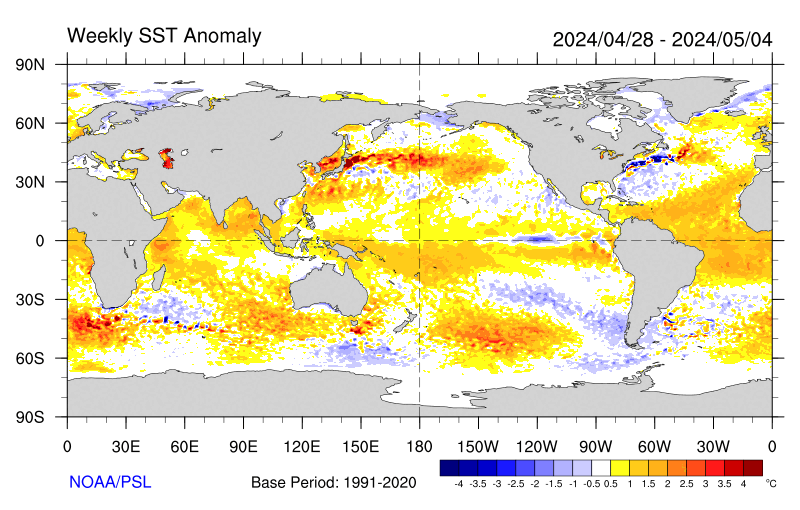
For an alternate interpretation of the current situation, I highly recommend reading the latest NOAA ENSO Advisory which represents the official and most recent Climate Prediction Center opinion on this subject. In its latest update (6 January 2011), La Niña conditions are expected to last “well” into the Northern Hemisphere spring of 2011.
There are several other ENSO indices that are kept up-to-date on the web. Several of these are tracked at the NCEP website that is usually updated around the same time as the MEI, not in time for this go-around. Niño regions 3 and 3.4 showed persistent anomalies above +0.5C from June 2009 through April 2010, with a peak of +1.6C for Niño 3 and +1.8C for Niño 3.4 in December 2009, only to drop to about -0.5C or lower in both regions by early June 2010, reaching just shy of -1.0C for the month of July, and near -1.5C since October for both Niño 3 and 3.4 anomalies.
One only has to go back to the La Niña winter of 2007-08 to find seasonal Niño 3.4 anomalies that were lower than this year’s, hence the reluctance of Niño 3.4-based classifications to call this event a ‘strong’ event. Nevertheless, the weekly SST anomalies in January 2011 were consistently at or below -1.5C, so that the three-month average should ‘qualify’ for the strong category based on Niño 3.4 SST. For extended Tahiti-Darwin SOI data back to 1876, and timely monthly updates, check the Australian Bureau of Meteorology website. This index has often been out of sync with other ENSO indices in the last few years, including a jump to +10 (+1 sigma) in April 2010 that was ahead of any other ENSO index in announcing La Niña conditions. After a drop to +2 in June, July rebounded to +20.5, followed by values between +16 (November) and +27 (December), including +20 in January 2011. The last time that this index showed higher values for the average of any six months was during the same half-year in 1917(!), so any SOI-based classification would classify this event as one the second-strongest event of the last century. An even longer Tahiti-Darwin SOI (back to 1866) is maintained at the Climate Research Unit of the University of East Anglia website, however with less frequent updates (currently through March 2010). Extended SST-based ENSO data can be found at the University of Washington-JISAO website, currently updated through May 2010 (which ended up just slightly below the long-term mean value).
Stay tuned for the next update (by March 5th) to see where the MEI will be heading next. While La Niña conditions are guaranteed well into 2011, it remains to be seen whether it can rally once more to cross the -2 sigma barrier, and/or whether it will indeed last into 2012, as discussed six months ago on this page.
I believe the odds for a two-year event remain well above 50%, made even more likely by the continued unabated strength in various ENSO indices.
REFERENCES
- Rasmusson, E.G., and T.H. Carpenter, 1982: Variations in tropical sea surface temperature and surface wind fields associated with the Southern Oscillation/El Niño. Mon. Wea. Rev., 110, 354-384. Available from the AMS.
- Wolter, K., 1987: The Southern Oscillation in surface circulation and climate over the tropical Atlantic, Eastern Pacific, and Indian Oceans as captured by cluster analysis. J. Climate Appl. Meteor., 26, 540-558. Available from the AMS.
- Wolter, K., and M.S. Timlin, 1993: Monitoring ENSO in COADS with a seasonally adjusted principal component index. Proc. of the 17th Climate Diagnostics Workshop, Norman, OK, NOAA/NMC/CAC, NSSL, Oklahoma Clim. Survey, CIMMS and the School of Meteor., Univ. of Oklahoma, 52-57. Download PDF.
- Wolter, K., and M. S. Timlin, 1998: Measuring the strength of ENSO events – how does 1997/98 rank? Weather,53, 315-324. Download PDF.
h/t to WUWT reader FergalR
Ok, that would be a major big deal. Normally during a La Nina, there are fewer clouds so the ocean actually gains energy but stacks it up in the Western Pacific Warm Pool and Indian Ocean. I noticed a week or so ago that these areas were oddly cool for a La Nina year. This would explain why. In fact, I wonder … was the 1998 El Nino anomalously clear? If that were the case it might explain why the “step up” in temperature after that event. And with this event being anomalously cloudy, we could be in store for a “step down” after this La Nina.
strange….. ALL of the Hansen prognostications are billed as official NASA reports…
So 2010 was a strong La Nina year which is contrary to what a lot of the pundits here have been saying.
This could then be a cold year with massive crop failures and multiple cold weather extremes.
May we even see a full year negative temperature anomaly ?
(At least with the data sets not tortured by climate activists and climategate team members.)
If you haven’t already checked out joe bastardi, give him a look. He is genuinely concerned that the next two or three winters will be very cold.
And you investor types, buy wheat/ grain futures and energy company shares..The really smart ones will be buying non marginal arable land. Buckle up folks, we are in for a really wild ride!
The ‘COADS’ link in the first paragraph does not work- did the author mean ICOADS?
http://icoads.noaa.gov/
Do I detect a thirty-year cyclical signal here? Up to 1976, the pattern dominated by cool La Ninas, then 1976-2006 the pattern dominated by warm El Ninos, now swinging back again?
…er, referring to a cycle whose TOTAL length is 60 years
One of the drawbacks to a multiyear La Nina is the additional recharging of the tropical Pacific warm water volume (above the 20 deg Isotherm) which can be thought of as a proxy for the fuel for the next El Nino, but so far the 2010/11 La Nina has not recharged it:
http://www.pmel.noaa.gov/tao/elnino/wwv/gif/wwva_std.gif
Graph is from the TOA project website:
http://www.pmel.noaa.gov/tao/elnino/wwv/
MMn please sun awaken and drive away the clouds.
PeterT says:
February 4, 2011 at 10:33 pm
> So 2010 was a strong La Nina year which is contrary
> to what a lot of the pundits here have been saying.
That is a disingenious (mis)interpretation. Ther was an El Nino during the 4th quarter of 2009 and the 1st quarter of 2010. There is currently a La Nina that started in the 3rd quarter of 2010, and is still going strong. Note also that ENSO is a “leading indicator” of global temperature anomalies, by a few months. So anomalies peaked around mid-2010 and are still falling.
> NOAA ENSO expert: “odds for a two-year (La Niña) event remain well above 50%”
I agree with him (or he agrees with me ). I pointed out here last year in post http://wattsupwiththat.com/2010/12/24/snowmageddon-ii-monster-blizzard-to-bomb-new-england/#comment-558623 that there is a 12-year pattern visible in Nino34 data. Simply invoking the 12-year cycle gets…
> After dropping into negative territory in the 2nd quarter of 1998,
> Nino3.4 didn’t go positive until the 2nd quarter of 2001. Assuming
> the 12 year pattern holds, Nino3.4 shouldn’t go positive until the
> 2nd quarter of 2013. And the next major peak will be late 2014.
That was over a month ago as a Christmas day prediction.
Lucy Skywalker says:
February 5, 2011 at 12:45 am
> Do I detect a thirty-year cyclical signal here? Up to 1976, the
> pattern dominated by cool La Ninas, then 1976-2006 the
> pattern dominated by warm El Ninos, now swinging back again?
I believe it’s called PDO (Pacific Decadal Oscillation). See http://jisao.washington.edu/pdo/
> Several independent studies find evidence for just two full PDO
> cycles in the past century: “cool” PDO regimes prevailed from
> 1890-1924 and again from 1947-1976, while “warm” PDO regimes
> dominated from 1925-1946 and from 1977 through (at least) the
> mid-1990’s.
Lucy Skywalker says: “Do I detect a thirty-year cyclical signal here? Up to 1976, the pattern dominated by cool La Ninas, then 1976-2006 the pattern dominated by warm El Ninos, now swinging back again?”
The data does not show a clear cycle. Refer to NINO3.4 SST anomalies smoothed with a 121-month running-average filter:
http://i43.tinypic.com/33agh3c.jpg
Sera says: “The ‘COADS’ link in the first paragraph does not work- did the author mean ICOADS?”
ICOADS is often referred to as COADS.
You mean their wonderful super models (computer type not girls) can’t predict La Niña and El Niño. Quel surpris. Toos a coin and you get 50-50. Wow a cheap super computer; a coin.
You see Dr David Whitehouse made this statement in an article here a few days ago.
“2010 was an El Nino year. Before I examine the monthly temperature for the year I thought it would be instructive to see what an El Nino year looks like. ”
What would motivate him to say that when data presented here suggest it wasn’t an El Nino year?
Lucy Skywalker says: February 5, 2011 at 12:45 am
Do I detect a thirty-year cyclical signal here? Up to 1976, the pattern dominated by cool La Ninas, then 1976-2006 the pattern dominated by warm El Ninos, now swinging back again?
Sure ’nuff. Obvious if you’re looking for it.
Thanks to Anthony & Klaus for such an interesting analysis.
One of the things that I find of interest is the periods that do not “fit” in to the most common tracks.
In the first top 7 chart the end of 70-72 being much higher than the rest at the end and 64-66 being much higher in the middle. Then again in the last of the charts 64-66 much higher in the middle , it would seem to be out of step with the rest of tracks. 70-72 again ends much higher than the rest as well.
I did not realise how much information went in to such a simple name as El Niño/Southern Oscillation (ENSO)
This whole argument about what is happening during “years” seems silly to me. A year is defined by mankind as return to an arbitrary date for man’s convience, not based upon what Gaia is doing.
Shouldn’t discussions about climatic data be based upon Gaia’s orbit, not mankind’s self-indulgent, arbitrary calendar?
Perihelion and Aphelion and candidates for end/beginning of Gaia years. Others could likely come up with other suggestions.
PeterT says: “What would motivate him to say that when data presented here suggest it wasn’t an El Nino year?”
The 2009/10 El Nino ended in 2010. The impacts on global temperatures typically lag NINO3.4 SST anomalies by 3 to 6 months, depending on whether you’re discussing surface temperatures (3 months) or lower troposphere temperatures (6 months).
Since ENSO events peak during boreal winters, it’s always best to describe them with the both years (or all years for multiyear events0, such as the 1997/98 El Nino and 1998/99/00/01 La Nina. It eliminates the confusion, but few people do it.
“One of the drawbacks to a multiyear La Nina is the additional recharging of the tropical Pacific warm water volume (above the 20 deg Isotherm) which can be thought of as a proxy for the fuel for the next El Nino, but so far the 2010/11 La Nina has not recharged it:
http://www.pmel.noaa.gov/tao/elnino/wwv/gif/wwva_std.gif
Graph is from the TOA project website:
http://www.pmel.noaa.gov/tao/elnino/wwv/
”
Bob – do you think this could be down the cloudiness factor that Crosspatch mentions? If solar energy is not able to compensate for the oceanic release of heat, then it seems that a temperature stepdown of some kind might well be expected; that assumes the cloud cover situation continues.
oceanic heat release from the previous el nino I mean.
Bob Tisdale says:
February 5, 2011 at 1:49 am
“The data does not show a clear cycle.”
How about your 31 yr filter? http://i54.tinypic.com/9gvyh0.jpg
There is a clear ~60 yr cycle and a weaker ~30 yr cycle
I would like to thank Klaus Wolter, Anthony and all the commentators for this very interesting post.
The subject is fascinating especially the implications about cloud cover. It will be very instructive to watch how this develops.