From the EPA might have something to say about that department…this press release from LNL suggests dumping tons of Calcium Bicarbonate as a byproduct of CO2 scrubbing into the oceans instead. Only one teeny little problem – most coal fired power plants (at least in the USA), aren’t anyway near the ocean.

Yeah, that’ll work. Ok I’ll give him a pass for saying it’s only applicable to plants near the ocean, but how many of those are there compared to the map above? Coal still rules.
| US Electric Power Industry Net Generation, 2009 |
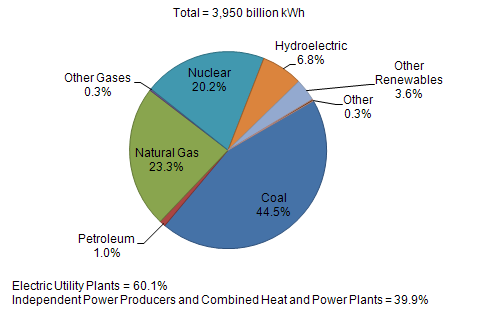 |
| Sources: U.S. Energy Information Administration, Form EIA-923, “Power Plant Operations Report.” |
================================================================
Speeding up Mother Nature’s very own CO2 mitigation process

LIVERMORE, Calif. — Using seawater and calcium to remove carbon dioxide (CO2) in a natural gas power plant’s flue stream, and then pumping the resulting calcium bicarbonate in the sea, could be beneficial to the oceans’ marine life.
Greg Rau, a senior scientist with the Institute of Marine Sciences at UC Santa Cruz and who also works in the Carbon Management Program at Lawrence Livermore National Laboratory, conducted a series of lab-scale experiments to find out if a seawater/mineral carbonate (limestone) gas scrubber would remove enough CO2 to be effective, and whether the resulting substance — dissolved calcium bicarbonate — could then be stored in the ocean where it might also benefit marine life.
In addition to global warming effects, when carbon dioxide is released into the atmosphere, a significant fraction is passively taken up by the ocean in a form that makes the ocean more acidic. This acidification has been shown to be harmful to marine life, especially corals and shellfish.
In his experiments, Rau found that the scrubber removed up to 97 percent of CO2 in a simulated flue gas stream, with a large fraction of the carbon ultimately converted to dissolved calcium bicarbonate.
At scale, the process would hydrate the carbon dioxide in power plant flue gas with water to produce a carbonic acid solution. This solution would react with limestone, neutralizing the carbon dioxide by converting it to calcium bicarbonate — and then would be released into the ocean. While this process occurs naturally (carbonate weathering), it is much less efficient, and is too slow paced to be effective.

“The experiment in effect mimics and speeds up nature’s own process,” said Rau. “Given enough time, carbonate mineral (limestone) weathering will naturally consume most anthropogenic CO2. Why not speed this up where it’s cost effective to do so?”
If the carbon dioxide reacted with crushed limestone and seawater, and the resulting solution was released to the ocean, this would not only sequester carbon from the atmosphere, but also would add ocean alkalinity that would help buffer and offset the effects of ongoing marine acidification. Again, this speeds up the natural CO2 consumption and buffering process offered by carbonate weathering.
Earlier research has shown that ocean acidification can cause exoskeletal components to decay, retard growth and reproduction, reduce activity and even kill marine life including coral reefs.
“This approach not only mitigates CO2, but also potentially treats the effects of ocean acidification,” Rau said. “Further research at larger scales and in more realistic settings is needed to prove these dual benefits.”
Rau said the process would be most applicable for CO2 mitigation at coastal, natural gas-fired power plants. Such plants frequently already use massive quantities of seawater for cooling, which could be cheaply reused for at least some of the CO2 mitigation process.
“This method allows a power plant to continue burning fossil fuel, but eliminates at least some of the carbon dioxide that is emitted, and in a way that in some locations should be less expensive and more environmentally friendly than other carbon dioxide sequestration methods,” he said.
The work, funded by the Energy Innovations Small Grant Program of the California Energy Commission and LLNL, appears in the journal Environmental Science & Technology.
More Information
“CO2 Mitigation via Capture and Chemical Conversion in Seawater,” Environmental Science & Technology
“Strengthening Our Understanding of Climate Change,” Science & Technology Review, December 2010
“Locked in Rock: Sequestering Carbon Dixoide Underground,” Science & Technology Review, May 2005
“The Siren Call of the Seas: Sequestering Carbon Dioxide,” Science & Technology Review, May 2004
I stand corrected.
kadaka (KD Knoebel) says:
Correction: A. Carbon Dioxide is identified as an Un-indicted Co-conspirator, due to a lack of a conclusive link between A.C.D. and any demonstrated damages.
The entire funding for this project from its inception until it is abandoned as stupid because CO2 is not a poison, must be funded by an amazingly heavy federal mileage tax on all electric cars. The electric cars will be multiplying all our power bills by X5 or X10 in a few years as electricity becomes more and more scarce and the price jumps accordingly.
It’s time the electric car greenies paid their fair share of the costs they cause on all of us.
Cquestering cites:
Kheshgi Haroon S “Sequestering atmospheric carbon dioxide by increasing ocean alkalinity”, 1995, Energy 20, 915-922.
Duh says:
January 20, 2011 at 7:32 am
Just ship it to the coats in diesel or coal-powered trains. Duh.
Whose coats would those be, Senor Duh?
Donut pots if yuh cont splel.
It would be interesting to see an overall energy balance and cost analysis for the CO2 capture process.
Think of the increased job opportunities. Several times as many trains/barges of limestone would be needed as trains/barges of coal, so the RR’s and barge companies would love it. Miners and truck drivers would benefit. More rail lines and roads would surely be needed so more people would be needed in construction and steel. New pipelines to the oceans would be needed, so pump makers, pipe foundries, etc., all would benefit. The benefits boggle the mind! We could be talking full employment for everyone. The only problem is, the cost of electric energy might need to increase a tad, like by a factor of three or four.
Carbon From The Deeps
Scientists believe that carbon released from the ocean floor played a key role in past episodes of climate change. Around 55 million years ago, the break-up of the northeast Atlantic continents was associated with the injection of large amounts of molten magma into seafloor sediments. Formation of the North Atlantic basalts heated the carbon-rich sediments, triggering the release of large quantities of methane and carbon dioxide into the ocean and atmosphere. It has been suggested that this release of previously sequestered carbon was responsible for a 100,000 year period of rapid temperature rise known as the Paleocene-Eocene Thermal Maximum or PETM. Three letters published in Nature Geoscience suggest that carbon trapped beneath the seabed continues to influence carbon dynamics, at least in the deep ocean
Once again, science is giving the public mixed messages. Researchers in one area propose “solutions” to global warming that ignore the dangers uncovered by other scientists. As Richard Feynman noted: “In this age of specialization men who thoroughly know one field are often incompetent to discuss another.” Nonetheless, governments are urged to charge ahead with “clean coal” and other carbon sequestration schemes.
Climate scientists and eco-activists, out to rein in human activity and make their personal reputations, form a collection of carbon cycle Don Quixotes. Tilting at global warming windmills, each of them, as Cervantes might have put it, is “spurred on by the conviction that the world needs his immediate presence.” None are more dangerous than the energetically ignorant.
Despite efforts to the contrary, more settled science has been unsettled, more consensus opinion overturned and our ignorance of the world around us revealed for all to see. Some scientists accept the truth—little is know about carbon from the deeps and its involvement in the present day carbon cycle. Being innocent of real understanding, we should look before we leap, rather than risk a major ecological or economic catastrophe in hopes of avoiding the unproven and ill-defined effects of anthropogenic global warming.
Be safe, enjoy the interglacial and stay sceptical
http://www.thegwpf.org/the-observatory/2243-carbon-from-the-deeps.html
Some have already mentioned the company, but here’s the Scientific American article on the subject of the “CO2 cement”.
http://www.scientificamerican.com/article.cfm?id=cement-from-carbon-dioxide
Wouldn’t it be cheaper to sequester this guys for the fish food? It would surely benefit the oceans too.
Obama’s War on Coal
Investor’s Business Daily, Jan. 19, 2011, reported that Obama is now going after coal mines.
Four years after obtaining a permit to mine coal in West Verginia, the Obama administration withdrew the permit from Arch Coal. No violation of the permit was noted. EPA explained that the mine employed “destructive and unsustainable mining practices that jeopardize the health of Applachian communities and clean water on which they depend”.
Just as Obama ordered EPA to find CO2 to be a pollutant, now he has ordered them to start closing down coal mining. As this new mine would likely use all the latest and best practices, can the closure of more mines be far behind? No coal, no CO2 problem. Also no jobs, no power, and an economy in ruins.
Bookmarked.
Oh dear, here we go again…
“when carbon dioxide is released into the atmosphere, a significant fraction is passively taken up by the ocean in a form that makes the ocean more acidic”…
“The ocean”, whichever one, will not become more acidic, simply because all sea water has never been acidic, as far as we know, and it certainly is not so now with a pH of between 7.6 and 8.2, depending on where you happen to be. It may become less alkaline, but, like most science, that’s debatable.
I’m sorry to say this again, but CO2 is a poison. It is a poison in very high concentrations. Since CO2 is heavier than air, people in a valley can, and have, died of CO2 poisoning. This is why pumping CO2 into the ground at high pressures is potentially dangerous. If the seals fail, a lot of CO2 could be suddenly released and in local low lying areas deaths could occur.