
Guest post by Dr. Walt Meier
Now that the summer is over, I thought people might be interested in a bit of retrospective of the sea ice melt season in 2010 and in the longer-term context. NSIDC provided a brief recap and the SEARCH Sea Ice Outlook will soon have their own recap. However, I can explain in a bit more detail and directly address some issues that arose here over the summer.
First, I thank Anthony for this opportunity and him and Steve for their frequent posts this summer, and for the handy sea ice reference page. It is nice to see climate and sea ice issues brought to an audience that might otherwise not hear about them. I hope the information will bring further clarity to some sea ice and polar climate processes. Some of the issues below, I at least touched on earlier this summer in posts here and here. As usual, I’m speaking for myself and not as a representative of the National Snow and Ice Data Center (NSDIC) or the University of Colorado.
Recap of summer predictions
I will start with a discussion of the prognostications from earlier this spring. In the June SEARCH Sea Ice Outlook there was fairly broad range of estimates, from 4.2 to 5.7 million square kilometers. If I remember correctly, Steve and Anthony’s estimates were 5.5 and 5.1 million square kilometers respectively. NSIDC’s initial estimate in June was 5.5 million square kilometers.
The first thing to point out is that none of the estimates approached the 1979-2000 monthly September average of 7.0 million square kilometers. Even the highest estimates were nearly 20% lower. This is a recognition that conditions have clearly changed since the 1980s and 1990s. It is no longer plausible to prognosticate anything near average levels. (For those who are curious, the 1979-2010 average, which of course includes the recent very low years, is 6.58 million square kilometers. Only one outlook (5.7 by Tivy) was within 1 million square kilometers of that value.)
NSIDC’s June estimate was too high compared to what actually happened. This is not at all surprising to me. We used a method that relies on past survival rates of ice of different ages. However, conditions have changed with the Arctic sea ice – the ice overall is thinner and less consolidated. Predictions based on past behavior are less likely to be valid. In other words, the odds of have changed. Steve’s prediction was based on a similar premise – the apparent similarity between winter 2006 and 2010 ice thickness patterns in the PIPS model.
Over the summer there was discussion ascribing the lower than predicted minimum extent primarily to ice motion. Ice motion indeed plays a role in the seasonal evolution of the ice cover as well as the interannual variation in the multiyear ice cover. However, to ascribe all or even the majority of sea ice changes to ice motion is simply wrong. As I discussed in my post earlier this summer, even in an extreme year like 2007, only a third of the extreme loss was due to anomalous ice motion. Over longer time scales, it has been shown that the Arctic Oscillation influences how much multiyear ice (MYI – ice that has survived at least one summer melt season) stays in the Arctic vs. how much leaves the Arctic over the winter, which in turn affects how much ice remains at the end of summer. For example, over the past winter, we had an extreme negative AO, which kept a lot of MYI in the central Arctic.
This summer was not particularly extreme in terms of ice motion. There were times during the summer where the ice pack was pushed together in some places, while at other times the motion was not a factor or even pushed the ice edge outward.
The importance of bottom and lateral melt
One factor that wasn’t discussed much is melt at the bottom and sides of the ice. This melt depends on the ocean temperatures. During summer when ice melts and open water is exposed, the ocean warms. The ocean accumulates heat which can then melt the ice, both along the edges (lateral melt) of the ice and on the bottom of the ice as currents move the warmer water under the ice and/or the ice is pushed over warmer water by winds. Most of the late season ice melt is due to lateral and bottom melt because the surface has cooled with the setting sun. This explains why even when the DMI air temperatures commonly discussed in the WUWT Sea Ice News, go below freezing around mid-August, there is still another month left in the melt season and extent continues to decline at least a few hundred thousand more square kilometers after mid-August. This year ocean temperatures were not as extreme as the past few summers, but there was still a considerable amount of ocean heat available to melt sea ice.
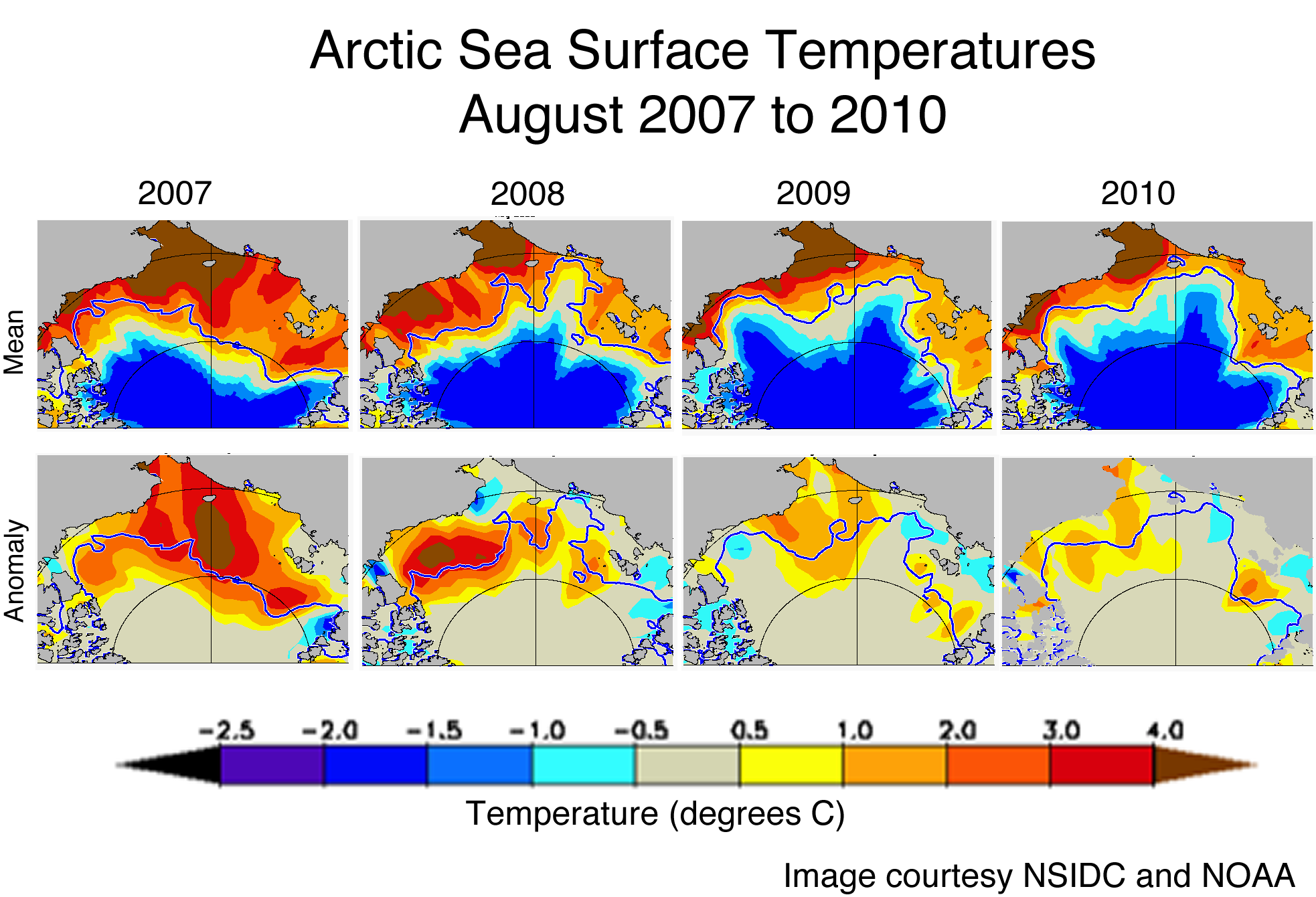
The bottom line is that while winds can make a difference at times, the overriding factor in seasonal and long-term Arctic sea ice decline is that warmer temperatures lead to less ice.
Why forecasts were too high
The biggest change in the ice over the past several years is that the ice is thinner overall than it used to be and there is less of the thicker, older ice. Another thing is that the old ice that remains is less consolidated – scattered floes of old ice with thinner, younger ice in between instead of tightly packed together. These factors affect the seasonal evolution of the summer sea ice in two ways. First, when the thicker, older ice is in broken up floes, it is more easily “attacked” on all sides by the ocean heat and can potentially be melted completely. Second, the less consolidated ice is more easily pushed around by the ice and more susceptible to winds pushing the ice together – in other words, the effect of the wind is amplified.
I think this is a major reason why a lot of the forecasts were too high. The tongue of mostly MYI in the Beaufort Sea completely melted out. In 2006, there was enough thick and consolidated ice to be vanguard against further ice loss, but by 2010 it was thinner and less consolidated and melted completely (Figure 1). This can be seen clearly in the ice age animation for the past year (Figure 2). The nice thing about these fields is that they show the effect of both motion and melt. If the extent decline were primarily motion, we would simply see the MYI in the Beaufort and Chukchi Seas get pushed together. Instead however, we see the older ice disappear over the summer, i.e., it melts (Figure 2).

Figure 1. Arctic sea ice age during March (left) and September (right) for 2006 (top) and 2010 (bottom). The color key denotes the age of ice (a value of “1” means first-year ice or ice that is 0-1 year old, etc.). Thanks to C. Fowler, Univ. of Colorado, for providing images.

Figure 2. Animation of sea ice age from September 2009 through September 2010. The color key denotes the age of ice (a value of “1” means first-year ice or ice that is 0-1 year old, etc.). The number in the lower right corner denotes the week of the year (1-52). Thanks to C. Fowler, Univ. of Colorado, for providing animation.
After the past couple of summers, there has been a build-up of young MYI – ice between 1 and 3 years old. It had been thought that this MYI would “buffer” the summer ice loss and keep extents from dropping too low. However, watch the animation (Figure 2) closely and see that the 3rd year ice (ice that is 2-3 years old, in green), dispersed and melted or exited out of the Arctic through the winter-spring of 2009-2010. So there was very little replenishment of the older ice. A lot of the 2nd year ice remained at the end of this summer, which has now aged into 3rd year ice. So maybe there’s hope for next year, but what we’re seeing is that the MYI just is not surviving like it used to. There is now almost no ice older than 4 years old remaining in the Arctic. This is a stark and fundamental change in the character of the Arctic sea ice.
PIPS vs. PIOMAS revisited
There was a lot of discussion earlier this year on the PIPS model sea ice fields vs. the PIOMAS model fields (e.g., here). At the beginning of the melt season, PIPS showed quite a bit of thick (3-4 m) ice throughout much of the Arctic Ocean, which wouldn’t be expected to melt completely. This portended less loss of ice during the summer. However, the PIPS fields did not agree well with the ice age fields, which showed less thick ice and a more dispersed multiyear ice cover. As it turned out, I think the PIPS were indeed to too thick, resulting in a forecast that was too high.
On the other hand, the PIOMAS total volume anomaly estimates were quite low going into the summer, indicating thinner ice and suggesting a low extent was likely. As I said previously, the volume seemed to me to be too low. Indeed, the PIOMAS forecast was lower than the actual minimum, though in the end it didn’t do a half-bad job in its prediction (4.7 predicted vs. 4.9 actual, in millions of sq km). To be sure, some of this could be attributed to luck, because there is always the wildcard of what the weather will do over the summer. Regardless, it is clear from the ice age, other ice thickness observations, and the overall state of the ice cover that volume is at or near record lows compared to at least the past 30 years. So while PIOMAS may be biased too low on ice volume, it captures the overall thinning trend and seems to better represent the actual state of the ice cover than PIPS.
Pre-satellite records of sea ice
Whenever I talk about “long-term” trends, I always see comments about how NSIDC’s data are only a 32 year record and hardly constitute “long-term” in the big picture of climate. This is a fair point. However unfortunate though it may be, that is all the data we have, at least in terms of a consistent and complete record. We have some data from earlier decades, but these are incomplete. For example, there was post earlier this week (October 16) about a recent book on longer-term sea ice changes in the 20th century. I read through this book earlier this year, so I’m familiar with it. As the title (“Climate Change in the Eurasian Arctic Shelf Seas”) states, the book analyzes data only the Russian shelf regions of the Arctic – it doesn’t include the central Arctic or U.S./Canadian Arctic, where a significant portion of the decline has occurred over the past decades. Their conclusions are drawn from data through only 2003, so with the recent low years since then, the observed patterns of variability may no longer hold. (There is a final section in the book on 2003-2008 sea ice conditions, but these data are discussed independently and are not incorporated to update their analyses earlier in the book.)
The book only superficially examines ice thickness changes (again only in the Russian shelf regions) and does not examine the recent thickness data from ICESat or the ice age fields. Finally, as it states in conclusion #2: “These cyclic oscillations of sea ice extent were superimposed on the background consisting of a negative long-term linear trend that characterizes gradual decrease of sea ice extent during the 20th century and the beginning of the 21st century.” In other words, even in the Russian data, there is a decline. The authors suggest this decline could be indicative of a longer cycle, but admit that such a conclusion can only be “conjectured”.
So while the book provides useful data (Russian information is often difficult to obtain), their conclusions about reasons for the changes in overall Arctic sea ice and the state of sea ice in the coming decades are more limited than the book seems to suggest. Andy Mahoney (a former colleague of mine at NSIDC) and others also analyzed the Russian data in a paper published in 2008 (Mahoney et al., 2008 – a brief summary is here).
Paleo records of sea ice
Even 100 years is still a fairly short period of time in terms of the history of the earth. However, in terms of climate change, such a period of time is enough discern the influence of large-scale forcing such as anthropogenic greenhouse gases. Nonetheless, it is useful to have longer-term data to understand climate history, particularly in terms of how sensitive various aspects of the climate system, such as sea ice, are to changes in climate forcings. We can obtain some information about earlier sea ice from proxy records, but it gets even more difficult to draw conclusions about conditions Arctic-wide.
For example, there was a post on September 23 about a 2006 paper discussing a proxy record indicating more extensive sea ice now than most of the past 9000 years. However, the paper is about a single record from a single location. It is very difficult to generalize from one isolated observation. As I mentioned in a previous post, the most recent and comprehensive analysis of all available proxy sea ice records, published earlier this year (Polyak et al., 2010 – note that Polyak is a co-author on the 2006 paper), indicates that current total Arctic-wide sea ice extents are likely lower than any time in the last several thousand years and are “not explainable by known natural variabilities”. The data are still sparse, but this is the best information we have at the moment.
The Northwest Passage, Northern Sea Route, and Circumnavigation of the Arctic
Navigation in the Arctic during the summer always gets a lot of interest. People point out that recent sailing expeditions through the Northwest Passage and Northern Sea Route (along the Siberian coast) are not unique in history. This is true. Amundsen navigated through the NWP in 1903, the Canadian vessel St. Roche went through the NWP a couple times in the 1940s. In 1969, the ice-strengthened freighter, USS Manhattan went through with Canadian icebreaker support. There were a few others before 2000. Many required icebreaker support or needed more than one summer to complete the journey (Amundsen needed nearly three summers). The Northeast Passage has been used by the Russians as an icebreaker-supported shipping route for many years and several ships have made the voyage.
However, this doesn’t mean conditions in the past were anything like today. They were not. While conditions will vary from year-to-year and I think it will be some time before either passage (especially the NWP) will be a reliable route, both passages have been far more open in recent years than in the past. What used to be a risky proposition, carefully navigating through narrow openings between ice floes, has in recent years become a mostly open water cruise with occasional ice (though still dangerous because even relatively small scattered floes of ice can damage a vessel). This year two vessels circumnavigated the pole through the two passages within one summer. In addition, several other vessels went through at least one of the passages this year. This is really quite remarkable and something I doubt anyone in the 20th century ever thought would be possible in 2010.
(Some complained when these expeditions were called “circumnavigating the Arctic” or “circumnavigating the Arctic Ocean” because they went south of Greenland. To technically circumnavigate the Arctic Ocean, one would need to follow the coast along the north coast of Greenland. This is true, but it in no way diminishes the feats nor does it contradict the reality that the Arctic is very different place than it was just twenty or thirty years ago.)
Antarctic sea ice
During the past Arctic summer, the Antarctic winter sea ice was showing some interesting behavior. As the Arctic ice declined, Antarctic ice went to much higher than normal levels. This caused a bit of a stir. It seemed like the Antarctic was headed to a record-shattering maximum. Alas, this did not happen. The extent went back to down to normal. Now it is again above normal. Such variability is characteristic of the Antarctic, especially in winter. The entire circumference of the Antarctic continent is surrounded by sea ice. Most of the ice is less than 1 meter thick, and much of it is less than 0.5 meters, particularly near the ice edge. This means shifts in currents and winds can quite quickly shift the ice edge in or out. So fairly dramatic ups and downs in Antarctic sea ice extent are not uncommon.
Nonethless, over the satellite record there is a small upward trend in overall Antarctic sea ice extent. The magnitude of the trend is much smaller than the Arctic (1-4% per decade vs. 3-11% per decade, depending on the month). And when you look at the spatial trends, where the decline is occurring, you see an interesting difference. In the Arctic, there is decline in almost all regions throughout the entire year (the Bering Sea during winter being the lone exception). In the Antarctic, all months are characterized by variation in the trends – in one region there is an increasing trend in extent and in another region there is a decrease (Figure 3). This is a clue that a main driver is changing circulation patterns, and indeed the changes in Antarctic sea ice have been linked to changes in circulation from the Southern Annular Mode (SAM – kind of an Arctic Oscillation [AO] for the southern hemisphere), for example in Turner et al. (2010) (key points can be read here). Circulation changes affect the Arctic sea ice too of course, particularly the AO, but the impact is even greater in the Antarctic because the ice is so thin and the ice boundary is completely open throughout the year (as opposed to the Arctic where for much of the year most of the ice edge borders the coast).

Figure 3. Trends in Arctic (top) and Antarctic (bottom) sea ice for (from left to right): September, December, March, and June. Red shades mean an increasing trend of sea ice; blue shades mean a decreasing trend. Images from the NSIDC Sea Ice Index. Other months show similar patterns and can be viewed using the Sea Ice Index browse tool.
But why has the SAM changed? Some scientists have suggested that a possible mechanism is the ozone hole. The ozone hole changes circulation high in the atmosphere, which then changes circulation at the surface. It is a plausible theory, supported by some evidence (discussed for example in Turner et al., 2010), but still tentative. Recently, there was paper (Sigmond and Fyfe, 2010) that showed results of a modeling study where the ozone hole did not increase sea ice in their model as had been expected (discussed here). It is rare these days that a single paper provides a final answer, so while the results are intriguing, it could be that the model is not capturing all the physical processes (e.g., the details of the interaction between snow and sea ice discussed below); or it could be that the model results are correct and a new explanation is needed.
Another study that was mentioned this past summer, discussed here, was the paper by Liu and Curry (2010) on the seeming contradiction that warmer temperatures over the Antarctic Ocean can lead to more sea ice (at least for a while). This seems counterintuitive, especially in light of my comment about the Arctic sea ice and temperatures above.
The key is that the Antarctic and the Arctic sea ice regions are very different places. In the Arctic, we have a relatively shallow, semi-enclosed body of water. There is a lot of freshwater from rivers input into the surface of the ocean. This less saline water floats on the surface, while heavier and warmer water sits below – in other words the ocean is stratified. That heavier water has a lot of heat in it, but it is difficult for the heat to reach the ice. The waters in the Antarctic are not well-stratified and there is a lot of potential heat from the ocean that can melt ice.
Another difference is that because the Arctic Ocean is almost completely surrounded by land, there is not as much moisture available and snow fall is relatively low. In contrast, Antarctica is surrounded on all sides by an ocean. While the middle of the Antarctic continent is a desert (because moisture cannot reach the high altitudes inland), the coastal and sea ice regions actually receive a lot of snow.
The snow has two effects. First, when it falls into the open ocean, it serves to freshen (and hence stratify) the surface layers. Then the more stable ocean surface makes sea ice formation easier by keeping more ocean heat below the surface. Second, when it falls onto sea ice it accumulates on top and “weighs down” the sea ice. With Antarctic sea ice being on average much thinner than the Arctic, it is not uncommon for the weight of the snow to push the top surface of the ice below the water line. When this occurs, the snow gets flooded by the ocean waters, which then freeze and form what is called “snow ice”. Effectively, the snow is converted to ice and thickens the ice cover.
When the atmosphere is warmer, it can hold more moisture, which in the Southern Ocean will fall as snow. This increase in snowfall then leads to more sea ice growth. This potential effect has been long known to scientists, and Liu and Curry’s paper is evidence that supports this idea (with the same caveats above that this is just one paper). Thus, warmer temperatures can lead to more sea ice. At least up to a point. If, as expected, temperatures continue to warm over the Southern Ocean, eventually the direct effect of the warmer temperatures will overtake the indirect effect on sea ice via snow fall, and Antarctic sea ice will begin to decline.
Conclusion
Though I don’t have time to read nearly all of the posts here and even fewer of the comments, I am often impressed by the interest and passion expressed therein. I’m sure I haven’t answered all questions about sea ice here, but I hope I’ve addressed many things that people have been curious about, particularly issues that have come up over this past summer.
References
Liu, J., and J.A. Curry, 2010. Accelerated warming of the Southern Ocean its impacts on the hydrological cycle and sea ice, Proc. Nat’l Academies of Science, 107(34), 14987-14992, doi:10.1073/pnas.1003336107.
Mahoney, A.R., R.G. Barry, V. Smolyanitsky, and F. Fetterer, 2008. Observed sea ice extent in the Russian Arctic, 1933-2006, J. Geophysical Research, 113(C11005), doi:10.1029/2008JC004830.
Polyak, L., and 17 others, 2010. History of sea ice in the Arctic, Quaternary Science Rev., 29, 1757-1778, doi:10.1016/j.quascirev.2010.02.010.
Sigmond, M., and J. C. Fyfe (2010), Has the ozone hole contributed to increased Antarctic sea ice extent?, Geophys. Res. Lett., 37, L18502, doi:10.1029/2010GL044301.
Turner, J., R.A. Bindschadler, P. Convey, G. Di Prisco, E. Fahrbach, J. Gutt, D.A. Hodgson, P.A. Mayewski, and C.P. Summerhayes, 2010. Antarctic Climate Change and the Environment, Scientific Committee on Scientific Research (SCAR), ISBN 978-0-948277-22-1. http://www.scar.org/publications/occasionals/acce.html
Oh dear, did I rattle your cage Mike?
How can anyone have credible evidence for any claim to know the future? One can only guess. That’s the point. It’s a cycle. What goes around comes around. My prediction is as plausible as any other. No one lives forever. That’s indisputable, unless, of course, you know better. So, 40 0r 60 years ahead, the Arctic probably will be back as it was 20 or 30 years. Be glad if it is, the climate could have reversed into another glacial period and brass monkeys will be looking for artificers in metal. “‘ere mister, do you do welding?” BTW, I know they would require brazing, but it’s a joke about a blacksmith working in the depths of winter. Knock, knock!
Thanks Walt for an excellent post. However, I think your conclusions about the future of Arctic sea ice are wrong, and the next 30(ish) years will see the ice return to 1970 levels, or beyond. This is because we are now on the down curve of a 60y sinusoidal cycle and the low minimum NH ice levels we have seen over the last few years is, along with a quiet sun, a sign the cooling has begun.
Tim F says:
October 21, 2010 at 11:54 am
“That oughta completely agree with Tomino’s ” The best prediction is from past behavior” theory.”
Wrong. Past behaviour theory only works for linear systems where all the variables can be accounted for. Sea ice levels are the result of a non-linear process driven by deterministic chaos and linear trends and past history have no predictive value.
I still haven’t seen an answer to the question of what impact increased icebreaker activity might have had on ice conditions.
Now offhand someone might argue that icebreaker activity only covers a small portion of the Arctic Ice each season but I believe that is being far too simplistic. Often small cracks can compromise the integrity of much larger objects particularly if that object is under large amounts of stress and pressure and undergoing significant amounts of movement like the Arctic Ice is.
After doing a bit of background reserach on ice breakers I found the first nuclear icebreaker was launched in 1959 and the first to reach the North Pole did so in August 1977 at around the time we started keeping satellite records. Russia now has 8 state owned nuclear icebreakers in operation.
I fail to see how a fleet of ships designed specifically to break and crush large quatities of the Arctic Ice they travel through cant have an impact on the overall stability of the Arctic Ice. Surely an ice pack broken into a dozen peices is less sound than one which is not. Any time you put a weakness into something that was once solid, it cannot be a good thing.
Another fantastic contribution from the amazing Dr. Meier. Think Schmidt, Hansen, Mann, or Jones would do the same or allow an immediate subordinate to do so? Those guys would be a lot less borish and garner far less contempt if they’d engage, respect others regardless of pedigree and camp lines, and perhaps hang themselves out for a little scrutiny via dialogue.
Comparing journeys through arctic waters 100 years ago, 70 years ago, and 50 years ago (approximately) with today ignores several obvious points. Today we have GPS, satellite imagery, and little boxes called computers helping our ships along. The stated point that sailing in arctic waters used to be harder ignores the amount of information a modern ship and crew utilize, not to mention modern ship building.
Also, I am always fascinated by well educated people’s “faith” in computer modeling. It works really well were you can control all of the variables and variable-by-variable adjust the model to fit the experiemnts. It doesn’t work at all well when you simply tweak “things” until the results are similar to something you can’t control. A model that fails to find expected warming due to the “ozone hole” can simply be tweaked into submission.
Gradual warming due (mostly) to natural causes explains everything we see in the arctic today. Add in a little soot, and I don’t know there is much left to explain.
Just my opinion, no disresepect intended. Thank you for the article.
bubbagyro says: at 9:14 am
Why do we continue to use 1979-2000 for averages . . .
http://ams.confex.com/ams/pdfpapers/26747.pdf
Title = UNITED STATES CLIMATE NORMALS FOR THE 1971-2000 PERIOD:
PRODUCT DESCRIPTIONS AND APPLICATIONS
The mandate to describe the climate was combined with
guidelines established through international agreement. The
United Nation’s World Meteorological Organization (WMO)
requires the calculation of normals every 30 years, with the
latest covering the 1961-1990 period. However, many WMO
members, including the United States, update their normals at
the end of each decade.
Note: the text above indicates the 1961-1990 period so this is an older paper. I don’t have a newer reference.
And as the decade is not yet over the “normals” are not yet recalculated.
This rule was, I believe, first established in the 1930s –that :
means = “normal” and that they will be based on 30 years with the 30th year having an ending zero.
The idea seems to have been that when your local radio or newspaper reported the daily temperature and the “normal” it would be something the listener/reader could relate to through personal experience. It would change to fit personal experience faster than if the “normal” were anchored to the entire history for the station that might extend back before anyone was born that would currently be alive.
Wow, so many questions! Thanks for all the input. Obviously, I can’t possibly answer everything. I’ll try to briefly answer at least a few. Sorry to those I didn’t answer (it’s not because they’re not good questions):
Tonyb (10/21, 12:25 pm): “Also as regards to the ozone hole, how do we know it hasn’t always been there growing and shrinking in a random fashion. We have only had the instruments to measure it since the late 1950′s. How do we know it wasn’t much bigger (or smaller) in previous centuries?”
This is a great question in that it encompasses something that I think is often misunderstood. The reason we know the ozone hole is different this time is that we know the chemistry. Scientists did experiments that demonstrated how under conditions in the Antarctic stratosphere, CFCs break down ozone. And studies were done that showed how CFCs emitted by humans work their way up into the stratosphere.
Likewise, we know that the climate changes we’re seeing today are different because we know the chemistry/physics. We know that CO2 and other gasses have a greenhouse effect on the earth and we know humans are emitting a lot of GHGs. The observations are in a sense just confirmation of the process and an indication of the how much of an impact the GHGs have on various parts of the climate. Paleo records are useful because they provide a long-term context and help bracket the sensitivity of climate to changing forcing, but aren’t necessary to “prove” AGW. Some scientists have suggested negative feedbacks that will attenuate the GHG effect and/or have suggested that the GHG effect will be smaller than the evidence suggests to most climate scientists, but evidence presented in favor of these ideas has not (yet) been convincing. Of course GHG-climate connection is more complex than the CFC-ozone connection, so the uncertainties are higher, especially when you get into socioeconomic issues like impacts and adaptation.
A few others:
Jeremy (9:18): The Cryosphere Today fields are ice concentration, not thickness – it is still data just from the surface. When the concentration is low that can indicate thinner ice, but not necessarily. Also, concentration is affected by melt on top of the ice, so lower concentration values may simply mean more surface melt water, not necessarily lower concentration. This is one reason why NSIDC focuses on sea ice extent (ice vs. no-ice).
Jack Savage (9:37): We’re still on-track for an almost completely ice-free Arctic Ocean by 2050, if not earlier. And though I didn’t address the issue, yes, soot/black carbon, have and still are playing a role in the loss of sea ice, though the amount is still uncertain.
Jim Cripwell (9:44): I don’t know when Cryosat-2 data will become available. There is always time needed for calibration and validation of the data. I suspect we’ll start hearing something soon. It will be a great resource for much better information on sea ice thickness, but I caution people about getting too excited. There are lots of uncertainties in the satellite data, particularly since this a relatively young technology. And of course it doesn’t provide a long-term (multi-decades) data record, though it could be very useful in terms of accurate initial conditions for seasonal forecasts.
Wes (10:14): Icebreakers have a negligible effect on the sea ice. Even with more icebreakers, the area they impact is very small compared to the overall sea ice cover.
Dan in California (10:43): Satellite data certainly helps make things safer (though ship radars are more important because a lot of the ice is too small to be seen by satellites). But conditions are much different. I suggest reading some of the tales of Amundsen or the Franklin Expedition compared to today’s experiences.
Kuhnkat (11:26): The decline in ice cover actually makes things quite a bit more dangerous. Before there was too much ice for most to even consider sailing in the Arctic, but with less ice there is much more temptation. But even small floes of ice can damage or sink a ship and when there is very little ice, what is there is more easily missed.
Mark r (1:12pm): Technically yes I suppose – increased snow going onto the ice or into the ocean would raise sea level. But it would only be an imperceptible amount – the amount of snow compared to the volume of the ocean is very small.
TomRude (1:32 pm): There is probably some 100 year, 50 year, etc. sea ice in the Arctic. “Ice islands” and some ice shelves like Ward Hunt) are actually sea ice that have thickened through the years (though a lot of the thickening comes from snow fall). These form as fast ice – ice that is attached to the coast and doesn’t move. But it only forms in relatively small protected bays where the wind can’t blow it away from the coast. The rest of the ice cover either melts during summer or moves with the winds and currents and eventually moves out of the Arctic where it melts. This process can take up to 10 years, but you won’t find much ice older than that in the Arctic.
Basically, there is a balance between growth/melt/export. Every year some ice grows and some ice melts. Normally, a little more grows than melts, with the excess moved out of the Arctic. But now, the balance has changed – we’re (on average) losing more ice than gaining in year.
walt
Mike this is the NOAA report Dr. Meier is part of… and since it’s covered by MSM it’s easy to understand how skewed it is…
Emphasis mine.
It seems to me that “only a third” is not an insubstantial fraction of the whole.
Welcome to WUWT.
I would not dispute that the Arctic has less ice cover than in the recent past. The data speaks for itself.
But I am curious to know how much the recent navigation through the Arctic waters have benefited from GPS technology and satellite imagery of ice extent. Technologically, they must have benefited from the full spectrum.
The opening of Arctic waters for sea transport ought to be welcomed. It’d have tremendous benefits for the world economy by shortening the route between East Asia and US & Europe. In fact, I am surprised that shipping merchants have not yet taken up the opportunity, and navigation in these waters continues to remain at “proof of concept” level. With the help of recent technology, a single medium or heavy ice breaker could lead a huge convoy of merchant ships to their destinations.
Maslanik eta al., sea ice age, week 17, 2010 (http://www.arcus.org/search/seaiceoutlook/2010/june): http://img153.imageshack.us/img153/644/fig2new2x.png
Maslanik et al., sea ice age, week 17, 2010, as showed in the frame used in the animation above: http://img836.imageshack.us/img836/4473/172010anima.gif
Look the changes from green (MYI) to blue (FYI) in the area near the Pole, north Greenland and Svalbard… ????????????
There seems to be a spike in fall temps regularly. I clearly remember this last year and the warmistas using it as *proof* of something or other. It was a big freeze year last year, and I am going to bet on another this year.
Thank you for your insights Dr Meier.
One question that’s often puzzled me is whether the world’s navies are contributing data to sea ice thickness, especially in the Arctic where it’s been a more sensitive subject. Ice thickness has always been of interest, and for quite a while, they were the only people really collecting data. Has this been incorporated into the historical records for Arctic ice?
Walt Meier says:
October 21, 2010 at 4:00 pm
Commenting with equal scientific precision, yes, “humans are emitting a lot of GHGs,” but relative to GHGs from natural sources, the amount emitted by humans is minuscule and not sufficient to have a controlling effect on climate trends.
There is not a single observation, other than perhaps elevated temperatures measured in urban heat islands (which, by the way, cover a minuscule portion of the surface of the Earth) relating to global or arctic climate trends that permit anyone to discern whether a given aspect of the climatic is caused by humans or nature.
There is not even a single observation that proves “how much of an impact the GHGs have on various parts of the climate.” The applies to natural and anthropogenic portions of GHGs and to both combined.
Your assertions to the contrary are not supported by observations.
Sorry, “The applies” should read “That applies”.
Week 30, end of july 2010. Then (http://www.arcus.org/search/seaiceoutlook/2010/august#pan-arctic) and now (in the animation provided by Walt Meier):
http://img821.imageshack.us/img821/7995/animateanda.gif
The same week, and the ice a lot younger…
Astonishing…
If I could get a taxpayer grant; then I could go and get the answers to my questions myself; and probably have some fun doing it.
But absent any rebuttal I will just assume that I am right on the money.
Dr. Meier : There was also a prediction of 1.0. Mine (to my humilation).
Nonetheless, I congratulate you on not sneering at me … actually, I made so radical a prediction for a Reason – – I felt the stong pacific Warmth (El Nino) would melt ALL the ice except the really thick shelves, which had not detatched from land in 4100 years.
… Then they did. As that wondrous Animation shows.
Nonetheless your reliance on the Arctic being influenced by MANY factors proved a better Model.
Nonetheless, I am curious about your Sea surface temperature — the Danish seemed MUCH higher relative to all other years save 2007. Albeit your map seems more in line with how the melt went in July & early August. Where do you get your Sea Surface Temperatures ? Is it a Publically available map ? .
Thanks.
But why has southern ocean sea ice been so stable? You say global warming will either make it go up or down, it is actually doing neither.
A nice presentation, Dr. Meier.
A few caveats about the similarites and dissimmilarities between the Arctic & Antartic.
The temperature 80N stayed lower longer than anything since 1958.
The Sea Ice Extent in the Antarctic reached Maximum earlier and has stayed up at that level longer, and has yet to come down.
These two conditions, plus the oncoming La Nina in major portions of the Pacific (spreading) has forced warmer waters up North.
This is temporary (warmer water forced North). TSI is flat, and is not moving upwards, and that has to factor into the ocean heat supply over time.
Somebody has to be right and somebody has to be wrong in this controversy, but I do appreciate you putting your best hand at the wheel. I look for a turnaround in the Global Sea Ice anomaly to be part & parcel of the recovery from 2007 plunge.
First Target: 22M km^2
Thanks Dr Meier,
I’m going to add to the long list of questions in the comments.
1) On the tongue of ice I wonder the relevance of this type of analysis. Saying the ice behaved differently to 2006 (n=2) is hardly enlightening. I had a look at the Sept ice extents using the Cryosphere Today comparison tool. You’re obviously not saying 2010 is unique with respect to this ‘tongue’ melting’ but you are suggesting it’s a standout feature, to what extent is that claim scientific without a greater historical perspective? Looking at the final extents going back a decade or two 2005 stands out where a similar tongue survived like 2006. Many of the other years where the Beaufort Sea melted to any great extent seem to show no evidence of this feature, mainly featureless straight final extent like 2010, 1999 is a good earlier example. I know this is crude, the intention was to highlight a point. It can seem that at times arctic ice researchers are prone to extrapolating too much. Do you think this is a problem? I will say though that the 30year downward trend in the satellite data is the most important feature of the data and something I’ve critisised WUWT for ignoring.
2)These comments are all probably overlapping in some way. The arctic sea ice is a constantly replenishing system. My understanding is ice is rarely much more than 6 years old. This must mean that eventually all MYI is lossed in some way. Surely the huge clearout in 2007 must still be weighing heavily on arctic sea ice conditions today and probably will for a few years to come. You may not wish to comment on other scientists work but I’ve seen some work and quotes in the news (Christian Haas stands out) who suggest that little has changed since 2007. I’m sure you know he goes out in planes and measures ice thickness. He’s certainly not in the sceptic camp and recognises the long term trend but he certainly seems to have a different take on post 2007 ice. I don’t just think this is a style issue, I think it’s in his data. Is it possible that the 2007 clearout is weighing more heavily on the model based analysis of sea ice than it is in reality?
3) My final question/comment is about variability. This was brought home to me when I skipped through past issues of ‘state of the climate’. In early versions the observations were primarily about variability in the system. Obviously the discussion in recent years is all about the trend. I think many sceptics are concerned about the horror stories that emerge. Barber’s “rotten ice”, “death spirals” might be examples of this. Barber’s observation that satellite data may mis-catorgorize different ice type was important but it seems to me what blew this up into news worthy stuff was his enthusiastic use of the “rotten ice” term and his willingness to repeat it to anybody who asked. Even the example of your melting tongue might fall into this catagory because I’ve seen this repeated on other blogs. Having relegated variability to a minor role in favour of the trend do you think there is now a tendancy to try to explain everything in terms of the long term trend and is this causing problems for the science or at least the reporting of the science?
George E. Smith says:
October 21, 2010 at 5:41 pm
If I could get a taxpayer grant; then I could go and get the answers to my questions myself; and probably have some fun doing it.
But absent any rebuttal I will just assume that I am right on the money.
xxxxxxxxxxxxxxxxxxxxxxxxxxxxxxxxxxxxxxxxxxxxxxxxxxxx
George: You usually are.
tonyb says: at 12:25 pm
Also as regards to the ozone hole , how do we know it hasn’t always been there growing and shrinking in a random fashion.
Despite Dr. Meier’s comments, I think you are almost right. The quibble is with your term random. There may be something as a cause, but what? Maybe hurricanes or something lifting seawater.
Last year a couple of WUWT posts focused on ozone. There is too much of a back story to believe pure science triumphed regarding CFCs. Among other things, patents were about to expire and new chemicals would renew the income stream.
http://onlinelibrary.wiley.com/doi/10.1002/(SICI)1099-0836(199711)6:5%3C276::AID-BSE123%3E3.0.CO;2-A/abstract
TITLE = There’s money in the air: the CFC ban and DuPont’s regulatory strategy
While the scientists said it would take years for all the CFCs to work up over the South Pole it is a wonder that the largest ozone hole ever observed occurred on 24 Sept 2006, just 4 years ago.
Maybe that is because there are compounds (halogens) naturally available to do the work blamed on CFCs.
http://www.nature.com/nature/journal/v453/n7199/full/nature07035.html
TITLE = Extensive halogen-mediated ozone destruction over the tropical Atlantic Ocean
~ ~ ~ ~ ~ ~
I haven’t made much of a foray into this topic but did note from previous WUWT posts that there are still some issues.
http://wattsupwiththat.com/2008/10/25/new-theory-predicts-the-largest-ozone-hole-over-antarctica-will-occur-this-month/
http://wattsupwiththat.com/2008/10/25/new-theory-predicts-the-largest-ozone-hole-over-antarctica-will-occur-this-month/
Small item:
You imply that Amundsen took three seasons to complete the NW passage because of ice conditions. In fact he spent two of those seasons at Gjoa Haven on King William Island studying the north magnetic pole which, at that time, was in that immediate vicinity.
Anecdote:
Sir John Franklin’s expedition to complete the NW Passage encountered severe ice conditions along the west coast of King William Island in 1846/7 with the well known loss of the entire expedition. About 1964 the small (class 2) Canadian ice breaker “Camsell” circumnavigated King William Island with ease. However, a few years later the “Camsell” was swept onto a shoal by heavy, drifting ice and, but or heroic efforts from a nearby freighter and extra pumps helicoptered in, would have joined Franklin’s ships on the bottom.