
Geoff Sharp writes in comments:
NASA releases their new estimate for SC24. The new number is 64 but not allowing for any 13 month smoothing is noted.
The text is quite comical, they have no idea. By Xmas I predict they will be inline with my prediction made in 2008.
Perhaps. This blink comparator that I made (see below), tells the story pretty well.
Back in October of 2007, the SC24 smoothed SSN prediction was for 150. Now it is 64. But, let us not be too critical of Dr. Hathaway, unlike some scientists we know, he has the integrity and courage to admit when his forecasts and models don’t work, and to revise them in the face of reality. Speaking from experience, Nature can be a bitch to forecast.
Here’s the current prediction below:
Solar Cycle Prediction
(Updated 2010/10/05)

Current prediction for the next sunspot cycle maximum gives a smoothed sunspot number maximum of about 64 in July of 2013.
Predicting the behavior of a sunspot cycle is fairly reliable once the cycle is well underway (about 3 years after the minimum in sunspot number occurs [see Hathaway, Wilson, and Reichmann Solar Physics; 151, 177 (1994)]). Prior to that time the predictions are less reliable but nonetheless equally as important. Planning for satellite orbits and space missions often require knowledge of solar activity levels years in advance.
A number of techniques are used to predict the amplitude of a cycle during the time near and before sunspot minimum. Relationships have been found between the size of the next cycle maximum and the length of the previous cycle, the level of activity at sunspot minimum, and the size of the previous cycle. Among the most reliable techniques are those that use the measurements of changes in the Earth’s magnetic field at, and before, sunspot minimum. These changes in the Earth’s magnetic field are known to be caused by solar storms but the precise connections between them and future solar activity levels is still uncertain.
Of these “geomagnetic precursor” techniques three stand out. The earliest is from Ohl and Ohl [Solar-Terrestrial Predictions Proceedings, Vol. II. 258 (1979)] They found that the value of the geomagnetic aa index at its minimum was related to the sunspot number during the ensuing maximum. The primary disadvantage of this technique is that the minimum in the geomagnetic aa index often occurs slightly after sunspot minimum so the prediction isn’t available until the sunspot cycle has started.
An alternative method is due to a process suggested by Joan Feynman. She separates the geomagnetic aa index into two components: one in phase with and proportional to the sunspot number, the other component is then the remaining signal. This remaining signal has, in the past, given good estimates of the sunspot numbers several years in advance. The maximum in this signal occurs near sunspot minimum and is proportional to the sunspot number during the following maximum. This method does allow for a prediction of the next sunspot maximum at the time of sunspot minimum.
A third method is due to Richard Thompson [Solar Physics 148, 383 (1993)]. He found a relationship between the number of days during a sunspot cycle in which the geomagnetic field was “disturbed” and the amplitude of the next sunspot maximum. His method has the advantage of giving a prediction for the size of the next sunspot maximum well before sunspot minimum.
We have suggested using the average of the predictions given by the Feynman-based method and by Thompson’s method. [See Hathaway, Wilson, and Reichmann J. Geophys. Res. 104, 22,375 (1999)] However, both of these methods were impacted by the “Halloween Events” of October/November 2003 which were not reflected in the sunspot numbers. Both methods give larger than average amplitude to Cycle 24 while its delayed start and low minimum strongly suggest a much smaller cycle. The smoothed aa index reached its minimum (a record low) of 8.4 in September of 2009. Using Ohl’s method now indicates a maximum sunspot number of 70 ± 18 for cycle 24. We then use the shape of the sunspot cycle as described by Hathaway, Wilson, and Reichmann [Solar Physics 151, 177 (1994)] and determine a starting time for the cycle by fitting the data to produce a prediction of the monthly sunspot numbers through the next cycle. We find a starting time of August 2008 with minimum occurring in November or December 2008 and maximum of about 66 in June of 2013. The predicted numbers are available in a text file, as a GIF image, and as a pdf-file. As the cycle progresses, the prediction process switches over to giving more weight to the fitting of the monthly values to the cycle shape function. At this phase of cycle 24 we now give 22% weight to the curve-fitting technique of Hathaway, Wilson, and Reichmann Solar Physics 151, 177 (1994). That technique currently gives highly uncertain (but smaller) values.
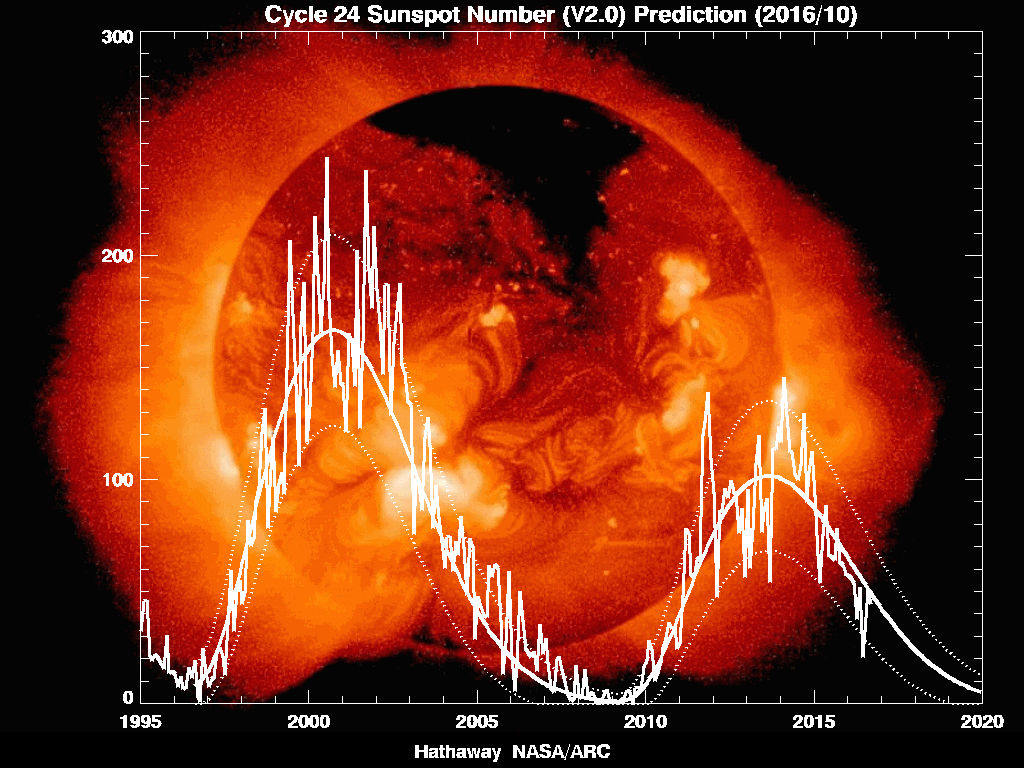
Note: These predictions are for “smoothed” International Sunspot Numbers. The smoothing is usually over time periods of about a year or more so both the daily and the monthly values for the International Sunspot Number should fluctuate about our predicted numbers. The dotted lines on the prediction plots indicate the expected range of the monthly sunspot numbers. Also note that the “Boulder” numbers reported daily at www.spaceweather.com are typically about 35% higher than the International sunspot number.
Another indicator of the level of solar activity is the flux of radio emission from the Sun at a wavelength of 10.7 cm (2.8 GHz frequency). This flux has been measured daily since 1947. It is an important indicator of solar activity because it tends to follow the changes in the solar ultraviolet that influence the Earth’s upper atmosphere and ionosphere. Many models of the upper atmosphere use the 10.7 cm flux (F10.7) as input to determine atmospheric densities and satellite drag. F10.7 has been shown to follow the sunspot number quite closely and similar prediction techniques can be used. Our predictions for F10.7 are available in a text file, as a GIF image, and as a pdf-file. Current values for F10.7 can be found at: http://www.spaceweather.ca/sx-4-eng.php.

Here’s my blink comparator:

Discover more from Watts Up With That?
Subscribe to get the latest posts sent to your email.
Is Leif still holding to his 72 prediction? Leif has there been anything that indicates to you that you would reduce your own prediction number? Also, even Hathaway and others from the NASA team had previously predicted a very low cycle 25, is this still the case?
He still has it wrong. We’re looking at a peak in 2016 and a an end to the cycle in 2022 or so. I’ll also venture that solar activity will have more powerful solar storms, but less frequent.
The key is the next solar cycle. If that one tanks, like the current cycle, it doesn’t bode well for our current warm temperatures.
A maximum of 64 would make Solar Cycle 24 the quietest for nearly 200 years. It will be interesting to see what effect that will have on Global Temperatures……
Sunspot predictions, best to wait until cycle 25 to predict what 24 will be. It’s become that kind of sun — Maybe the sunspot numbers aren’t that predictable after all.
Can you imagine what the predictions must have looked like during the Maunder Minimum. No offense to the prediction folks, but it is not an exact science and fraught with peril.
What were these “Halloween events” in 2003?
OT (again)
Don’t whish to start panic (just find a deep cave to hide, not for those of nervous disposition).
http://ssd.jpl.nasa.gov/sbdb.cgi?sstr=2010 JL33&orb=1
(zoom in until max E’s orbit and click on ‘>l’, set date to Dec 7th 2010.
Link for the above (copy and paste)
http://ssd.jpl.nasa.gov/sbdb.cgi?sstr=2010 JL33&orb=1
i say: 98
In Feb ’09, Solaemon collated 45 predictions for cycle 24, With Rmax ranging from 50 to 169. Anyone claiming their early prediction is any better than a lucky guess needs to explain why their method was demonstrably better when they made their prediction.
This NASA prediction should be in the ‘once the cycle has started’ range, so more accurate, but still assuming that solar behaviour is following the same pattern as has been observed in the past. Remember that the cycle still has a good few years to run so a good prediction now is valuable for many commercial uses even if the earlier projections were pessimistic. (I think high is expensive for satellites in terms of both shielding and drag)
If somebody changes his/her prediction every day, it is not a prediction, but a joke or a childish game, and it transpires that he/she knows not what law operates behind.
Hi!
Too bad the “blink” comperator is scaled differently.
The old prediction goes to 2015, the new prediciton to 2020.. :(..
Could you fix?
HLx
> let us not be too critical of Dr. Hathaway,
Absolutely – I’m mystified by the folks who expect that a prediction should be made and never updated. If I go watch the weather segment on the nightly news, I don’t want to see tomorrow’s forecast be from the five day forecast four days ago. Nor do I ridicule that forecast unless I think I can do a better job. Even then understand why that forecast was made is better than ridiculing it.
To gauge the accuracy of long term predictions, people will just have to make a matrix of date of prediction and the prediction. Easy enough to do and can be done without whining. Look at the bright side – we’re learning a lot about the Sun thanks to SC24.
Hathaway’s prediction is now below Leif’s – is that a first for SC24 for that comparison?
Given that we appear to be losing sun spots to the Livingston/Penn effect, we should be giving more note of 10.7 cm predictions. Hathaway’s latest is at http://solarscience.msfc.nasa.gov/images/f107_predict.gif in is calling for about 120 (123.3 in his .txt file) in a range of 100-150. SC23 reached 180.
@vuk etc.
Closest Approach is actually 12/12/2010. It still looks like it wont get within the distance of lunar orbit, presuming the graph in any way represents reality.
Vuk etc…could you just tell us plainly what???
cos I cant get it to work
His current prediction shows an unacceptable lack of fit to the current data, most of the current data is below the best fit line, although it is still within the 5% lower error bar.
Vuk etc. says:
October 6, 2010 at 9:09 am
We ought to trust in that “double layer” EM shield called “atmosphere” (& all its “spheres”), where its effect usually called “friction” by some, will vaporize it.
Predictions????? Hathaway is actually making adjustments as reality has caught up with his computer predictions. He should quit while he’s ahead.
Whoever made that blink-comparator needs another cup of coffee or something. They need to re-scale the graphs to match each other before comparing them. They’re on different timescales, and the relevant sections for comparison don’t overlap properly.
Hmmn, a misleading graph ginned up by someone overly keen to prove a point. There’s a certain irony there…
Sean Houlihane says:
Anyone claiming their early prediction is any better than a lucky guess needs to explain why their method was demonstrably better when they made their prediction.
There are number of values, actual, smoothed, annual, (SSN, Rmax etc). I made my prediction in 2003 for actual peak number which you can see HERE ; it is 80, we have already seen actual count of 60+.
Method of my prediction
Jeremy writes “What were these “Halloween events” in 2003?”
Some of the most active sunspots of this century occurred at the end of October 2003. Aircraft flew at lower altitudes, and various other precautions were taken.
apparently the Sun flunked Statistics 101 … just because we can measure something doesn’t mean we can predict its future numbers … all we can see are the results (sunspots) of interactions inside the Sun that we have not the slightest idea about …
@vuk again.. (sorry for OT threadjackspam moderators.)
Vuk, I apologize, closest approach is actually December 9th, at 0.0428 AU from Earth.
http://www.flickr.com/photos/50716889@N00/5057653820/
That is approximately 6,402,794.4 kilometers (or 3,978,511.99 miles), which is WELL outside of lunar orbit. Again presuming this graph in any way is close to reality, I think we’re ok.
/end threadjack
Well done to Dr Hathaway for updating and explaining the basis of his predictions, we will watch with interest. I check Geoff Sharp’s site regularly and find the discussions with Leif entertaining.
Interesting times ahead.
So what – the variations in the Sun’s output are not part of the present warming.
Well, I predicted 42 in April 2008 (I did!)