Guest Post by Thomas Fuller
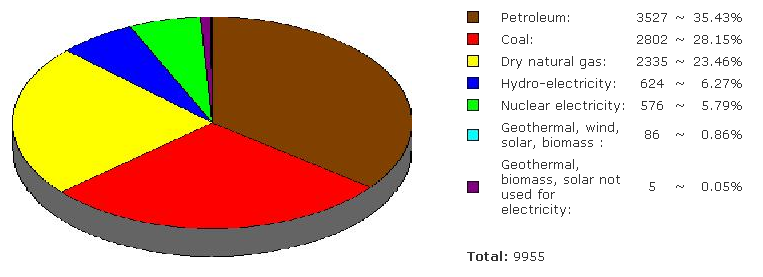
This is a great time to talk about energy use worldwide. Not because it’s topical, or politically important, or anything like that. It’s a great time because the math is easier now than ever before, and easier than it ever will be again.
It’s similar to a time a few years ago when there were almost exactly 100 million households in the United States. It made a lot of calculations really easy to do. And this year, the United States Department of Energy calculates that the world used 500 quads of energy. Ah, the symmetry.
Even more conveniently, the United States and China will each use roughly 100 quads. Comparisons, contrasts–you don’t even need a calculator! A quad is a quadrillion British Thermal Units, and is roughly equivalent to the energy liberated from 36 million tons of coal. It’s a lot of energy, and 500 of those quads is really a mind stretcher. (For those of you who are counting, about 52 of those quads came from renewable energy. Of those 52 quads, about 50 came from hydroelectric power… urkk…)
In 2035, the DOE figures the world will consume about 683 quads, give or take. The UN, more ambitiously, thinks it’ll come in at about 703 quads. Either way, they anticipate a 40% growth in energy requirements. Is it okay if I say I think they’re both wrong?
Here’s why: The UN (and pretty much everybody else) believes that the world’s population will be at or around 8 billion in 2035. The UN (and pretty much everybody else) believes that world GDP will grow by about 3% per year between now and then–which is pretty much what it has been doing for quite a while. But most of that growth is projected to occur in the developing world. And most of that growth will be very energy intensive.
Here in the U.S., our energy consumption per person has been declining for a while, now. We’re down from 337 million btu’s per person to 323 mbtu’s per capita. But it’s going in the other direction in the developing world. They need the energy to actually, well, develop. And then they want the energy to enjoy the fruits of their development. Makes sense–that’s exactly what we did here.
Price Waterhouse Coopers has projected GDP growth to 2050 for major economies. For the U.S., they predict per capita growth in GDP from $40,339 in 2005 to $88,443 in 2050. Most of the very well developed countries show the same level of growth–a bit better than doubling.
The Department of Energy has energy use per person for many of the same countries. So let’s look at China. Before I start, remember that China has doubled its energy use since 2000. And they’re not done yet.
Their 2005 GDP per capita was $1,664 and their energy usage per capita was 58.8 mbtu’s. Their 2050 GDP per capita is projected to be $23,534, similar to Spain’s present GDP per person. Spain’s energy use is 164 mbtu’s. So who wants to predict China’s energy use per person in 2050? In 2035?
We’re always picking on China, and we don’t need to. The scary part is we can do the exact same thing for Indonesia, Brazil, Mexico, Turkey and India. The developing world is developing. They are going to be energy-sucking monsters for the next 80 years–just like we were.
My calculations show that, if we succeed in persuading the developing world to use energy efficient technologies wherever possible, switching from coal to natural gas, adopting wind and solar, buying best of breed turbines, etc., the world’s energy consumption in 2035 will be about 1,100 quads. However, if they proceed as they are (mostly) doing now, throwing up dirty coal to avoid blackouts and brownouts, cobbling together solutions however they can, world energy use in 2035 might well approach 2,000 quads–or even surpass it.
Imagine a world of 8.1 billion people, 7 billion of whom are using energy at the same rate as we do here in America–323 million btu’s per head. (3.23 x 7, for Joe Romm). That’s over 2,100 quads. It is at this point that some ugly questions appear. If we burn coal to obtain this energy, that’s 2,100 x 36 million tons of coal. If we withhold energy from these people, we condemn them to lives of starvation and poverty. If we subsidize clean energy solutions for them, we are spending our hard earned tax money on the poorest of the poor, many of whom live in countries that are not friendly to us. Oh, wait… we’re already doing that, aren’t we?
I favor the third solution. Using your and my tax dollars to help the poor afford electricity that comes from natural gas, nuclear and other cleaner solutions, so they can afford to buy our video games and see our movies (and, well, pay for them…). I do not expect my idea of the best solution to be very popular. Not with climate alarmists, who already don’t like natural gas or nuclear, and want to limit energy consumption by everybody except for themselves. Probably not with many readers here, who have seen taxpayer money go up in smoke on so many poorly-designed projects. But I think it’s our duty to ourselves, as well as the poorest of the poor.
GM says (September 1, 2010 at 6:20 pm): “Actually I’m at a private institution :)”
Must…resist…institutional joke…too tempting…don’t give in…to…dark side…
Big Al says:
I expect the vast majority of that would immediately be used for A/C 🙂
Personally I always preferred Larry Niven’s Ringworld. It was a more achievable structure and still insanely huge.
There seems to be a pervasive misconception on this thread that GDP cannot grow without the consumption of more stuff. This is clearly false. GDP is an economic concept, it revolves around money. As societies develop, they get to a stage where most people already have all the “stuff” they need. They then start to value (ie pay for) things such as personal services that do not require “stuff” as an input. In most modern societies, the services sector is the dominant part of the economy. For example, in Australia (which is conventionally viewed as a mining-dominated economy) 70% of GDP is produced by the services sector.
I don’t think GM should be allowed to post again until he has read every single page and link on this site: http://www-formal.stanford.edu/jmc/progress/index.html
All in favor?
GM – how much electricity are you using to carry out this debate? All the buzzing PC’s of those debating you, the Google searches (7g CO2 released per search!), the servers and cohosts. How could you do such a thing to Mother Earth?
GM says September 1, 2010 at 6:20 pm
Smokey says: September 1, 2010 at 6:02 pm
As oil is consumed, the free market, without regulation of any kind, through competition brings about the desired result, as more cost-effective alternatives replace oil: transistors took over the market for tubes [valves]; kerosene replaced whale oil, etc.
If this was the case, the price of oil would have been steadily rising from the very moment the first well was drilled in 1859. That’s not the case, so apparently the market doesn’t get resources right. So much for that fallacy.
———————————————————————————-
GM Oh! Come on! How can you say such a stupid thing as that and still have the gall to spend all this time here writing tripe.
Gary Hladik says: September 1, 2010 at 7:14 pm
GM says (September 1, 2010 at 6:20 pm): “Actually I’m at a private institution :)”
Must…resist…institutional joke…too tempting…don’t give in…to…dark side…
—————————————————————-
Gary. Go on do give in to the temptation and give us all a laugh!
Doug
Daniel Taylor says:
September 1, 2010 at 7:33 pm
I don’t think GM should be allowed to post again until he has read every single page and link on this site: http://www-formal.stanford.edu/jmc/progress/index.html
All in favor?
========================================================
No, he’s fun. He really seems to be a fairly sharp guy.(who’s read too many horror stories and now wets his pants every time he fills up his car.) And he keeps our wits sharp. He’s an honest to goodness Malthusian. Rarely, does one have enough fortitude to admit such lunacy. Most alarmists are closet Malthusians but won’t admit it.
BTW, that is a great site. I’m not sure, but I think I visited it years ago. Memory is a strange thing, but I remember one in the same format with the same content!
This was sufficient to make me stop wasting my time:
“BTW, that is a great site. ”
Yes it is good. Note how the truth is presented in a plain way while lies have to dress themselves up with fancy graphics and sob stories.
Yeah, because all that fancy graphics stuff makes one’s head hurt…
@GM
This was sufficient to make me stop wasting my time:
With the development of nuclear energy, it became possible to show that there are no apparent obstacles even to billion year sustainability.(1)
========================================================
You don’t think you may be reading it too literally? Relative to mankind’s stay here, what’s a zero or two?
Or, one could read it as an affirmation of mankind’s ability to find newer and better ways to sate the ever increasing demand for energy. Fission, fusion, cold, hot, …..later what? We haven’t even started on hydrogen. Thermal? GM, already, with what I’ve listed, if necessary, these sources of energy either are or will be readily available in the very near future. We’re not going to run out of sources for energy. Who knows what we’ll find tomorrow? Quit worrying about now, it’s already past. We’re fine. Worry about the recession. Worry about the boy your daughter is seeing. There’s plenty of things to worry about. Energy sources isn’t one of them.
“Yeah, because all that fancy graphics stuff makes one’s head hurt…”
So you don’t deny that they do that. A small step.
Fancy graphics cna say whatever the author wants the too, and then be changed or denied.
WOrds count.
You words are a form of evil. Yu are peddling evil ideas formulated by unethical people with bad agendas.
As someone mentioned you will realize this one day and feel shame.
We do not need to live like marooned sailors.
[my emphasis]
By now others have taken care of most of GM’s wild assertions and calumny, but to claim that “we are due for global societal collapse in the next few decades,” presumably because of resource depletion (the topic of this thread), suggests that GM is either a fervent ideologue or a bomb-throwing provocateur—or both. I have seen the latter type of troll destroy an on-line political forum, but GM does offer a modicum of entertainment here—and even incidental instruction: I was not aware of this John McCarthy link posted by Daniel Taylor above: http://www-formal.stanford.edu/jmc/progress/index.html
“The Sustainability of Human Progress” (McCarthy) is a great phrase, which very neatly gives the lie to the fanatical exponents of ‘sustainability’, who would deny future progress and return us to the Dark Ages. And that’s where we’re headed, if we listen to the likes of GM.
/Mr Lynn
And Simmons was not a lunatic? Everything Simmons claimed was debunked in the paper I provided,
Crop Circles in the Desert: The Strange Controversy Over Saudi Oil Production (PDF) (Michael C. Lynch, President of Strategic Energy and Economic Research)
“…In this case, we are being asked to believe whether it is more likely that a Harvard M.B.A. with no technical background has correctly perceived an extraordinary conclusion from engineering papers, contradicting all other data and observed reality as well as the vast majority of expert opinion, or whether he simply got it wrong. The evidence in this paper shows that what he has said, which can be tested, is demonstrably wrong.”
It is funny how ALL of the recent peak propaganda claims revolved around Simmons. I watched every documentary on it and they ALL had Simmons in them as their chief spokesperson.
Is Matt Simmons Credible? (Energy Tribune)
“The purpose of this essay was not simply to dump on Simmons. But he is involved in sensationalistic fear-mongering, enabled by the media’s mistaken belief that he is an expert in all things oil-related. I want to make sure people know that they should take his claims with the grain of salt they deserve. As I have documented here, that grain of salt is warranted based on his history of sensational claims that never materialized.”
I get so tired of the Matthew Simmons hysterics. Especially when the guy has not been right about a damn thing.
GM, I’d like to suggest some reading material – Matt Ridley’s The Rational Optimist.
Poptech says:
September 1, 2010 at 8:40 pm
GM says: And yet another lunatic.
========================================================
It’s a form of misanthropy or autophobia. It doesn’t matter if Simmons is right or wrong. It fits with his belief system.
I tell him we’re fine. I give him examples of sources of energy he knows we haven’t even begun to tap, yet he insists on the idea we’re all going to die because we used up all of the earth’s resources. Other people have given good arguments as to why we’re going to be ok, yet he clings to doom as if it is his salvation. And, in a way it is. It is part of his belief system, or part of his self. He will lose what he regards as part of his definition if he changes his beliefs.
GM, you should come to the light side. Its way cooler here……………………………………just testing a different form of argument. Hope you don’t mind.
“Peak Uranium” is such a fascinating theoretical concept.
The Canadian-invented CANDU reactor uses low-level fuels, originally made for natural un-enriched uranium. It can use rather directly what we in the US consider spent fuel, no chemical reprocessing needed. And it can use many different nuclear fuels.
If we start building CANDU reactors in the US, and stop this nonsense about permanently burying “spent fuel” from the Light Water Reactors, we already have many decades of usable fuel stockpiled in “holding pools” at LWR plants. We could go a half century or longer without needing any new fuel for energy production.
Peak uranium? That people can believe such is anything to worry about anytime this century, makes me wonder if we’ve passed Peak Intelligence.
Any one who is interested in issues related to energy demand in this century should read a document, prepared by ExxonMobil, called “Outlook for Energy, A view to 2030”. The document is available here:
http://www.exxonmobil.com/corporate/files/news_pub_eo_2009.pdf
Some very good stuff in there by people who know a lot about energy, and I believe the document is updated annually.
Ah, the politics of scarcity.
There is a natural cycle to everything, including population. We don’t need to worry about it, mama nature will sort it out in her own good time.
The solution to the population bomb used to be to bomb populations. Hopefully we’ll grow out of that behaviour.
However, the realpolitik is that China will look to extending its influence in Africa, Australia, and other mineable places. We in the west had better use our much vaunted technological prowess to come up with something clever sooner rather tha later, otherwise conflict is on the horizon.
Our priority then, should be to find an efficient way to generate and distribute power to cater for our needs. If we don’t, we will find ourselves being client states to political regimes we don’t like. It’s not in China’s interests that the west should become energy poor, but it’s not in our interest to have them dictate the terms of our consumption either.
The main thing preventing us having a robust grid supplied by distributed small scale production of energy from reasonably clean resources is the interest of our own corporate-governmental axis. Time for Joe Public to kick the asses of those we pay to serve US.
Dozens of climate martyrs committed a mass self harming at Rommstown, today when the Wednesday Hate poster was replaced by a mirror.
tallbloke says: September 1, 2010 at 11:13 pm
Ah, the politics of scarcity. Etc.
How true Tallbloke. And that is a real problem so much closer to our time.
Doug
We need fusion power, and fast.
This was sufficient to make me stop wasting my time: With the development of nuclear energy, it became possible to show that there are no apparent obstacles even to billion year sustainability.(1)
Closed minded much?
Maybe you have information that Professor Emeritus of Physics at Pittsburgh University Bernard Cohen did not when he computed this based on 1980’s technology?
http://www-formal.stanford.edu/jmc/progress/cohen.html
Was he incorrect about the amount of uranium in seawater or the cost of extraction? Was he incorrect about the physics of fast breeder reactors? (I somehow doubt it.) If you don’t have hard facts and numbers that he did not have, numbers which alter his formula, then why do you dismiss his work out of hand?
Try this: either demonstrate with hard facts and numbers that Cohen was wrong in his estimates of the sustainability of nuclear power generation, or finish reading every single page on that site, and with a mind open to the possibility that you are wrong and the information you are receiving is correct.
Regarding all the other things that we’re supposedly going to run out of, name for me please a single material resource which:
A) Our civilization cannot exist without.
B) Is truly “used up” by man and cannot be recycled and reused from waste products, or created again from other input materials.
C) Has absolutely no substitute what so ever.
D) Will be gone well before technology provides a reasonable alternative through recycling, substitutes, manufacturing, or off planet mining.
Hint #1: this going to be harder than you think given the conservation of matter and energy.
Hint #2: it’s certainly not liquid petroleum which not only has substitutes, but which can be manufactured. Not only can we grow it (literally) today, but we’re actually quite close to being able to manufacture it out of thin air. We will certainly be capable of doing this, if desired, before we run out of coal and shale oil, perhaps even before we run out of liquid petroleum.
http://www.lanl.gov/news/index.php/fuseaction/home.story/story_id/12554
http://www.technologyreview.com/Energy/18582/
http://www.newscientist.com/article/dn19308-the-next-best-thing-to-oil.html
http://www.science20.com/news/turning_carbon_dioxide_into_fuel_using_solar_power
I’ve noticed on this thread, as have others, that GM has a shortage of hard facts to hand (apart from one book whose correctness is contested above by Gary Hladik. I’ve also noticed a lot of simplistic arguments and argumentation style – on both sides.
I’m trying to get a handle on all these issues of sustainability and energy reserves and resources. And while I believe yes, the universe’s resources, and our ingenuity, are both pretty limitless, I also see other factors coming into the “real world” scenarios that can make for limits to growth at times. Like cashflow problems and insufficient foresight stopping R&D, let’s say, for thorium reactors, or tidal power, or ocean heat exchange, etc. Like claims that “space travel will solve everything” being at odds with the level of space travel, or costing for resources acquisition, actually attained. Short-term blocks, perhaps, nevertheless still real in history. Like the Depression-plus-WW1-treaty that combined to tempt Germany into the Nazi “solution” to bankruptcy – which happened between periods of growth.
So I suspect that there are real “Peak Oil” issues, even if their manifestation is linked to politics, belief systems, and the rest, even though I also believe in our great capacity for invention eg thorium, LENR, and beyond, and even though I also believe in the existence of usable resources rather greater than “Limits To Growth” works with eg uranium from the sea.
In my universe, optimists and pessimists both have important contributions; I suspect there are partial truths on both sides, and I would like to see a less polarized dialogue to bring out some of that, because in the synthesis which courteous debate allows, new ideas altogether can emerge, and wild ideas can become more tempered to what is really possible. Divisions into “we’re all goodies and they’re all out of their tree” rising levels of heated argument shift nothing and lack the Socratic element that says “do you agree with me that…” before leading into areas of disagreement. GM, you will have to work hard at that, to translate ad homs into science snippets we can understand and check, simply because you are the sole representative here of a whole “side”. But alas, I suspect you are a dyed-in-the-wool
trollevangelist, and unable to change your approach. I remain open.The Stone Age did’nt end because of lack of stones.
And it didnt end because some government decided it to end.
And there was no commitee deciding it to end.
It just ended because people adapted, found new materials, moved on.
All by themselves.