Guest Post by Thomas Fuller
This is a great time to talk about energy use worldwide. Not because it’s topical, or politically important, or anything like that. It’s a great time because the math is easier now than ever before, and easier than it ever will be again.
It’s similar to a time a few years ago when there were almost exactly 100 million households in the United States. It made a lot of calculations really easy to do. And this year, the United States Department of Energy calculates that the world used 500 quads of energy. Ah, the symmetry.
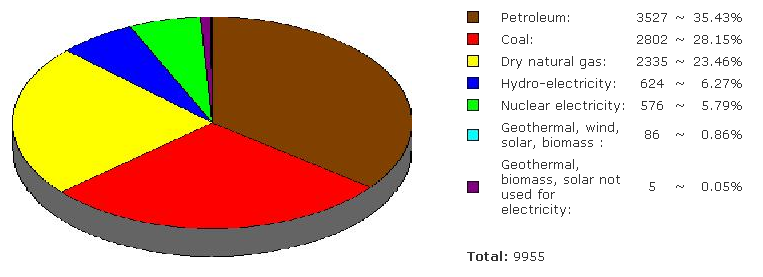
Even more conveniently, the United States and China will each use roughly 100 quads. Comparisons, contrasts–you don’t even need a calculator! A quad is a quadrillion British Thermal Units, and is roughly equivalent to the energy liberated from 36 million tons of coal. It’s a lot of energy, and 500 of those quads is really a mind stretcher. (For those of you who are counting, about 52 of those quads came from renewable energy. Of those 52 quads, about 50 came from hydroelectric power… urkk…)
In 2035, the DOE figures the world will consume about 683 quads, give or take. The UN, more ambitiously, thinks it’ll come in at about 703 quads. Either way, they anticipate a 40% growth in energy requirements. Is it okay if I say I think they’re both wrong?
Here’s why: The UN (and pretty much everybody else) believes that the world’s population will be at or around 8 billion in 2035. The UN (and pretty much everybody else) believes that world GDP will grow by about 3% per year between now and then–which is pretty much what it has been doing for quite a while. But most of that growth is projected to occur in the developing world. And most of that growth will be very energy intensive.
Here in the U.S., our energy consumption per person has been declining for a while, now. We’re down from 337 million btu’s per person to 323 mbtu’s per capita. But it’s going in the other direction in the developing world. They need the energy to actually, well, develop. And then they want the energy to enjoy the fruits of their development. Makes sense–that’s exactly what we did here.
Price Waterhouse Coopers has projected GDP growth to 2050 for major economies. For the U.S., they predict per capita growth in GDP from $40,339 in 2005 to $88,443 in 2050. Most of the very well developed countries show the same level of growth–a bit better than doubling.
The Department of Energy has energy use per person for many of the same countries. So let’s look at China. Before I start, remember that China has doubled its energy use since 2000. And they’re not done yet.
Their 2005 GDP per capita was $1,664 and their energy usage per capita was 58.8 mbtu’s. Their 2050 GDP per capita is projected to be $23,534, similar to Spain’s present GDP per person. Spain’s energy use is 164 mbtu’s. So who wants to predict China’s energy use per person in 2050? In 2035?
We’re always picking on China, and we don’t need to. The scary part is we can do the exact same thing for Indonesia, Brazil, Mexico, Turkey and India. The developing world is developing. They are going to be energy-sucking monsters for the next 80 years–just like we were.
My calculations show that, if we succeed in persuading the developing world to use energy efficient technologies wherever possible, switching from coal to natural gas, adopting wind and solar, buying best of breed turbines, etc., the world’s energy consumption in 2035 will be about 1,100 quads. However, if they proceed as they are (mostly) doing now, throwing up dirty coal to avoid blackouts and brownouts, cobbling together solutions however they can, world energy use in 2035 might well approach 2,000 quads–or even surpass it.
Imagine a world of 8.1 billion people, 7 billion of whom are using energy at the same rate as we do here in America–323 million btu’s per head. (3.23 x 7, for Joe Romm). That’s over 2,100 quads. It is at this point that some ugly questions appear. If we burn coal to obtain this energy, that’s 2,100 x 36 million tons of coal. If we withhold energy from these people, we condemn them to lives of starvation and poverty. If we subsidize clean energy solutions for them, we are spending our hard earned tax money on the poorest of the poor, many of whom live in countries that are not friendly to us. Oh, wait… we’re already doing that, aren’t we?
I favor the third solution. Using your and my tax dollars to help the poor afford electricity that comes from natural gas, nuclear and other cleaner solutions, so they can afford to buy our video games and see our movies (and, well, pay for them…). I do not expect my idea of the best solution to be very popular. Not with climate alarmists, who already don’t like natural gas or nuclear, and want to limit energy consumption by everybody except for themselves. Probably not with many readers here, who have seen taxpayer money go up in smoke on so many poorly-designed projects. But I think it’s our duty to ourselves, as well as the poorest of the poor.
Anybody who recommends subsidies of any kind is economically illiterate. If you want the poor to have access to cheap energy then you need to free up their economies and remove the regulatory and tax burdens that is preventing them from developing.
It is clear more people need to read these books,
The Bottomless Well: The Twilight of Fuel, the Virtue of Waste, and Why We Will Never Run Out of Energy (Peter Huber, Ph.D. Mechanical Engineering, MIT, 2005)
Power Hungry: The Myths of “Green” Energy and the Real Fuels of the Future (Robert Bryce, 2010)
Bart notes that Europe’s per-capita energy consumption is around half the US’s. True, but I would attribute that largely to two factors not directly connected to energy policy:
a) Less extreme climates — between the warming Gulf Stream and the cooling Meterranean, there is less need for heating and air conditioning through the year. Europe really has nothing like Phoenix, New Orleans, Minneapolis, or Fargo.
b) More compact cities with generally better (and subsidized) train and bus service, plus high taxes on gasoline and auto use generally.
Trying to get Americans to accept (b) is fruitless. And once India gets its electricity widespread and cheap, how popular do you think air conditioning will become?
“Peak uranium” is a joke. The US has enough “spent” fuel rods to provide their electricity for a considerable number of years – estimates are in the hundreds of years. They almost got to the point of using them with the IFR (Integral Fast Reactor), but NRDC got Clinton to cancel it in 1994, just in the nick of time to stop commercialization of the concept. Talk about a history-changing event…
Go nuclear.
I hereby call that Thomas Fuller never posts here again as he is not only economically illiterate but has no remote clue about energy. There are plenty of educated people on this issue we do not need arm-chair emotional types making posts here.
REPLY: Ya know, at least he has the courage to put his name to his work. He’ll likely be here again, see the announcements thread. – Anthony
“Probably not with many readers here, who have seen taxpayer money go up in smoke on so many poorly-designed projects. But I think it’s our duty to ourselves, as well as the poorest of the poor. ”
From each according to their ability to each according to their need. Kind of a catchy phrase ….
From each according to his ability, to each according to his need (or needs) is a slogan popularized by Karl Marx in his 1875 Critique of the Gotha Program.[1]
Really and how does one distribute the 2100 quads.
R de Haan
“The so called “Green, renewable energies are all based on carbon fuels and I bet the carbon fuel needed to produce wind mills and solar panels are not calculated into
the equation. ” This is not strictly accurate, but it is an interesting question. The embedded carbon in renewable energy systems is a subject of much interest from researchers at the moment and there are big unknowns such as the embedded energy required to provide conventional generation backup to relieve the intermittency problems inherent in wind energy. We certainly don’t know the full answer and from a personal perspective I would prefer that we were counting the embedded energy rather than the embedded carbon. The obsession with carbon is absurd.
Human beings are best left to their own devices. Using one’s own resources to shore up another person’s resources is a fool’s errand, exponentially enlarged when applied to countries. You will both end up in the poor house.
Your best bet on improving the countries around you is to continue to build and maintain your own infrastructure (IE roads, educational opportunities, and energy availability) and by providing ample opportunities without roadblocks for your own citizenry to act on their own initiative and drive to make use of that infrastructure.
If I have to put up with one more push for magic energy sources….
Five myths about green energy (The Washington Post)
The Real Problem With Renewables (Hint: It’s physics) (Forbes)
OT
Science isn’t settled, and it might have a bit of a problem on its hands.
http://www.vukcevic.talktalk.net/SSNnd.htm
On the first sight not great correlation, even so it is of profound and fundamental importance.
GM
You are or appear to be another worrier about ‘exponential’ population growth, energy shortfall and all the rest of it.
Human population will not reach the 9 billion mark. War, famine, plague and poverty will stem the flood.
If you know a virologist, have a chat with them about influenza in particular and pandemics in general. Then you will have something completely different to worry about.
Re GM:
I just love hitting the ‘Peak Oil’ (and ‘Peak Whatever’) doomsayers with these two posts by E.M. Smith:
http://chiefio.wordpress.com/2009/05/08/there-is-no-shortage-of-stuff/
http://chiefio.wordpress.com/2009/03/20/there-is-no-energy-shortage/
“THERE IS NO SHORTAGE OF STUFF, AND THERE NEVER WILL BE”—E. M. Smith
So far, I’ve heard no rebuttals.
/Mr Lynn
I favor the third solution. Using your and my tax dollars to help the poor afford electricity that comes from natural gas, nuclear and other cleaner solutions, so they can afford to buy our video games and see our movies (and, well, pay for them…).
The Federal government is flat broke, and we are staring into the abyss of a potential 2nd Great Depression. We don’t have the luxury of deciding whether or not to spend our tax dollars helping 3rd world nations pursue clean energy options. Very soon we are going to have to slash spending on our own problems (education, health care, Social Security, defense) just to survive.
We need to solve our own very serious, very pressing problems. Maybe then we can worry about helping other nations.
Do people know what has been done to improve the burn efficiency of coal? You remember, Bush’s clean coal initiative? Raising the efficiency up into the range of 50-60%. It’s called IGCC — integrated coal gasification combined-cycle. The Polk Power plant in Florida has a full scale plant online —- http://www.tampaelectric.com/news/powerstation/polk/
Why don’t more people know about it?
If your cause is global warming driven by CO2, then why isn’t your savior nuclear power?
The author is firmly in la-la land if he thinks that he can write a credible post on energy and not mention a word about Peak Oil/Gas/Coal/Uranium,…
Yes, the author completely blew it by not mentioning that we will face a Peak Uranium crisis in about 1 billion years.
http://www-formal.stanford.edu/jmc/progress/nuclear-faq.html
Can we have this silly unit of the “quadrillion BTU” defined in SI ? I reckon its 1 EJ OR 10^18 Joules.
We need to help third world countries learn to be corrupt like modern countries?
Steve Fitzpatrick (wrote):
“If breeder technology is used, and thorium technology is developed and used, there is a huge potential for nuclear energy production. ”
Yep. Currently, these are the only viable short to medium term options for large scale energy production, so they certainly get my vote. I really can’t believe that so little work is being done on Thorium reactors as the world is certainly on the way to running out of Uranium. Still, let’s stick up another wind turbine – that’ll sort it out – If you’re very, very, very lucky, it might just about pay for istelf just before it’s time to rip it down and replace it – I wouldn’t hold your breath though 😉
The WUWT crowd’s dismissal of GHG emissions as a factor in the world energy picture is not surprising. One needn’t be concerned with the elephant’s destructive potential if one denies it’s in the room.
Alas for the group here, even their darling Bjørn Lomborg has at last admitted to the presence of the climate change pachyderm:
http://tinyurl.com/33hbt8f
It’s our duty to ourselves here in the U.S. to concentrate on our own energy policy and our own economic woes. A bankrupt U.S. is no good to anyone.
It is not up to us, or anyone else to tell, or influence another country how they should develop their energy base. If they have coal available, then that is what they will, and should use. Simple as that.
Unfortunately, much of this is academic.
What we are likely to see first is that as the weather gets cooler there will be more food shortages with growing time reductions. These will occur as we start seeing the effects of being past peak oil and energy prices increase. All the byproducts of oil refining that we now take for granted will also become more expensive and in short supply. As energy costs increase and energy and food supplies reduce – we have the recipe for some very ugly times ahead. Unless, as Steve Fitzpatrick says we move to thorium and pebble-bed reactors.
Resource (energy is the master one) is more than a stock of stuffs. Summing Julian Simon’s work, Ben Wattenberg wrote (in The Wall Street Journal February 11, 1998):
That said, some countries are more energy efficient than others: see for example this interesting perspective [PDF].
If we keep being dependent on fossil fuels as we currently are, we will bear most of the damage of increasing fuel prices.
Are we able to fight wars to get access to fossil fuels? No matter who wins the war, the oil/gas/coal goes to the global market, we buy from the global market and we pay global prices.
The dependence on fossil fuels makes our country vulnerable, and we might cease to be the world superpower. If that happens, it is going to be a sad situation, with many people suffering and in debt.
By that time oil will be so expensive so that all those useful oil byproducts such as plastics will become expensive. It’s a shame and stupidity to use oil for electricity production while we could save it for more appropriate uses.
Mr Fuller wrote: “I favor the third solution. Using your and my tax dollars to help the poor afford electricity that comes from natural gas, nuclear and other cleaner solutions, so they can afford to buy our video games and see our movies (and, well, pay for them…). ”
Dollars directed by politicians and bureaucrats is not as efficient nor flexible as dollars directed by consumers into the hands of producers. Bureaucrats and politicians are always susceptible to corporate interests and the more hands and mouths between the money in my pocket and the bank account of the person that made the ‘stuff’ I buy the less money ends up in his or her pocket.
If despotic regimes had to raise money through taxing their own people rather than survive on handouts taken by force from foreign taxpayers they would rapidly have to up their game or get kicked out of office. Trade is the key not redirecting tax revenue.
Wind mills and solar panels have a lifetime of around 20-30 years. The net benefits are enormous to cancel out any production footprint.
Let’s talk about a single solar panel, that produces 200W at peak. Let’s assume that it produces at peak for five hours per day (very modest estimate). Per year, our single solar panel produces 73KWh and for the 30 years of lifetime this makes 2.2MWh.
How much energy do we need to produce this single solar panel in terms of the 2.2MWh we get back?