Guest Post by Thomas Fuller
This is a great time to talk about energy use worldwide. Not because it’s topical, or politically important, or anything like that. It’s a great time because the math is easier now than ever before, and easier than it ever will be again.
It’s similar to a time a few years ago when there were almost exactly 100 million households in the United States. It made a lot of calculations really easy to do. And this year, the United States Department of Energy calculates that the world used 500 quads of energy. Ah, the symmetry.
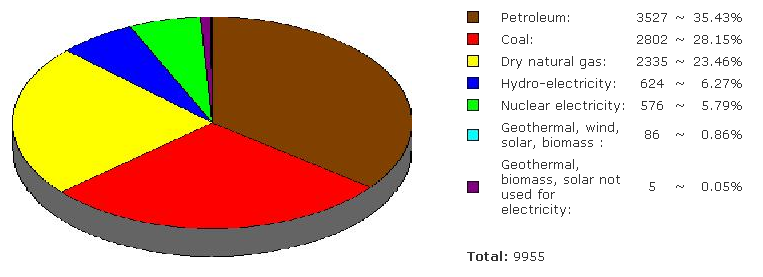
Even more conveniently, the United States and China will each use roughly 100 quads. Comparisons, contrasts–you don’t even need a calculator! A quad is a quadrillion British Thermal Units, and is roughly equivalent to the energy liberated from 36 million tons of coal. It’s a lot of energy, and 500 of those quads is really a mind stretcher. (For those of you who are counting, about 52 of those quads came from renewable energy. Of those 52 quads, about 50 came from hydroelectric power… urkk…)
In 2035, the DOE figures the world will consume about 683 quads, give or take. The UN, more ambitiously, thinks it’ll come in at about 703 quads. Either way, they anticipate a 40% growth in energy requirements. Is it okay if I say I think they’re both wrong?
Here’s why: The UN (and pretty much everybody else) believes that the world’s population will be at or around 8 billion in 2035. The UN (and pretty much everybody else) believes that world GDP will grow by about 3% per year between now and then–which is pretty much what it has been doing for quite a while. But most of that growth is projected to occur in the developing world. And most of that growth will be very energy intensive.
Here in the U.S., our energy consumption per person has been declining for a while, now. We’re down from 337 million btu’s per person to 323 mbtu’s per capita. But it’s going in the other direction in the developing world. They need the energy to actually, well, develop. And then they want the energy to enjoy the fruits of their development. Makes sense–that’s exactly what we did here.
Price Waterhouse Coopers has projected GDP growth to 2050 for major economies. For the U.S., they predict per capita growth in GDP from $40,339 in 2005 to $88,443 in 2050. Most of the very well developed countries show the same level of growth–a bit better than doubling.
The Department of Energy has energy use per person for many of the same countries. So let’s look at China. Before I start, remember that China has doubled its energy use since 2000. And they’re not done yet.
Their 2005 GDP per capita was $1,664 and their energy usage per capita was 58.8 mbtu’s. Their 2050 GDP per capita is projected to be $23,534, similar to Spain’s present GDP per person. Spain’s energy use is 164 mbtu’s. So who wants to predict China’s energy use per person in 2050? In 2035?
We’re always picking on China, and we don’t need to. The scary part is we can do the exact same thing for Indonesia, Brazil, Mexico, Turkey and India. The developing world is developing. They are going to be energy-sucking monsters for the next 80 years–just like we were.
My calculations show that, if we succeed in persuading the developing world to use energy efficient technologies wherever possible, switching from coal to natural gas, adopting wind and solar, buying best of breed turbines, etc., the world’s energy consumption in 2035 will be about 1,100 quads. However, if they proceed as they are (mostly) doing now, throwing up dirty coal to avoid blackouts and brownouts, cobbling together solutions however they can, world energy use in 2035 might well approach 2,000 quads–or even surpass it.
Imagine a world of 8.1 billion people, 7 billion of whom are using energy at the same rate as we do here in America–323 million btu’s per head. (3.23 x 7, for Joe Romm). That’s over 2,100 quads. It is at this point that some ugly questions appear. If we burn coal to obtain this energy, that’s 2,100 x 36 million tons of coal. If we withhold energy from these people, we condemn them to lives of starvation and poverty. If we subsidize clean energy solutions for them, we are spending our hard earned tax money on the poorest of the poor, many of whom live in countries that are not friendly to us. Oh, wait… we’re already doing that, aren’t we?
I favor the third solution. Using your and my tax dollars to help the poor afford electricity that comes from natural gas, nuclear and other cleaner solutions, so they can afford to buy our video games and see our movies (and, well, pay for them…). I do not expect my idea of the best solution to be very popular. Not with climate alarmists, who already don’t like natural gas or nuclear, and want to limit energy consumption by everybody except for themselves. Probably not with many readers here, who have seen taxpayer money go up in smoke on so many poorly-designed projects. But I think it’s our duty to ourselves, as well as the poorest of the poor.
kadaka, I love it … “peak intelligence” … I know many places where that can be applied. Thanks for the chuckle.
Sadly, it describes so many “educated” people these days.
I strongly suspect GM is a card carrying member of the far, far left. A raging anti-corporatist.
It is common for these types to jump on the sustainability bandwagon because it fits right in with their politics. Any facts presented to them will be summarily dismissed as we have already seen several times from GM. You can’t convert those with strong religious beliefs with facts. First you have to convert their religion.
I’d ignore the troll that is GM, as regular posters here know ‘proof or it didn’t happen’ rules apply and Mr GM has not given a shred of evidence to his drivel.
He appears to be the usual enviro-watermelon and refuses to educate himself with knowledge that does not go with his belief system. I believe these are called ‘closed-minded’.
Maybe an article in The New York Times and the journal Science will convince some of the fence sitters on the hysterics of “Peak Oil”,
Oil: Never Cry Wolf—Why the Petroleum Age Is Far from over (PDF)
(Science, Volume 304, Number 5674, pp. 1114-1115, May 2004)
– Leonardo Maugeri
‘Peak Oil’ Is a Waste of Energy (The New York Times)
Peak Oil theorists prefer emotion over logic and reason.
Many of the posters here are engineers. Although we have different backgrounds and different knowledge bases, we have one thing in common. Our daily jobs are applying our knowledge to solve problems. We are essentially problem solvers. Through our careers we’ve seen example after example of seemingly (at the time) unsolvable problems being solved … and sometimes quite easily.
I believe this is why we don’t have the same view of problems as folks like GM. I’d guess Smokey pegged him right from the start. He is an academic with little to no practical experience. He simply doesn’t understand how progress works like those who have lived it for decades. Hopefully, he will learn something here although I rather doubt it.
GM, you are throwing around a lot of insults, and in the process, providing examples of how you seem to be representative of those insults, not the people you decry.
For reference, we are not “using” 5 times what we are “consuming”. What we are “using” is equal to what we are “consuming”. Whether it is efficient, effective or prudent is another matter.
Sen. Ernest “Fritz” Hollings (D-SC)…”There’s too much consumin goin on out there.”
I have a problem with some of the language used in this post. “Dirty Coal.” But then you push natural gas as a solution. Somehow natural gas is not dirty? It comes from the same places in the ground as that “dirty oil” does. Maybe you have heard about the Hydrofracing controversy going in in Pennsylvania right now? If not please go do some reading. I fail to see how using water laced with chemicals, that make their way into our groundwater supply, to push natural gas out of the ground is any better than strip mining a mountaintop.
I get that natural gas can return a higher BTU value per lb than coal. But that does not mean you put all your eggs in that basket and forsake “dirty coal”. Especially if the world does need 2100 quads of energy. We will need a sane mix of technologies to sustain that much energy consumption.
Lets not talk about the fact that you have to build pipelines to transport natural gas around. And if you want to ship it over an ocean you need to compress the hell out of it or liquefy it. At that point pushing it around is no better than pushing around coal barges. At least the coal barge isn’t an explosion waiting to happen.
In my “humble” opinion (I’m a mechanical engineer working in the energy sector) we need to get back to building nuclear plants. Yes you need to deal with the radioactive waste but it really is the least impact way to make lots of energy. Queue up that post from a month ago about the salt cooled nuclear reactors. Why isn’t our government investing in this?!
Paul:
Dirty coal. ☺
GM,
I invited you to share evidence of any predictions that Limits to Growth have made that have come true. You linked me to an online bookstore containing the virtual dust cover of a new Limits to Growth edition. The dust cover explains something along the lines that the authors have used new modelling techniques to forecast that humankind is over using resources, which WILL LEAD TO DIRE CONSEQUENCES.
In other words, this is just another prediction. There has not been to date any prediction by Limits to Growth that has become reality.
Is this not the Seed of war? It’s taken this long for a nutter to watch the Nupty of Nashville present his toxic nonsense to rent-a-crowd in a studio and then go out and ‘do something about it!’ (at the Discovery Channel). In WWII, the British leaders were able to rally their citizens to total mobilization for war when Germany camped in France. The British leadership could make the case for their impending destruction. In the wrong hands, then the AGW case as presented, could present national leadership with that ability. The rubbish theory of AGW could appear to un-developed countries, with the carbon footprint of a flip-flop, the idea that industrialised nations are destroying their country, their environment, their earth. That lays down the gauntlet: what are you going to do about it?
So, it is with glee that i read this article from Ambrose Evans Pritchard of the Telegraph about THORIUM ( BTW–there is a french puppet political show which once depicted the White House with George Bush as president, Stallone as defense secretary, Stallone as Chief of Staff, and Stallone as Secretary of State! War anyone?)
Anyway, the answer to all our problems perhaps lies in THORIUM:
(HI Anna. No idea what it is. Can you explain?)
‘………………. The International Energy Agency says the world must invest $26 trillion (£16.7 trillion) over the next 20 years to avert an energy shock. The scramble for scarce fuel is already leading to friction between China, India, and the West. nThere is no certain bet in nuclear physics but work by Nobel laureate Carlo Rubbia at CERN (European Organization for Nuclear Research) on the use of thorium as a cheap, clean and safe alternative to uranium in reactors may be the magic bullet we have all been hoping for, though we have barely begun to crack the potential of solar power. Dr Rubbia says a tonne of the silvery metal – named after the Norse god of thunder, who also gave us Thor’s day or Thursday – produces as much energy as 200 tonnes of uranium, or 3,500,000 tonnes of coal. A mere fistful would light London for a week. Thorium eats its own hazardous waste. It can even scavenge the plutonium left by uranium reactors, acting as an eco-cleaner. “It’s the Big One,” said Kirk Sorensen, a former NASA rocket engineer and now chief nuclear technologist at Teledyne Brown Engineering. “Once you start looking more closely, it blows your mind away. You can run civilisation on thorium for hundreds of thousands of years, and it’s essentially free. You don’t have to deal with uranium cartels,” he said.
Thorium is so common that miners treat it as a nuisance, a radioactive by-product if they try to dig up rare earth metals. The US and Australia are full of the stuff. So are the granite rocks of Cornwall. You do not need much: all is potentially usable as fuel, compared to just 0.7pc for uranium. After the Manhattan Project, US physicists in the late 1940s were tempted by thorium for use in civil reactors. It has a higher neutron yield per neutron absorbed. It does not require isotope separation, a big cost saving. But by then America needed the plutonium residue from uranium to build bombs. “They were really going after the weapons,” said Professor Egil Lillestol, a world authority on the thorium fuel-cycle at CERN. “It is almost impossible make nuclear weapons out of thorium because it is too difficult to handle. It wouldn’t be worth trying.” It emits too many high gamma rays. You might have thought that thorium reactors were the answer to every dream but when CERN went to the European Commission for development funds in 1999-2000, they were rebuffed.
Brussels turned to its technical experts, who happened to be French because the French dominate the EU’s nuclear industry. “They didn’t want competition because they had made a huge investment in the old technology,” he said. Another decade was lost. It was a sad triumph of vested interests over scientific progress. “We have very little time to waste because the world is running out of fossil fuels. Renewables can’t replace them. Nuclear fusion is not going work for a century, if ever,” he said.
The Norwegian group Aker Solutions has bought Dr Rubbia’s patent for the thorium fuel-cycle, and is working on his design for a proton accelerator at its UK operation.
Victoria Ashley, the project manager, said it could lead to a network of pint-sized 600MW reactors that are lodged underground, can supply small grids, and do not require a safety citadel. It will take £2bn to build the first one, and Aker needs £100mn for the next test phase. The UK has shown little appetite for what it regards as a “huge paradigm shift to a new technology”. Too much work and sunk cost has already gone into the next generation of reactors, which have another 60 years of life. So Aker is looking for tie-ups with the US, Russia, or China. The Indians have their own projects – none yet built – dating from days when they switched to thorium because their weapons programme prompted a uranium ban.
America should have fewer inhibitions than Europe in creating a leapfrog technology. The US allowed its nuclear industry to stagnate after Three Mile Island in 1979. Anti-nuclear neorosis is at last ebbing. The White House has approved $8bn in loan guarantees for new reactors, yet America has been strangely passive. Where is the superb confidence that put a man on the moon? A few US pioneers are exploring a truly radical shift to a liquid fuel based on molten-fluoride salts, an idea once pursued by US physicist Alvin Weinberg at Oak Ridge National Lab in Tennessee in the 1960s. The original documents were retrieved by Mr Sorensen.
Moving away from solid fuel may overcome some of Thorium’s “idiosyncracies”.
“You have to use the right machine. You don’t use diesel in a petrol car: you build a diesel engine,” said Mr Sorensen. Thorium-fluoride reactors can operate at atmospheric temperature. “The plants would be much smaller and less expensive. You wouldn’t need those huge containment domes because there’s no pressurized water in the reactor. It’s close-fitting,” he said. Nuclear power could become routine and unthreatening. But first there is the barrier of establishment prejudice.
When Hungarian scientists led by Leo Szilard tried to alert Washington in late 1939 that the Nazis were working on an atomic bomb, they were brushed off with disbelief. Albert Einstein interceded through the Belgian queen mother, eventually getting a personal envoy into the Oval Office. Roosevelt initially fobbed him off. He listened more closely at a second meeting over breakfast the next day, then made up his mind within minutes. “This needs action,” he told his military aide. It was the birth of the Manhattan Project. As a result, the US had an atomic weapon early enough to deter Stalin from going too far in Europe. The global energy crunch needs equal “action”. If it works, Manhattan II could restore American optimism and strategic leadership at a stroke: if not, it is a boost for US science and surely a more fruitful way to pull the US out of perma-slump than scattershot stimulus.
Even better, team up with China and do it together, for all our sakes……………..’
I used to think about Limbaugh’s proposition that obortion would be the cause of the next civil war in this country. Then I used to think about the cause, if any, of the next big war, and peak oil for me has been replaced by AGW. Doesn’t the Nupty of Nashville, et al,’s theory of AGW, as presented to rent-a-crowd in recording studio/theater, lay down the gauntlett to under developed countries to ‘do something about it’. In WWII, the British leadership was able to rally the entire British citizenship to brace for war, because their destruction was camped over the channel in France. Doesn’t AGW do the same for under developed countries. I watched a French political puppet show which depicted Bush in the White House with Stallone as defense secretary, Stallone as Secretary of State and Stallone as chief of staff…..war anyone?? Here is an article on the answer to all our problems…
(hopefully ANNA can tell us a little bit about Thorium)
from AEP @ur momisugly Telegraph:
‘…….We could then stop arguing about wind mills, deepwater drilling, IPCC hockey sticks, or strategic reliance on the Kremlin. History will move on fast. Muddling on with the status quo is not a grown-up policy. The International Energy Agency says the world must invest $26 trillion (£16.7 trillion) over the next 20 years to avert an energy shock. The scramble for scarce fuel is already leading to friction between China, India, and the West. nThere is no certain bet in nuclear physics but work by Nobel laureate Carlo Rubbia at CERN (European Organization for Nuclear Research) on the use of thorium as a cheap, clean and safe alternative to uranium in reactors may be the magic bullet we have all been hoping for, though we have barely begun to crack the potential of solar power. Dr Rubbia says a tonne of the silvery metal – named after the Norse god of thunder, who also gave us Thor’s day or Thursday – produces as much energy as 200 tonnes of uranium, or 3,500,000 tonnes of coal. A mere fistful would light London for a week. Thorium eats its own hazardous waste. It can even scavenge the plutonium left by uranium reactors, acting as an eco-cleaner. “It’s the Big One,” said Kirk Sorensen, a former NASA rocket engineer and now chief nuclear technologist at Teledyne Brown Engineering. “Once you start looking more closely, it blows your mind away. You can run civilisation on thorium for hundreds of thousands of years, and it’s essentially free. You don’t have to deal with uranium cartels,” he said. Thorium is so common that miners treat it as a nuisance, a radioactive by-product if they try to dig up rare earth metals. The US and Australia are full of the stuff. So are the granite rocks of Cornwall. You do not need much: all is potentially usable as fuel, compared to just 0.7pc for uranium. After the Manhattan Project, US physicists in the late 1940s were tempted by thorium for use in civil reactors. It has a higher neutron yield per neutron absorbed. It does not require isotope separation, a big cost saving. But by then America needed the plutonium residue from uranium to build bombs. “They were really going after the weapons,” said Professor Egil Lillestol, a world authority on the thorium fuel-cycle at CERN. “It is almost impossible make nuclear weapons out of thorium because it is too difficult to handle. It wouldn’t be worth trying.” It emits too many high gamma rays. You might have thought that thorium reactors were the answer to every dream but when CERN went to the European Commission for development funds in 1999-2000, they were rebuffed. Brussels turned to its technical experts, who happened to be French because the French dominate the EU’s nuclear industry. “They didn’t want competition because they had made a huge investment in the old technology,” he said. Another decade was lost. It was a sad triumph of vested interests over scientific progress. “We have very little time to waste because the world is running out of fossil fuels. Renewables can’t replace them. Nuclear fusion is not going work for a century, if ever,” he said. The Norwegian group Aker Solutions has bought Dr Rubbia’s patent for the thorium fuel-cycle, and is working on his design for a proton accelerator at its UK operation. Victoria Ashley, the project manager, said it could lead to a network of pint-sized 600MW reactors that are lodged underground, can supply small grids, and do not require a safety citadel. It will take £2bn to build the first one, and Aker needs £100mn for the next test phase.
The UK has shown little appetite for what it regards as a “huge paradigm shift to a new technology”. Too much work and sunk cost has already gone into the next generation of reactors, which have another 60 years of life. So Aker is looking for tie-ups with the US, Russia, or China. The Indians have their own projects – none yet built – dating from days when they switched to thorium because their weapons programme prompted a uranium ban. America should have fewer inhibitions than Europe in creating a leapfrog technology. The US allowed its nuclear industry to stagnate after Three Mile Island in 1979. Anti-nuclear neorosis is at last ebbing. The White House has approved $8bn in loan guarantees for new reactors, yet America has been strangely passive. Where is the superb confidence that put a man on the moon? A few US pioneers are exploring a truly radical shift to a liquid fuel based on molten-fluoride salts, an idea once pursued by US physicist Alvin Weinberg at Oak Ridge National Lab in Tennessee in the 1960s. The original documents were retrieved by Mr Sorensen. Moving away from solid fuel may overcome some of thorium’s “idiosyncracies”. “You have to use the right machine. You don’t use diesel in a petrol car: you build a diesel engine,” said Mr Sorensen. Thorium-fluoride reactors can operate at atmospheric temperature. “The plants would be much smaller and less expensive. You wouldn’t need those huge containment domes because there’s no pressurized water in the reactor. It’s close-fitting,” he said.
Nuclear power could become routine and unthreatening. But first there is the barrier of establishment prejudice. When Hungarian scientists led by Leo Szilard tried to alert Washington in late 1939 that the Nazis were working on an atomic bomb, they were brushed off with disbelief. Albert Einstein interceded through the Belgian queen mother, eventually getting a personal envoy into the Oval Office.
Roosevelt initially fobbed him off. He listened more closely at a second meeting over breakfast the next day, then made up his mind within minutes. “This needs action,” he told his military aide. It was the birth of the Manhattan Project. As a result, the US had an atomic weapon early enough to deter Stalin from going too far in Europe.
The global energy crunch needs equal “action”. If it works, Manhattan II could restore American optimism and strategic leadership at a stroke: if not, it is a boost for US science and surely a more fruitful way to pull the US out of perma-slump than scattershot stimulus. Even better, team up with China and do it together, for all our sakes…………………………………………………………………………………………………….’
RE: GM’s theories
Malthusian minds are locked into 18th century thinking. Kind of like the Majinot minds of one of our WWII allies, preparing for horse drawn warfare against tanks.
Lucy Skywalker says (September 2, 2010 at 1:52 am): “And while I believe yes, the universe’s resources, and our ingenuity, are both pretty limitless, I also see other factors coming into the “real world” scenarios that can make for limits to growth at times.”
Indeed, and of course the doomsters see these temporary episodes as confirmation of their religion. Take our friend GM, for example (September 1, 2010 at 11:27 am):
“…we are talking about infrastructure that will take decades to build, while the price signal will come on a much shorter time scale, and when it does society will most likely not be able to organize itself into building the infrastructure.” In other words, this time we’re DOOOOOMED! 🙂
As economist Julian Simon has written, however, “More people, and increased income, cause resources to become more scarce in the short run. Heightened scarcity causes prices to rise. The higher prices present opportunity, and prompt inventors and entrepreneurs to search for solutions. Many fail in the search, at cost to themselves. But in a free society, solutions are eventually found. And in the long run the new developments leave us better off than if the problems had not arisen.” No wonder that, to an economic illiterate like GM, Simon is the Antichrist. 🙂
Note the “free society” caveat in Simon’s quote. Politicians tend to hide/spin bad news and interfere with market responses to economic problems (often provoked by governments, e.g. inflation). GM’s vision of the future could still come true, not because we pass “peak resources”, but because we pass kadaka’s “peak intelligence”.
I like reading all the comments and thinking how to add value (or incremental improvement) to the thread. To wit:
It has taken a long time for this thread to come round to start to understand what’s got us into our current (and rhyming through history) predicament. And thus is my hypothesis: the human species (and individual humans in particular) has/(have) an inate ability to innovate technological solutions but an apparent inate INABILITY to develop governmental solutions to support the technology (the USA experiment has devolved into the “tyranny of the democracy” getting closer and closer to the “socialist” democracies growing in number across the world stage). In simpler and louder terms: OUR GOVERNMENTS STAND IN THE WAY OF OUR PROGRESS!
They are inertia (literally!). They will kill billions of us just as surely as GM expects!
We have a little bit more than an energy technology problem on our hands (easily solved by Thorium reactors, as I’m glad to see many have commented)… we have a greviously serious government technology problem to solve. Our politicians and bureacrats, left to their own devices, will somehow manage to get most of us killed (maybe GM’s 6.7B). This is where the CAGW’rs were headed before getting headed off at the pass by the skeptics (and, yes, they are definitely headed off at the CO2 pass: over 100ppmv increase with maybe 0.7C increase in temps (headed down now) when it should be 6C to 8C). “WHERE IS THE BEEF!”
Just so everyone knows where I think we are, our politicians, bureaucrats, and banker consultants have, for the umpteenth, rhyming time in history, brought us to the point where our finances are based upon fiat currency and credit (only this time they’ve done it with computers (Models!? Do skeptics have problems with models?)). Only this time on a global basis. We don’t get a happy ending from this, and I can forgive GM if this is the basis of his angst (although he/she has not made a single reference to this worry). I can’t see an easy way out of this, but i’m open to suggestions.
I’m going deep here, but WUWT wasn’t meant just for climate skepticism. If you are a skeptic (and I know you are from all my lurking), it doesn’t stop at the climate. We are declaring independence by pledging “our lives, our fortunes, and our sacred honor!” We don’t want our current government. We want technologically advanced government. To match our technologically advanced thinking. Hint: let’s ditch the tribal chief and the witch doctor and use what we,ve found that works. If you know the answer (I do), it gives all 6.8B of us our best shot at survival, maybe even thriving despite GM’s negative waves! Any takers on the solution (I have it).
h/t Andrew Galambos.
God bless us all,
Ralph Dwyer
“Its a shame to use all that oil for electricity production….”
Only 1.1% of US electricity production is from oil ( according to DOE for 2008 and its probably even less now)…..
Hence all those cries to build renewable generation, etc. to reduce imported oil are either based on ignorance or intentional fraud.
For Ralph Dwyer (September 2, 2010 at 10:07 pm), India and China may have already passed “peak socialism”, and perhaps in November the US will, too. 🙂
Jeremy’s posts on extra-terrestrial resources and Wayne Delbeke’s post on making methane from CO2 reminded me of the “Mars Direct” concept:
http://en.wikipedia.org/wiki/Mars_Direct
Fuel (methane & oxygen) for the return journey is made from Martian CO2, plus hydrogen imported from Earth or electrolyzed from Martian water. The power source is nuclear.