By Steve Goddard

Darkness is returning to the Arctic as the sun moves towards the horizon. In four weeks, the sun will disappear completely at the North Pole.

Solar Energy as a function of latitude and date
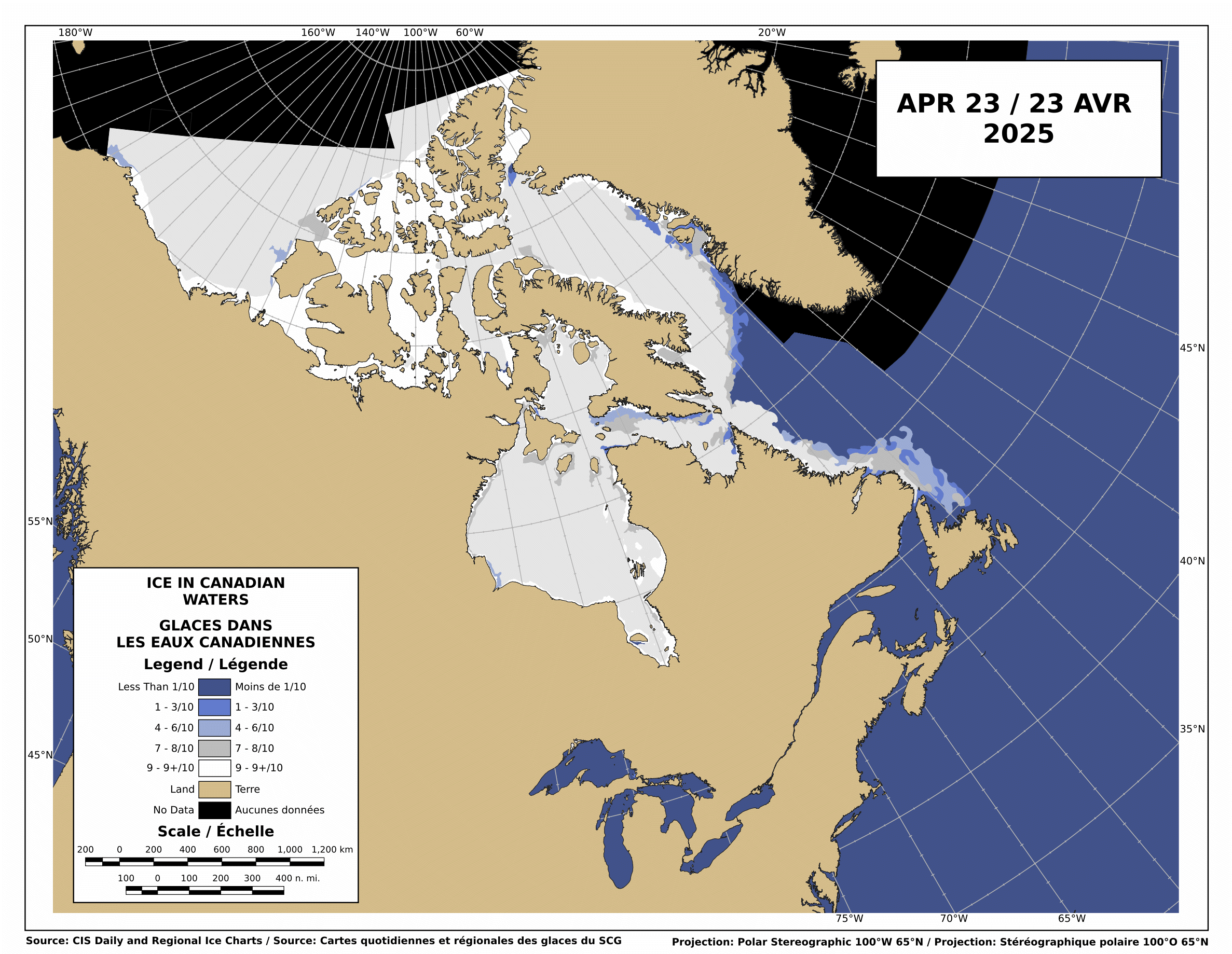
The Canadian Ice Service shows that there is still low-medium concentration ice blocking the Northwest Passage.

http://ice-glaces.ec.gc.ca/Ice_Can/CMMBCTCA.gif
If you owned a ship, would you send it through a route knowing it will face shifting pack ice, possible icebergs, fog, darkness, wind, storms and the possibility of an early freeze?
“The plans that you make can change completely,” he says. This uncertainty, delay, liability, increased insurance and other costs of using the Northwest Passage are likely to deter commercial shipping here. A ship with a reinforced hull could possibly make it intact through the passage. But if it got stuck, it would cost thousands of dollars for an icebreaker like the Amundsen to come to the rescue. So even if the Northwest Passage is less ice-choked than before, the route may not become a shipping short-cut in the near future, as some have predicted.
The Arctic Oscillation was negative for a few days, which allowed colder air to escape from the Arctic and warmer air to invade the Arctic. Note that the period of positive AO starting in early July corresponded to the Moscow heat wave. The cold air was trapped in the Arctic.

The negative dip this week allowed a blast of southerly air to melt and compact the ice during the past week, as we forecast in last week’s sea ice news.


http://ocean.dmi.dk/arctic/icecover.uk.php
Ice extent loss has dropped off dramatically in the last few days, as seen in the DMI graph above and the JAXA graph below.

Note that there was little loss in ice extent during 2006, after August 22.

What does the remainder of 2010 hold? Difficult to say. NCEP forecasts freezing temperatures over the broken ice in the Beaufort Sea during the next two weeks.

http://wxmaps.org/pix/temp2.html
If the remainder of the summer follows a path like 2006, 5.5 million is the right number. Another blast of southerly wind during the next few weeks. and it goes below 5.5. All of the ice indexes currently show 2010 ahead of 2008. DMI and NORSEX show it ahead of 2009 as well. JAXA also shows that the ice area curve has flattened. Ice area is always less than extent, and area trends tend to lead extent by a week or two.

There are large areas of low concentration ice which are vulnerable to compaction, spreading or melt.

My forecast remains unchanged. 5.5 million, finishing above 2009 and below 2006. Same as it has been since May.
The video below shows ice movement in the Beaufort Sea this week. Earlier in the week, it was compacting rapidly, now it is slightly expanding.
It all comes down to the temperature and wind over the next few weeks.
PIOMASS forecasts continue to stray further from the mark. Areas in red are places where PIOMASS incorrectly forecast melt. Solid green is the opposite misprediction.



Lindsay and Zhang forecast a minimum of 3.96 million in July.
The modified NSIDC image below shows ice loss during the last week. Mainly in the Beaufort Sea.

The modified NSIDC image below shows ice gain since 2007 in green, loss in red.

I’m not going to make a forecast for the next week, because there aren’t any dominant indicators either way.

Günther Kirschbaum says:
August 23, 2010 at 9:55 am
The webcam on this US Coast ice breaker is showing what 90%-100% sea ice concentration looks like: http://mgds.ldeo.columbia.edu/healy/reports/aloftcon/2010/20100823-1601.jpeg
Right…
I think this would make for a very good What’s Up With That article, wouldn’t you? Because something is wrong somewhere
______
Why do you think something is wrong? The Healy is currently traversing an area of sea ice that is of mixed concentration, ranging from around 80% down to 15%. This map shows the area (they are currently in the general area of where C1 and C2 cross).
http://www.icefloe.net/cruisetrack.html
This area is somewhat near where David Barber was last year when he found his famous “rotten ice”. If you look at the webcam photo, and imagine this ice didn’t entirely melt by the time the winter freeze started, you can well imagine how that “rotten ice” would form, as this partially melted ice with lots of open water, melt ponds, and leads get frozen over with a top layer of snow. A satellite image might then show this as solid area of older ice, but it would take an actual trip to the ice, as David Barber did, or CryoSat 2 data to show the true nature of the “rotten ice” underneath.
BTW, the Healy is on a very interesting science mission to study the condition of the ice during the later stages of the 2010 melt season. You can follow that mission here:
http://www.icefloe.net/reports_healy.html
Just a followup to the Healy cruise track data. This is a better link:
http://www.icefloe.net/hly1002/tracklines_21Apr10.jpg
Günther Kirschbaum says:
“You really don’t see it, do ya? :-D”
What, the flying saucer? Has it finally arrived?
Does snow lay on top of open water on your planet?
Earlier in the thread here I made a crack at mecago’s assertion that the Arctic ice would be gone in 20 years and even worse I aimed it at the wrong person, Scott. I’ve already said I was sorry and I meant it. I shouldn’t have done it. It was not productive or mature of me to bring the comments down to that low level. After all this is not the Real Climate site. Now that I have said that, I must address the motivation behind it. It may be off topic, but; I believe it is relevant. Hopefully the moderators will allow it.
I find the rabid belief in Man made Global Warming or the belief that all the ice will melt away to be absurd on its face. Even the proposition of these beliefs are ridiculous and that’s what they are beliefs with the attempts to dignify them with,”Science.” While the argument of how many Angels can dance on the head of a pin rage on here and else where, it is important for me to understand why and how these people have gotten such a sway on the body politic at large and the stature of legitimacy that they have acquired. This view must be fought on a serious academic level and also mocked in order to bring a little humour to this fight. That’s why I made the remark.
I believe with all my heart that they must be stopped and all this Climate Astrology shown as the fraud it really is.
What is truly frightening to me is the influence that these terror mongers have over the media and the public at large.
I don’t understand the self hatred, guilt and loathing they have for their very humanity and the repugnance they have for the very Spirit Of Man and its age old struggle to climb up out of the mud and dispel darkness from our minds and from the Earth. I’ve always thought that great Spirit was our greatest gift and is what makes us Human.
If one wants to hate ones self, fine; go ahead. But when public and economic policy is made on the basis of this self hatred which is masked in, “Climate Science,” then something has to be done.
When these people talk about mass extinctions, the, “culling” of the Human Race and their desire to see mass death, starvation and oppression of Humanity at large, it is truly frightening. It is a scary trend today, you see all of the National Geographic shows about life after Human extinction or dramas about how one form of Man made Apocalypse or another is going to wipe us all out. This stuff is becoming main stream now, its not just some idiot professor living in a grass hut wishing for the mass destruction of Civilisation.
It one thing to destroy yourself or desire to. It’s quite another to obtain enough power to exact that hatred on the World at large.
Again, I don’t understand where this malevolence comes from. I’d like to though it’s very important to me.
That’s all I have to say and any posts I make in the future will be more appropriate.
Okay now back to fighting over the ice extent.
Thanks,
William
Why do you think something is wrong? The Healy is currently traversing an area of sea ice that is of mixed concentration, ranging from around 80% down to 15%.
R. Gates, my point is that Cryosphere Today and Uni Bremen sea ice concentration maps show this area as containing sea ice concentrations of 90-100%. I’m not sure about CT, but Uni Bremen has grid lines.
Maybe I should wait until they cross 80N and see what the images look like over there.
Does snow lay on top of open water on your planet?
Ah, so you are seeing the open water? You do learn fast.
R. Gates:
Regarding your anticipation that 2010 minimum would approach 2007’s:
I do understand that one can conveniently forget past “forecasts,” but this age of the internet helps other people remember. Here are your words from May 23, 2010:
“Another strong reason for the likelihood of a lower summer arctic sea ice minimum is the fact that January to April 2010 was the warmest first 4 months of any year . . .
I honestly just don’t see how we can’t have another summer arctic sea ice minimum that approaches 2007′s low, and certainly falls below 2008 and 2009.”
In addition, I also remember your comments on May 23rd that this summer the “PIOMAS model [will be] proven once more as very solid. . .”
We can also quote your projection (immediately made after 2010 crossed 2007) that 2010’s line would “parallel” 2007’s. I trust that you do not feel picked on. Mr. Goddard is getting similar examination.
Correction on the current mission of the Icebreaker Healy. The current mission has nothing to do with the study of the ice (though there may be a few scientists on board doing this). The current primary project until Sept. 6 is:
“The mission of the U.S. Extended Continental Shelf Project is to establish the full extent of the continental shelf of the United States, consistent with international law. Since 2003, the United States has been gathering and analyzing data to determine its extended continental shelf, following the criteria contained in Article 76 of the United Nations Convention on the Law of the Sea.”
It was the just prior mission of the Healy (Nasa’s Arctic Voyage 2010) that was a ice science mission.
Jarmo says: August 23, 2010 at 12:49 am
“Just The Facts, I have no problem with Steve’s assertation. I just took a look at the graphs and wondered how AO running mean can show such a high value (+2), when daily AO has not reached +2 during 2010 (as far as I know).”
I see your point, when you look at the monthly data;
http://www.cpc.noaa.gov/products/precip/CWlink/daily_ao_index/monthly.ao.index.b50.current.ascii.table
none of the last three months comes close to the 3 month running mean show at the end of this chart:
http://www.cpc.noaa.gov/products/precip/CWlink/daily_ao_index/month_ao_index.shtml
I’m not sure why this is, could be their graphing software outputting garbage when 3 months of data isn’t available, could be a result of the standardization technique they are using, “The departures are standardized using the 1950-2000 base period statistics.” or it could just be erroneous data.
If so inclined, you might want to contact the Climate Prediction Center (CPC);
http://www.cpc.noaa.gov/comment-form.html
http://www.cpc.noaa.gov/information/personnel/contacts.shtml
to get their thoughts on the matter.
Günther,
When you’re deep in a hole, it’s best to stop digging. If you want to insist that snow drifts lay atop open water, you’re making it too easy for me. In fact, the picture you posted claiming to show open water actually shows snow laying on ice.
And you never did answer my question: doesn’t “Kirschbaum” translate as “cherry-tree”?☺
R Gates said;
“This puts 2010 in the top five lowest sea ice extents in the JAXA record.”
The Jaxa record being extremely short of course when measured against historic or geological time. Quite what it is supposed to prove other than sea ice has been dropping for the proverbial blink of an eye I don’t know.
Tonyb
In fact, the picture you posted claiming to show open water actually shows snow laying on ice.
My dear, dear Smokey. I didn’t claim the picture was showing open water, that was your confirmation bias filter (this is a great opportunity to learn something about yourself, something that is invisible to you yourself and you do not wish to see).
I said: “The webcam on this US Coast ice breaker is showing what 90%-100% sea ice concentration looks like”.
At least that is what the University of Bremen sea ice concentration map (which sadly doesn’t get much airplay here, just like the MODIS satellite images of the Northwest Passage for instance) is saying should be there. In the upper part of the image from the Healy webcam you can see their position.
Maybe I didn’t look right, I tried to follow the Uni Bremen grids. That’s why I posted it here, because people love puzzling things here. Well, I would think it rather puzzling that 90-100% sea ice concentration still shows – in my opinion – quite a bit of open water.
R. Gates himself, one of the smarter guys in this room, said: “an area of sea ice that is of mixed concentration, ranging from around 80% down to 15%.”
So WUWT?
a) I made a mistake and the Healy is not in the purple-pink area on the Uni Bremen map.
b) The Uni Bremen grid lines are not where they should be.
c) The position of the Healy is not displayed correctly in the webcam image.
d) The ice concentration is lower than the one the Uni Bremen sea ice concentration map is showing.
e) Coincidentally just this small area had a lower sea ice concentration. We will see 100% concentration once the Healy moves North a bit more.
doesn’t “Kirschbaum” translate as “cherry-tree”?☺
It does indeed. I have come to the right place, haven’t I? 😛
R. Gates, which track is the Healy now following? C1?
In response to William:
Being one of the few “warmists” here on WUWT, I would like to comment on your previous length post regarding your misperception that those who think that AGW is likely happening as having some sort of desire to see the destruction of the human race, or as you put it, “wishing for the mass destruction of Civilization.”
I do not deny that there may be some small fringe minority (very small minority) who may feel this way or something close to this. But this is not the motivation of the majority of dedicated scientists who study the science of climate change every day. They are seeking to understand and are driven by natural curiosity about the systems of the earth, not animosity toward their fellow humans. If the science leads them to believe that humans are affecting the planet in diverse ways that could lead to serious issues for humanity, then that is where the science has led them. Very very few, (and probably exactly 0) of the professional science community wishes any thing catastrophic to happen, even though a few might suggest that something could.
In regards to the non-professional scientists, such as myself, who are “warmists” in the sense that we think that AGW is likely happening, I can only speak for myself, when I say that I am far more interested in the truth behind what is happening, and far less focused (currently) on the implications for the survival of humanity. I have faith in our future. Humans have been successful as a species because we are adaptable and able to use our large brains to figure out how to survive. If it turns out that AGW really is happening (as I think is likely) then I have no doubt that we’ll find a way to deal with it in an appropriate manner. Other “warmists” obviously believe that time is now, and that our carbon based civilization needs to shift now, in order to avert the worst impacts of AGW and climate change. Even in these sorts of “warmist” thoughts, I don’t see a wish for the destruction of civilization, but quite the opposite, they feel the urgency to do whatever it takes to ensure the future of that civilization. So in all these cases, from the professional scientist studying climate change, to those like myself who study it as “armchair” scientists, to others who feel that enough is already known and we need to take action now, I don’t see the dark and hateful motivations that you described in your post. There well may be that very rare and unbalanced person who says, “the worlds going to hell in a hand basket, and it’s won’t be too soon for me…” but this sort of psychotic personality has nothing to do with the mainstream “warmist”.
R. Gates says:
August 23, 2010 at 8:08 am
Million K^2. Following that is 2005
________
“…I’ve projected we’ll just nudge under 2008 by virtue of a later final low date then we had in 2008. 2008′s low was set on Sept. 9, and I think this year we’ll see a later final low (similar to 2007 or 2005) and it will be hit during the period of Sept. 20-25.”
You’ve written of this late melt ending date a few times now, but never explained your reasoning for expecting the melt to continue for so long. Lacking an explanation, it’s tempting to assume that your reasoning revolves around “that’s how long it will have to melt for my prediction to have any hope of coming close.”
So, do you have a reasonable explanation for expecting an unusually late end to the melt season? Warmer waters persisting longer, warm southern breezes, winds pushing ice out of the Arctic, converging ice, diverging ice melting faster? Or just hoping?
While I have little actual knowledge of the situation, it would seem to me that the relatively cold summer and the late start to the melt season last spring would both argue for an early end, rather than a late one, much as Steve G. has been expecting, for reasons of his own.
Rod
tonyb says:
August 23, 2010 at 11:43 am
R Gates said;
“This puts 2010 in the top five lowest sea ice extents in the JAXA record.”
The Jaxa record being extremely short of course when measured against historic or geological time. Quite what it is supposed to prove other than sea ice has been dropping for the proverbial blink of an eye I don’t know.
Tonyb
______
Actually Tony, that was not me who said that but rather Jeff P. You must have read one of my posts where I quoted Jeff P. I agree with the short term nature of the JAXA data, and so of course, look the longer term Cryosphere Today data as being more suitable for speaking about longer term trends.
As it stands now though, I look for 2010 to give 2008 a good run for the 2nd lowest spot on JAXA data, and certainly the AGW skeptics will be needing to find some reason why their recovery of Arctic Sea ice, (which really wasn’t a recovery anyway) didn’t happen this year as planned, and will I suppose need to be called a “Recovery Spiral”.
Smokey says:
August 23, 2010 at 11:35 am
Günther,
When you’re deep in a hole, it’s best to stop digging. If you want to insist that snow drifts lay atop open water, you’re making it too easy for me. In fact, the picture you posted claiming to show open water actually shows snow laying on ice.
The picture posted was supposed to be of ~90% extent
Günther Kirschbaum says:
August 23, 2010 at 9:55 am
The webcam on this US Coast ice breaker is showing what 90%-100% sea ice concentration looks like: http://mgds.ldeo.columbia.edu/healy/reports/aloftcon/2010/20100823-1601.jpeg
Perhaps you should stop digging?
Also can you confirm that your name translates as ‘one who blows smoke’?
Has Gunther been cherrypicking photos? Hmmm, let’s see….
http://mgds.ldeo.columbia.edu/healy/reports/aloftcon/2010/
Rod Everson says:
August 23, 2010 at 12:30 pm
R. Gates says:
August 23, 2010 at 8:08 am
Million K^2. Following that is 2005
________
“…I’ve projected we’ll just nudge under 2008 by virtue of a later final low date then we had in 2008. 2008′s low was set on Sept. 9, and I think this year we’ll see a later final low (similar to 2007 or 2005) and it will be hit during the period of Sept. 20-25.”
You’ve written of this late melt ending date a few times now, but never explained your reasoning for expecting the melt to continue for so long. Lacking an explanation, it’s tempting to assume that your reasoning revolves around “that’s how long it will have to melt for my prediction to have any hope of coming close.”
So, do you have a reasonable explanation for expecting an unusually late end to the melt season? Warmer waters persisting longer, warm southern breezes, winds pushing ice out of the Arctic, converging ice, diverging ice melting faster? Or just hoping?
While I have little actual knowledge of the situation, it would seem to me that the relatively cold summer and the late start to the melt season last spring would both argue for an early end, rather than a late one, much as Steve G. has been expecting, for reasons of his own.
Rod
______
Rod, I have in fact given my reasoning before, but in a nutshell, it all has to do with water temps and the amount of open water. Water temps are, and have been anomalously warm across the Arctic and they are what primarily drive the late season melt and dictate when the final low will be set. Added to this of course will be the timing, duration, and intensity of high and low pressure systems, which will contract or diverge the ice in different places and different ways– but water temps set the stage. Also, the Arctic has not been unusually cool this summer, despite what Steve et. al. seem to be indicating. I look for 2010 to reach the bottom around Sept. 20-25, following a similar trend shown in 2005 and 2007.
Günther Kirschbaum says:
August 23, 2010 at 11:57 am
R. Gates, which track is the Healy now following? C1?
_____
Healy is actually following C2 right now. And if you look at this latest picture, in addition to noticing that the air temp is well above freezing (upper part of the image) you can see a whole lot of open water and it is actually following another ship:
http://mgds.ldeo.columbia.edu/healy/reports/aloftcon/2010/20100823-2001.jpeg
No doubt about my estimate of being in a 15 to 80% concentration area. Nice to know my “armchair” science skills are still sharp!
jorgekafkazar says:
August 23, 2010 at 12:04 am “enthalpy”
You and Cassandra King are correct. I interpreted her phrase “100% warmer” as referring to the temperature reading rather than the available energy. Thanks for the correction.
No doubt about my estimate of being in a 15 to 80% concentration area. Nice to know my “armchair” science skills are still sharp!
R. Gates, I never doubted your estimate. In fact, I agree with it.
My question is: Why is the Uni Bremen sea ice concentration map saying there should be 90-100% sea ice concentration there?
Steven,
You may be right (about Fulham)). I have nearly 55 years of bias in my viewing of any match involving MU!
Just cked my weather stations from Barrow around thru the canadian Islands to the tip of greenland over to Svalbard & over to some russian Islands on the other side..they average out to 77.7 north & have an average temp of 39…not good…I also do not see much if any cool down in next 7 days..I’m bumming..
Sean Peake says:
August 23, 2010 at 12:58 pm
Has Gunther been cherrypicking photos? Hmmm, let’s see….
____________________
In other news a dog bit a man, cat coughs up a hairball, and Global Warming occurs in the summer season every year.
Günther Kirschbaum says:
August 23, 2010 at 1:45 pm
No doubt about my estimate of being in a 15 to 80% concentration area. Nice to know my “armchair” science skills are still sharp!
R. Gates, I never doubted your estimate. In fact, I agree with it.
My question is: Why is the Uni Bremen sea ice concentration map saying there should be 90-100% sea ice concentration there?
______
Ah, good question, now I see. But I rarely use the Bremen map as I think CT’s has much better fidelity:
http://arctic.atmos.uiuc.edu/cryosphere/NEWIMAGES/arctic.seaice.color.000.png
I couldn’t begin to tell you about the difference in approach, but I’ve noticed that CT’s usually corresponds closely with ground based observations. (as our example of the Healy shows), and so I go with it as I like the higher fidelity.