By Steve Goddard

Darkness is returning to the Arctic as the sun moves towards the horizon. In four weeks, the sun will disappear completely at the North Pole.

Solar Energy as a function of latitude and date
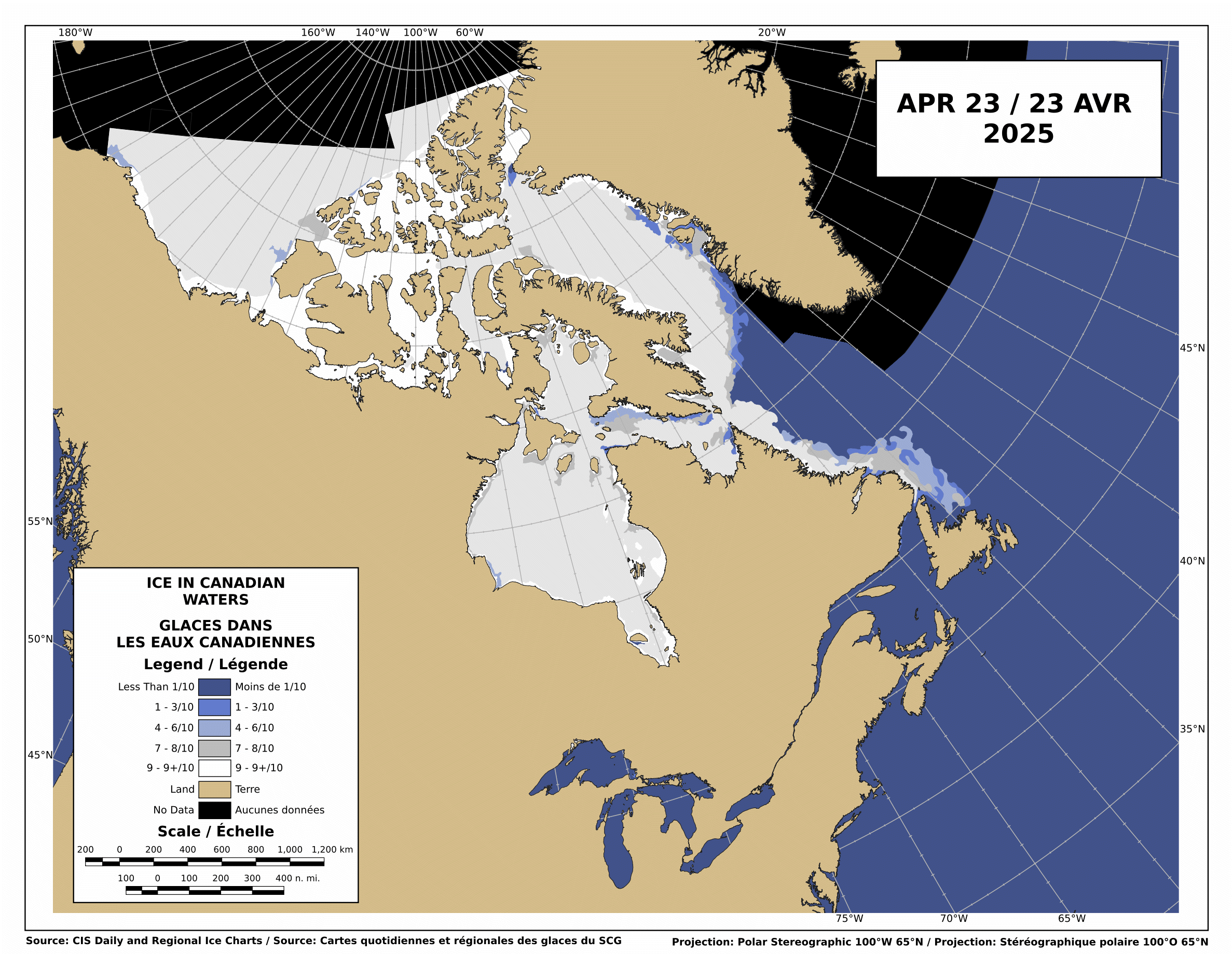
The Canadian Ice Service shows that there is still low-medium concentration ice blocking the Northwest Passage.

http://ice-glaces.ec.gc.ca/Ice_Can/CMMBCTCA.gif
If you owned a ship, would you send it through a route knowing it will face shifting pack ice, possible icebergs, fog, darkness, wind, storms and the possibility of an early freeze?
“The plans that you make can change completely,” he says. This uncertainty, delay, liability, increased insurance and other costs of using the Northwest Passage are likely to deter commercial shipping here. A ship with a reinforced hull could possibly make it intact through the passage. But if it got stuck, it would cost thousands of dollars for an icebreaker like the Amundsen to come to the rescue. So even if the Northwest Passage is less ice-choked than before, the route may not become a shipping short-cut in the near future, as some have predicted.
The Arctic Oscillation was negative for a few days, which allowed colder air to escape from the Arctic and warmer air to invade the Arctic. Note that the period of positive AO starting in early July corresponded to the Moscow heat wave. The cold air was trapped in the Arctic.

The negative dip this week allowed a blast of southerly air to melt and compact the ice during the past week, as we forecast in last week’s sea ice news.


http://ocean.dmi.dk/arctic/icecover.uk.php
Ice extent loss has dropped off dramatically in the last few days, as seen in the DMI graph above and the JAXA graph below.

Note that there was little loss in ice extent during 2006, after August 22.

What does the remainder of 2010 hold? Difficult to say. NCEP forecasts freezing temperatures over the broken ice in the Beaufort Sea during the next two weeks.

http://wxmaps.org/pix/temp2.html
If the remainder of the summer follows a path like 2006, 5.5 million is the right number. Another blast of southerly wind during the next few weeks. and it goes below 5.5. All of the ice indexes currently show 2010 ahead of 2008. DMI and NORSEX show it ahead of 2009 as well. JAXA also shows that the ice area curve has flattened. Ice area is always less than extent, and area trends tend to lead extent by a week or two.

There are large areas of low concentration ice which are vulnerable to compaction, spreading or melt.

My forecast remains unchanged. 5.5 million, finishing above 2009 and below 2006. Same as it has been since May.
The video below shows ice movement in the Beaufort Sea this week. Earlier in the week, it was compacting rapidly, now it is slightly expanding.
It all comes down to the temperature and wind over the next few weeks.
PIOMASS forecasts continue to stray further from the mark. Areas in red are places where PIOMASS incorrectly forecast melt. Solid green is the opposite misprediction.



Lindsay and Zhang forecast a minimum of 3.96 million in July.
The modified NSIDC image below shows ice loss during the last week. Mainly in the Beaufort Sea.

The modified NSIDC image below shows ice gain since 2007 in green, loss in red.

I’m not going to make a forecast for the next week, because there aren’t any dominant indicators either way.

Neymar snubbed Chelsea. Crazy !!!!!!!!!!!!!!!!!
mecago says:
August 22, 2010 at 8:11 pm
Ummmm…. Nope, not high. I reckon it’s catnip, mate, you got burned!
How come there is so much ‘1st year ice’ in 2008 that was covered by 2nd year or older ice in 2007?
How come there is so much ‘1st year ice’ in 2009 that was covered by 2nd year or older ice in 2008?
I’ll bet 2010 will show the same ‘magic’ situation.
in the 70’s people were claiming a massive Global Cooling scare. Even Hansen had models proclaiming it to be true. I wonder why the ice is slightly less now? Could it be because we’ve warmed up again? Hmmm…. now that may make more sense than a panic in the opposite direction a few decades later, especially hen said panic is based on the same bloke’s models. But that’s just my opinion. As with the catnip.
mecago says:
August 23, 2010 at 12:17 am
Especially not since we’d all be dead in seconds, I guess not, no. That would be REAL global warming!
Phil
Do you have a citation for your info on Fort Ross, Bellot Straits, and the number of resupply trips taken by the HBC? Thanks in advance.
Nylo
On Cryosphere Today click on “Download historical sea ice data here”. That will take you a page where you can download historical grids and documentation for 1870-2008. Data is ascii text. William Chapman has his contact info for questions.
For later presatellite data there is a report called “Climatic Atlas for Arctic Sea Ice Extent and Anomalies 1953-1984” by D.K. Manak & L.A. Mysak, CRG Report 87-8 Sept. 1987. You can find it by google (I think I found it at Magill University). The resolution of presatellite data is pretty darn sparse.
I notice that the NSIDC compare current sea ice extent to the MEDIAN of 1979-2000, yet they describe the outline as the “average”.
I’m trying to get my head around the relevance of the median. Obviously it would be difficult for them to create an outline of a mean extent.
Presumably NSIDC look at the extents on any particular date from each of the years from 1979-2000, line them up in order, and compare the current day to the median. It strikes me this could be very different to the mean. eg. the median of 3 large circles and 2 small ones would be one of the large ones.
Also, if this is what NSIDC do, then it may be helpful if they could state the year with which they are comparing current extent, eg. today the 1983 extent could be the median, yet tomorrow the extent in 1993 could be.
What conclusions can be drawn from such comparisons?
The final days of the 2010 melt season are here and the horse race is on.
2010 is the 9th year in the JAXA record. How will it place?
Today 2010 has the 2002 minimum beat. Let’s look at the standing.
2003 Min.: 6,041,250: Busted 8/14/10
2004 Min.: 5,784,688: Busted 8/19/10
2006: Min.: 5,781,719: Busted 8/19/10
2002: Min: 5,646,875: Busted Today!
Goddard Min,:5,500,000: ????
This puts 2010 in the top five lowest sea ice extents in the JAXA record.
Next up is the Goddard Minimum at 5.5 Million K^2. Following that is 2005.
David Gould says:
August 22, 2010 at 6:45 pm
the people supposedly traversing it are in reality sitting at home in air-conditioned comfort?
Nah, they were watching Brett Favre.
Jeff P
Given that there are only eight years in the JAXA record, being “in the bottom five” could also be described as “above average.”
LOL
How far to get to the PIOMASS 3.9 forecast, or Mark Serreze “Possible record minimum?”
Amino Acids in Meteorites says:
“Nah, they were watching Brett Favre.”
He is a Viking after all! That should be no problem for him.
While we are playing that game, COI has 2010 in the “top three highest extents ever recorded for the date.”
http://ocean.dmi.dk/arctic/icecover.uk.php
If the comparison to 2006 is right then flattening is ready to start
http://img841.imageshack.us/img841/107/yamsreseaiceextentl22cr.jpg
Here’s some open areas. This is what I consider ‘open’ because it’s…….open.
http://img841.imageshack.us/img841/4745/zcmmbctca.gif
Ice concentration around the Titanic was less than 1%. Think about that.
stevengoddard says:
August 23, 2010 at 7:06 am
While we are playing that game, COI has 2010 in the “top three highest extents ever recorded for the date.”
——-
Steve,
It’s a little late in the game to be changing data sets, isn’t it? Changing the measuring stick when you don’t like the results is for people who are more committed to their narrative than the truth. I’d like to think that isn’t you.
You chose JAXA so it’s only fair to stick with JAXA.
Jeff P
Please …. I have been discussing all the ice data sets all year, and will continue to do so. They all provide different information.
Why are you so desperate to prove that my forecast might not be exactly perfect? In target shooting competition, closest to the bullseye wins. People rarely hit dead center, nor do they expect to.
Jeff P says:
August 23, 2010 at 6:08 am
The final days of the 2010 melt season are here and the horse race is on.
2010 is the 9th year in the JAXA record. How will it place?
Today 2010 has the 2002 minimum beat. Let’s look at the standing.
2003 Min.: 6,041,250: Busted 8/14/10
2004 Min.: 5,784,688: Busted 8/19/10
2006: Min.: 5,781,719: Busted 8/19/10
2002: Min: 5,646,875: Busted Today!
Goddard Min,:5,500,000: ????
This puts 2010 in the top five lowest sea ice extents in the JAXA record.
Next up is the Goddard Minimum at 5.5 Million K^2. Following that is 2005
________
Wow Jeff, you are really are watching this closely. Really though, as I said last week, the only race left if whether or not it falls below 2008’s level, and as has been pointed out, that will be based on how low pressure and high pressure systems cross the Arctic in this final phase of the summer melt season. I’ve projected we’ll just nudge under 2008 by virtue of a later final low date then we had in 2008. 2008’s low was set on Sept. 9, and I think this year we’ll see a later final low (similar to 2007 or 2005) and it will be hit during the period of Sept. 20-25.
And besides which, DMI is at 4 million. Why would I even consider comparing my 5.5 forecast (15% concentration) vs DMI’s 30% concentration?
stevengoddard says:
August 23, 2010 at 8:05 am
Jeff P
Please …. I have been discussing all the ice data sets all year, and will continue to do so. They all provide different information.
Why are you so desperate to prove that my forecast might not be exactly perfect?
———————————————
LOL, I feel no desperation, are you projecting?
I’ve been following along for a while and you have consistently been using JAXA data as the numbers to compare your prediction against. It seems odd to start using a data set that is half the size so late in the game.
To be clear: I’m NOT calling foul on using new data for a more robust analysis, I AM calling foul on using new numbers to measure your prediction against.
stevengoddard said:
August 23, 2010 at 7:37 am
Ice concentration around the Titanic was less than 1%. Think about that.
______________________________________
Well given that and yours and Amino Acids in Meteorites definition it means the Atlantic was blocked in that year, and all years subsequently when any iceberg has been in the north Atlantic :p
Amino Acid is still clinging to his Canadian ice service image even with his own defininition of what “open” is, even if it is at odds with what other peoples is and the boats going through it show…..
Andy
The webcam on this US Coast ice breaker is showing what 90%-100% sea ice concentration looks like: http://mgds.ldeo.columbia.edu/healy/reports/aloftcon/2010/20100823-1601.jpeg
Right…
I think this would make for a very good What’s Up With That article, wouldn’t you? Because something is wrong somewhere.
I’m beginning to think 2010’s story line may turn out to be “revenge of the consensus”, with extent minimum more or less splitting the “establishment 16” predictions in reasonable range of dead center.
Which would still leave Zhang and PIOMAS with some ‘splaining to do.
Günther Kirschbaum,
Thanks for the pic of snow on ice. You should write an article about it.
Uhhhh… so that’s why Antarctic ice is increasing – 6 solid months of black, and 5 months of mixed/light. Whereas the Arctic is 5 solid months of black, and 6 months of mixed/light. It certainly seems there is a bias that is not 50/50 there. My point is the Antarctic is darker longer according to the chart.
Which would still leave Zhang and PIOMAS with some ‘splaining to do.
They will have some ‘splaining to do if their model deviates enormously from CryoSat-2 data.
Thanks for the pic of snow on ice.
You really don’t see it, do ya? 😀