Radiative Physics Simplified II
A guest post by Jeff Id
Radiative physics of CO2 is a contentious issue at WUWT’s crowd but to someone like myself, this is not where the argument against AGW exists. I’m going to take a crack at making the issue so simple, that I can actually convince someone in blogland. This post is in reply to Tom Vonk’s recent post at WUWT which concluded that the radiative warming effect of CO2, doesn’t exist. We already know that I won’t succeed with everyone but when skeptics of extremist warming get this wrong, it undermines the credibility of their otherwise good arguments.
My statement is – CO2 does create a warming effect in the lower atmosphere.
Before that makes you scream at the monitor, I’ve not said anything about the magnitude or danger or even measurability of the effect. I only assert that the effect is real, is provable, it’s basic physics and it does exist.
From Tom Vonk’s recent post, we have this image:
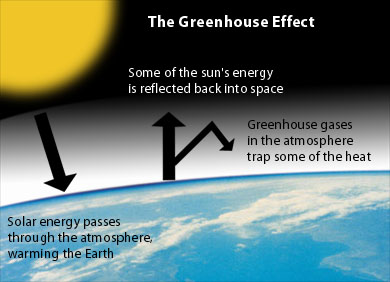 Figure 1
Short wavelength light energy from the sun comes in, is absorbed, and is re-emitted at far longer wavelengths. Basic physics as determined by Planck, a very long time ago. No argument here right!
Figure 2 below has several absorption curves. On the vertical axis, 100 is high absorption. The gas curves are verified from dozens of other links and the Planck curves are verified by my calcs here. There shouldn’t be any disagreement here either – I hope.
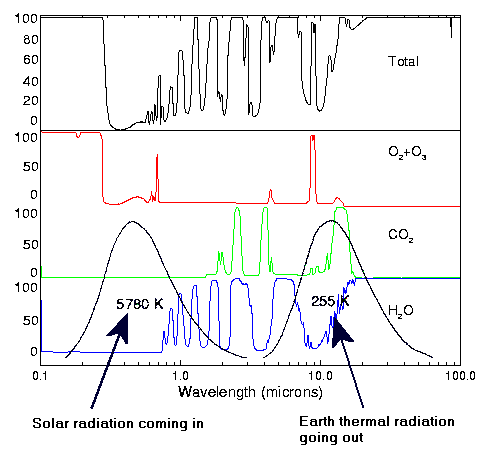 Figure 2 – Absorption curves of various molecules in the atmosphere and Planck curve overlay.
What is nice about this plot though is that the unknown author has overlaid the Planck spectrums of both incoming and outgoing radiation on top of the absorption curves. You can see by looking at the graph (or the sun) that most of the incoming curve passes through the atmosphere with little impediment. The outgoing curve however is blocked – mostly by moisture in the air – with a little tiny sliver of CO2 (green curve) effective at absorption at about 15 micrometers wavelength (the black arrow tip on the right side is at about 15um wavelength). From this figure we can see that CO2 has almost no absorption for incoming radiation (left curve), yet absorbs some outgoing radiation (right curve). No disagreement with that either – I hope. Tom Vonk’s recent post agrees with what I’ve written here.
Energy in from the Sun equals energy out from the Earth’s perspective — at least over extended time periods and without considering the relatively small amount of energy projecting from the earth’s core. If you add CO2 to our air, this simple fact of equilibrium over extended time periods does not change.
So what causes the atmospheric warming?
Air temperature is a measure of the energy stored as kinetic velocity in the atoms and molecules of the atmosphere. It’s the movement of the air! Nothing fancy, just a lot of little tiny electrically charged balls bouncing off each other and against the various forces which hold them together.
Air temperature is an expression of the kinetic energy stored in the air. Wiki has a couple of good videos at this link.
“Warming” is an increase in that kinetic energy.
So, to prove that CO2 causes warming for those who are unconvinced so far, I attempted a thought experiment yesterday morning on Tom Vonk’s thread. Unfortunately, it didn’t gain much attention. DeWitt Payne came up with a better example anyway which he left at tAV in the comments. I’ve modified it for this post.
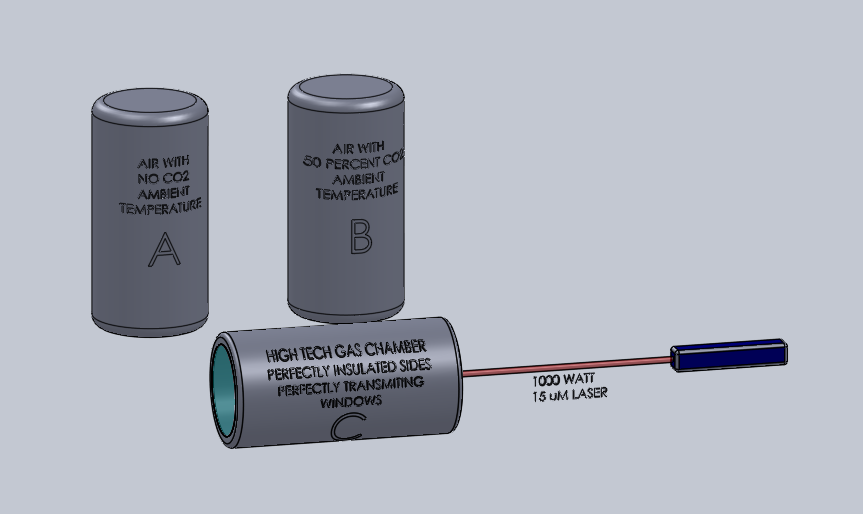 Figure 3- Experimental setup. A – gas can of air with all CO2 removed at ambient temp and standard pressure. B – gas can of air diluted by 50 percent CO2, also at ambient temp and standard pressure. C ultra insulated laser chamber with perfectly transparent end window and a tiny input window on the back to allow light in from the laser. Heat exit’s the single large window and cannot exit the sides of the chamber.
Figure 4 is a depiction of what happens when C contains a vacuum.
 Figure 4 – Laser passes straight through the chamber unimpeded and a full 1000 Watt beam exits our perfect window.
The example in Figure 5 is filling tank C with air from tank A air (zero CO2) at the equilibrium state.
 Figure 5 – Equilibrium of hypothetical system filled with zero CO2 air from canister A.
Minor absorption of the main beam causes infrared absorption and re-emission from the gas reducing the main beam from the laser. This small amount of energy is re-emitted from the gas through the end window and scattered over a full 180 degree hemisphere.
What happens when we instantly replace the no-CO2 air in chamber C with the 50% CO2 air mixture in B?
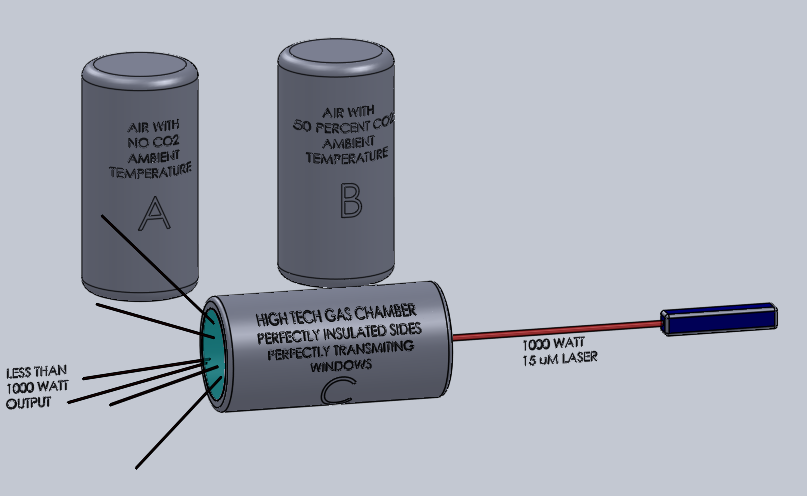 Figure 6 – Air in C is replaced instantly with gas from reservoir B
From the perspective of 15 micrometer wavelength infrared laser, the CO2 filled air is black stuff. The laser cannot penetrate it. At the moment the gas is switched, the laser beam stops penetrating and the 1000 watts (or energy per time) is added to the gas. At the moment of the switch, the gas still emits the same random energy as is shown in Figure 5 based on its ambient temperature, but the gas is now absorbing 1000 watts of laser light.
Since the beam cannot pass through, the CO2 gains vibrational energy which is then turned into translational energy and is passed back and forth between the other air molecules building greater and greater translational and vibrational velocities. —- It heats up.
As it heats, emissions from the window increase in energy according to Planck’s blackbody equation. Eventually the system reaches a new equilibrium temperature where the output from our window is exactly equal to the input from our laser – 1000 watts. Equilibrium! – (Figure 7)
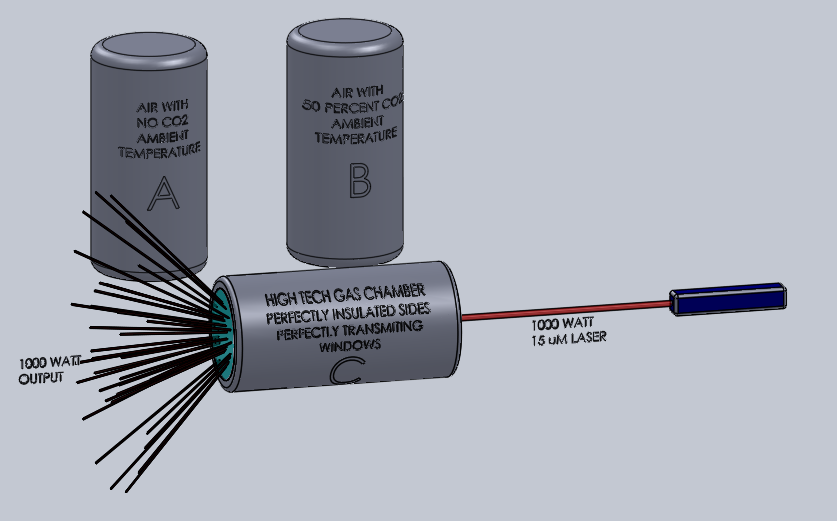 Figure 7 – Equilibrium reached when gas inside chamber C heats up to a temperature sufficient to balance incoming light energy..
The delay time between the instant the air in C is switched from A type air to B air to the time when C warms to equilibrium temperature is sometimes stated as a trapping of energy in the atmosphere.
“CO2 traps part of the infrared radiation between ground and the upper part of the atmosphere”
So from a few simple concepts, two gasses at the same temp, one transparent the other black (at infrared wavelengths), we’ve demonstrated that different absorption gasses heat differently when exposed to an energy source.
How does that apply to AGW?
The difference between this result and Tom Vonk’s recent post, is that he confuses equilibrium with zero energy flow. In his examples and equations, he has a net energy flow through the system of zero, which is fine. Where he goes wrong is equating that assumption to AGW.
What we have on Earth, is a source of 15micrometer radiation (the ground) projecting energy upward through the atmosphere, exiting through a perfect window (space) – sound familiar? Incoming solar energy passes through the atmosphere so we can ignore it when considering the most basic concepts of CO2 based warming (this post), but it is also an energy flow. In our planet, the upwelling light at IR wavelengths is a unidirectional net IR energy flow (figure 2 – outgoing radiation), like the laser in the example here.
Of course adding CO2 to our atmosphere causes some of the outgoing energy to be absorbed rather than transmitted uninterrupted to space (as shown in the example), this absorption is converted into vibrational and translational modes (heating). Yes, Tom is right, these conversions go in both directions. The energy moves in and out of CO2 and other molecules, but as shown in cavity C above, the gas takes finite measurable time to warm up and reach equilibrium with space (the window), creating a warming effect in the atmosphere.
None of the statements in this post violate any of Tom’s equations; the difference between this post and his, is only in the assumption of energy flow from the Sun to Earth and from Earth back to space. His post confused equilibrium with zero flow and his conclusions were based on the assumed zero energy flow. The math and physics were fine, but his conclusion that insulating an energy flow doesn’t cause warming is non-physical and absolutely incorrect.
Oddly enough, if you’ve ever seen an infrared CO2 laser cut steel, you have seen the same effect on an extreme scale.
————-
So finally, as a formal skeptic of AGW extremism, NONE of this should create any alarm. Sure CO2 can cause warming (a little) but warmer air holds more moisture, which changes clouds, which will cause feedbacks to the temperature. If the feedback is low or negative (as Roy Spencer recently demonstrated), none of the IPCC predictions come true, and none of the certainly exaggerated damage occurs. The CO2 then, can be considered nothing but plant food, and we can keep our tax money and take our good sweet time building the currently non-existent cleaner energy sources the enviro’s will demand anyway. If feedback is high and positive as the models predict, then the temperature measurements have some catching up to do.
Even a slight change in the amount of measured warming would send the IPCC back to the drawing board, which is what makes true and high quality results from Anthony’s surfacestations project so critically important.
This is where the AGW discussion is unsettled.
====================================
My thanks to Jeff for offering this guest post – Anthony
RACookPE1978 says:
August 6, 2010 at 7:35 pm
“However, this graph also shows that O2 and O3 at 209460 ppm (537 times the amount of CO2!) have a combined absorbtion peak in the same range of outgoing radiated energy (between 9.8 and 10 microns).”
This would be entirely O3, which is of order 1-10 ppm in the stratosphere. It is quite an effective GHG too. As mentioned elsewhere O2 contributes almost nothing at these wavelengths.
George E Smith made a good point regarding the “average” 240 watts from the sun.
In fact, earth is receiving, and radiating away, heat at higher temperatures during the daytime than during the nighttime. As the earth heats up, earth’s radiation band shifts towards the left, and a smaller FRACTION of earth’s radiation is absorbed by CO2- negative feedback.
Regarding those greenhouse models, I checked out this article regarding multi
layer atmospheres,
http://www.geo.utexas.edu/courses/387H/Lectures/chap2.pdf
came across Newton’s law of cooling, and posted this at
“Science Of Doom”
http://scienceofdoom.com/2010/07/24/the-amazing-case-of-back-radiation-part-two/#comment-5086
My simple model assumed we get the same amount of radiation from the
atmosphere both day and night, and we get all our radiation from the sun during
the day, the same amount all day.
Obviously a lot of latent heat goes into the atmosphere during the daytime , otherwise the earth’s surface would get much hotter during the day than it actually does
So, the science isn’t really settled? Gosh, this earth is a complicated place. 😉
For those who still haven’t seen Roy Spencer’s talk on negative feedback here it is in 2 parts:
Part 1
Part 2
A point missed in the thought experiment is that the 1000 W coming out is all at 15 microns because that is the only wavelength CO2 could emit at (unless the temperature has pushed the envelope in Figure 2 far enough left to make other bands possible). This is an important point that gases emit only at their allowed wavelengths within their black-body temperature envelope, and with the intensity consistent with that envelope. It is like it is trying to be a black body but only has a few windows to output its photons. This is known as low emissivity (where perfect emissivity of 1 is a black body).
The intensity of the 15 micron emission of a region of gas is defined by the temperature and concentration of the CO2 in that region.
Congratulations Jeff probably one of the best posts on the physics involving the interaction between CO2 and outgoing LW radiation and it clearly shows the competition between water vapour and CO2 in the 15um wavelength range. But since the outgoing LW radiation energy is all absorbed the heating effect on the atmosphere is the same irrespective of which molecule absorbs the energy.
The IPCC do however repeatedly talk about the reradiated energy which finds its way back to the surface and thus increases the radiation absorbed by the earth.
Your post does not cover this claim by the IPCC and I realize one can not cover all the bases in one post so this is not a criticism.
In actual fact the absorption of IR by a molecule if looked at in detail is considerably greater at the actual spectral line frequencies and decreases at the frequencies on either side of the spectral line, thus you have a mini Planck curve around each spectral line. There are many spectral lines in the absorption zones shown in your diagram and as the concentration of the gas increases the Planck curve gets wider which is known as line broadening. It is this line broadening effect which forms the theoretical basis for the IPCC formula relating CO2 increase with increased temperatures I believe the forcing factor due to increased water vapour is strictly empirical. However at the current levels the Planck curves all overlap so the line broadening effect has no impact.
With regard to the reradiation back to earth the CO2 molecule will only reradiate energy which is exactly at the spectral lines so although the intermediate wavelengths travel further vertically since their absorption rate is less the resonant frequencies travel a much shorter distance downwards before they are absorbed. Thus a minuscule amount of reradiated energy gets back to earth and the concentration of CO2, once the mini Planck curves have overlapped, has no effect on the energy absorbed and therefore temperatures.
This is an interesting suggestion — i’ll give it a shot. The two objects as described are essentially blackbody cavities (The classical construction of a blackbody is a deep slender cavity drilled into any material–the specific material doesn’t matter). Radiation goes in and bounces around, and some gets absorbed, and what comes out can only come out the window in each case. Most of the radiation is absorbed in each cavity and only a little comes out the window at first. The cavity filled with CO2 will heat up more quickly than the empty cavity. However, at equilibrium what each is made of, and filled with, will not matter at all. As long as each can only view the sun through the window, each will achieve the same temperature, and as long as each is only exchanging radiation with the sun, each will reach the surface temperature of the sun. In short, each will be perfectly absorptive and emittive. There will be no temperature difference to exploit in an engine.
In the realistic case, of course, each tube will radiate into a large solid angle, as it isn’t possible to prevent conduction through a real layer of insulation. Then there may be a temperature difference at equilibrium, but this would be no different than the scheme of connecting a stainless steel panel to a white painted aluminum panel through a heat engine. The steel panel will get quite hot in sunlight, and the aluminum will stay cool. The heat engine produces work. You don’t even need to put this contraption in orbit.
At first I thought this was a straightforward post. Michael Dunn has me thinking about this a bit more. I think I’ll want to read Tom’s post before commenting further.
George Smith, I thought that I should argue a point with you regarding intensity of incoming solar radiation:
“I disagree with those who want to divide this number by 4 after applying some albedo reduction to get some puny 240 W/m^2 all over the earth surface.”
It seems to me that the divide by 4 is straightforward. Solar radiation is averaged over the surface of the earth (area 4 pi radius^2). Projection of solar radiation onto earth is (pi radius^2) (ie. this is the area of space that Earth blocks the solar radiation). So I think that you need to divide by 4.
George E. Smith, and there is still more incoming in the near infrared than outgoing in the earth’s blackbody.
About 50% of the suns’ blackbody is in its infrared. About 45% is in the visible.
Maybe you can tell me if the Climate Models use the 1-4 micron range as visible energy? If not, their accounting is rather shoddy.
As much as I dislike aggressive and ignorant AGW climatards, I hate when the opposite side makes authoritative but wrong or half-accurate statements. Let’s see:
“What you need to understand about Tom Vonk’s post is that he was explaining that the atmosphere does not warm by any radiative absorption process. (And it doesn’t.”
Oh yes it does. What we need to understand that the term “warm” is usually consonant with “up” (and “cool” with “down”), which emphasizes some directional process. Therefore, if we start with a cool gas mixture and begin to shine the 15um laser, the mixture will warm up. Period. Obviously, when/if the system reaches a STATIONARY STATE, it stops warming up, and stays flat. Only then we can say that radiation does not warm it, which is kind of trivial. Even then we need to understand that Tom Vonk is wrong, he does not realize that LTE is not an absolute equilibrium, but is only a first-order approximation of mechanics of continuous medium at a mesosciopic level.
In second approximation, the media allows for temperature gradients, macroscopic motions, eddies, and diffusion transport. That’s exactly what happens with radiation in highly absorbing bands, where the media is “optically thick”. For this reason the propagation of radiation in this opaque media mathematically resembles diffusion, and is called “diffusion approximation”, or Rosseland approximation.
Therefore, it takes time to interact with temperature fluctuations of the size of mean free path of photons. Therefore, the other statements as
“So, temperature equilibrium is almost instantly established” and “Radiative equilibrium is established throughout the atmosphere faster than the air can gain temperature”
are highly inaccurate bunk, it is valid only for nearly transparent (“optically thin”) bands.
“And the air is worthless as a heat sink”.
Not if it flows at a speed. Every computer uses moving air to “sink” the heat from CPU and other parts. As a matter of paradox, the _effective_ thermal conductivity of atmosphere is about 100 times better than copper.
Also, transition from Fig.6 to Fig.7 will take quite a measurable time due to finite rate of diffusion of radiation and finite thermal capacity of air inside, so it does take time to warm up before starting to emit 1000W through that small window. Of course, the term “instantaneous” is quite stretchable…
More, the radiation from Jeff’s chamber might be pretty close to black body, because the can itself looks like a deep cavity, and inner surface of the cavity will experience multiple reflections, will warm up, and will emit close to black body. Hollow cavity is a standard model for blackbodies in physics.
It is also interesting that even with plain air at 375ppm of CO2 and the chamber length of 10cm, the chamber will have to absorb about 350W. Assuming the window area of 10cm2, it is equivalent to 350 kiloWatts/m2, such that the air (and chamber walls) will heat up to about 1500K before reaching a stationary state. Pretty stiff, is not it?
Cheers,
– Al
Hallo,
I’m interested in other work that Tom Vonk has done as a physicist.
So if anyone can point me to his university, or papers he has had published , that would be great, thanks
Hmmm… interesting article… how does Ferenc Miskolczi’s Saturated Greenhouse Effect Theory fit into this?
Ferenc Miskolczi’s Saturated Greenhouse Effect Theory: C02 Cannot Cause Any More “Global Warming”
http://pathstoknowledge.net/2010/01/13/ferenc-miskolczi%E2%80%99s-saturated-greenhouse-effect-theory-c02-cannot-cause-any-more-global-warming
It would really be great to have Ferenc Miskolczi or one of his collegues address the issues and points raised by Tom Vonk and Jeff Id.
Bob Tisdale.
Some of these links might help you:
http://search.orange.co.uk/all?q=jet+stream+shifts+1970+to+2000&brand=ouk&tab=web&p=searchbox&pt=todayweb_hp4&home=false&x=21&y=15
My post doesn’t seem to have registered so here it is again. Mods please delete one if it comes up twice.
Bob Tisdale:
Some of these links may help you.
http://search.orange.co.uk/all?q=jet+stream+shifts+1970+to+2000&brand=ouk&tab=web&p=searchbox&pt=todayweb_hp4&home=false&x=21&y=15
Great experiment but
What is the pressure in the “chambers” from whom will depend the rate off conductive occurence between the CO2 molecule, and the molecule off the other gazes?
We know for sure(maby) that the other molecule will not trap the laser beam, so the only way too exchange energy is let Us say”mecanical” and we foud again the “laps rate off transmission”.
An amount off energy is trapped by the CO2 molecule, and reemitted immediately,but a part is exchange with the molecule off the other gazes by conduction depending off the pressure in the chamber,and then reemitted as IR, in all directions,weekening the total beam.
The exemple off the cutting laser is perfect.Iron has a structural organisation off molecule that enchance the rate off transmission and the energy ,captured in surface odd the sheet is transmitted further by conduction,so the cutting effect
In the atmosphere, things are quite different:CO2 is a trace gaz, and the “mecanical” process is very week.And in the upper atmosphere, tings are going to be more critical, because pressure is very low.There in praticaly no chance off enchancing the t° off the other gazes there.
Back to the black board, because things appear to be unclear….
I have read it but has he actually done the experiment? No! It was a thought experiment. There is one glaring error in that you cannot get a perfect insulator. An insulator will delay heat flow but will not stop it. ie. the 2nd law of thermodynamice holds true. What happens when something heat up quickly, ie it has a low specipic heat so requires less heat to raise its temperature through 1 degreeK than an object that heats slowly. This is easy to check- get two saucepans with the same weight of 1-water and 2 cooking oil and heat on the stove, check the time to raise the temperature from ambient to, say, 50C. The oil will take the shorter time. Now check cooling time and the oil will cool faster. This second part is important because it is a good example of the 2nd law- entropy must increase. The temperature must equal out so heat can only flow from hot to cold.
The atmosphere, containing some CO2 is heated by incoming solar radiation, the CO2 directly and the other air molecules by conduction/radiation from the CO2 and conduction with the ground and long wave radiation from the ground. Warm air rises and will cool adiabatically as it rises. So where is the back radiation commimg from? Not from the rising air because this is now cooler than the surface. We have established that hot to cold is OK but not the reverse.
This has been the problem with the Greenhouse Theory and the lost heat which Mann described as a travesty that it could not be found. The models, which believe the Greenhouse Theory and are embedded with it, show a warm lower troposphere which does the reradiation back to the surface but measurement by radiosonde or dropsonde cannot find it. If you cannot measure a temperature difference then that temperature difference is not there and the reradiation cannot take place.
In the atmosphere the rising air, though cooler than the surface, is still warmer than that above so it will radiate to the cooler zones. Cloud, which plays a vital part in temperature control in the atmosphere, is another story and one that we have yet to master and one that is not covered by any models which is one reason why they are always wrong.
Radiative adsorbtion and black body radiation is all very well but the theory of GHG’s must obey the two basic laws of thermodynamics. It does not.
It is difficult to justify this assertion. The wavelength at which c02 captures radiation is in the subzero region around its peak of 15microns and shoulders slightly less, and at the shoulders c02 has to compete with oxygen and nitogens’s wavelnths of heat absorption. These figures give around 7% heat absorption for c02 of outgoing radiation, and that is fixed according to saturation windows than quantity. C02 suspends heat loss to space a tiny fraction of IR, but nothing significant. It cannot send it back to terrestrial levels, as air presure, climate and other factors maintain a higher temperature at ground level than the regions of the troposphere where c02 is the most active in its heat absorbing height (where the troposphere is subzero). In other words, c02’s subzero active region cannot add heat below, where it is already warmer.
The experiment sends flags. Applied to AGW it would have to replicate air pressure, temperature and various other climatic factors, again. to be verifiable.
Its true that a c02 molecule’s stretching mode would allow it to transfer energy to other atmospheric molecules, such as the ghg water vapour, but this requires so much energy that it doesn’t occur even at 300K, with the c02 absorbtion bands, and there’s some 3,000 other molecules apart from c02 in a given volume of air, making collisions between thermally excited c02 molecules very unlikely.
I greatly appreciated the graphic showing the absorption spectra of various atmospheric gases as compared to the incoming and outgoing radiation. However there was no spectrum for methane. Here in New Zealand we are constantly told by warmists that we NZers have one of worst GHG emission rates per capita due to the levels of methane produced by our cows and sheep and because “methane absorbs 15x as much IR”.
This may be true, and if methane was a GHG in isolation might be important. But it seems to me that if methane’s absorption spectrum significantly overlaps those of the other gases, then then the argument about adding extra coats of paint on a window that is already largely opaque applies.
I have tried to search the web for a graph showing the absorption of methane compared to other gases; thus far I have come up with nothing. Has anybody seen a graph they can point me at.
beegdawg007 says:
August 6, 2010 at 6:28 pm
Ah, yes! A very good post from Jeff Id. Now, next step is a real experiment with a laser, and 0.04% CO2. Then step up to 0.08%CO2. Measure.
Figure 2 seems to show that just about all the out-going radiation that CO2 can absorb is already being absorbed.
Isn’t the main flaw in Jeff ID’s argument that we should look at what happens if we go from a 280ppm CO2 chamber to a 560ppm CO2 chamber? Or more general from a non-zero CO2 to a higher CO2 chamber? Anyone able to explain how that would alter Jeff’s “gedankenexperiment”?
To me the two disputants appear to argue past each other slightly, so I’m grateful for Merick’s comment above. To me, it goes to the heart of the matter.
But, knowing that as a layman I am easily led astray, I found Merick’s statement that “air temperature is NOT an expression of the average kinetic energy in air” disquieting. That statement doesn’t appear critical to his overall point, but, since I had always thought temperature is indeed the measure of average TRANSLATIONAL molecular kinetic energy, it makes me wonder whether something else in his comment is wrong, too. Has anyone detected anything?
Gail Combs says:
the CO2 laden air will absorb IR close to the ground, it will then heat up,
____________________________________________________________
NOPE.
Absorption of IR causes an electron to go from the ground state to the excited state. VELOCITY of the molecule is what we call heat. You missed a step.
Gail, an interesting assertion, and whether I was right to miss this step depends on the relative conversion rate from energised electrons to vibrational modes.
My assertion was based on an article I read that IR given off by CO2 in the atmosphere travels only a few meters before being reabsorbed. The point of the article was that a change in CO2 levels meant a difference of a few meters in the distance CO2-IR travelled.
Now if we assume 10m average distance travelled, then 10km of atmosphere would represent 1000 average path distances.
The big question we have is: “would we obtain near enough to heat equilibrium in substance with 1000 average path distances to say” the IR causes the atmosphere to heat up. (for a 10km slice)
My hunch is that for all practical purposes you can assume the atmosphere heats up by IR, if however someone can puts some figures on that hunch I would be extremely grateful and if necessary start baking a humble pie.
Sorry, I didn’t put that well.
The question is:
When IR is absorbed by CO2, what percentage of that IR is re-emitted as IR, what percentage is converted to vibrational & motion modes, and what percentage to other “pathways”.
Using my engineers rule of thumb, if the relative proportions of IR-IR to IR-‘heat’ is not greater than 100-1, (i.e. if more than 1% of events are converted to heat) then after 1000 absorption-re-emission events, the relative proportion of IR-quantised energy will be an order of magnitude less than that of motion energy (heat)