Radiative Physics Simplified II
A guest post by Jeff Id
Radiative physics of CO2 is a contentious issue at WUWT’s crowd but to someone like myself, this is not where the argument against AGW exists. I’m going to take a crack at making the issue so simple, that I can actually convince someone in blogland. This post is in reply to Tom Vonk’s recent post at WUWT which concluded that the radiative warming effect of CO2, doesn’t exist. We already know that I won’t succeed with everyone but when skeptics of extremist warming get this wrong, it undermines the credibility of their otherwise good arguments.
My statement is – CO2 does create a warming effect in the lower atmosphere.
Before that makes you scream at the monitor, I’ve not said anything about the magnitude or danger or even measurability of the effect. I only assert that the effect is real, is provable, it’s basic physics and it does exist.
From Tom Vonk’s recent post, we have this image:
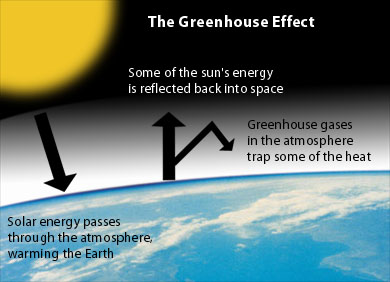 Figure 1
Short wavelength light energy from the sun comes in, is absorbed, and is re-emitted at far longer wavelengths. Basic physics as determined by Planck, a very long time ago. No argument here right!
Figure 2 below has several absorption curves. On the vertical axis, 100 is high absorption. The gas curves are verified from dozens of other links and the Planck curves are verified by my calcs here. There shouldn’t be any disagreement here either – I hope.
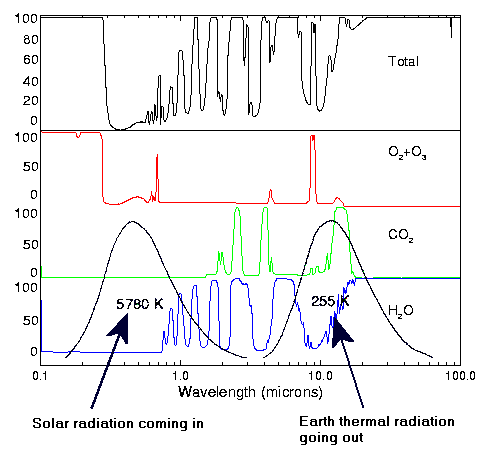 Figure 2 – Absorption curves of various molecules in the atmosphere and Planck curve overlay.
What is nice about this plot though is that the unknown author has overlaid the Planck spectrums of both incoming and outgoing radiation on top of the absorption curves. You can see by looking at the graph (or the sun) that most of the incoming curve passes through the atmosphere with little impediment. The outgoing curve however is blocked – mostly by moisture in the air – with a little tiny sliver of CO2 (green curve) effective at absorption at about 15 micrometers wavelength (the black arrow tip on the right side is at about 15um wavelength). From this figure we can see that CO2 has almost no absorption for incoming radiation (left curve), yet absorbs some outgoing radiation (right curve). No disagreement with that either – I hope. Tom Vonk’s recent post agrees with what I’ve written here.
Energy in from the Sun equals energy out from the Earth’s perspective — at least over extended time periods and without considering the relatively small amount of energy projecting from the earth’s core. If you add CO2 to our air, this simple fact of equilibrium over extended time periods does not change.
So what causes the atmospheric warming?
Air temperature is a measure of the energy stored as kinetic velocity in the atoms and molecules of the atmosphere. It’s the movement of the air! Nothing fancy, just a lot of little tiny electrically charged balls bouncing off each other and against the various forces which hold them together.
Air temperature is an expression of the kinetic energy stored in the air. Wiki has a couple of good videos at this link.
“Warming” is an increase in that kinetic energy.
So, to prove that CO2 causes warming for those who are unconvinced so far, I attempted a thought experiment yesterday morning on Tom Vonk’s thread. Unfortunately, it didn’t gain much attention. DeWitt Payne came up with a better example anyway which he left at tAV in the comments. I’ve modified it for this post.
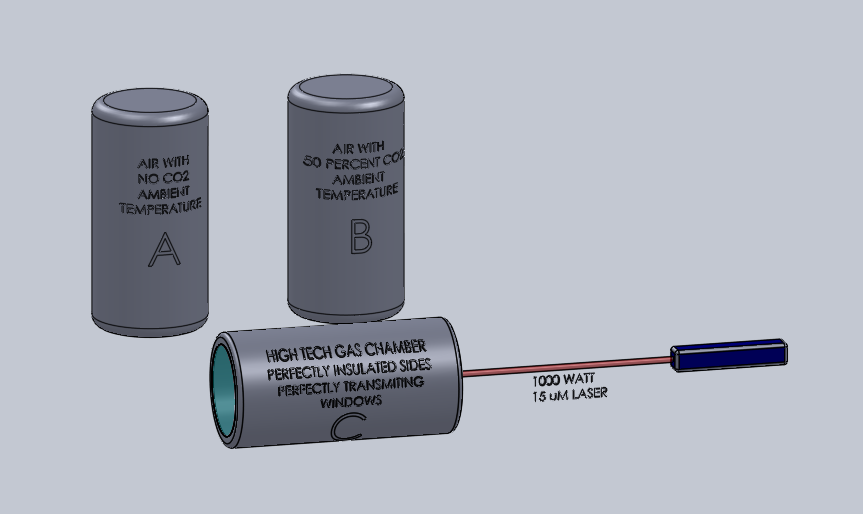 Figure 3- Experimental setup. A – gas can of air with all CO2 removed at ambient temp and standard pressure. B – gas can of air diluted by 50 percent CO2, also at ambient temp and standard pressure. C ultra insulated laser chamber with perfectly transparent end window and a tiny input window on the back to allow light in from the laser. Heat exit’s the single large window and cannot exit the sides of the chamber.
Figure 4 is a depiction of what happens when C contains a vacuum.
 Figure 4 – Laser passes straight through the chamber unimpeded and a full 1000 Watt beam exits our perfect window.
The example in Figure 5 is filling tank C with air from tank A air (zero CO2) at the equilibrium state.
 Figure 5 – Equilibrium of hypothetical system filled with zero CO2 air from canister A.
Minor absorption of the main beam causes infrared absorption and re-emission from the gas reducing the main beam from the laser. This small amount of energy is re-emitted from the gas through the end window and scattered over a full 180 degree hemisphere.
What happens when we instantly replace the no-CO2 air in chamber C with the 50% CO2 air mixture in B?
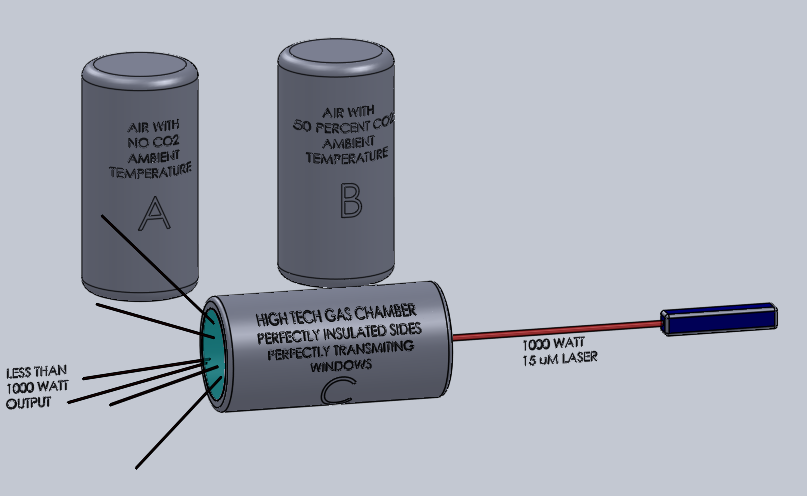 Figure 6 – Air in C is replaced instantly with gas from reservoir B
From the perspective of 15 micrometer wavelength infrared laser, the CO2 filled air is black stuff. The laser cannot penetrate it. At the moment the gas is switched, the laser beam stops penetrating and the 1000 watts (or energy per time) is added to the gas. At the moment of the switch, the gas still emits the same random energy as is shown in Figure 5 based on its ambient temperature, but the gas is now absorbing 1000 watts of laser light.
Since the beam cannot pass through, the CO2 gains vibrational energy which is then turned into translational energy and is passed back and forth between the other air molecules building greater and greater translational and vibrational velocities. —- It heats up.
As it heats, emissions from the window increase in energy according to Planck’s blackbody equation. Eventually the system reaches a new equilibrium temperature where the output from our window is exactly equal to the input from our laser – 1000 watts. Equilibrium! – (Figure 7)
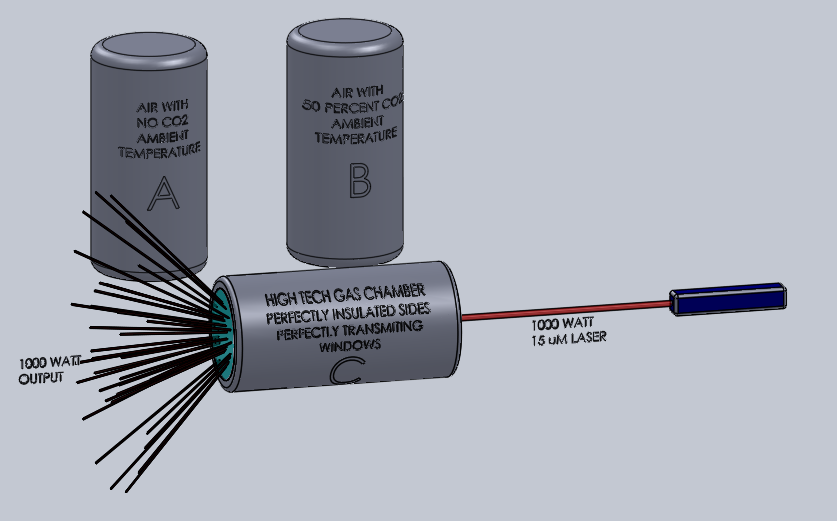 Figure 7 – Equilibrium reached when gas inside chamber C heats up to a temperature sufficient to balance incoming light energy..
The delay time between the instant the air in C is switched from A type air to B air to the time when C warms to equilibrium temperature is sometimes stated as a trapping of energy in the atmosphere.
“CO2 traps part of the infrared radiation between ground and the upper part of the atmosphere”
So from a few simple concepts, two gasses at the same temp, one transparent the other black (at infrared wavelengths), we’ve demonstrated that different absorption gasses heat differently when exposed to an energy source.
How does that apply to AGW?
The difference between this result and Tom Vonk’s recent post, is that he confuses equilibrium with zero energy flow. In his examples and equations, he has a net energy flow through the system of zero, which is fine. Where he goes wrong is equating that assumption to AGW.
What we have on Earth, is a source of 15micrometer radiation (the ground) projecting energy upward through the atmosphere, exiting through a perfect window (space) – sound familiar? Incoming solar energy passes through the atmosphere so we can ignore it when considering the most basic concepts of CO2 based warming (this post), but it is also an energy flow. In our planet, the upwelling light at IR wavelengths is a unidirectional net IR energy flow (figure 2 – outgoing radiation), like the laser in the example here.
Of course adding CO2 to our atmosphere causes some of the outgoing energy to be absorbed rather than transmitted uninterrupted to space (as shown in the example), this absorption is converted into vibrational and translational modes (heating). Yes, Tom is right, these conversions go in both directions. The energy moves in and out of CO2 and other molecules, but as shown in cavity C above, the gas takes finite measurable time to warm up and reach equilibrium with space (the window), creating a warming effect in the atmosphere.
None of the statements in this post violate any of Tom’s equations; the difference between this post and his, is only in the assumption of energy flow from the Sun to Earth and from Earth back to space. His post confused equilibrium with zero flow and his conclusions were based on the assumed zero energy flow. The math and physics were fine, but his conclusion that insulating an energy flow doesn’t cause warming is non-physical and absolutely incorrect.
Oddly enough, if you’ve ever seen an infrared CO2 laser cut steel, you have seen the same effect on an extreme scale.
————-
So finally, as a formal skeptic of AGW extremism, NONE of this should create any alarm. Sure CO2 can cause warming (a little) but warmer air holds more moisture, which changes clouds, which will cause feedbacks to the temperature. If the feedback is low or negative (as Roy Spencer recently demonstrated), none of the IPCC predictions come true, and none of the certainly exaggerated damage occurs. The CO2 then, can be considered nothing but plant food, and we can keep our tax money and take our good sweet time building the currently non-existent cleaner energy sources the enviro’s will demand anyway. If feedback is high and positive as the models predict, then the temperature measurements have some catching up to do.
Even a slight change in the amount of measured warming would send the IPCC back to the drawing board, which is what makes true and high quality results from Anthony’s surfacestations project so critically important.
This is where the AGW discussion is unsettled.
====================================
My thanks to Jeff for offering this guest post – Anthony
We don’t live in a thermometer. We live in a dynamic heat pump.
Jeff Id,
With all due respect, your post did not address the same topic as Tom Vonk but was titled “A reply to Vonk . . . “.
WUWT?
John
Derek,
Don’t misinterpret my post for an alarmist, believer or even we should do something about it one. It’s just the initial physics, the rest is up for disagreement.
This is one of the key’s to ‘settled science’. They use the line and revert to the basics, if skeptics don’t respond intelligently to the basics, their understanding is weak and not worth the time.
Once the basics are agreed to, the rest is up for discussion, because the rest of the physics are not certain. It’s called uncertainty in climate, but I call it unknowainty because there is a difference.
John Whitman :
A quote from Tom Vonk’s post:
“CO2 absorbs the outgoing infrared energy and warms the atmosphere” – or –
“CO2 traps part of the infrared radiation between ground and the upper part of the atmosphere”
…you will be millionaire .
Even Internet sites that are said to have a good scientific level like “Science of doom” publish statements similar to those quoted above . These statements are all wrong yet happen so often that I submitted this guest post to Anthony to clear this issue once for all.
They are not ‘wrong’, but their magnitude and effects are definitely in question.
If a CO2 molecule encounters a photon at 15 nm then immediately emits a photon at 15 nm, did the CO2 molecule beacame warmer? Became colder? Became neither warmer nor colder?
Stephen Wilde says:
August 6, 2010 at 3:35 pm
Stephen,
I Really liked your hot water bottle post. The atmosphere just transports heat. The oceans are the repository.
Gail Combs:
Nope. Absorption of an IR photon causes a vibrational excitation. Electronic excitations require visible or ultraviolet photons.
And, no, velocity and heat are not interchangeable. Heat is rigorously defined only for systems in thermodynamic equilibrium. That means that not only is there energy in kinetic (external) energy of the atoms and molecules but that there is also energyin thermally available rotations and excitations.
Doesn’t anyone other than physical chemists understand this?
Ok, that’s a nice example showing that a CONFINED volume of a gas will selectively absorb and then remit specific wavelengths of light. While a bit fancier than the plastic soda bottle filled with CO2 in front of a light bulb it does not show anything new. Yes indeed gases can selectively absorb certain wavelengths of light, then the gas warms, then the gas emits energy at the same wavelength in all directions, then in a final and very important step, the gas cools by an amount equal to the energy reemitted.
Some more salient observations are;
No point on the surface of the Sun, on the surface of the Earth, or in the gaseous atmosphere of the Earth ever reaches an “equilibrium” temperature. As any point reaches a new higher temperature it immediately starts to cool faster. If this faster cooling is not overwhelmed by another larger warming force it will cause the temperature of that location to start to drop.
As the Sun illuminates the Earth’s surface (with mostly visible light) the surface “races” to catch up to the new “equilibrium” temperature. However, due to the thermal capacities and thermal conductivities (combined they determine the speed of heat) in the materials involved the surface never reaches the “equilibrium” temperature predicted by Kirchhoff’s Law.
As the Earth’s surface “races” to catch up to the new higher “equilibrium” temperature the gases in the atmosphere are also “racing” to catch up to the new higher “equilibrium” temperature at their location.
After the Sun sets the Earth’s surface temperature now switches direction and begins “racing” towards the new lower “equilibrium” temperature, likewise for the gases in the atmosphere.
The whole idea of an “equilibrium” temperature is very useful for a Pizza oven with a thermostat, but it is useless in understanding a system that consists of many different materials each of which respond differently to energy inputs. The only common denominator is that as each material warms it will respond by cooling faster. Some materials (i.e. seawater) radiate across a very broad spectrum, but mostly in one direction. Other materials (i.e. “greenhouse” gases) absorb and radiate selective wavelengths in all directions. Still other materials (i.e.”non-greenhouse” gases) exchange energy with any nearby material mostly via conduction and convection.
The only important question is;
Does the substitution of very small quantities (tens of parts per million) of “non-greenhouse” gases with “greenhouse” gases change the speed at which the temperature at any location “races” to meet up with its new ”equilibrium” temperature ?
My postulated answer is;
The replacement of “non-greenhouse” gases with “greenhouse” gases actually works to increase the SPEED OF HEAT through the atmosphere since more heat/energy travels at the speed of light (i.e. Infrared Radiation) versus at the Speed of Heat (much slower). The result of this is that each location more closely approaches its “equilibrium” temperature during each “Sunlight” .vs. “Sans Sunlight” cycle (i.e. Each Day). This does not cause any permanent increase in the “average” surface temperature of the Earth.
Now you might argue that this causes higher daytime and lower nighttime temperatures, but I think if you do some simple calculations you will find that this effect is so small that we probably could not spend enough money to measure it. For example, calculate the thermal capacity in Joules per cubic meter of sea water and compare it to the thermal capacity in Joules per cubic meter of the atmosphere when it contains 4% water vapor. Or for another analogy, try docking the Queen Mary using a couple of Radio Controlled Hobby Boats, yes, in theory it can be possibly be accomplished, but I don’t want to be around to see the attempts……….
In summary, I do not deny that some gases in the atmosphere selectively absorb and reemit energy (in the form of infrared light) backwards towards the Earth’s surface. I do deny that this can in any conceivable way cause the Earth’s surface to assume a new higher “equilibrium” temperature.
Cheers, Kevin.
Kevin,
Steve Mosher’s comment (August 6, 2010 at 10:06 am ) was addressed to Jeff, but I think it was really written for you.
Again, I will repeat, co2 does not cause warming in earth’s atmosphere because of it’s effects on H2O. Roy Spencer’s work shows a negative feedback from H2O. Yes co2 does have warming effects on its own and it would stay a warming effect if not for far more powerful forces at work in the atmosphere that keep co2’s effects easily in check. H2O comprises 95% of GHG’s. It is the largest factor in GHG’s and it is the factor that should be getting the most attention in studies.
My oh my how we’ve fretted over CO2 for far too long.
Stephen Wilde: You wrote, “Well I reckon you could get that from the latitudinal shift in the cloud bands that we have actually observed over the period 1970 to 1995.” And continued, “Since then the cloud bands have been going back equatorward again and hey presto albedo is increasing.”
And as always when you write this, I will ask, have you found a dataset that illustrates this latitudinal variation in clouds from 1970 to 1995 and back toward the equator since then?
The complexity of Jeff’s post, obscures a simple reality. Realize that the radiation which is reflected in the 15 nm range is very close to constant. Certainly increasing or decreasing the amount of CO2 in the atmosphere does nothing to increase the amount of 15 nm radiation being reflected from the earth. The real issue is, how much does incremental CO2 increase the greenhouse gas effect. Dr. Heinz Hug has done experiments which indicate that doubling CO2 to 700 PPM, would likely result in increasing the temp. or the earth by only a measly .015 deg C.
http://www.john-daly.com/artifact.htm
I thought exercise which can be used to understand why this true might be helpful. Picture a sunny room on a bright day. Now attempt to completely darken the room by adding layers of shades. The first shade leaves only 30% of the incoming light, the next shade leaves only 30% of the light passing through shade 1, which leaves only 9% of the original light level. The next shade leaves 2.7%, shade four leaves .81% etc.. by shade seven, it is nearly pitch black since only .022% of the original light now enters the room. Adding more shades will simply not make much difference to the brightness of the room since it is already 99.98% dark after shade seven. This is the similar to what happens when CO2 is added to the atmosphere since most of the 15 nm range of IR energy available to CO2 is absorbed by the first 300 ppm of CO2. Raising CO2 from .03% to say .07% of the atmosphere will simply have no real impact on global warming. Vegetation however, would flourish.
Jeff Id says:
August 6, 2010 at 5:31 pm
John Whitman :
A quote from Tom Vonk’s post:
“CO2 absorbs the outgoing infrared energy and warms the atmosphere” – or –
“CO2 traps part of the infrared radiation between ground and the upper part of the atmosphere”
…you will be millionaire .
Even Internet sites that are said to have a good scientific level like “Science of doom” publish statements similar to those quoted above . These statements are all wrong yet happen so often that I submitted this guest post to Anthony to clear this issue once for all.
They are not ‘wrong’, but their magnitude and effects are definitely in question.
——————-
Jeff Id,
I think there is a misunderstanding of the thrust of Tom Vonk’s post and the thrust of your reply to it. Maybe my solution is to read them both for the third time? OK. I will.
John
Derek B says:
August 6, 2010 at 5:07 pm
…So, much as we distrust them, we are reduced to depending on models and basing policy on risk minimisation. Meanwhile, we do know that there was significant surface warming over the 20th century as a whole. Yes, there are several candidate explanations, but none of them can claim to be more convincing than the known rise in CO2.
______________________________________________________
You left out the other side of the risk equation: The climate gets a lot colder from natural causes. Funny how everyone always over looks that part of the risk equation.
Woods Hole Oceanographic Institution states:
…It ignores recent and rapidly advancing evidence that Earth’s climate repeatedly has shifted abruptly and dramatically in the past, and is capable of doing so in the future… Fossil evidence clearly demonstrates that Earth vs climate can shift gears within a decade… Thus, world leaders may be planning for climate scenarios of global warming that are opposite to what might actually occur…
Peer-reviewed papers:
Lesson from the past: present insolation minimum holds potential for glacial inception (Science speak for we have the correct conditions for an Ice Age)
Solar energy reached a summer maximum (9% higher than at present) ca 11 ka ago and has been decreasing since then, primarily in response to the precession of the equinoxes. The extra energy elevated early Holocene summer temperatures throughout the Arctic 1-3° C above 20th century averages….
So what if, as these papers show, the only thing PREVENTING a return to full blown Ice Ages conditions is mankind’s increasing CO2????
During the 20th century the sun has been very active according to this paper and NASA However in the 21st century this is no longer true according to the Solar Dynamics Observatory Mission News
This shows how temperatures in Greenland have gradually fallen during the Holocene (present on right) http://jonova.s3.amazonaws.com/graphs/lappi/gisp-last-10000-new.png
This shows how temperatures have fallen during the Holocene in the Antarctic -10,000 yrs of Vostock Ice Core data (present on right)
http://2.bp.blogspot.com/_cHhMa7ARDDg/SsVwd55PJ8I/AAAAAAAABKY/52SrhXN4C3c/s1600-h/Vostok-10Kd.jpg
And finally the real kicker, the Vostock Ice Core shows we are at the end of the Holocene time wise. The sharp pointy upspikes are the interglacials everything else is ice cube city. You will note we have had a long run compared to most of the rest of the interglacials. (present on the left)
http://cdiac.ornl.gov/trends/temp/vostok/graphics/tempplot5.gif
Don’t you think this evidence should also be considered before any decisions are made to eviscerate our present technological society? I think rapid conversion to nuclear power is the best solution for both risks, not wimpy solar and wind power.
Stephen Wilde wrote, “Thanks Bob. That is my ‘Hot Water Bottle Effect’ in a nutshell and it’s hugely greater than the so called Greenhouse Effect.”
No reason to thank me for my earlier comment about the oceans having their own greenhouse effect. That’s something I always keep in mind from an old John Daly post. Took me a few seconds to find it again. Here ya go:
http://www.john-daly.com/deepsea.htm
Scroll down to “DO THE OCEANS WARM THE PLANET?”
Wow. Now I know that solid state gain media get hot in lasers but gaseous gain media in laser doesn’t get hot – because the Einstein A and B coefficients ensure that the gaseous media radiate the photons oput as fast as they come in.
And laser media in a state of population inversion have a negative temperature.
Sorry. That’s just wrong. Please point me to any sources that state that gas lasers don’t require cooling and that lasing media in population inversiom are characterized by negative temperature. Negative temperature is an unrelated concept related to very cold materials with highly aligned spin states.
Merrick says:
August 6, 2010 at 5:48 pm
Gail Combs:
Nope. Absorption of an IR photon causes a vibrational excitation. Electronic excitations require visible or ultraviolet photons.
And, no, velocity and heat are not interchangeable. Heat is rigorously defined only for systems in thermodynamic equilibrium. That means that not only is there energy in kinetic (external) energy of the atoms and molecules but that there is also energyin thermally available rotations and excitations.
Doesn’t anyone other than physical chemists understand this?
_________________________________________
Doesn’t anyone other than physical chemists understand this?
Not many. Only physicists, physical chemists, a smattering of other chemists and the avid readers who devour anything connected to climate. That is why I suggest a few of these “simplified physics” articles were a very good idea.
SO thank you for the clarification. My chemistry teacher for physical chemistry (thermo) had a heart attack and we got stuck with an organic chemist who hated P chem and did not understand it. That class, my one and only, was forty years ago. That is why I asked in my first post for correction if I got stuff incorrect.
Hopefully others will learn from my putting both feet in my mouth.
George Steiner,
At the Air Vent Pat Frank left a calculation which showed 30 milliseconds is typical before release of the energy. More than enough time for a collision to occur. This means most of the energy is released through kinetic interaction.
Jeff,
Thank you for this post.
As many others have pointed out above, it is very important for contributors here to call out sub-standard science /arguement, rather than remain silent and so leave the impression that the readership is in general agreement with something which is easily discreditted. Otherwise you end up looking like realclimate.
George Steiner says:
August 6, 2010 at 5:31 pm
If a CO2 molecule encounters a photon at 15 nm then immediately emits a photon at 15 nm, did the CO2 molecule beacame warmer? Became colder? Became neither warmer nor colder?
—————–
I know the answer to that one!
It became warmer, warmed adjacent N2 molecules, radiated back to Earth and sent what was left to the sun.
Gail Combs: I don’t see any chance of refuting Al Gore with “science that the majority of people can understand,” if that means science that isn’t oversimplified so far as to be incorrect. On the other hand, my alternative may be equally unrealistic. I think the majority of people should be skeptical (of both sides, or all sides) as any reasonable person would be of something he doesn’t understand.
I know that doesn’t answer the question of what happens when people vote; despite their skepticism, they may vote for the wrong side; but I just don’t see that a reasonable but ignorant person should have any attitude other than the skepticism I’m talking about. How could he? I know more science and math than the majority of people, and I’ve been following AGW for nearly 20 years, but I can’t swear that the warmists are wrong. I think they’re wrong, but if they’re right, that’s the way life is.
Don’t get me wrong. There are things that are within the reach of the majority, if the media would present them. They’re not all scientific. The majority don’t know beans.
Interesting. But empirically, addition of carbon dioxide to the atmosphere simply does not change the transmittance of the atmosphere in the infrared as Ferenc Miskolczi has shown. He used NOAA weather balloon database to show that the global average annual infrared optical density of the atmosphere has not changed for 61 years and has the value of 1.87. This means that constant addition of CO2 to the atmosphere for the last 61 years has had no effect on how much infrared radiation the atmosphere absorbs. Where does this fit in with your theory?
OK.
It appears there may be a problem with the recent-increase-in-CO2-causes-catastrophic-global-warming theory …
From the above graph, CO2 at 380 ppm has an absorption peak between 10.5 and 11 microns that will absorb some of the outgoing radiation from the earth. This absorbed energy is then assumed to increase the vibration (motion) of the (very few) CO2 molecules in the atmosphere, which then hit nearby air (O2 and N2 molecules) and cause them to increase the motion (temperature). Fine, an increase in CO2 would be assumed to cause an increase in net energy in the air (although that increased heat energy cannot be measured yet, and the increase will decrease logarithmically as CO2 increases linearly.)
However, this graph also shows that O2 and O3 at 209460 ppm (537 times the amount of CO2!) have a combined absorbtion peak in the same range of outgoing radiated energy (between 9.8 and 10 microns).
Why then, is CO2 is considered a massive threat towards heating the earth when O2 (being subject to the same heat exchange and radiation equations) is 537 times more prevalent? Is it because only CO2 can be used to control the world’s capitalist monies by taxation, restrictions, and international policies of government control?
(Yes, the ratio of peak absorption for CO2 is higher than that for O2/O3 … But it isn’t 537 times higher. Water – conventionally considered a greater green house gas than CO2 – is also conveniently ignored in this graph. Again, because the UN cannot tax water vapor.)
I add a caveat: Since 2003, the amount of O2 in ppm has decreased slightly. Since worldwide temperatures have reamined the same, the amount of volcanism has remained near constant, but CO2 has increased and O2 decreased, what is the net reflective and absorptive difference in the earth’s heat imbalance?
The CAGW alarmist cannot explain the cyclical changes in the earth’s tempeorature. It doesn’t fit their cherished, simplistic theory that REQUIRES the earth temperature respond linearly to a linear change in CO2 levels. Therefore, they had to invent – and still have to cling to – Mann’s-made global warming via the hockey stick and by ignoring changes since the depths of the LIA in the mid-1600’s.
Arno,
Here is another reminder that the science is not settled:
Article and link.
stevengoddard says:
August 6, 2010 at 11:36 am
CRS, Dr.P.H.
Thanks for the Hansen link.
I hope you are going to make a post, or posts, on it!