Radiative Physics Simplified II
A guest post by Jeff Id
Radiative physics of CO2 is a contentious issue at WUWT’s crowd but to someone like myself, this is not where the argument against AGW exists. I’m going to take a crack at making the issue so simple, that I can actually convince someone in blogland. This post is in reply to Tom Vonk’s recent post at WUWT which concluded that the radiative warming effect of CO2, doesn’t exist. We already know that I won’t succeed with everyone but when skeptics of extremist warming get this wrong, it undermines the credibility of their otherwise good arguments.
My statement is – CO2 does create a warming effect in the lower atmosphere.
Before that makes you scream at the monitor, I’ve not said anything about the magnitude or danger or even measurability of the effect. I only assert that the effect is real, is provable, it’s basic physics and it does exist.
From Tom Vonk’s recent post, we have this image:
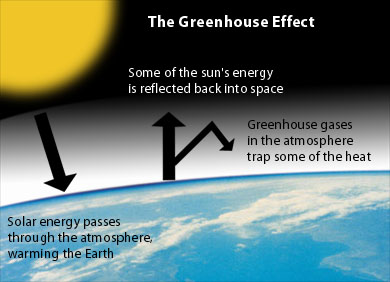 Figure 1
Short wavelength light energy from the sun comes in, is absorbed, and is re-emitted at far longer wavelengths. Basic physics as determined by Planck, a very long time ago. No argument here right!
Figure 2 below has several absorption curves. On the vertical axis, 100 is high absorption. The gas curves are verified from dozens of other links and the Planck curves are verified by my calcs here. There shouldn’t be any disagreement here either – I hope.
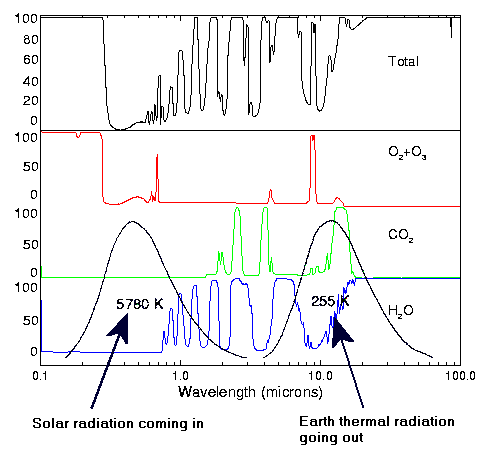 Figure 2 – Absorption curves of various molecules in the atmosphere and Planck curve overlay.
What is nice about this plot though is that the unknown author has overlaid the Planck spectrums of both incoming and outgoing radiation on top of the absorption curves. You can see by looking at the graph (or the sun) that most of the incoming curve passes through the atmosphere with little impediment. The outgoing curve however is blocked – mostly by moisture in the air – with a little tiny sliver of CO2 (green curve) effective at absorption at about 15 micrometers wavelength (the black arrow tip on the right side is at about 15um wavelength). From this figure we can see that CO2 has almost no absorption for incoming radiation (left curve), yet absorbs some outgoing radiation (right curve). No disagreement with that either – I hope. Tom Vonk’s recent post agrees with what I’ve written here.
Energy in from the Sun equals energy out from the Earth’s perspective — at least over extended time periods and without considering the relatively small amount of energy projecting from the earth’s core. If you add CO2 to our air, this simple fact of equilibrium over extended time periods does not change.
So what causes the atmospheric warming?
Air temperature is a measure of the energy stored as kinetic velocity in the atoms and molecules of the atmosphere. It’s the movement of the air! Nothing fancy, just a lot of little tiny electrically charged balls bouncing off each other and against the various forces which hold them together.
Air temperature is an expression of the kinetic energy stored in the air. Wiki has a couple of good videos at this link.
“Warming” is an increase in that kinetic energy.
So, to prove that CO2 causes warming for those who are unconvinced so far, I attempted a thought experiment yesterday morning on Tom Vonk’s thread. Unfortunately, it didn’t gain much attention. DeWitt Payne came up with a better example anyway which he left at tAV in the comments. I’ve modified it for this post.
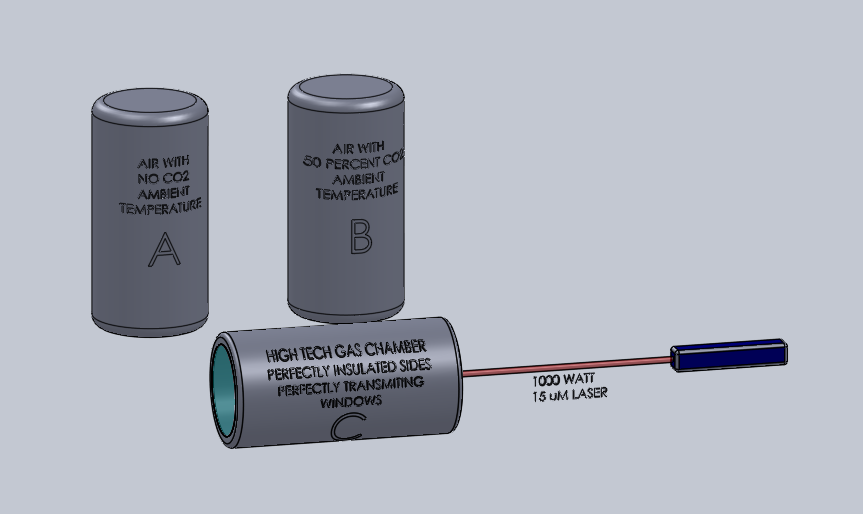 Figure 3- Experimental setup. A – gas can of air with all CO2 removed at ambient temp and standard pressure. B – gas can of air diluted by 50 percent CO2, also at ambient temp and standard pressure. C ultra insulated laser chamber with perfectly transparent end window and a tiny input window on the back to allow light in from the laser. Heat exit’s the single large window and cannot exit the sides of the chamber.
Figure 4 is a depiction of what happens when C contains a vacuum.
 Figure 4 – Laser passes straight through the chamber unimpeded and a full 1000 Watt beam exits our perfect window.
The example in Figure 5 is filling tank C with air from tank A air (zero CO2) at the equilibrium state.
 Figure 5 – Equilibrium of hypothetical system filled with zero CO2 air from canister A.
Minor absorption of the main beam causes infrared absorption and re-emission from the gas reducing the main beam from the laser. This small amount of energy is re-emitted from the gas through the end window and scattered over a full 180 degree hemisphere.
What happens when we instantly replace the no-CO2 air in chamber C with the 50% CO2 air mixture in B?
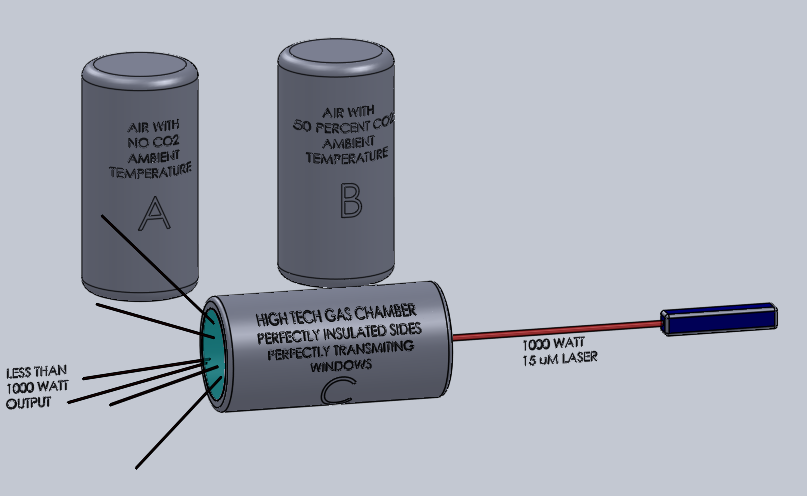 Figure 6 – Air in C is replaced instantly with gas from reservoir B
From the perspective of 15 micrometer wavelength infrared laser, the CO2 filled air is black stuff. The laser cannot penetrate it. At the moment the gas is switched, the laser beam stops penetrating and the 1000 watts (or energy per time) is added to the gas. At the moment of the switch, the gas still emits the same random energy as is shown in Figure 5 based on its ambient temperature, but the gas is now absorbing 1000 watts of laser light.
Since the beam cannot pass through, the CO2 gains vibrational energy which is then turned into translational energy and is passed back and forth between the other air molecules building greater and greater translational and vibrational velocities. —- It heats up.
As it heats, emissions from the window increase in energy according to Planck’s blackbody equation. Eventually the system reaches a new equilibrium temperature where the output from our window is exactly equal to the input from our laser – 1000 watts. Equilibrium! – (Figure 7)
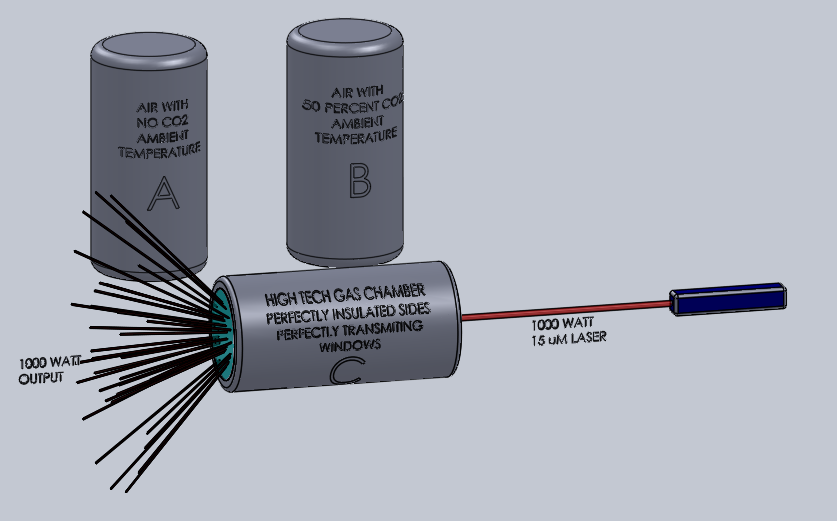 Figure 7 – Equilibrium reached when gas inside chamber C heats up to a temperature sufficient to balance incoming light energy..
The delay time between the instant the air in C is switched from A type air to B air to the time when C warms to equilibrium temperature is sometimes stated as a trapping of energy in the atmosphere.
“CO2 traps part of the infrared radiation between ground and the upper part of the atmosphere”
So from a few simple concepts, two gasses at the same temp, one transparent the other black (at infrared wavelengths), we’ve demonstrated that different absorption gasses heat differently when exposed to an energy source.
How does that apply to AGW?
The difference between this result and Tom Vonk’s recent post, is that he confuses equilibrium with zero energy flow. In his examples and equations, he has a net energy flow through the system of zero, which is fine. Where he goes wrong is equating that assumption to AGW.
What we have on Earth, is a source of 15micrometer radiation (the ground) projecting energy upward through the atmosphere, exiting through a perfect window (space) – sound familiar? Incoming solar energy passes through the atmosphere so we can ignore it when considering the most basic concepts of CO2 based warming (this post), but it is also an energy flow. In our planet, the upwelling light at IR wavelengths is a unidirectional net IR energy flow (figure 2 – outgoing radiation), like the laser in the example here.
Of course adding CO2 to our atmosphere causes some of the outgoing energy to be absorbed rather than transmitted uninterrupted to space (as shown in the example), this absorption is converted into vibrational and translational modes (heating). Yes, Tom is right, these conversions go in both directions. The energy moves in and out of CO2 and other molecules, but as shown in cavity C above, the gas takes finite measurable time to warm up and reach equilibrium with space (the window), creating a warming effect in the atmosphere.
None of the statements in this post violate any of Tom’s equations; the difference between this post and his, is only in the assumption of energy flow from the Sun to Earth and from Earth back to space. His post confused equilibrium with zero flow and his conclusions were based on the assumed zero energy flow. The math and physics were fine, but his conclusion that insulating an energy flow doesn’t cause warming is non-physical and absolutely incorrect.
Oddly enough, if you’ve ever seen an infrared CO2 laser cut steel, you have seen the same effect on an extreme scale.
————-
So finally, as a formal skeptic of AGW extremism, NONE of this should create any alarm. Sure CO2 can cause warming (a little) but warmer air holds more moisture, which changes clouds, which will cause feedbacks to the temperature. If the feedback is low or negative (as Roy Spencer recently demonstrated), none of the IPCC predictions come true, and none of the certainly exaggerated damage occurs. The CO2 then, can be considered nothing but plant food, and we can keep our tax money and take our good sweet time building the currently non-existent cleaner energy sources the enviro’s will demand anyway. If feedback is high and positive as the models predict, then the temperature measurements have some catching up to do.
Even a slight change in the amount of measured warming would send the IPCC back to the drawing board, which is what makes true and high quality results from Anthony’s surfacestations project so critically important.
This is where the AGW discussion is unsettled.
====================================
My thanks to Jeff for offering this guest post – Anthony
Mind blowing post by Michael J Dunn!
I hope he comes back ^.^
#
#
Mike Haseler says:
August 6, 2010 at 10:59 am
Why is it that when anyone talks about the “greenhouse effect”, they totally ignore the fact that the atmosphere doesn’t just sit there.
As everyone knows HOT AIR RISES.
So, considering only the radiation bands blocked by CO2, the CO2 laden air will absorb IR close to the ground, it will then heat up, causing the gas to expand and so rise, rise rise, rise, until it finds a way to emit that extra energy … and how is that done?…..
____________________________________________________________
NOPE.
Absorption of IR causes an electron to go from the ground state to the excited state. VELOCITY of the molecule is what we call heat. You missed a step.
Reread tom’s post closely he explains the difference. http://wattsupwiththat.com/2010/08/05/co2-heats-the-atmosphere-a-counter-view/
Well, it went better than I thought so far. For those who are discussing convective heat transfer, of course you are right that this happens but it is related to the magnitude of the warming effect rather than whether the effect exists. As far as I’m concerned, I’ve got no idea about the magnitude of the warming.
Michael J. Dunn
“The second lapse, critical to your argument—and which I have addressed above—is that the transition from Fig. 6 to Fig. 7 is essentially instantaneous. There is no heat accumulation. Also, there is no blackbody radiation! When we are speaking of molecular resonance absorption and emission, we are out of the realm of continuum radiation altogether.”
I understand what you are trying to say, but if you are right, your laser cavity won’t need that water cooling jacket or gas circulation pump anymore. Go ahead and blast a thousand watts at an absorbing medium the size of a coffee cup, I think you’ll find it might get warm. 😀 The blackbody radiation comes into effect when the vibrating molecular bonds collide with other particles and it turns into translational energy.
Gail Combs says ‘don’t you believe that stuff (about a good education), Alexander.
Sorry Gail, but I meant a non-dumbed down education mal-fashioned by Greens, Marxists and others of devious and malign intent. My idea of a ‘good education’ comes pretty much from the teachings of Aristotle, not some wet-behind-the-ears Marxist camped in an undeserved university tenured professorship. And I believe that many of the essayists who post here at WUWT are giving us a wonderful education.
Mike, you have interesting points. CO2 is a pretty heavy gas. What equations do you have for its ability to rise once it has absorbed IR in this flow of rising warmed air? Or does it take a ride on water vapor and dust? Does it rise all by itself? Is water vapor the better mechanism for rising warmed air (it also absorbs IR)? How significant is CO2 compared to the other gasses in this process of rising air in order to cool the surface?
Jeff Id,
You ignore the FACT that the incoming IR from 1-4 microns is much larger than the outgoing through the earth’s complete power range among other things. It is really hard to compute RTE’s when you ignore large segments of the flux and concentrate on one area.
The graph you show has the sun’s output scaled to under 10 -6. Even Science of doom only used a graph at 10 -6 for the sun to get it on the same graph. Naughty naughty.
Your thought experiment is just so wonderful.
Trouble is, it can not be performed.
The world is fairly lossy, and will give you loads of trouble every time.
There is no perfectly transparent window and no material that will perfectly insulate a mass of gas.
As you add energy to the mass of gas the pressure will increase as it heats up.
That is where your new equilibrium will be established.
The other trouble is that at standard temperature radiation is not the primary mode of heat transfer and can not be neglected. The converse is probably more true.
I don’t think many people are disputing the basic physics. Its just that pesky everything else gets in the way in the real world. Nice try though.
A C Osborn says:
August 6, 2010 at 11:15 am
One thing that I find find very confusing about the Wavelength Diagram is how little the H2O has in the spectrum that affects the Incoming radiation and yet as everyone knows when it is cloudy the Temperature changes bu a very Significant amount. How does such a small bandwidth have such a large effect?
__________________________________________________________
Energy can be absorbed by a molecule, that is cause an electron to move to a higher state, or energy can be reflected.
A change in cloud cover causes a change in the albedo. The water in the clouds is reflecting the sun’s energy like a mirror does before it can even hit the ground. That is why skeptics have hissy fits about climate models that keep cloud cover constant.
Albedo: http://www.answers.com/topic/albedo
Changes in cloud cover:
Inter-annual variations in Earth’s reflectance 1999-2007.
http://bbso.njit.edu/Research/EarthShine/literature/Palle_etal_2008_JGR.pdf
Research Article: Automated Observations of the Earthshine
http://www.hindawi.com/journals/aa/2010/963650.html
“For a decade, we have been measuring the Earth’s reflectance by observing the earthshine, which is sunlight reflected from the Earth to the Moon and retroflected to the nighttime Earth. …..The earthshine observations reveal a large decadal variability in the Earth’s reflectance [7], which is yet not fully understood, but which is in line with other satellite and ground-based global radiation data…”
Kuhn,
It’s the shape of the graph that matters, if you follow the verification link you’ll see that I demonstrated it both ways.
Not so naughty.
Also, it matters exactly zero what’s going on in 1-4 microns, that’s a magnitude of the warming issue, not a basic physics issue.
RE: Gail Combs says: (August 6, 2010 at 1:05 pm) “The photon absorbed and the photon emitted should be exactly the same energy value.”
That only applies if there is absolutely no change in the energy of the entity that absorbed the photon in the first place. If you get $20 and it is stolen, then you cannot spend it. If the robber only takes $10, then you might be able to spend the other $10.
In the molecular world, the robbery may take place as a collision between two molecules. Such a collision may also result in the donation of energy.
Very elegant experiment and explanation, thanks!.
Now get out your 1000W sunlamp and a fan and a full swimming pool. We need to evaporate all that and get to the bottom of it.
@crazydung
‘I believe what most of us have meant is that although we might be persuaded that CO2 has a warming effect, there are times when CO2 rises and the planet cools. To a none scientist it seems reasonable to conclude that during those times, CO2 has no warming effect ^.^’
Perhaps a better statement would be ‘History shows that there have been times when the warming produced by an increase in CO2 has been outweighed by other, as yet unclear, cooling mechanisms, leading to an overall drop in temperature’
In other words, its a bit more complicated than just CO2.
(Shine on You Crazy Dungmand……)
Mike Haseler says:
August 6, 2010 at 11:52 am
Julio says: “As a physicist, I appreciate your effort here, but I still think one needs to stress that the important point is that some of the energy reradiated by the CO2 in the atmosphere is sent downwards, that is, back to Earth. ”
That is why you can’t ignore the convective transport of heat through the atmosphere!…
_________________________________________
Actually I like the idea of posts that take tiny bites out of the whole complex subject.
Tom Vonk’s recent post, even though it had problems gave me a very clear picture of the actual mechanism of infrared energy absorption by molecules and how the energy moves around and becomes “heat” (increased velocity)
This post takes the next step. A non-equilibrium state. Hopefully we will see other posts that build on the knowledge gained from these two posts until we have a decent picture of what is happening in a very complex system.
The problem I have with Tom’s figure is that it doesn’t say where the reflection happens. Does some of it happen above the surface (such as by clouds)? I certainly think so. And is this reflection just sunlight? What about GHGs above the clouds, do they emit energy? Don’t the clouds reflect this energy too? It seems reasonable to believe so.
So it seems to me that wherever there are clouds, the majority of high-altitude GHG emission goes into space.
During the day I doubt it matters. Why? Because while their emissions are getting lost in space, they are receiving sunlight both directly as well as reflected by the clouds.
During the night I think it matters in 2 ways.
1. There is no sunlight, and yet the clouds keep on reflecting the GHG emissions. So it seems to me that wherever there are clouds, high altitude GHGs cool down more quickly at night.
2. Seems to me the same clouds would reflect GHG emissions from underneath too, but that prevents them from getting lost in space, so it can be re-absorbed by these low altitude GHGs. So it seems to me that wherever there are clouds, low altitude GHGs have trouble cooling down. Now, if high altitude air is cooling down at a faster rate than low altitude, what happens? Well, you get cold air above warm air. Then what happens? Convection.
With convection happening, you can now imagine warmer GHGs ascending above the clouds, where they can cool more quickly (point 1 above). But while this is happening, there are cooler GHGs descending below the clouds. Well, since they are GHGs, they can absorb the glowing warmth of the planet down here, collecting it. Since they are below the clouds, they have trouble getting it back out to space by emission. But this makes convection ever the more eager to raise them above the clouds again.
So let me summarize what I expect from reflection of clouds + GHGs:
Day:
– warming above
– shading below
– upper warm air opposes convection, trapping heat above
Night:
– cooling above
– retaining warmth below
– upper cool air aids convection, transporting heat from below
How much does this matter? I don’t know. So then my question to the scientists is: how well do clouds reflect the spectrum emitted by GHGs?
Jeff Id: Great post. Nice to have the greenhouse effect explained in a clear way.
Now consider that the three primary suppliers of long-term surface temperature measurements (GISS, Hadley Centre, and NCDC) only include surface air temperature measurements and extrapolations for approximately 30% of the Earth’s surface. The remaining 70% is ocean, the temperature of which is measured at the top “x” feet.
The oceans have their own “greenhouse effect”: they absorb downward shortwave radiation to depths of approximately 100 meters and absorb longwave radiation at only the top few millimeters, but the oceans can only release heat at the surface. The amount of heat released from the oceans varies due many factors. One of these includes the direct impacts of ENSO, which increases the surface temperature of the tropical Pacific through changes in trade wind strength and changes in the strengths of surface and subsurface ocean currents. Those changes cause warm waters to be drawn from the Pacific Warm Pool and spread across the surface of the equatorial Pacific. (This rise in temperature of the tropical Pacific SST directly impacts the measured global temperature, because “x” % of the ocean rose.) Also included are the indirect impacts of ENSO outside of the tropical Pacific, which are caused by changes in atmospheric circulation. Sea surface temperature rises when wind speed decreases, and vice versa.
Just a few things that always seem to be overlooked when there are discussions of greenhouse effect.
Regards
Michael J. Dunn says:
August 6, 2010 at 12:48 pm
Experimental proof, anyone? The predicted tropospheric “hot spot” does not exist. As Tom has pointed out, it cannot exist. This is a key falsification of the “global warming” theory.
=======================================================
Most excellent Michael, thank you for taking the time.
I’m tired of this “CO2 warming” business.
CO2 doesn’t warm anything, it insulates.
Michael, I meant “all” of your post, not just the line I quoted.
ShrNfr says:
August 6, 2010 at 11:52 am
The last time I saw a first derivative of temperature with respect to CO2 concentration from a source I could respect, it was of the order of 0.00125 to 0.00250 degrees C per ppm of CO2…. Do you have the source handy?
…. The earth is not a greenhouse. There are no glass plates on the roof. Sometimes it takes that other greenhouse gas up with it and makes these funny things called clouds which make your “window” pretty darn reflecting instead of transparent. (Hint, that is why deserts are hot by and large).
________________________________________________
Actually thanks to the lack of H2O deserts are very hot during the day and very cold at night. It would be a great place to check the average temperature and then compare it to the average temperature of a humid area at the exact same latitude.
It would also be a great place to do some CO2 experiments similar to the open field “CO2 fertilization” experiments to see if a large increase in CO2 causes an actual change in temperature.
Man, I’m way out of my comfort zone here but I thought the absorbtion was by photon capture by the electrons in the Carbon atom, and the energy went into boosting them into higher energy shells, not into kinetic energy of the molecule. Isn’t that what your absorbtion diagram is showing? They then re-emit the photon at the same energy level as they de-excite and this photon continues on its way either of into space, off to be captured by the next C atom or back down to the ground.
I have to admit I’m a geologist and so science isn’t my strong point.
Can comment only briefly, so apologies.
Crazydung: Thanx and a Hatlo Hat Tip to Tom Vonk.
Jeff: Think of the “absorptive” medium as a “re-radiant” medium. Yes, the laser cavity will get warm, because it is solid material. The gaseous medium will care less, because it is shedding photons as fast as it is picking them up. (Good old spontaneous emission and the Einstein A and B coefficients. Takes me back to grad school!) Or, think of it as a Roaring 20s mirrored ball: redistributing all the energy over 4 pi steradians, but not retaining any. (This is the basis for an even longer discussion, but gas lasers earn their keep by creating flows that are in severe disequilibrium and things are happening so fast that the processes are called “rate chemistry.” In fact, a laser’s inversion state is characterized by a negative temperature. Strange but true.)
Pamela Gray: The molecular weight of CO2 does not matter. Molecular diffusion in the atmosphere is so pervasive and effective that the atmosphere is essentially homogeneous to the upper stratosphere (where ozone production starts to mess with this picture). Parcels of air rise when they are heated by the ground (or ocean). Sometimes the buoyancy is influenced by the addition of water vapor, which is lighter than air. (It is the buoyancy of water vapor that holds clouds up; all the water droplets are actually heavier than air. The droplets maintain an equilibrium with the water vapor and are held up as an aerosol.) Air is best considered as 4/5 nitrogen and 1/5 oxygen, with seasoning in the form of argon, CO2, H2O, and trace gases. Excepting water vapor, the trace gases have no effect on air’s thermodynamic properties or behavior.
Khunkat: I think I have to defend Jeff’s graph. Yes, if the Earth were situated at the surface of the Sun, the Sun’s radiance would outstrip Earth’s all across the spectrum…which is the result that you get when you apply the Stefan-Boltzmann equation right out of the parking lot. But the Earth is 93 million miles away, which attenuates the radiance, so that the portion of the solar spectrum in the far infrared is much lower than the right-in-our-faces Earth emission spectrum.
There’s a lot of physics out there. All of it on the side of truth.
Steven mosher says: “…Like you I believe in moving the discussion FORWARD….”
Amen!!
“…And just for good measure we will throw in some appeal to authority: Spenser….”
I particularly like his Faerie Queen.
One thing which I mentioned on tAV was that the perfect insulating cylinder isn’t quite as non-physical as it might seem.
If you think of the atmophere which is basically in equilibrium and define a 1 meter cylinder boundary from ground to orbit. Energy which escaped from the side of the cylinder will come back in from adjacent air on the other side of the cylinder. (Infinite insulation).
If you think of energy re-striking the ground, an equal energy is coming back up, also infinite insulation.
So you have a perfectly insulated cylinder with a perfect emitting window at the top. — not so bad an example I think.
DeWitt Payne gets credit for it though.
Pamela Gray says:
August 6, 2010 at 12:42 pm
Gail, the Dewey denigrating article you linked to is a bit out of date, or if currently being spread, is somewhat out of touch. While I understand that historically, whole language become the preferred/only (and very unfortunate) method of reading instruction, it is no longer the case….
____________________________________________-
As a victim of the reading method described I am glad it got trashed. However the historic facts of Dewey’s effect on the education of most of us who are now adults is still visible. It was for the history I linked to the article.
“For 10 years, William Schmidt, a statistics professor at Michigan State University, has looked at how U.S. students stack up against students in other countries in math and science. “In fourth-grade, we start out pretty well, near the top of the distribution among countries; by eighth-grade, we’re around average, and by 12th-grade, we’re at the bottom of the heap, outperforming only two countries, Cyprus and South Africa.”
http://www.enterstageright.com/archive/articles/0804/0804textbooks.htm
…the U.S. ranks 21st out of 29 Organization for Economic Cooperation and Development (OECD) countries in mathematics scores, with nearly one-quarter of students unable to solve the easiest level of questions….In 2000, 28 percent of all freshmen entering a degree-granting institution required remedial coursework
http://www.edreform.com/_upload/CER_JunkFoodDiet.pdf
Our education system is still crap and it traces back to John Dewey. If you have a better reference I would be happy to see it.
Jeff,
The only place I would have any disagreement with you is in the numbers. I have the same set of atmospheric absorption spectra you have; but I don’t know definitively whether they are calculated or measured; but not too important.
Some people have criticised the incoming and outgoing BB spectra arguing the vertical scales are wrong (including me).
Of course the direct solar BB spectrum is orders of magnitude higher than depicted; BUT that spectrum is attenuated by the inverse square law down to the extra=terrestrial TSI of 1366 W/m^2 or to a somewhat distorted (AM = 1) ground level spectrum at about 1000 W/m^2 .
Your 255 K earth emission source would give only 240 W/m^2, and one would then claim that the 1kW/m^2 only falls on 1/4 of the surface while the 240 is emitted from the entire surface.
I would disagree the 1000 W/m^2 certainly only falls on a portion of the surface; but the effect of that on that portion of the surface is quite different from having 250 W/m^2 fall on the entire surface.
And the 255 K is way too low to correctly represent the outgoing. Even at the mean surface temperature which is allegedly 288 K the outgoing would be 390 W/m^2; but in reality significant amounts of the surface are a lot hotter than 15 deg C so they radiate a more intense and shorter wavelength spectrum than your 255 K source which would peak at 11.4 versus 10.1 for the 288 K source or as low as 8.7 for a hot 60 deg C desert surface; which will emit 1.8 times what a 288 K source emits.
These are small differences I know; but I don’t think they should be ignored because the match between the actual GHG absorption spectra; and the real surface radiation emission spectra is critical for calculating the correct amounts of energy intercepted by GHG.
But I am quite in agreement with your end conclusion that it is all moot because I believe that cloud feedback is ALWAYS negative and highly so as is hinted at in Wentz et al; “How Much more rain Will Globalk Warming Bring ?” SCIENCE for July 7 2007.
Rmember when we talk about cloud feedback what we mean is something like:- If average global cloud cover increases from its present value by say 1% for the next 30 years (climate time scale) will that heat or cool the earth; and the answer is unquestionably it will cool the earth. Wnetz et al results hint that cloud cover; at least the precipitable component of cloud cover in terms of area, optical density, and persistence time should increase by about 7% for a one deg C increase in average global surface temperature; since their measurments show that Global evaporation, total atmospheric moisture and global precipitation ALL do increase by 7% per deg C Temperature rise; and I don’t know about you; but I like to have clouds with my precipitation; I’m kinda funny that way.
So I think the negative cloud feedback is huge, and totally swamps any effect that CO2 or any other GHG could have.
ONLY water (H2O) exists in the atmosphere in all three ordinary phases of matter; and it is the physical and chemical and other properties of water that totally regulate the range of temperatures on earth to the extent that even solar fluctuations get washed out by cloud modulation over the long haul.
I’d like to see the incoming solar spectrum curve at a 4x amplitude relative to the outgoing since the day time surface temperatures reached would never be reached with only 1/4 of the insolation.
On average, absolutely nothing ever happens. Mother Gaia does not do statistical mathematics; she works in real time.
Bob Tisdalr said:
“The oceans have their own “greenhouse effect”: they absorb downward shortwave radiation to depths of approximately 100 meters and absorb longwave radiation at only the top few millimeters, but the oceans can only release heat at the surface.”
Thanks Bob. That is my ‘Hot Water Bottle Effect’ in a nutshell and it’s hugely greater than the so called Greenhouse Effect.