Radiative Physics Simplified II
A guest post by Jeff Id
Radiative physics of CO2 is a contentious issue at WUWT’s crowd but to someone like myself, this is not where the argument against AGW exists. I’m going to take a crack at making the issue so simple, that I can actually convince someone in blogland. This post is in reply to Tom Vonk’s recent post at WUWT which concluded that the radiative warming effect of CO2, doesn’t exist. We already know that I won’t succeed with everyone but when skeptics of extremist warming get this wrong, it undermines the credibility of their otherwise good arguments.
My statement is – CO2 does create a warming effect in the lower atmosphere.
Before that makes you scream at the monitor, I’ve not said anything about the magnitude or danger or even measurability of the effect. I only assert that the effect is real, is provable, it’s basic physics and it does exist.
From Tom Vonk’s recent post, we have this image:
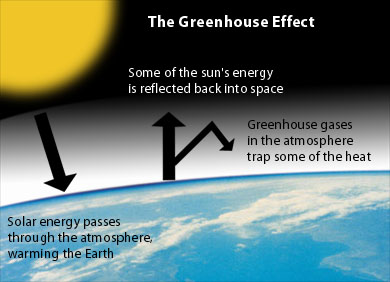 Figure 1
Short wavelength light energy from the sun comes in, is absorbed, and is re-emitted at far longer wavelengths. Basic physics as determined by Planck, a very long time ago. No argument here right!
Figure 2 below has several absorption curves. On the vertical axis, 100 is high absorption. The gas curves are verified from dozens of other links and the Planck curves are verified by my calcs here. There shouldn’t be any disagreement here either – I hope.
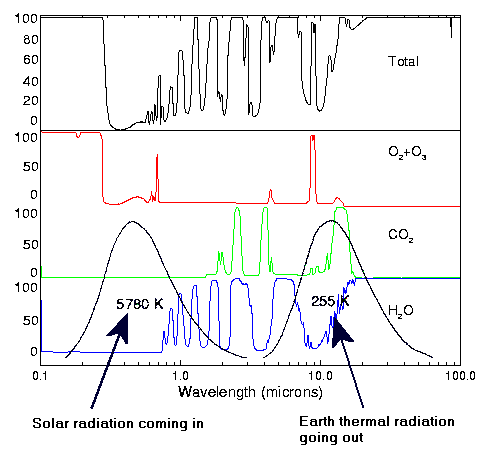 Figure 2 – Absorption curves of various molecules in the atmosphere and Planck curve overlay.
What is nice about this plot though is that the unknown author has overlaid the Planck spectrums of both incoming and outgoing radiation on top of the absorption curves. You can see by looking at the graph (or the sun) that most of the incoming curve passes through the atmosphere with little impediment. The outgoing curve however is blocked – mostly by moisture in the air – with a little tiny sliver of CO2 (green curve) effective at absorption at about 15 micrometers wavelength (the black arrow tip on the right side is at about 15um wavelength). From this figure we can see that CO2 has almost no absorption for incoming radiation (left curve), yet absorbs some outgoing radiation (right curve). No disagreement with that either – I hope. Tom Vonk’s recent post agrees with what I’ve written here.
Energy in from the Sun equals energy out from the Earth’s perspective — at least over extended time periods and without considering the relatively small amount of energy projecting from the earth’s core. If you add CO2 to our air, this simple fact of equilibrium over extended time periods does not change.
So what causes the atmospheric warming?
Air temperature is a measure of the energy stored as kinetic velocity in the atoms and molecules of the atmosphere. It’s the movement of the air! Nothing fancy, just a lot of little tiny electrically charged balls bouncing off each other and against the various forces which hold them together.
Air temperature is an expression of the kinetic energy stored in the air. Wiki has a couple of good videos at this link.
“Warming” is an increase in that kinetic energy.
So, to prove that CO2 causes warming for those who are unconvinced so far, I attempted a thought experiment yesterday morning on Tom Vonk’s thread. Unfortunately, it didn’t gain much attention. DeWitt Payne came up with a better example anyway which he left at tAV in the comments. I’ve modified it for this post.
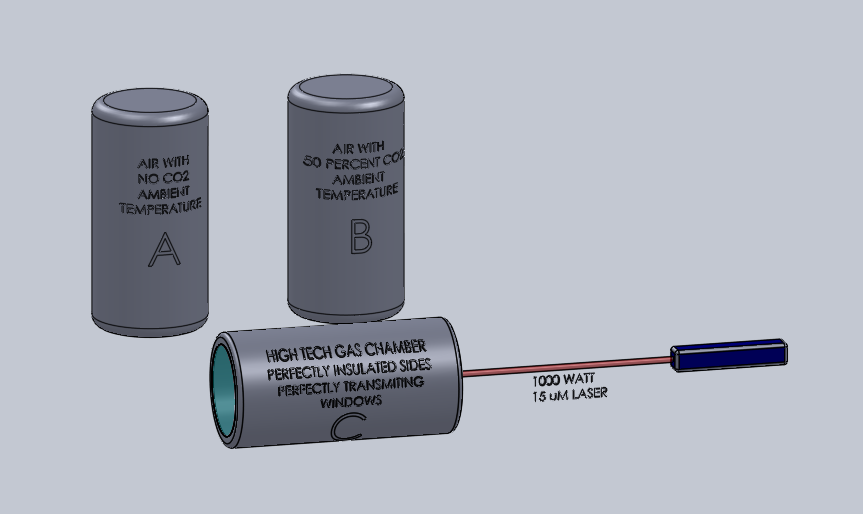 Figure 3- Experimental setup. A – gas can of air with all CO2 removed at ambient temp and standard pressure. B – gas can of air diluted by 50 percent CO2, also at ambient temp and standard pressure. C ultra insulated laser chamber with perfectly transparent end window and a tiny input window on the back to allow light in from the laser. Heat exit’s the single large window and cannot exit the sides of the chamber.
Figure 4 is a depiction of what happens when C contains a vacuum.
 Figure 4 – Laser passes straight through the chamber unimpeded and a full 1000 Watt beam exits our perfect window.
The example in Figure 5 is filling tank C with air from tank A air (zero CO2) at the equilibrium state.
 Figure 5 – Equilibrium of hypothetical system filled with zero CO2 air from canister A.
Minor absorption of the main beam causes infrared absorption and re-emission from the gas reducing the main beam from the laser. This small amount of energy is re-emitted from the gas through the end window and scattered over a full 180 degree hemisphere.
What happens when we instantly replace the no-CO2 air in chamber C with the 50% CO2 air mixture in B?
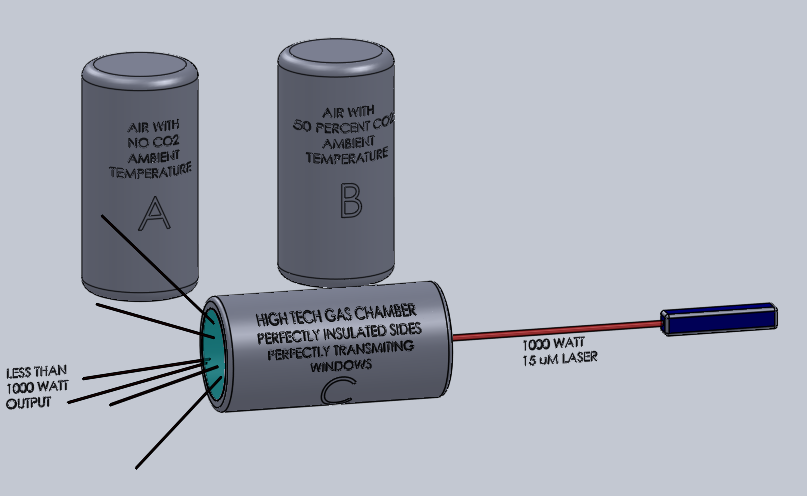 Figure 6 – Air in C is replaced instantly with gas from reservoir B
From the perspective of 15 micrometer wavelength infrared laser, the CO2 filled air is black stuff. The laser cannot penetrate it. At the moment the gas is switched, the laser beam stops penetrating and the 1000 watts (or energy per time) is added to the gas. At the moment of the switch, the gas still emits the same random energy as is shown in Figure 5 based on its ambient temperature, but the gas is now absorbing 1000 watts of laser light.
Since the beam cannot pass through, the CO2 gains vibrational energy which is then turned into translational energy and is passed back and forth between the other air molecules building greater and greater translational and vibrational velocities. —- It heats up.
As it heats, emissions from the window increase in energy according to Planck’s blackbody equation. Eventually the system reaches a new equilibrium temperature where the output from our window is exactly equal to the input from our laser – 1000 watts. Equilibrium! – (Figure 7)
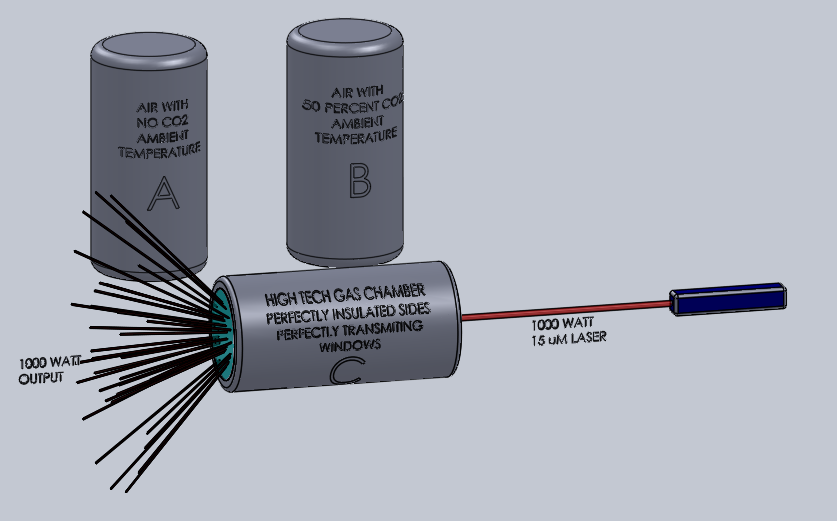 Figure 7 – Equilibrium reached when gas inside chamber C heats up to a temperature sufficient to balance incoming light energy..
The delay time between the instant the air in C is switched from A type air to B air to the time when C warms to equilibrium temperature is sometimes stated as a trapping of energy in the atmosphere.
“CO2 traps part of the infrared radiation between ground and the upper part of the atmosphere”
So from a few simple concepts, two gasses at the same temp, one transparent the other black (at infrared wavelengths), we’ve demonstrated that different absorption gasses heat differently when exposed to an energy source.
How does that apply to AGW?
The difference between this result and Tom Vonk’s recent post, is that he confuses equilibrium with zero energy flow. In his examples and equations, he has a net energy flow through the system of zero, which is fine. Where he goes wrong is equating that assumption to AGW.
What we have on Earth, is a source of 15micrometer radiation (the ground) projecting energy upward through the atmosphere, exiting through a perfect window (space) – sound familiar? Incoming solar energy passes through the atmosphere so we can ignore it when considering the most basic concepts of CO2 based warming (this post), but it is also an energy flow. In our planet, the upwelling light at IR wavelengths is a unidirectional net IR energy flow (figure 2 – outgoing radiation), like the laser in the example here.
Of course adding CO2 to our atmosphere causes some of the outgoing energy to be absorbed rather than transmitted uninterrupted to space (as shown in the example), this absorption is converted into vibrational and translational modes (heating). Yes, Tom is right, these conversions go in both directions. The energy moves in and out of CO2 and other molecules, but as shown in cavity C above, the gas takes finite measurable time to warm up and reach equilibrium with space (the window), creating a warming effect in the atmosphere.
None of the statements in this post violate any of Tom’s equations; the difference between this post and his, is only in the assumption of energy flow from the Sun to Earth and from Earth back to space. His post confused equilibrium with zero flow and his conclusions were based on the assumed zero energy flow. The math and physics were fine, but his conclusion that insulating an energy flow doesn’t cause warming is non-physical and absolutely incorrect.
Oddly enough, if you’ve ever seen an infrared CO2 laser cut steel, you have seen the same effect on an extreme scale.
————-
So finally, as a formal skeptic of AGW extremism, NONE of this should create any alarm. Sure CO2 can cause warming (a little) but warmer air holds more moisture, which changes clouds, which will cause feedbacks to the temperature. If the feedback is low or negative (as Roy Spencer recently demonstrated), none of the IPCC predictions come true, and none of the certainly exaggerated damage occurs. The CO2 then, can be considered nothing but plant food, and we can keep our tax money and take our good sweet time building the currently non-existent cleaner energy sources the enviro’s will demand anyway. If feedback is high and positive as the models predict, then the temperature measurements have some catching up to do.
Even a slight change in the amount of measured warming would send the IPCC back to the drawing board, which is what makes true and high quality results from Anthony’s surfacestations project so critically important.
This is where the AGW discussion is unsettled.
====================================
My thanks to Jeff for offering this guest post – Anthony
I don’t think anyone in their right mind disputes that CO2 and that horrible green house gas H2O do not cause an increase in the mean global temperature. Its the question of the first and second derivative. The last time I saw a first derivative of temperature with respect to CO2 concentration from a source I could respect, it was of the order of 0.00125 to 0.00250 degrees C per ppm of CO2. The second derivative was negative. Of course, this being the complex system that it is with convection and all even static first derivatives are at best a wag.
“CO2 traps part of the infrared radiation between ground and the upper part of the atmosphere” totally ignores the fact that convective activity takes the CO2 heated air upwards into the atmosphere and replaces it with cooler air from higher alititudes. The earth is not a greenhouse. There are no glass plates on the roof. Sometimes it takes that other greenhouse gas up with it and makes these funny things called clouds which make your “window” pretty darn reflecting instead of transparent. (Hint, that is why deserts are hot by and large).
Bomber_the_Cat says:
August 6, 2010 at 10:45 am
…If it is a real experiment, there are other possible explanations for what is said to happen….. I think you need to repeat the experiment with the whole chamber made of what you call “perfectly transparent” window material. The radiation will not then heat the chamber itself, but simply pass through it.
________________________________________________________
A “perfectly transparent” window material is a plate of salt (NaCl) it is used in chemistry to hold the test sample in Infrared Spectrophotometers.
It was used by Woods in 1909 to show the true” greenhouse effect” found in greenhouses was from the normal glass allowing the sun’s energy (high wavelengths) to pass into the greenhouse but trapping the infrared energy (lower wavelengths) so it could not be re-radiated out. A greenhouse built with salt glass did not become warm.
An explanation of the experiment is here: http://hockeyschtick.blogspot.com/2010/06/greenhouse-theory-disproven-in-1909.html
Weather is cold, cloudy, and miserable in UK, a typical summer!
We could do with a bit of CO2 warming feedback! but it looks like it isn’t going to happen.
I am off to Spain! see you all soon!
RE: Joss: (August 6, 2010 at 11:00 am) “On earth, every point source emits isotropically.”
That is quite true, however, in the upper atmosphere there is a conical segment about straight up in which radiation may have a good chance of escaping to outer space.
For each earthshine absorbing/emitting (greenhouse) gas it might be useful to define an altitude where perhaps all radiation emitted within 45 degrees of straight up has a 50 percent chance of escaping to outer space.
Thank you for the post which helped me alot. However I see from the comments that I need to read a lot more.
As a none scientific sceptic I can comment on your point about us saying CO2 does not cause warming.
I believe what most of us have meant is that although we might be persuaded that CO2 has a warming effect, there are times when CO2 rises and the planet cools. To a none scientist it seems reasonable to conclude that during those times, CO2 has no warming effect ^.^
What is the saturation point of atmospheric CO2 and at what point does the increase in CO have a negligible effect?
As there has been some warming, but none matching any of the models I think this is where the battleground truly exists.
The low down of radiative physics:
Crap gets radiated, crap has to go somewhere, crap hits some things some of the time, but most of the time it just keeps going, and going, and going into out space, and beyond. And that’s how all that outer space crap reach us in the first place.
Cheers
Steve Goddard says
In order to have a sane discussion about the theory of “global warming,” it is important for all camps to accept the fundamentals of science – which Jeff presents here well.
Who gave him the right to decide what is ‘fundamental science’. Science is process. Science is the sane discussion. That is science is the use of logic and numbers.
This complex thought experiment from Jeff Id does not at all resemble the earth’s atmosphere. So it can not show that CO2 causes it to heat up.
http://realplanet.eu/atmoseffect.htm
Here the author explains the effect using a thought experiment about the earth’s atmosphere. He does need to consider the chemistry of atmosphere
Not this “re-radiate” stuff again. Objects “radiate”, they don’t “re-radiate”. When you eat a steak, are you “re-digesting” the grass that the cow ate?
Just drop the “re-” part and all your statements will not only still make sense, but they will be accurate, too.
Thank you Jeff, An excellent explanation of the natural greenhouse effect.
Absorption of 15 micron radiation by CO2 raises the internal – vibrational – energy of the molecule, this is a quantized reaction and the CO2 rapidly relaxes to its ground state by emitting 15 micron radiation. CO2 molecules in the atmosphere will thus absorb outgoing thermal radiation and re-radiate it in a random direction. Some of this scattered radiation will reach the earth and provide a little extra warming. It is however important to recognise that, because of the quantum nature of this process, the CO2 molecules involved do not gain kinetic energy and are therefore incapable of “warming” (ie. adding kinetic energy)to the atmosphere unless there exist receptors such as dust, or vapours which absorb the 15 micron radiation kinetically.
It is thus correct to state that CO2 absorbs IR and re-radiates some of it back to earth, the so-called Greenhouse Effect. However, in my opinion ,FWIW, the impact on Global temperature pales into insignificance when faced with the complexity of natural feedbacks as Dr Spencer and others have ably demonstrate.
Scott says:
August 6, 2010 at 10:24 am
Can some back-of-the-envelope numbers using Beer’s Law and molar absorptivities/extinction coefficients be provided in this analysis?
Google it. There are plenty of responses
Gail, the Dewey denigrating article you linked to is a bit out of date, or if currently being spread, is somewhat out of touch. While I understand that historically, whole language become the preferred/only (and very unfortunate) method of reading instruction, it is no longer the case. Auditory phonemic awareness (sounds in spoken words) and phonological letter-sound association awareness is a key explicitly taught skill element in reading instruction in kgt through grade 2. Children are tested frequently throughout the year regarding decoding and recoding ability, with targeted phonics-based intervention applied when these skills are not being developed.
My concern is that commercial reading intervention products are not very strong in oral practice of phonics and rely too heavily on teacher talk and worksheets, or worse, try to do too much by including comprehension in the mix. Many also introduce spoken-sound practice and letter-sound practice in less than preferred ways in my opinion.
I have my favorites (one is out of print but I use it anyway and the other has just been re-issued at more than quadruple the price) and my less than favorites (which consists of most of the new programs), and then there is my list of bad, bad, bad interventions (also consisting of new programs) like “Read Naturally”. It is often touted as a computer based reading fluency intervention but is at the top of my bad list. It is a whole language holdover that needs to be entirely removed from our schools, burned till nothing is left but ashes, and the authors tarred and feathered.
Drat, that should be demonstrated.
There should be no doubt that the downward LWIR flux from both CO2 and H2O in the atmosphere exchanges LWIR flux with the surface and helps keep the surface warmer than it otherwise would be. Most (>90%) of this flux originates in the first km layer above the surface. However, the emission is determined by the species concentrations and the temperature profile (lapse rate) in the lower troposphere. The lapse rate is set by the bulk thermodynamics of the convection. As soon as the sun begins to heat the surface and sets up a temperature difference, the air is warmed at the surface and rises though the atmosphere. Under summer sun conditions with a dry surface, the surface temperature (the one under your bare feet) can easily reach 50 C. The air temperature will be about 25 C because the convection mixes cooler air down to the surface. Just using Stefan’s law, (sigma.T^4), the upper limit to the net LWIR flux radiated from the surface is about 200 W.m-2. The incoming solar flux is ~1000 W.m-2, so the balance is convection. ~80% of the thermal energy from a dry ground surface is transfered to the atmopshere as convection. If the surface is moist, evaporation will reduce the surface temperature and some of the energy will be tranported as latent heat.
The fundamental error in the AGW argument is equating the small increase in downard LWIR flux from 100 ppm CO2 (1.7 W.m-2) with an increase in ‘EQUILIBRIUM SURFACE TEMPERATURE’ using Stefans Law, with ‘WATER VAPOR FEEDBACK’ to fix the discrepancy in the presumed numbers. (These numbers come from the hockey stick calibration, but that is a separate fraud). In reality it is impossible to measure the effect of a 100 ppm increase in CO2 concentration/LWIR flux on the surface temperature. +1.7 in a flux that changes pseudorandomly from +1000 to -100 W.m-2 makes no difference to the surface/subsurface temperature of a cubic meter of soil. Changes in humidity alone will alter the downward LWIR flux by 50 W.m-2. Forget 100 ppm of CO2 – or 200 or even 2000 ppm! Alternatively the whole daily dose of 1.7 W.m-2 100 ppm CO2 LWIR flux is equivalent to less than 3 minutes of sunshine at 1000 W.m-2, or the evaporation of a layer of water 65 microns thick over an area of 1 m^2.
Furthermore, convection is mass transport, which means that the air mass as it rises through the atmosphere has to do work against gravity. That is undelying reason why the air cools as it rises. This is where the excess surface energy goes.
At night there is much less convection, so a stable air layer near the surface slowly cools by LWIR emission up through the atmosphere. The heat capacity of a 1 m^2 x 1 km column of air at the surface is about 1 MJ, so the radiative cooling rate is around 0.1 C/hr. The thermal gradient is reset each day by the surface convection.
The downward LWIR flux from CO2 helps to keep the surface warmer than it would otherwise be, but it does not control the surface temerpature. It is just a relatively stable component in a highly variable surface energy flux. To understand the greenhouse effect we need to look at the short term variations in the entire energy flux, not long term averages of small parts of the radiative flux.
Misunderstandings are so unfortunate.
What you need to understand about Tom Vonk’s post is that he was explaining that the atmosphere does not warm by any radiative absorption process. (And it doesn’t. If you look at the temperature profile of the atmosphere with altitude, once it gets above the terrestrial boundary layer, there is only a weak relationship with surface temperature.) This is not identical with saying that a greenhouse process does not exist (which he wasn’t arguing).
In a nutshell, the picture is this: Sunlight heats the earth. The earth maintains the temperature of the atmosphere through convection. If certain gases are in the atmosphere, they function effectively as a spectrally-sensitive beam-splitter, scattering 50% of some outbound infrared spectra back to the earth, which can raise the temperature of the earth (greenhouse effect). The temperature of the atmosphere is unaffected by this beam-splitting process per se, because it is an equilibrium where input = output (no heat accumulation).
For those who are distracted by the “time lag,” it is negligible. Radiative equilibrium in an absorbing-emitting gas proceeds at the speed of light between molecules…very nearly the speed of light through open space, excepting for the random directions of the emitted photons. From a radiative heat transfer standpoint, the absorptive gases are like an opaque body with an internal heat conductivity that is thousands of times more rapid than normal conductivity. So, temperature equilibirum is almost instantly established, and the outbound radiation is unimpeded. (The substantial atmosphere is about 10 km deep. At 1/10 the speed of light, which is about a million times faster than molecular thermal velocities, the transit time is about 3/10 of a millisecond. Radiative equilibrium is established throughout the atmosphere faster than the air can gain temperature.)
And the air is worthless as a heat sink. We normally use it as an insulator. When nightfall hits the desert, it chills down rapidly. The air does not keep it warm. (The heat capacity of air is dominated by the condensibility of water vapor.)
My professional expertise includes performing detailed analysis of the radiative balance of high-energy laser beams engaging military targets. We have a definite interest in what happens to IR photons zipping through the air and how they affect solid materials. Tom is on firm ground. Try to understand it.
Jeff, your gedankenexperiment was okay except for two lapses of proper analogy. The first lapse is that the basic model should have been of a 15-micron laser hitting a black-body endwall (earth surface) and reflecting back out. But that doesn’t affect the experiment. The second lapse, critical to your argument—and which I have addressed above—is that the transition from Fig. 6 to Fig. 7 is essentially instantaneous. There is no heat accumulation. Also, there is no blackbody radiation! When we are speaking of molecular resonance absorption and emission, we are out of the realm of continuum radiation altogether. These are quantum mechanical processes for which (you guessed it) temperature cannot be defined. The earth emits as a black-body, but the atmospheric gases do not.
Experimental proof, anyone? The predicted tropospheric “hot spot” does not exist. As Tom has pointed out, it cannot exist. This is a key falsification of the “global warming” theory. (Don’t worry about stratospheric heating; that is chemical recombination of atomic oxygen, a much different process.) Gotta go. I know there is at least one regular out there who doesn’t like lectures….
Re: Scott says:
August 6, 2010 at 10:24 am
[Anyway, the main point of my comment is that I want someone to direct me to where I can get molar absorptivities for CO2 and hopefully water too. If no one has run the actual numbers with respect to saturation, I can start working on that (lots of numerical integrations, I know).],
Scott, you can learn a lot about the optical properties of water here:
http://omlc.ogi.edu/spectra/water/abs/
The optical properties of CO2 can be found here:
http://www.spectralcalc.com/info/about.php
A C Osborn says:
August 6, 2010 at 11:15 am
Hi AC Osborn – the reason these don’t match up is because the diagram is an absorbance diagram. Clouds reduce the incoming radiation intensity (mostly) via a scattering mechanism. This is also the reason that aerosols in the atmosphere have a net cooling effect. Finally, it’s also the reason why skeptics complain that changes in cloud cover aren’t included in climate models. IIRC, according to Roy Spencer, all of the supposed warming in recent decades can be accounted for with only a 2% change in cloud cover.
-Scott
Joss, the keyword is net IR energy flow.
So the idea that co2 does not warm the atmosphere is to be dismissed with a thought experiment,I am open to the idea that co2 does warm the atmosphere but have not seen any proof yet.If as suggested by tom vonk that the atmosphere does not warm up with outgoing infrared radiation from the earth then the atmosphere could still warm when h20 is evaporated from the ground and condenses in the atmosphere ,taking heat from the ground and adding it to the atmosphere,co2 does not condense in the atmosphere however it gets into the atmosphere .There could be infrared radiation going back to the earth from this as well as by backradiation caused by the absorption of h20 and co2.
Those two ‘black body radiation’ humps are very wrong.
The profile of a lower temp. body’s frequency spectrum is always lower than that of a higher temperature body. So the earth receives more IR in sunlight than it emits at night. Thus the blanket effect that warms the earth at night would by definition shade the earth from incoming sun IR which must be a bigger effect because of the extra IR.
Google ‘black body radiation’ and hit images to see what I mean.
Good article. This also doesn’t address how the doubling of CO2 doesn’t double the amount of IR absorbed by the CO2.
But for me always, the arguments pro/con AGW is historical. If the atmosphere was unstable, as the AGWers maintain (positive feedbacks ARE unstable) then the temperature would have run away billions of years ago.
thegoodlocust says:
August 6, 2010 at 10:49 am
I never got this far into physics and perhaps someone could enlighten me.
When CO2 absorbs infrared radiation and then emits it, does that increase the wavelength? If so, how many times would that radiation need to be absorbed and re-emitted by CO2/Earth until it was at a wavelength that CO2 is transparent to?
______________________________________________________
Physicists please correct me if I am wrong:
The photon absorbed and the photon emitted should be exactly the same energy value. The only thing I can think of that would change that is “spectral line broadening”. If I recall “spectral line broadening” is caused by pressure effects: http://www.rsc.org/ebooks/archive/free/BK9780854045754/BK9780854045754-00001.pdf
There is one way the energy of the photon “packet” could be changed. It is when the infrared energized CO2 molecule collides with another gas (N2, O2, H2O…) and the photon energy is translated into velocity. Since velocity ca be of any value subsequent collisions can change the velocity (energy) by dividing it between the colliding partners.
The amount of “heat” (velocity) caused by the infrared energy absorbed by the CO2 depends on how much is translated into velocity of other air molecules and how much is re-radiated downward back to the earth’s surface. Do not forget that this is ONLY the energy from the specific IR bands shown in Figure 2, third line (green) on the right side under the bell shaped black line representing the gray body emissions of earth. Of course H2O (blue line) is going to be competing for some of that energy too. This can be seen in the shape of the black line at the top.
As a thought experiment of the positive feedbacks that the AGWers claim, let’s model this feedback with some electric heaters in the above gas chamber. We will measure the temperature in the gas chamber and icnrease the electric heating proportionally to the increase in temperature. This is positive feedback.
I wouldn’t assume that Anthony would be particularly interested, and given my current load in professional and personal life I certainly can’t imagine finding the time, but when I read articles like this I’m glad that much of the basic physics required to understand the big picture is in place, but frustrated as usual that much of the important “physics” is left out.
As I alluded to in several posts under Tom’s article there’s a lot more to this than just the 15 um CO2 vibrational mode and translational energy. And, specifically, air temperature is NOT an expression of the average kinetic energy in air – despite what Wikipedia says – though it is related to the average kinetic energy. That definition completely disregards molecular internal energy, which is a little critical here, since light can only be absorbed into internal modes! One of the assumptions of Tom’s article, and tacitly in this one, seems to be that the way the 15 um CO2 vibrational excitation is relaxed non-radiatively is through V -> T (vibrational to translational) transfer from CO2 to N2. I haven’t taken the time to do a thorough analysis of this, but I suspect that’s a low-probability event. In general, V -> V and V -> R (rotational) energy are microscopically more likely. For a given type of transfer to take place it has to be energetically allowed and geometrically favored (through the impact parameter). The only impact parameters for strong V -> T coupling to N2 are those impact parameters near zero and along the axis of the N2 molecule. Given that there are a lot more impact parameters greater than zero than there are near zero and that there are a lot more approach angles off the N2 axis than near the axis this tends to result in it being much more likely for this particular energy transfer to be V -> R than V -> T.
Now, we’re talking about a lot of translational energy. The 15 um photon that is absorbed has an energy of a little less than 0.1 eV. At room temperature the available free energy is about 0.025 eV (k T). This means that the translationally excited N2 molecule (traveling at about 0.08 eV) running into any other molecule immediately after the CO2 collision which excited it, is generally going to run into a molecule with a lot less translational energy (about 0.025 eV). And therefore lose some translational energy.
We’re now back to the issue of energy transfer and the CO2 molecule. Very few N2 (or any other) molecules are going have sufficient translational energy to pass back to the CO2 molecule to excite a vibrational excitation when a subsequent collision occurs. And the very few molecules that still do have the required translational energy to transfer back must have alignment and impact parameter with the CO2 molecule such that essentially all of the energy is available to excite the vibration. And even then it’s still far more likely to excite a rotation or even just transfer the energy over as translation. All other alignments favor T -> R.
Now, in fairness, back-transfer DOES happen. One can get the order of magnitude of the fraction of excited state molecules in any *thermal* system from a simple Boltzmann calculation:
Ni / N = exp[-Ei / (k T)], where Ei is the excited state energy, T is the temperature, k is Boltzmann’s constant, and Ni and N are the excited state and ground state populations. [This is an oversimplification! – but of the right order of magnitude – there are partition function and degeneracy terms to account for]
For the 15 um CO2 vibrational state at 15C you get about 4% excitated state population of the CO2. So, as Tom suggested in his original article, there are definitely excited state CO2 molecules available to radiate 15 um radiation out in all directions. But it is the fact that the CO2 vibrational excitation, in general, cannot re-radiate before collisional cooling (as Tom originally stated in his article) and that it’s really hard to back-populate the CO2 vibrational excitation that makes you realize how much energy has to be placed into translational and internal molecular modes of all the other molecules before the back transfer starts to be likely to occur that gives you the appreciation for how CO2 is causing the atmosphere to heat up.
So, again, nothing in the article keeps the big-picture physics from being correctly understood, but the fine details leave out much of the more important chemistry that’s required for a more in depth discussion of the actual thermodynamics occurring.