Radiative Physics Simplified II
A guest post by Jeff Id
Radiative physics of CO2 is a contentious issue at WUWT’s crowd but to someone like myself, this is not where the argument against AGW exists. I’m going to take a crack at making the issue so simple, that I can actually convince someone in blogland. This post is in reply to Tom Vonk’s recent post at WUWT which concluded that the radiative warming effect of CO2, doesn’t exist. We already know that I won’t succeed with everyone but when skeptics of extremist warming get this wrong, it undermines the credibility of their otherwise good arguments.
My statement is – CO2 does create a warming effect in the lower atmosphere.
Before that makes you scream at the monitor, I’ve not said anything about the magnitude or danger or even measurability of the effect. I only assert that the effect is real, is provable, it’s basic physics and it does exist.
From Tom Vonk’s recent post, we have this image:
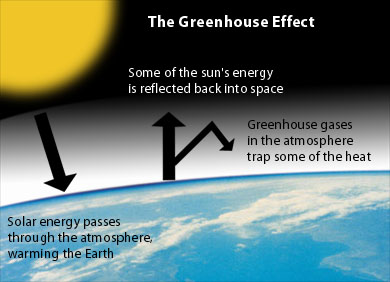 Figure 1
Short wavelength light energy from the sun comes in, is absorbed, and is re-emitted at far longer wavelengths. Basic physics as determined by Planck, a very long time ago. No argument here right!
Figure 2 below has several absorption curves. On the vertical axis, 100 is high absorption. The gas curves are verified from dozens of other links and the Planck curves are verified by my calcs here. There shouldn’t be any disagreement here either – I hope.
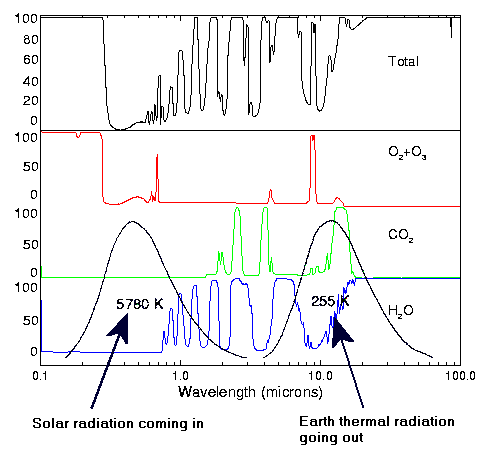 Figure 2 – Absorption curves of various molecules in the atmosphere and Planck curve overlay.
What is nice about this plot though is that the unknown author has overlaid the Planck spectrums of both incoming and outgoing radiation on top of the absorption curves. You can see by looking at the graph (or the sun) that most of the incoming curve passes through the atmosphere with little impediment. The outgoing curve however is blocked – mostly by moisture in the air – with a little tiny sliver of CO2 (green curve) effective at absorption at about 15 micrometers wavelength (the black arrow tip on the right side is at about 15um wavelength). From this figure we can see that CO2 has almost no absorption for incoming radiation (left curve), yet absorbs some outgoing radiation (right curve). No disagreement with that either – I hope. Tom Vonk’s recent post agrees with what I’ve written here.
Energy in from the Sun equals energy out from the Earth’s perspective — at least over extended time periods and without considering the relatively small amount of energy projecting from the earth’s core. If you add CO2 to our air, this simple fact of equilibrium over extended time periods does not change.
So what causes the atmospheric warming?
Air temperature is a measure of the energy stored as kinetic velocity in the atoms and molecules of the atmosphere. It’s the movement of the air! Nothing fancy, just a lot of little tiny electrically charged balls bouncing off each other and against the various forces which hold them together.
Air temperature is an expression of the kinetic energy stored in the air. Wiki has a couple of good videos at this link.
“Warming” is an increase in that kinetic energy.
So, to prove that CO2 causes warming for those who are unconvinced so far, I attempted a thought experiment yesterday morning on Tom Vonk’s thread. Unfortunately, it didn’t gain much attention. DeWitt Payne came up with a better example anyway which he left at tAV in the comments. I’ve modified it for this post.
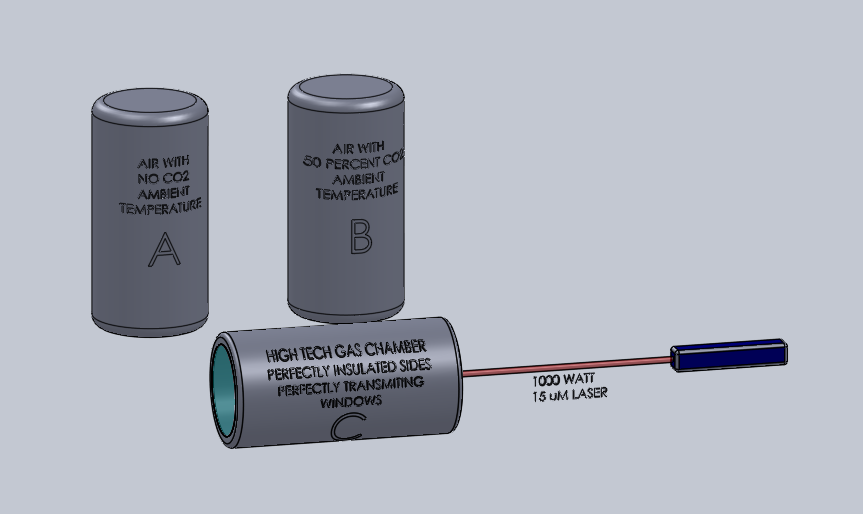 Figure 3- Experimental setup. A – gas can of air with all CO2 removed at ambient temp and standard pressure. B – gas can of air diluted by 50 percent CO2, also at ambient temp and standard pressure. C ultra insulated laser chamber with perfectly transparent end window and a tiny input window on the back to allow light in from the laser. Heat exit’s the single large window and cannot exit the sides of the chamber.
Figure 4 is a depiction of what happens when C contains a vacuum.
 Figure 4 – Laser passes straight through the chamber unimpeded and a full 1000 Watt beam exits our perfect window.
The example in Figure 5 is filling tank C with air from tank A air (zero CO2) at the equilibrium state.
 Figure 5 – Equilibrium of hypothetical system filled with zero CO2 air from canister A.
Minor absorption of the main beam causes infrared absorption and re-emission from the gas reducing the main beam from the laser. This small amount of energy is re-emitted from the gas through the end window and scattered over a full 180 degree hemisphere.
What happens when we instantly replace the no-CO2 air in chamber C with the 50% CO2 air mixture in B?
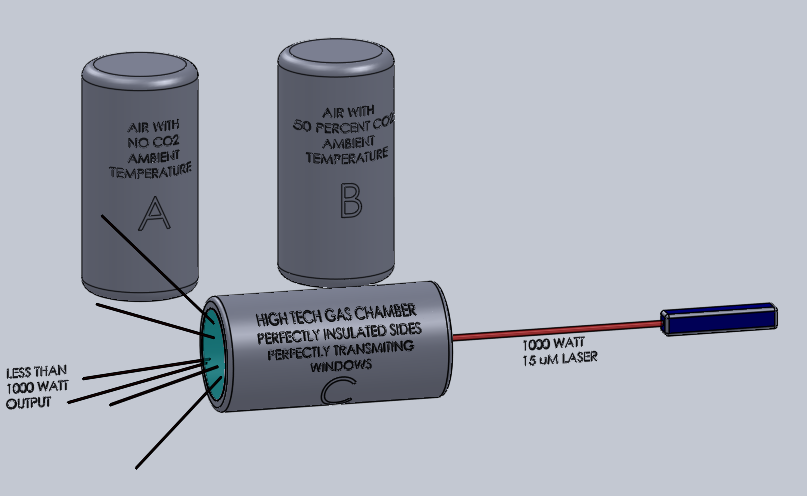 Figure 6 – Air in C is replaced instantly with gas from reservoir B
From the perspective of 15 micrometer wavelength infrared laser, the CO2 filled air is black stuff. The laser cannot penetrate it. At the moment the gas is switched, the laser beam stops penetrating and the 1000 watts (or energy per time) is added to the gas. At the moment of the switch, the gas still emits the same random energy as is shown in Figure 5 based on its ambient temperature, but the gas is now absorbing 1000 watts of laser light.
Since the beam cannot pass through, the CO2 gains vibrational energy which is then turned into translational energy and is passed back and forth between the other air molecules building greater and greater translational and vibrational velocities. —- It heats up.
As it heats, emissions from the window increase in energy according to Planck’s blackbody equation. Eventually the system reaches a new equilibrium temperature where the output from our window is exactly equal to the input from our laser – 1000 watts. Equilibrium! – (Figure 7)
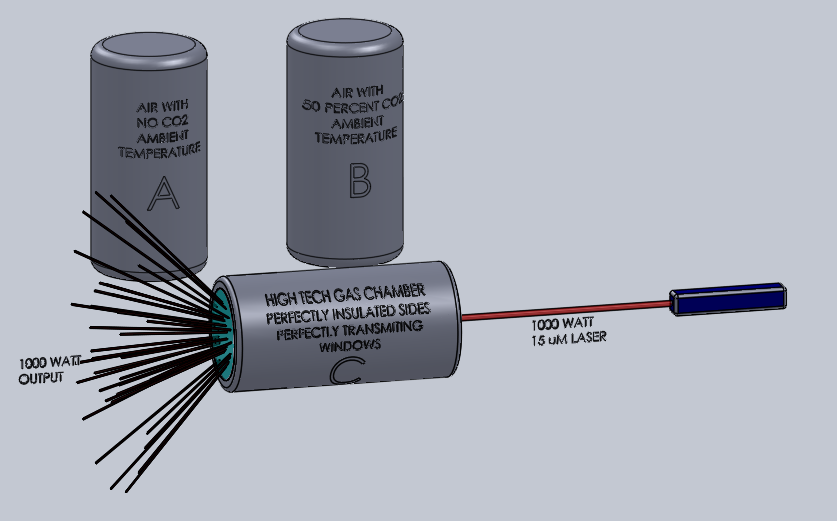 Figure 7 – Equilibrium reached when gas inside chamber C heats up to a temperature sufficient to balance incoming light energy..
The delay time between the instant the air in C is switched from A type air to B air to the time when C warms to equilibrium temperature is sometimes stated as a trapping of energy in the atmosphere.
“CO2 traps part of the infrared radiation between ground and the upper part of the atmosphere”
So from a few simple concepts, two gasses at the same temp, one transparent the other black (at infrared wavelengths), we’ve demonstrated that different absorption gasses heat differently when exposed to an energy source.
How does that apply to AGW?
The difference between this result and Tom Vonk’s recent post, is that he confuses equilibrium with zero energy flow. In his examples and equations, he has a net energy flow through the system of zero, which is fine. Where he goes wrong is equating that assumption to AGW.
What we have on Earth, is a source of 15micrometer radiation (the ground) projecting energy upward through the atmosphere, exiting through a perfect window (space) – sound familiar? Incoming solar energy passes through the atmosphere so we can ignore it when considering the most basic concepts of CO2 based warming (this post), but it is also an energy flow. In our planet, the upwelling light at IR wavelengths is a unidirectional net IR energy flow (figure 2 – outgoing radiation), like the laser in the example here.
Of course adding CO2 to our atmosphere causes some of the outgoing energy to be absorbed rather than transmitted uninterrupted to space (as shown in the example), this absorption is converted into vibrational and translational modes (heating). Yes, Tom is right, these conversions go in both directions. The energy moves in and out of CO2 and other molecules, but as shown in cavity C above, the gas takes finite measurable time to warm up and reach equilibrium with space (the window), creating a warming effect in the atmosphere.
None of the statements in this post violate any of Tom’s equations; the difference between this post and his, is only in the assumption of energy flow from the Sun to Earth and from Earth back to space. His post confused equilibrium with zero flow and his conclusions were based on the assumed zero energy flow. The math and physics were fine, but his conclusion that insulating an energy flow doesn’t cause warming is non-physical and absolutely incorrect.
Oddly enough, if you’ve ever seen an infrared CO2 laser cut steel, you have seen the same effect on an extreme scale.
————-
So finally, as a formal skeptic of AGW extremism, NONE of this should create any alarm. Sure CO2 can cause warming (a little) but warmer air holds more moisture, which changes clouds, which will cause feedbacks to the temperature. If the feedback is low or negative (as Roy Spencer recently demonstrated), none of the IPCC predictions come true, and none of the certainly exaggerated damage occurs. The CO2 then, can be considered nothing but plant food, and we can keep our tax money and take our good sweet time building the currently non-existent cleaner energy sources the enviro’s will demand anyway. If feedback is high and positive as the models predict, then the temperature measurements have some catching up to do.
Even a slight change in the amount of measured warming would send the IPCC back to the drawing board, which is what makes true and high quality results from Anthony’s surfacestations project so critically important.
This is where the AGW discussion is unsettled.
====================================
My thanks to Jeff for offering this guest post – Anthony
George E. Smith
Doesn’t absorbed light in an optical medium simply turn to heat and then become radiated as a Planck blackbody ish curve?
After reading through it all…. it all boils down to the most difficult decision;
-Which physical law can be used where?
I think I go with Claes Johnson;
http://www.nada.kth.se/~cgjoh/simpleclimate.pdf
Spector,
The approach required is more than just the temperature or a single molecule. Ultimately, you’ve got to create a spectrum from all of these lines and conditions because that’s what you’ve got. For fidelity, you’ll need to do the analysis by layer as well.
Note that there is a response to me from Tom Vonk on the other thread that includes a reference to a 200 page paper concerning the characteristics of IR in the atmosphere. It has all sorts of details that would prove helpful if this is the sort of thing you want to do.
Jeff Id says:
August 9, 2010 at 4:24 pm
George E. Smith
Doesn’t absorbed light in an optical medium simply turn to heat and then become radiated as a Planck blackbody ish curve?
——-
Of course. the reason why the stuff works well is that it’s normally associated with visible light and room temperature experiments. If you consider only the absorption or separate the absorption concept from the emission concept, it is of value in describing the absorption when emission also exists. It becomes radiative transfer when both are combined.
One point I would like to make about figure 2 in this article is that it is a standard representation of earthshine modulating (greenhouse) gases in the atmosphere, [apparently derived originally from articles by J. N. Howard, 1959: Proc. I.R. E 47, 1459; and R. M. Goody and G. D. Robinson, 1951: Quart. J. Roy. Meteorol, Soc. 77 153] and its primary purpose is to show how black-body radiation from the Earth’s surface (earthshine) is influenced by these gases, both individually and in total. Even though it may be hiding the fact that these bands are actually composed of many fine hair-lines, it is a good illustration of the process of surface radiation blocking by greenhouse gases.
What it does not do, (and was not intended to do) in my opinion, is give a picture of the upper-air radiation emission process that should be crucial for the proper understanding of the operation of the convective thermal control system in our atmosphere.
Even though one can see a wide gap in H2O absorption spectrum over the earthshine thermal radiation band, I speculate that H2O plays a random game of dollars and cents over this range, continually emitting more 20 micron photons as the temperature increases and occasionally emitting 6 micron photons to make up the difference. I believe the same might be said of CO2 from 4 to 15 microns. While this is probably quite a simplified description of what really happens and perhaps subject to error, I hope it is useful.
Jeff,
If you have only CO2 and other gases are optically inert, your 15um beam will be absorbed by CO2, and re-distributed as heat to all other molecules (called “buffer gas”). However, since these other molecules have nothing to emit on their own, the emission will occur only on CO2 lines, including 2.5 and 4um (and all other) lines, but from the entire gas chamber volume. Whole thing must heat up to a temperature quite higher than the equivalent blackbody to keep the overall balance. In the case of small chamber, the walls will be involved, and only then you will have a wider and continuous spectrum.
It would be interesting however to see how the 1kW 15um beam will look in open air. I think it will look as a plasma blowtorch.
In his essay, Jeff ID states a proposition. When skeptics fail to admit that this proposition is true, Jeff says, “…it undermines the credibility of their otherwise good arguments.” In a response, stevengoddard states his concurrence with Jeff on skeptics’ loss of credibility if they fail to accept Jeff’s proposition as true.
However, skeptics do not undermine the credibility of their arguments by failing to admit that a proposition is true if this proposition is false. Is Jeff’s proposition true or is it false? In the following remarks, I examine details of Jeff’s argument in an attempt at answering this question.
As stated in the second paragraph of Jeff’s essay, Jeff’s proposition is that “CO2 does create a warming effect in the lower atmosphere.” Before the truth or falsity of a proposition may be adjudicated, this proposition must be stated in such a way for the the variable which is called the “truth-value” of this proposition to take on the value of “true” or “false” but not both values simultaneously. This requirement sets the associated requirement for the proposition to be stated unambiguously. Jeff’s statement of his proposition is somewhat ambiguous. In order to move forward, I’ll disambiguate it while trying to be faithful to Jeff’s intent.
In technical writing, the “effect” of a statistical event is the state of nature that is produced by the “cause” of this event. Here, the cause seems to be a rise in the CO2 concentration in the lower atmosphere and the effect seems to be a rise in the temperature at an (x, y, z) space point in the lower atmosphere. Also, in climatology, a “warming” of the atmosphere designates increasing temperature at a space point. If this is what Jeff has in mind then Jeff’s proposition can be expressed in disambiguated form as:
“A rise in the CO2 concentration in the lower atmosphere causes a rise in the temperature at a space point in the lower atmosphere.”
Going forward, I’ll assume the above statement is an accurate representation of Jeff’s proposition.
At paragraph 11, Jeff announces his intention of proving this proposition true. His method of proof is generalization from the result of a thought experiment.
The result from Jeff’s thought experiment supports the proposition that “A rise in the CO2 concentration of the experimental apparatus causes a rise of the temperature at a space point in this apparatus.” Jeff’s proposition that “A rise in the CO2 concentration in the lower atmosphere causes a rise in the temperature at a space point in the lower atmosphere” results from generalization of the previously stated proposition.
Is this generalization true? A single empirical counter example would prove it false.
As the CO2 concentration rises monotonically with time, the temperature at every space point in the lower atmosphere must rise monotonically in order for Jeff’s generalization to be true. However, it has sometimes been observed that the temperature at a space point falls. Thus, Jeff’s generalization is false.
In circumstances such as these, economists sometimes preserve a statement of a cause and effect relationship from falsification by addition of the clause “ceteris paribus” (other things being equal) to the description of this relationship. Using this approach, Jeff could modify his proposition to read “A rise in the CO2 concentration in the lower atmosphere causes a rise in the temperature at a space point in the lower atmosphere, ceteris paribus,” thus preserving it from falsification.
A downside from avoidance of falsification by addition of a “ceteris paribus” clause is that the achieved generalization is not falsifiable, for if the realized effect differs from the stated one, the “other things” may not have been equal. That it is not falsifiable places the achieved generalization outside science, under Karl Popper’s criterion.
“”” Jeff Id says:
August 9, 2010 at 4:24 pm
George E. Smith
Doesn’t absorbed light in an optical medium simply turn to heat and then become radiated as a Planck blackbody ish curve? “””
Well yes Jeff, of course it does; and of course I knew that you knew that; but that is almost never pointed out in normal Optics courses; since the absorbed and radiated spectra are so completely different.
Where we are facing problems in the atmospheric radiation question is that the spectra being emitted (thermal continuum) and that being absorbed cherry is picked “bands” from some other thermal continuum from the surface or other atmospheric layers; with almost the same Temperature signatures.
Which is why people go astray in talking about the “Saturation” of the CO2 bands. No matter how big a chunk of the available radiation is grabbed by CO2 layers near the ground; or by a thinner layer if the CO2 amount goes up as in say doubling; the re-emission of that energy from the warmed atmosphere; simply has to try and make it through the next layer of CO2 containing atmosphere.
The “saturation” argument is as deceptive as the second law argument; and I’m quite sure you knew that too.
When you get a nice 20 mWatt HeCd laser beam of 2.8 eV photons absorbed in a slab of red glass; which doesn’t get very warm; you don’t think about hunting for it by chasing 120 meV photons; and with room temperature all around you they are damn hard to find even if you think of it.
Al Tekhasski :
I want to post a graphic here that may be of interest in discussing temperature inversion effects.
http://climateaudit.files.wordpress.com/2008/01/daly_spectra.gif
Note in this downward spectrum, the minimum around 660 /cm is interrupted by an upward spike, and generally looks like it is folded over in that region. I believe this is the inversion effect. The spike is a CO2 spike almost exactly at 15 microns, that far exceeds other CO2 absorption around it. The spike may be responding to the inversion, causing the folding effect. What happens as you double CO2 is that this spike will amplify upwards, but meanwhile the broader band will widen, and the latter would be the dominant effect in this region (which is Guam).
This (top) figure in the following link shows the basic CO2 spectrum with the spike at 15 microns surrounded by shoulders.
http://how-it-looks.blogspot.com/2010/03/infrared-spectra-of-molecules-of.html
It would be interesting however to see how the 1kW 15um beam will look in open air. I think it will look as a plasma blowtorch.
———————————-
There are lots of videos on youtube of high powered co2 lasers in operation.
You can’t see the beam at all, of course, because it’s IR. If you make something incandesce, you can see the light from that.
http://cgi.ebay.com/New-150W-co2-laser-tube-water-cool-power-supply-/130417546927?pt=LH_DefaultDomain_0
Everyone should have one or more!
Regarding the proposition that CO2 does create a warming effect in the lower atmosphere, I believe that all depends on what is meant by a warming effect and whether it is linear progressive or not. Here are a few selected results I obtained from the MODTRAN online radiation calculator utility for clear tropical air for the surface temperatures required to obtain a fixed output flux of 292.993 W/m2.
   ATM CO2       Surface Tmp
     ppm             °K
    0.000         293.56
    1.094         294.67
   12.375         296.79
   70             298.96
  140             299.85
  280             300.73
  396             301.18
  560             301.63
  792             302.10
 1,120            302.58
 2,240            303.61
 8,960            306.10
71,680            312.40
I believe these represent the raw CO2 effect on the radiation budget of the atmosphere. This is without regard to the action of any natural temperature regulation or feedback effects. The MODTRAN results should not be confused with real data – they are only computer calculated projections. As I understand it, there has only been about a 0.6 deg C increase in average global temperatures since 1880.
In the end, it all depends on what Jeff means by a ‘warming effect.’
spector
I believe you have it right there. One of the options is the 1976 std atm. which is typical even if it’s not an average. It provides a nice standard. The calculator is of course for clear sky only and it is radiative only.
Gnomish says:
“There are lots of videos on youtube of high powered co2 lasers in operation. You can’t see the beam at all, of course, because it’s IR. If you make something incandesce, you can see the light from that.”
This is a 10.6um laser. Absorption at 15um is 35,000 times stronger. Air at 10.6 um is practically transparent at 400ppm CO2. That’s why these lasers are in use, and that’s why you don’t see the beam, only when it hit something. At 15um, the entire (99%) of 1kW laser beam will be absorbed in 1m. If the beam is 1mm in diameter, there must be quite substantial power density, and very small heat exchange. But you are right, it probably will not glow yet.
Jim D,
Re http://climateaudit.files.wordpress.com/2008/01/daly_spectra.gif
This chart can have a different interpretation, that the entire band is already “inverted”, and the spike is higher because it emits from warmer area of stratosphere.
I also recommend this site for how the 70 km downward-looking spectrum changes with increasing CO2.
http://chriscolose.wordpress.com/2010/02/18/greenhouse-effect-revisited/
Note how the spike is first downwards then “bounces” up with higher concentrations. This is expected as it saturates in the inverted stratospheric temperature profile.
Spector said:
“In the end, it all depends on what Jeff means by a ‘warming effect.’ “.
Yes, that raises a point that I made in an earlier post in this thread.
The ‘warming’ effect of increased downward IR from more CO2 in the air quickly gets gets translated into increased evaporation from water surfaces and of course evaporation has a net cooling effect so the temperature of the surrounding environment should actually drop all other things being equal.
Anyway the energy from the extra CO2 is still present but it gets converted to latent heat which does not register on thermometers.
So it could be somewhat misleading to assert that the extra CO2 causes warming in the usual sense. What it actually does is increase the energy content of the atmosphere but not in a way that necessarily results in any measurable warming at or near the surface. At least not netted out globally if water surfaces predominate as they do.
Then we have to bear in mind that water vapour is a very light gas so despite the lack of detectable warming there will nonetheless be an increase in convection just because the extra water vapour is lighter that the surrounding air.
So the hydrological cycle speeds up despite a lack of measurable warming and again that increases the speed of upward energy transport for another net cooling effect at the surface on top of the earlier net cooling effect of evaporation alone.
Then cloudiness increases to reduce solar shortwave into the body of any water and any rainfall is cooler than the surface temperature so the warming of the oceans from solar input slows down too.
So we see a whole raft of cooling processes that can be initiated by more CO2 (or any other GHGs) in the air with the warming effect not registering on thermometers because all the extra energy goes into faster evaporation and gets hidden as latent heat.
I’m satisfied that in theory, in the absence of a hydrological cycle GHGs of whatever nature are capable of making an atmosphere warmer than it otherwise would be.
But what is the net result of the presence of so much water with all it’s phase changes? It appears logical to me that the hydrological cycle effectively negates ANY such attempted warming effect from the atmosphere by converting ALL the extra energy from GHGs to latent form thereby speeding up the hydrological cycle to maintain an equilibrium temperature set not by GHGs but instead by the density and pressure differentials between oceans, air and space and crucially also by the properties of water.
Forget the greenhouse effect because the Hot Water Bottle Effect reigns supreme.
Unless of course it can be shown empirically that there is extra non latent (sensible) heat left over on a netted out basis globally from the extra GHG induced downward IR radiation. But that couldn’t be so unless the planet was less than 50% water covered because evaporation has that net cooling effect and one would need the greater effect of warming over a larger global land area to more that offset the cooling evaporative effects over the oceans. We do not have that additional necessary factor of a surplus of land surfaces.
http://www.john-daly.com/artifact.htm
It looks like this was tested-
maybe 10 meters is closer for the extinction at 15um?
http://lasersparkpluginc.com/uploads/CO2_Absorption_Data.pdf
Indeed. In 43F ambient you can make ice by evaporative cooling.
It seems a reply disappeared, so rerun:
It looks like the CO2 in a tube experiment has been quantified:
http://www.john-daly.com/artifact.htm
and then there’s this-
http://lasersparkpluginc.com/uploads/CO2_Absorption_Data.pdf
so maybe 10 meters for extinction at 15um ?
Jim D,
Ok, the sequence of spectra looks pretty convincing. In fact, the 15um peak begins to invert at 25ppm, and the side bands start to fold back above 100ppm. So, MODTRAN calculates that, despite of the fold back with negative contribution to flux, the band broadening has bigger effect. However, please note that actual peak spacing in side bands around 15um is about 1.8cm-1, while the MODTRAN resolution is 2 cm-1. This means that the picket-fence spectrum structure gets averaged, and most of the inversion effect is therefore calculated incorrectly. So my concern still applies.
I am aware that there have been several publications that claim that LBL codes based on HITRAN confirm the overall result of 4W/m2 per CO2 doubling. But given the fundamental differences between band-averaged spectra and their fine line structure, I am sorry, I cannot believe in these results. It is simply impossible.
It’s very important that this be understood.
The actual CO2 and temp record (assuming they are trustworthy) in the small range from 280-396ppm agree with predictions from statistical thermodynamics.
It appears any feedbacks, either positive or negative, are either absent or cancel each other out, given that the calculated rise in temperature due to additional insulation by CO2 matches the observed rise in temperature.
In short then there is nothing to fear from exponentially rising anthropogenic emission of CO2 and in fact we can expect great benefit from it as global economic output increases and the biosphere becomes more productive.
The only thing we have to fear is fear itself. ~Franklin Delano Roosevelt
@Al Tekhasski
“If you have only CO2 and other gases are optically inert, your 15um beam will be absorbed by CO2, and re-distributed as heat to all other molecules (called “buffer gas”). However, since these other molecules have nothing to emit on their own”
That’s quite wrong. Unless they are at zero kelvin they will emit blackbody radiation with peak energy corresponding to temperature. In effect the CO2 converts upwelling 15um radiation from the surface into thermal (kinetic) energy which radiates equally in all directions. This is how the insulation happens – the net effect is the energy in the 15um band is slowed down on its way out the door in the upper atmosphere. All insulators work this way. They slow down either or all of convective, conductive, or radiative transport of energy. The roof and insulation of a building stop virtually all convective and radiative transfer from inside air to outside air and force the energy to flow through conduction alone while a material that has poor conductive properties (like fiberglass batting)is used to minimize that path as well.
Dave Springer says: “That’s quite wrong”, with regard to my statement that other [optically-inert] molecules have nothing to emit on their own.
Dave, you are confusing rarefied gas spectroscopy with solid-state spectroscopy. Please.
Re: Al Tekhasski: August 9, 2010 at 10:23 pm
It needs to be shown to me that better spectral resolution changes the results. Unless all the unresolved peaks are significantly broad and higher than the value shown, they are not going to change the mean behavior shown by MODTRAN. If there was an error of this type due to resolution alone, it would have been noticed by now, and hyped by the non-AGW people, but they seem silent on this issue. MODTRAN is successful in reproducing satellite-observed spectra. That is the bottom line that matters, unless you also doubt the satellites, which maybe you do.
Gnomish, the arguments about 10m extinction distances fall apart when you see how this applies to a very small fraction of the CO2 effect (the spike). Most of the CO2 doubling effect is coming from the troposphere, not the stratosphere, as is seen by the cold effective temperatures in observed emission.
Regarding CO2 1 K per doubling.
People show that we expect 0.4 K from CO2 alone since the beginning of the industrial age, and we actually have 0.6 K. They then infer a small positive feedback by neglecting any other possible effect on temperature than CO2, while at the same time arguing that there are all kinds of other effects, but that is beside the point. The point is that the rapid rise in aerosols, which I think was due to the oil age that started in the 40’s, did cause cooling, especially downstream of industrial areas (see global dimming). By increasing the albedo due to haze and cloud-particle effects, it can account for one degree of cooling and the reduced solar radiation observed, stunted tree growth in Siberia(?), and the fact that more cooling occurred in the northern hemisphere from the 40’s to 70’s as the haze cloud spread to its maximum size (due to limited lifetime of haze in the atmosphere and limited industrial areas). If you add that degree, you get 1.6 K, and a feedback factor of 4. My opinion is that you can’t just choose to neglect the effect of global dimming in this period.