Radiative Physics Simplified II
A guest post by Jeff Id
Radiative physics of CO2 is a contentious issue at WUWT’s crowd but to someone like myself, this is not where the argument against AGW exists. I’m going to take a crack at making the issue so simple, that I can actually convince someone in blogland. This post is in reply to Tom Vonk’s recent post at WUWT which concluded that the radiative warming effect of CO2, doesn’t exist. We already know that I won’t succeed with everyone but when skeptics of extremist warming get this wrong, it undermines the credibility of their otherwise good arguments.
My statement is – CO2 does create a warming effect in the lower atmosphere.
Before that makes you scream at the monitor, I’ve not said anything about the magnitude or danger or even measurability of the effect. I only assert that the effect is real, is provable, it’s basic physics and it does exist.
From Tom Vonk’s recent post, we have this image:
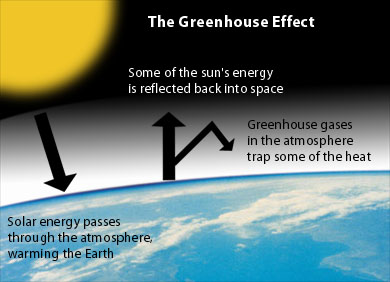 Figure 1
Short wavelength light energy from the sun comes in, is absorbed, and is re-emitted at far longer wavelengths. Basic physics as determined by Planck, a very long time ago. No argument here right!
Figure 2 below has several absorption curves. On the vertical axis, 100 is high absorption. The gas curves are verified from dozens of other links and the Planck curves are verified by my calcs here. There shouldn’t be any disagreement here either – I hope.
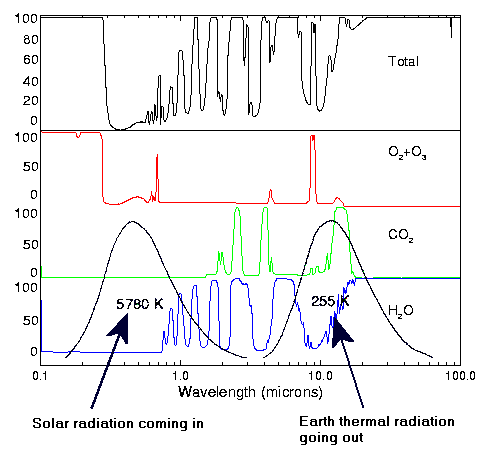 Figure 2 – Absorption curves of various molecules in the atmosphere and Planck curve overlay.
What is nice about this plot though is that the unknown author has overlaid the Planck spectrums of both incoming and outgoing radiation on top of the absorption curves. You can see by looking at the graph (or the sun) that most of the incoming curve passes through the atmosphere with little impediment. The outgoing curve however is blocked – mostly by moisture in the air – with a little tiny sliver of CO2 (green curve) effective at absorption at about 15 micrometers wavelength (the black arrow tip on the right side is at about 15um wavelength). From this figure we can see that CO2 has almost no absorption for incoming radiation (left curve), yet absorbs some outgoing radiation (right curve). No disagreement with that either – I hope. Tom Vonk’s recent post agrees with what I’ve written here.
Energy in from the Sun equals energy out from the Earth’s perspective — at least over extended time periods and without considering the relatively small amount of energy projecting from the earth’s core. If you add CO2 to our air, this simple fact of equilibrium over extended time periods does not change.
So what causes the atmospheric warming?
Air temperature is a measure of the energy stored as kinetic velocity in the atoms and molecules of the atmosphere. It’s the movement of the air! Nothing fancy, just a lot of little tiny electrically charged balls bouncing off each other and against the various forces which hold them together.
Air temperature is an expression of the kinetic energy stored in the air. Wiki has a couple of good videos at this link.
“Warming” is an increase in that kinetic energy.
So, to prove that CO2 causes warming for those who are unconvinced so far, I attempted a thought experiment yesterday morning on Tom Vonk’s thread. Unfortunately, it didn’t gain much attention. DeWitt Payne came up with a better example anyway which he left at tAV in the comments. I’ve modified it for this post.
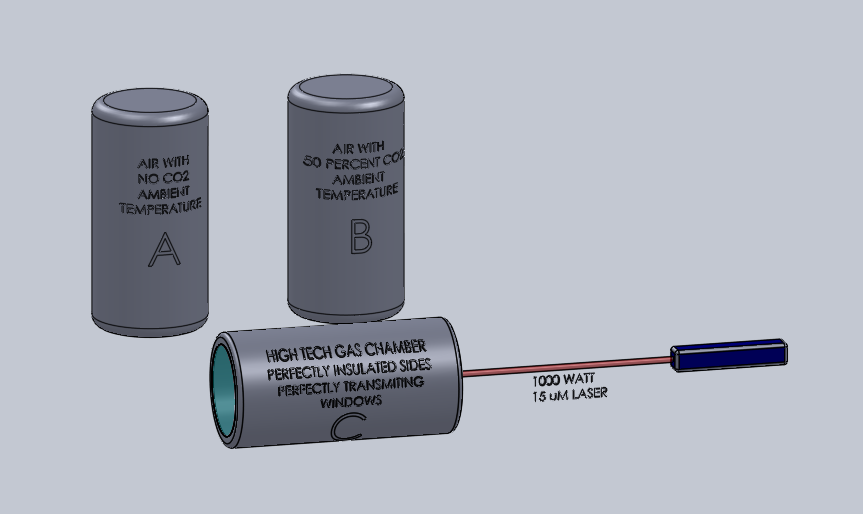 Figure 3- Experimental setup. A – gas can of air with all CO2 removed at ambient temp and standard pressure. B – gas can of air diluted by 50 percent CO2, also at ambient temp and standard pressure. C ultra insulated laser chamber with perfectly transparent end window and a tiny input window on the back to allow light in from the laser. Heat exit’s the single large window and cannot exit the sides of the chamber.
Figure 4 is a depiction of what happens when C contains a vacuum.
 Figure 4 – Laser passes straight through the chamber unimpeded and a full 1000 Watt beam exits our perfect window.
The example in Figure 5 is filling tank C with air from tank A air (zero CO2) at the equilibrium state.
 Figure 5 – Equilibrium of hypothetical system filled with zero CO2 air from canister A.
Minor absorption of the main beam causes infrared absorption and re-emission from the gas reducing the main beam from the laser. This small amount of energy is re-emitted from the gas through the end window and scattered over a full 180 degree hemisphere.
What happens when we instantly replace the no-CO2 air in chamber C with the 50% CO2 air mixture in B?
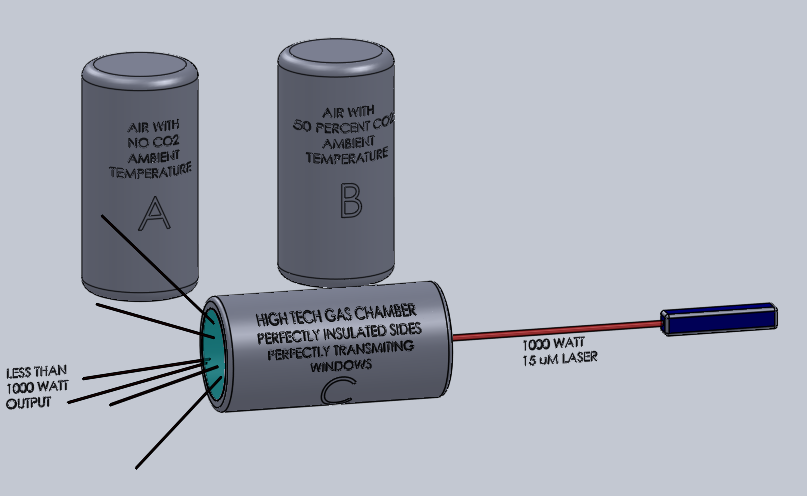 Figure 6 – Air in C is replaced instantly with gas from reservoir B
From the perspective of 15 micrometer wavelength infrared laser, the CO2 filled air is black stuff. The laser cannot penetrate it. At the moment the gas is switched, the laser beam stops penetrating and the 1000 watts (or energy per time) is added to the gas. At the moment of the switch, the gas still emits the same random energy as is shown in Figure 5 based on its ambient temperature, but the gas is now absorbing 1000 watts of laser light.
Since the beam cannot pass through, the CO2 gains vibrational energy which is then turned into translational energy and is passed back and forth between the other air molecules building greater and greater translational and vibrational velocities. —- It heats up.
As it heats, emissions from the window increase in energy according to Planck’s blackbody equation. Eventually the system reaches a new equilibrium temperature where the output from our window is exactly equal to the input from our laser – 1000 watts. Equilibrium! – (Figure 7)
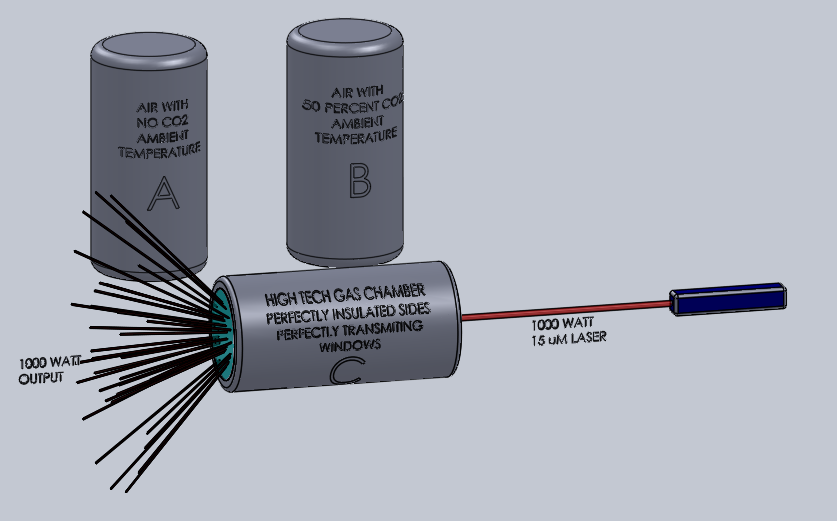 Figure 7 – Equilibrium reached when gas inside chamber C heats up to a temperature sufficient to balance incoming light energy..
The delay time between the instant the air in C is switched from A type air to B air to the time when C warms to equilibrium temperature is sometimes stated as a trapping of energy in the atmosphere.
“CO2 traps part of the infrared radiation between ground and the upper part of the atmosphere”
So from a few simple concepts, two gasses at the same temp, one transparent the other black (at infrared wavelengths), we’ve demonstrated that different absorption gasses heat differently when exposed to an energy source.
How does that apply to AGW?
The difference between this result and Tom Vonk’s recent post, is that he confuses equilibrium with zero energy flow. In his examples and equations, he has a net energy flow through the system of zero, which is fine. Where he goes wrong is equating that assumption to AGW.
What we have on Earth, is a source of 15micrometer radiation (the ground) projecting energy upward through the atmosphere, exiting through a perfect window (space) – sound familiar? Incoming solar energy passes through the atmosphere so we can ignore it when considering the most basic concepts of CO2 based warming (this post), but it is also an energy flow. In our planet, the upwelling light at IR wavelengths is a unidirectional net IR energy flow (figure 2 – outgoing radiation), like the laser in the example here.
Of course adding CO2 to our atmosphere causes some of the outgoing energy to be absorbed rather than transmitted uninterrupted to space (as shown in the example), this absorption is converted into vibrational and translational modes (heating). Yes, Tom is right, these conversions go in both directions. The energy moves in and out of CO2 and other molecules, but as shown in cavity C above, the gas takes finite measurable time to warm up and reach equilibrium with space (the window), creating a warming effect in the atmosphere.
None of the statements in this post violate any of Tom’s equations; the difference between this post and his, is only in the assumption of energy flow from the Sun to Earth and from Earth back to space. His post confused equilibrium with zero flow and his conclusions were based on the assumed zero energy flow. The math and physics were fine, but his conclusion that insulating an energy flow doesn’t cause warming is non-physical and absolutely incorrect.
Oddly enough, if you’ve ever seen an infrared CO2 laser cut steel, you have seen the same effect on an extreme scale.
————-
So finally, as a formal skeptic of AGW extremism, NONE of this should create any alarm. Sure CO2 can cause warming (a little) but warmer air holds more moisture, which changes clouds, which will cause feedbacks to the temperature. If the feedback is low or negative (as Roy Spencer recently demonstrated), none of the IPCC predictions come true, and none of the certainly exaggerated damage occurs. The CO2 then, can be considered nothing but plant food, and we can keep our tax money and take our good sweet time building the currently non-existent cleaner energy sources the enviro’s will demand anyway. If feedback is high and positive as the models predict, then the temperature measurements have some catching up to do.
Even a slight change in the amount of measured warming would send the IPCC back to the drawing board, which is what makes true and high quality results from Anthony’s surfacestations project so critically important.
This is where the AGW discussion is unsettled.
====================================
My thanks to Jeff for offering this guest post – Anthony
RE: Gnomish says: (August 8, 2010 at 4:25 pm) A more accurate statement might be:Heating from below causes convection. Radiation is not required at all, even though that’s the only way heat gets to the bottom of the system from outside of it.
That is true as it stands, however to have convective cooling, the heat transported upward must leave the planet, radiation being the only ticket out, or you have the equivalent of a stove with a plugged chimney.
Jim D,
Thanks for your reply.
“The laser intensity at 15 microns is equivalent to the emission of a black body at some (probably high) temperature. This is the temperature towards which the CO2 will go.”
My conclusion is actually the same as yours. Except I’m pointing out that CO2 concentration doesn’t matter. CO2 concentration doesn’t change the equilibrium temperature (at least not in the case of perfectly insulated chamber surrounded by a vaccum). I argued this point in my last post. I haven’t seen anyone try to refute that argument.
If I can add CO2 or take it away and it doesn’t change the temperature then isn’t Tom right to say that CO2 has no net effect warming the gas?
Re: Spector: August 8, 2010 at 6:33 pm
At 225 K and 200 mb pressure, I figured (and may be wrong) the ice saturation value is less than 200 ppm. Taking an average as 50% RH relative to ice gives less than 100 ppm, so that is where it comes from. The 3 to 4 per cent is an atmospheric average, but it varies strongly with temperature being restricted by the saturation upper limit that decreases with temperature.
Mike Blackadder says:
August 8, 2010 at 7:25 pm
“If I can add CO2 or take it away and it doesn’t change the temperature then isn’t Tom right to say that CO2 has no net effect warming the gas?”
Interesting point. It doesn’t change the equilibrium temperature of the CO2 when you go from 1 to 2 per cent, as that is still determined by the laser intensity. What it does change is the emission intensity at 15 microns of that CO2, which depends on the number of molecules at that temperature.
correction to my 7:33 pm
3 to 4 per cent is the extreme value, found near the ground in the tropics. The atmospheric average is about 0.4 per cent.
Aye, true. Radiation is the dominant heat transfer process at the radiator end. It’s also the delivery system for the boiler.
See calculations for the vast energy lofted to the radiator by convection with no temperature change and no BB radiation spectrum shift that is known as phase change.
If the water is in the air as gas, no temperature change was required. The density of H2O gas is the lowest of any major constituent of our atmosphere. It goes uP.
It’s also really important to note that degrees can not be converted to watts.
Air on the surface is not static or else the CO2 would just puddle there by density.
It is a continuous flow – away.
CO2 is a diffuser and disperser = conductor of heat just as much as every other gas.
I sure don’t know how it earns any sort of prize for insulation.
If you put black carbon particles in your coolant fluid, your engine will run cooler, guaranteed.
Jim D says: “maybe that is how the emission decreases as CO2 increases, which has been established taking all these line-by-line factors into account.”
Do you mean it was established by using entire two atmospheric profiles, tropical and extratropicals, out of dozens of climatic zones, and not counting any polar areas? Like in Myhre at al.?
Jim D,
“It doesn’t change the equilibrium temperature of the CO2 when you go from 1 to 2 per cent, as that is still determined by the laser intensity. What it does change is the emission intensity at 15 microns of that CO2, which depends on the number of molecules at that temperature.”
Exactly. Thanks again for the reply. That was the point that I thought I was having an argument about and you’ve helped to clear that up.
So essentially the effect of higher CO2 concentration is that it allows the gas temperature to adjust faster in response to changes in radiation forcing, not to change the equilibrium temperature for a constant radiation forcing.
GCMs routinely integrate over global areas, and this is one of the things that is easy to test by just doubling the CO2, keeping everything else the same, and seeing its instantaneous effect on global outgoing longwave. In fact, this can be tested without even running the GCM forward in time, just specifying a global analysis in it, then compare with doubling the CO2. The radiation schemes and global weather analyses are certainly good enough to test this, which is why expect it has been done many times already.
Jim_D, my example establishes that theoretically speaking the effect of increasing CO2 across multilayer- structured atmosphere has a _negative_ effect on warming. In particular, it is painfully clear that the effect is definitely negative if the atmosphere has an inverted sounding profile, which is known to frequently happen in polar areas. Are you saying that the estimation of “radiative forcing” from CO2 doubling is most accurate if you exclude polar areas? You do realize that entire AGW scare runs on the basis of this estimation, around that notorious 3.7W/m2, which RC called once as “best accurate estimate” of CO2-based radiative forcing? Are you being serious?
Re: Al Tekhasski: August 8, 2010 at 9:22 pm
I am saying that I am sure this is part of the global average effect that is normally given. Polar areas are actually quite small, and latitudes should be weighted as cosine latitude to give the correct area weight. Less than 10% of the global area is in the Arctic and Antarctic circles, 40% is tropical and 50% is the rest.
RE Jim D: (August 8, 2010 at 7:33 pm) “At 225 K and 200 mb pressure, I figured (and may be wrong) the ice saturation value is less than 200 ppm. Taking an average as 50% RH relative to ice gives less than 100 ppm, so that is where it comes from. The 3 to 4 per cent is an atmospheric average, but it varies strongly with temperature being restricted by the saturation upper limit that decreases with temperature.”
“correction … 3 to 4 per cent is the extreme value, found near the ground in the tropics. The atmospheric average is about 0.4 per cent.”
A correction on my part, I find the original source of my high H2O concentration levels was from a seemingly general statement from: [denatured link]
http : // www . netl . doe . gov /KeyIssues/climate_change3 . html
“Water vapor is present in the atmosphere in concentrations of 3-4% whereas carbon dioxide is at 387 ppm or 0.0386%.”
If this were true at the tropopause level it would suggest that for every molecule of CO2 in a given volume of upper air that might radiate to outer space, there should be a lot more H2O molecules ready to do the same thing. I now do suspect that writer of this DOE document may have made an unwitting error without realizing that this statement, if true in the upper atmosphere, had the potential to pull rug out from under the CO2 Global Warming Theory.
Mike,
I want to answer because you’re putting a lot of work into this but it’s so long worded that I’m having trouble following, I’ll try to answer in bold.
Mike Blackadder says:
August 7, 2010 at 8:04 pm
Jeff,
I think I see the problem.
So we have a perfectly insulated chamber with windows at the ends to let radiation in and out, and I will add that it is surrounded by a vaccuum.
A 15um laser is firing through the gas in the chamber and we’ll consider how this effects the temperature of the gas depending on mix of N2 and CO2. Note: We’ll get to the case of no CO2 at the end.
Scenario 1) 1% CO2: Turn the laser on. With 1% CO2 we’ll assume that the gas does NOT appear completely black to the laser. So some laser light passes right through the chamber. The CO2 absorbs X photons/sec. Before being able to re-emit it gets in millions of collisions and will tend to transfer their vibrational energy to the cooler N2 gas (and also the collisions will result in translational energy of the CO2 molecules as well). So the air heats up. So the air is absorbing X photon/sec but is emitting less than X photon/sec. Eventually the gas will warm up to an equilibrium temperature where it is emitting X photon/sec and absorbing X photons/sec.
Here’s the important part. This only happens at the point when the following collision events are equally probable: CO2* + N2 -> CO2 + N2′, and CO2 + N2′ -> CO2* + N2. If this is not the case then a net amount of absorbed radiation is being translated into heating of the case or vice-versa.
Scenario 1, not all laser energy absorbed, eventually we reach equilibrium
Scenario 2) 2% CO2. Turn the laser on. Still some laser light passes through the gas without being absorbed but now a greater amount is absorbed: Y photons/sec. The same thing happens when the gas is cool, where there are more CO2* + N2 -> CO2 + N2′ than the CO2 + N2′ -> CO2* + N2, and so the CO2 doesn’t get a chance to release photons before transfering it to heating of the gas. We know that it will warm up and reach equilibrium when emitting Y photons/sec.
Scenario 2, more but not all laser energy absorbed, eventually we reach equilibrium
The problem is you assume this is a higher gas temperature than scenario 1, but it isn’t. In fact it is only when collision event CO2*+N2 -> CO2 + N2′ is equally probable to CO2 + N2′ -> CO2* + N2, which is the same temperature. The CO2 and N2 molecules involved in this collision have no knowledge of gas concentrations surrounding them. There is no reason why N2 suddenly has to be a higher temperature in order to energize CO2 as often as it deenergizes CO2.
I think I’m following your logic now. Maybe, but it’s still confusing especially in the lst sentence. If more of the laser light passes straight through the gas, I assert it will be cooler. If less passes through, it will be warmer. Otherwise, where would the energy go?
Finally Scenario 3) 0% CO2. Turn on laser. Hopefully this helps clear things up. No laser light is absorbed by the gas, and all laser light passes right through. The gas doesn’t heat up.
Question: What’s the gas temperature? Before you say 0 K, remember the gas is in a perfect insulator surrounded by a vaccuum.
initial temperature is room temp – ambient as written on the cans
The truth is the gas temperature could be anything. This illustrates how you’re only considering one side of the problem. In Scenario 1 & 2 we know the gas is cool when we start the laser because the gas contained CO2 which was emitting heat out of the chamber (net CO2 + N2′ -> CO2* + N2) transactions. Without the CO2 this can’t happen.
the gas temp was the same as the room so no net energy loss (cooling)over time, At ambient temp the second law of thermo states that the net energy transfer through the perfect window is zero. No cooling.
==========================================================
I’m sorry if I didn’t keep up with all the comments here, feel free to leave a comment at the Air Vent if I’ve missed something important.
Thanks to Anthony for carrying this post, I hope people found it helpful.
Jeff Id
I have no issues with this post and agree with almost everything .
The only (minor) issue is when you state : Where he goes wrong is equating that assumption to AGW.
I do not think that I used the term AGW once and I neither analysed radiative transfer nor considered transient regimes . The purpose of my post was very exactly and exclusively to give arguments for the statement written at the beginning .
Like you rightly say I considered a volume in LTE what , per definition , excludes transients at microscopical level .
If you wish , in the frame of your laser experiment , my post would cover what happens inside the cylinder for all t > t0 where t0 is the time at which the cylinder emits by the transparent side 1000 W .
It is for those t that the “CO2 does not heat the N2” even if it continues to absorb the whole 1000 W .
My purpose was to say that in those conditions there can’t be a net energy transfer from the vibrational modes to the translational modes because else the cylinder would continue to heat and emit less than it absorbs .
A minor technical point is that like Merrick says , temperature is indeed not merely an average of the kinetic energy but an average of energy what includes non kinetic energy too .
Spector,
A single line has something like a gaussian distribution. Variations used include Lorentz distribution and Voigt distribution. That boils down to the situation that where on this curve one is looking at to determine the path length. What’s more, as one goes higher, the line width is going to get narrower, reducing further the path length at that wavelength and that also increases the attenuation closer in to the line center due to reduced pressure. All this is compounded by the temperature which affects the likelihood that there will be an emitted photon going outward to replace the one captured. when the temperature of the gas reaches that of the surface emitting the continuum, there will be enough molecules in the gas sample that will radiate outward as there is a likelihood that the incoming photon is absorbed. At that point, one no longer sees absorption lines occurring. In fact, if the gas temperature increases beyond that of the original BB radiating surface, one would see emission lines of the gas.
So, the OCO aids in thermalizing the atmosphere, which stores heat for a while, but does not “trap” heat.
Mean Free Path of Photons through the Troposphere and Time of Crossing Path of Photons by Dr. Nasif S. Nahle, Scientific Research Director at Biology Cabinet
“The carbon dioxide (CO2) is a very important molecule for life on Earth. Carbon dioxide is taken in from the atmosphere by photosynthetic organisms, which use the molecules of CO2 on building more complex substances where the energy transferred from the photons to the molecules of chlorophyll is stored.
The CO2 is diluted in the atmosphere in a concentration of 0.038%, and it has been proposed by the IPCC as a main driver of the climate on Earth. Contrary to what the IPCC proposes, the physics of the thermal energy transfer indicates smashingly that the CO2 is not capable of changing the temperature of the atmosphere in a significant way”.
http://climaterealists.com/?id=6111
http://climaterealists.com/?id=6111
good find!!
And so, in this one thread there is every bit of info needed to put CO2 in its place.
It’s not much sizzle and certainly no steak.
“Mean Free Path of Photons through the Troposphere and Time of Crossing Path of Photons by Dr. Nasif S. Nahle, Scientific Research Director at Biology Cabinet”
How could anyone take seriously and refer to such an incoherent drivel as this? The guy obviously is not familiar with distinction between scattering and selective absorption, and with anything else. I am so sorry for his students.
Drench them in your pity, Al.
Emo is so progressive.
RE cba: (August 9, 2010 at 5:50 am) “Spector, A single line has something like a gaussian distribution. Variations used include Lorentz distribution and Voigt distribution. That boils down to the situation that where on this curve one is looking at to determine the path length.”
Perhaps going line-by-line might be getting a little too detailed – I understand that each line observed may represent a convolution of structural theory and real-world processes.
What I am hoping to see is the development of a theory that goes beyond Planck’s law of black-body radiation to cover radiation from molecular trace gases embedded in an otherwise largely transparent gas matrix and where the radiating zone may have an effective average depth and radiating population density. I assume one could develop a function indicating the expected radiation rate and absorption cross-section for each vibration mode of any given polar molecule or polar molecule-pair (dimer) as a function of temperature and how much of that radiation escapes to outer-space.
Sorry Spector, the spectra are sharp enough and their positions irregular enough that you have to do a line by line calculation (to say nothing about the collisional continua. The weeds are very high on this one.
I have noted from time to time that posters here cite “Beer’s Law” or the “Beer-Lambert Law” which are two names for the same thing.
This is the E = E0. e^-alpha.x form; that assumes a linear relationship between input energy/power/intensity/whatever; and the corresponding output after some thickness (x) of absorbing medium; and embodying the concept that any subsequent equal absorber thickness will simply treat its reduced input in the same way.
In the geometrical Optics field; it is also fashionable to point out that this is “Internal Absorption” only, and that at the (presumed) two ends of the absorptive medium; where a change of medium occurs; there will inevitably be a Fresnel reflection/rfraction split involving Polarisation and incidence angles ets. Well in an atmospheric absorption case; we tend to dispense with the Fresnel losses at the end; and concentrate on the internal absorption.
There is one very fundamental aspect of Beer’s Law that seems to be constantly overlooked and ignored. In its derivation, it is tacitly assumed that the absorbed optical energy simply disappears from the known universe; never to be seen again.
It will sometimes be noted that the absorption coefficient (alpha) is likely to be a function of wavelength; so depending on the input spectrum and the absorbing medium, the output energy spectrum is likely to differ from that of the input; and sometimes quite markedly; and deliberately;when used in spectral filtering applications. But one thing that the user of Beer’s Law can be absolutely sure of, is that the Output Spectrum WILL NOT conatain ANY energy having spectral components that were not present in the input source. It is a lossy system; and nothing is added that was not previously present.
Well you see there is the rub; the atmosphere simply DOES NOT obey Beer’s Law. And a great many kinds of Optical Media DO NOT obey Beer’s Law. Well they don’t when the output and input are simply energy/power/intensity/whatever and no limitations are placed on the spectral correspondence of input and output.
I have at my desk; some very common Optical materials, and if I place them in the path of a HeCd blue Laser beam at 441.6 nm wavelength; and pass the ouput through a grating monochromator tuned to 441.6; I can easily get an extinction of four to five orders of magnitude from a thin 3 mm sample.
If I remove the monochromator, and simply measure the output power/energy/intensity/whatever with a broadband detector I get all kinds of power output; so far I have never got out more than I put in but I get an amazing amount out; easily enough to see; and it no longer is blue. Could be yellow/orange.red/whatever.
Those sharp cut optical filter glasses, and lots of other media; including the atmosphere are “fluorescent” or some other “escent” that converts some fraction of the input to an output at a totally different wavelength or output spectrum.
So it is advisable to forget about Beer’s Law when talking about atmospehric absorption.; well it may still be true that the actual absorption of the input photons; if you can assign a Maxwell’s Demon to account for all of them; but it will get a bit tricky sorting them out if the output spectrum actually overlays the input spectrum; even though they are different.
Beer’s law did no contemplate that the absorbed energy would ever see the light of day again (pun intended).
And in the case of the atmosphere where specific absorptions are a product of various GHG molecular species; while output emissions are the product of a thermal continuum spectrum that is due simply to the Temperature of the atmosphere; we will actually have a cascade of successive absorption and emission events that are far more complex than Beer’s law to analyse.
So far as I know (and you know what that means) the atmosphere does radiate a blackbody like (thermal) continuum spectrum of emissions based on its Temperature; and likely following a roughly 4th power with Temperature Law; but not necessarily with a full BB Planck spectrum; but the absorption of radiation in the same general spectral range (LWIR) is more of a molecular line/band spectrum; characteristic of the absorbing molecular species.
So I don’t think it is correct to say that the atmosphere; or gases in general “absorb” blackbody radiation; they do pick out pieces of it with molecular selectivity; while the total atmosphere should radiate based on just the Temperature. Classical Physics places the source of this emission as being the acceleration of electric charge due to the atomic or molecular motions.
My Quantum Mechanics stopped short of learning what the non-classical explanation for BB radiation is. My recollection is that Jeans and others were messing around with the equipartition principle; and the number of degrees of freedom; which is some whacking great number involving Avogardo’s number or maybe Factorial Avogadro’s number; and ultimately Planck assigned 0.5kT to each mode.
Evidently Jeans must have learned from Planck; because I seem to recall that Jeans did a similar computation to establish the low Temperature Specific Heats of solids using a similar argument (no I wasn’t there at the time).
Hey there has to be something extra you have to learn to get a PhD; so I didn’t learn that; OK !