Radiative Physics Simplified II
A guest post by Jeff Id
Radiative physics of CO2 is a contentious issue at WUWT’s crowd but to someone like myself, this is not where the argument against AGW exists. I’m going to take a crack at making the issue so simple, that I can actually convince someone in blogland. This post is in reply to Tom Vonk’s recent post at WUWT which concluded that the radiative warming effect of CO2, doesn’t exist. We already know that I won’t succeed with everyone but when skeptics of extremist warming get this wrong, it undermines the credibility of their otherwise good arguments.
My statement is – CO2 does create a warming effect in the lower atmosphere.
Before that makes you scream at the monitor, I’ve not said anything about the magnitude or danger or even measurability of the effect. I only assert that the effect is real, is provable, it’s basic physics and it does exist.
From Tom Vonk’s recent post, we have this image:
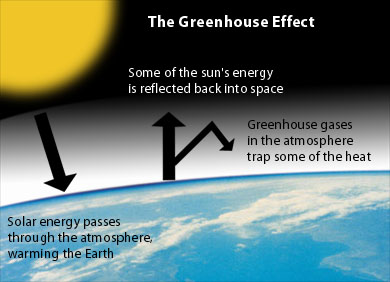 Figure 1
Short wavelength light energy from the sun comes in, is absorbed, and is re-emitted at far longer wavelengths. Basic physics as determined by Planck, a very long time ago. No argument here right!
Figure 2 below has several absorption curves. On the vertical axis, 100 is high absorption. The gas curves are verified from dozens of other links and the Planck curves are verified by my calcs here. There shouldn’t be any disagreement here either – I hope.
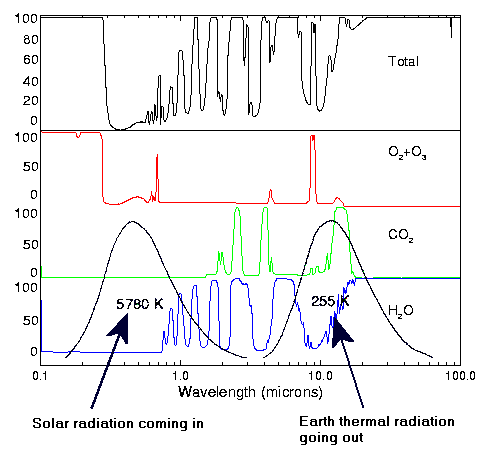 Figure 2 – Absorption curves of various molecules in the atmosphere and Planck curve overlay.
What is nice about this plot though is that the unknown author has overlaid the Planck spectrums of both incoming and outgoing radiation on top of the absorption curves. You can see by looking at the graph (or the sun) that most of the incoming curve passes through the atmosphere with little impediment. The outgoing curve however is blocked – mostly by moisture in the air – with a little tiny sliver of CO2 (green curve) effective at absorption at about 15 micrometers wavelength (the black arrow tip on the right side is at about 15um wavelength). From this figure we can see that CO2 has almost no absorption for incoming radiation (left curve), yet absorbs some outgoing radiation (right curve). No disagreement with that either – I hope. Tom Vonk’s recent post agrees with what I’ve written here.
Energy in from the Sun equals energy out from the Earth’s perspective — at least over extended time periods and without considering the relatively small amount of energy projecting from the earth’s core. If you add CO2 to our air, this simple fact of equilibrium over extended time periods does not change.
So what causes the atmospheric warming?
Air temperature is a measure of the energy stored as kinetic velocity in the atoms and molecules of the atmosphere. It’s the movement of the air! Nothing fancy, just a lot of little tiny electrically charged balls bouncing off each other and against the various forces which hold them together.
Air temperature is an expression of the kinetic energy stored in the air. Wiki has a couple of good videos at this link.
“Warming” is an increase in that kinetic energy.
So, to prove that CO2 causes warming for those who are unconvinced so far, I attempted a thought experiment yesterday morning on Tom Vonk’s thread. Unfortunately, it didn’t gain much attention. DeWitt Payne came up with a better example anyway which he left at tAV in the comments. I’ve modified it for this post.
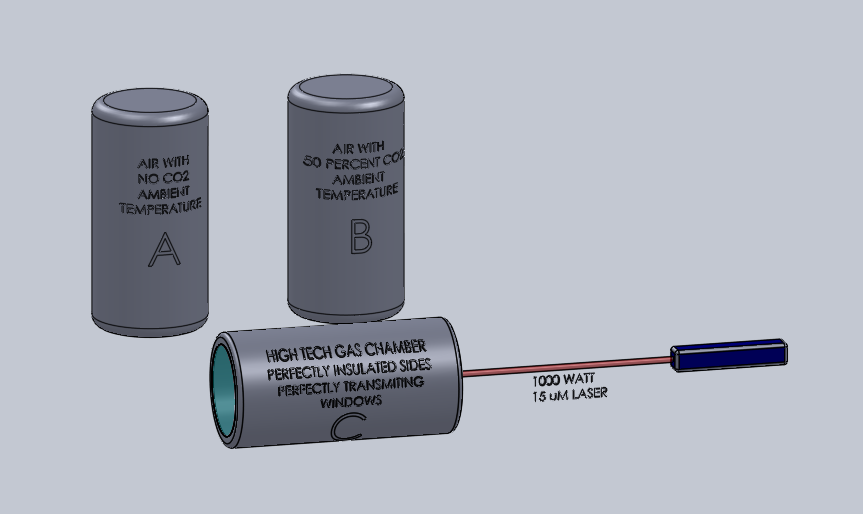 Figure 3- Experimental setup. A – gas can of air with all CO2 removed at ambient temp and standard pressure. B – gas can of air diluted by 50 percent CO2, also at ambient temp and standard pressure. C ultra insulated laser chamber with perfectly transparent end window and a tiny input window on the back to allow light in from the laser. Heat exit’s the single large window and cannot exit the sides of the chamber.
Figure 4 is a depiction of what happens when C contains a vacuum.
 Figure 4 – Laser passes straight through the chamber unimpeded and a full 1000 Watt beam exits our perfect window.
The example in Figure 5 is filling tank C with air from tank A air (zero CO2) at the equilibrium state.
 Figure 5 – Equilibrium of hypothetical system filled with zero CO2 air from canister A.
Minor absorption of the main beam causes infrared absorption and re-emission from the gas reducing the main beam from the laser. This small amount of energy is re-emitted from the gas through the end window and scattered over a full 180 degree hemisphere.
What happens when we instantly replace the no-CO2 air in chamber C with the 50% CO2 air mixture in B?
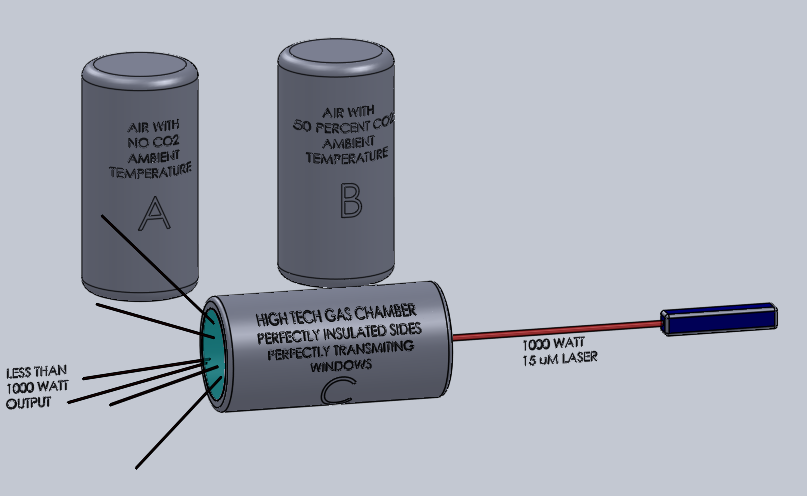 Figure 6 – Air in C is replaced instantly with gas from reservoir B
From the perspective of 15 micrometer wavelength infrared laser, the CO2 filled air is black stuff. The laser cannot penetrate it. At the moment the gas is switched, the laser beam stops penetrating and the 1000 watts (or energy per time) is added to the gas. At the moment of the switch, the gas still emits the same random energy as is shown in Figure 5 based on its ambient temperature, but the gas is now absorbing 1000 watts of laser light.
Since the beam cannot pass through, the CO2 gains vibrational energy which is then turned into translational energy and is passed back and forth between the other air molecules building greater and greater translational and vibrational velocities. —- It heats up.
As it heats, emissions from the window increase in energy according to Planck’s blackbody equation. Eventually the system reaches a new equilibrium temperature where the output from our window is exactly equal to the input from our laser – 1000 watts. Equilibrium! – (Figure 7)
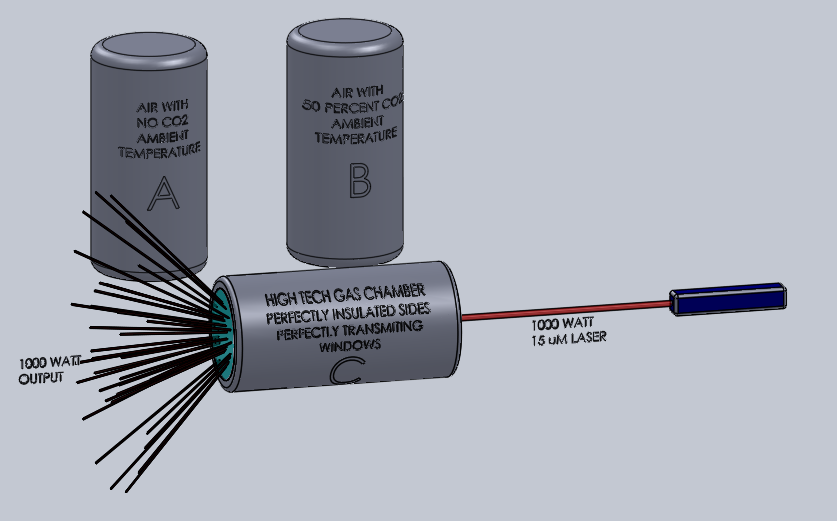 Figure 7 – Equilibrium reached when gas inside chamber C heats up to a temperature sufficient to balance incoming light energy..
The delay time between the instant the air in C is switched from A type air to B air to the time when C warms to equilibrium temperature is sometimes stated as a trapping of energy in the atmosphere.
“CO2 traps part of the infrared radiation between ground and the upper part of the atmosphere”
So from a few simple concepts, two gasses at the same temp, one transparent the other black (at infrared wavelengths), we’ve demonstrated that different absorption gasses heat differently when exposed to an energy source.
How does that apply to AGW?
The difference between this result and Tom Vonk’s recent post, is that he confuses equilibrium with zero energy flow. In his examples and equations, he has a net energy flow through the system of zero, which is fine. Where he goes wrong is equating that assumption to AGW.
What we have on Earth, is a source of 15micrometer radiation (the ground) projecting energy upward through the atmosphere, exiting through a perfect window (space) – sound familiar? Incoming solar energy passes through the atmosphere so we can ignore it when considering the most basic concepts of CO2 based warming (this post), but it is also an energy flow. In our planet, the upwelling light at IR wavelengths is a unidirectional net IR energy flow (figure 2 – outgoing radiation), like the laser in the example here.
Of course adding CO2 to our atmosphere causes some of the outgoing energy to be absorbed rather than transmitted uninterrupted to space (as shown in the example), this absorption is converted into vibrational and translational modes (heating). Yes, Tom is right, these conversions go in both directions. The energy moves in and out of CO2 and other molecules, but as shown in cavity C above, the gas takes finite measurable time to warm up and reach equilibrium with space (the window), creating a warming effect in the atmosphere.
None of the statements in this post violate any of Tom’s equations; the difference between this post and his, is only in the assumption of energy flow from the Sun to Earth and from Earth back to space. His post confused equilibrium with zero flow and his conclusions were based on the assumed zero energy flow. The math and physics were fine, but his conclusion that insulating an energy flow doesn’t cause warming is non-physical and absolutely incorrect.
Oddly enough, if you’ve ever seen an infrared CO2 laser cut steel, you have seen the same effect on an extreme scale.
————-
So finally, as a formal skeptic of AGW extremism, NONE of this should create any alarm. Sure CO2 can cause warming (a little) but warmer air holds more moisture, which changes clouds, which will cause feedbacks to the temperature. If the feedback is low or negative (as Roy Spencer recently demonstrated), none of the IPCC predictions come true, and none of the certainly exaggerated damage occurs. The CO2 then, can be considered nothing but plant food, and we can keep our tax money and take our good sweet time building the currently non-existent cleaner energy sources the enviro’s will demand anyway. If feedback is high and positive as the models predict, then the temperature measurements have some catching up to do.
Even a slight change in the amount of measured warming would send the IPCC back to the drawing board, which is what makes true and high quality results from Anthony’s surfacestations project so critically important.
This is where the AGW discussion is unsettled.
====================================
My thanks to Jeff for offering this guest post – Anthony
Jeff Id says:
August 7, 2010 at 5:33 pm
Mike, …
Maybe an even simpler explanation.
The laser passes through clear stuff — it gets absorbed by black stuff. The CO2 is black stuff. If we consider all the other minor aspects of what happens, the black stuff is still black. The laser cannot pass — so it makes heat.
_______
Jeff, oh I love your example to Mike. That’s a great classic view. So answer this if you can:
How much more black do you have to add to an already totally black gas system, the atmosphere, to have it absorb more of the 15 µm radiation from your laser than it already did? It seems the black gases at the exiting glass cannot get any warmer than it takes for the black (co2) to emit 1000 W at that temperature per fourth power law, SB with emissivity. Look deep right there.
You see, additional black does not decrease the amount of energy, 1000 W, flowing through the system after it has reached total blackness and a equalization temperature. Now, if some original laser radiation is still leaving through the exit glass, meaning true blackness has not yet been achieved, then more black it seems would warm the N2, but once total blackness (path length short enough to cause multiple interactions) has been achieved, more black does nothing, absolutely nothing, or so it seems. The temperature at the exit glass of the black content will always be the exact temperature it takes to eject 1000 W of energy, no more, no less. I think you said that above.
Now, if your entrance glass is identical to the exit glass, would 500 W be radiated out of both glasses? I can see where more would exit from the entrance glass than the exit glass being closer to the energy source. However, that doesn’t mimic the world very well. Better would be to change the laser for a special and fictional selective hot plate that emits at only ~15 µm IR that exactly covers the entrance to the container, i.e. the earths surface. Now, will the hot plate get hotter as you add more black to an already totally black air at the ~15 µm radiation inside the container?
I have to stop and think a bit on that one myself, my first thought is no, the hot plate would get warmer and warmer only until total blackness was initially achieved, from that point on, same temperature throughout the container for you cannot trap heat at the source end in the gases.
I might see that if there is such a property as “radiative conductivity”, i.e. the speed of radiation energy transfer, though I’ve never come across it, and that property was less than one, then would more black to an already black gas increase the temperature near the source end making the source end hotter than exit end? Seems non-physics to me. Once again you would be trapping heat at one end.
That’s like asking, “Can radiation energy transfer through a gas be slowed down in a macro sense when path length is short compared to the total distance traveled (don’t speak of individual photon jumps (q.m.), be symmetric)?”. The minute you turn the plate on it would be for a short period but would quickly equalize throughout, this is radiation heating, not thermal conduction, or that is my initial thought.
This might be what Tom Vonk and Mike Blackadder were trying to convey but looked at it from your “blackness” example.
Interesting. Your thoughts? My words are somewhat rough so tweak if necessary.
_____
Mr. Vonk – I learned much from your article. Keep it up.
Why not take a real laser, lock it on a satellite that can measure the incoming 15 uM during the day, night, through clouds and clear conditions and see how much is absorbed. Double the output power and test again. What are the results?
If the outgoing radiation from one of the tubes is allowed to radiate into a hemisphere, and has unit emissivity, then the equilibrium temperature is 394K (@1366W/m2). On the other hand, if the aperture can only see the sun, which is what I assumed, then the temperature is far higher, but could never exceed the surface temperature of the Sun in any case, as then we would have another machine of second kind. At any rate, this is a example that small differences in assumed conditions lead to very different results. Radiation problems in engineering are difficult enough without adding gasses into the problem. You will note that there is a lively discussion on this thread about the effects of gasses.
Gasses have a finite number of internal states that allow them to absorb radiation only at specific frequencies. These frequencies are widened into “bands” through the Doppler effect (velocity of molecules), collisions, and bound associations of two or more molecules (dimers), but until temperature/pressure is extremely high, gasses do not really approach a thermal emission spectrum. Rather they have some band gaps and the occasional lonely line or group. This is a large contributor to the complexity of radiation calculations in gasses — there is no simple rule like the Planck function for cavities to specify how molecules radiate. People use simplifying assumptions like LTE to justify the Planck function, but radiation in real gasses is not as simple as cavity radiation.
By the way, SB only applies if the entire spectrum is present in the emitted power. In the case of a window through which radiation must pass, such as that near 10 um in the Earth’s atmosphere, then radiation passing away from the surface follows more nearly a temperature to the 4.5 power. Darn those gasses!
Roger Clague :
Sorry to hear that. It makes attempting debate pointless. Even a debate must begin with a concession of what is known and not known, but you want to argue over if the podium is a podium or not. Sad.
Thanks again for your replies Kevin Kilty.
Sad to admit how little I know about optics, but your comments were very helpful.
I kinda got your point about the temperature rise in the cavity when the sun fills the aperture. However I found such an unusual point hard to believe, and I pressed the point about SB. Your explanation of SB holding for emission to a hemisphere sorted it out.
If I could conclude: the machine doesn’t work, because we cannot apply SB to the emitting surface at the basie of either tube. My mistake was assume we could. We expect both tubes will rise to a much higher temperature than implied by SB and the existence of CO2 in one of the tubes has no material effect.
Therefore there is no potential difference in the tubes and the machine doesn’t work. Also confim the rule that a practical machine cannot sink energy into its own heat source.
cba says: (August 8, 2010 at 10:12 am) “Something like the HITRAN database can provide raw information but it’s a tremendous effort to get something fairly complete out of that. One can also get fair mileage out of Archer’s online modtran calculator. Some lines will have extinction path lengths measured in the cm distances. A short distance away in the wavelength, one can have path lengths of 1km or more.
It might be interesting to also calculate the incoming extinction altitude for each line. This would be the altitude at which the remaining atmosphere to the edge of outer-space contains the same total mass per unit area of the absorbing gas as is contained over the surface level extinction distance.
I would be curious to see how many of these altitudes were above or below the equatorial tropopause level. As a first cut, one could ignore possibility that the gas concentrations might be altitude dependent.
LightRain says:
August 8, 2010 at 12:00 pm
Why not take a real laser, lock it on a satellite that can measure the incoming 15 uM during the day, night, through clouds and clear conditions and see how much is absorbed. Double the output power and test again. What are the results?
___
Since out atmosphere is totally black to ~15 µm IR radiation, due to CO2 and H2O, it’s not clear and transparent. The laser beam would be absorbed very high. You would just see the bright smear where it hit near the top of the atmosphere from the satellite and on the ground you would never see it at all. Same if doubled but brighter bigger smear as seen from the satellite. Much as a visible laser in dense fog, it wouldn’t travel far before scattered and absorbed no matter how bright and powerful.
Or that is the way I see it.
It’s black because the path length, you can view that as the distance any photon of that frequency would travel before encountering a molecule that can interact with it, is very short, I have read 10 meters for CO2 at these concentrations today. (anyone, if I off on that description of path length please let me know, still seeking correct information on that for CO2 and H2O)
Jeff,
I know this thread is petering out, but do you have any reply to my last comment?
Is there a flaw in your original post or did I make some error?
Regarding the first linked graphic posted by Dave Springer:
August 7, 2010 at 12:39 pm
Looking down from 20 km you see the 15 micron band at about 225K. This would almost entirely be due to CO2 at that temperature as the H2O content at those temperatures is much less than CO2 (maybe about 100 versus 390 ppm). This is why CO2 is highly relevant to the budget of outgoing longwave radiation, which is part of earth’s top-of-atmosphere energy budget. This point seems to have been missed when people talk about H2O dominating at the ground.
” The math and physics were fine, but his conclusion that insulating an energy flow doesn’t cause warming is non-physical and absolutely incorrect.”
You are correct and he is wrong.
I will attempt my answer to Mike Blackadder.
The laser intensity at 15 microns is equivalent to the emission of a black body at some (probably high) temperature. This is the temperature towards which the CO2 will go. Yes, for a low enough intensity (cold) laser, the CO2 could cool instead, because it would initially emit more than it receives.
The atmospheric-layer analogy is a hot laser at one end (bottom) and a cold laser at the other (top). In the real atmosphere, cooling wins out in almost all tropospheric layers, except perhaps a very thin layer near the ground.
This may seem surprising after all this discussion about GHG warming, but that is the way it is, and no, it does not contradict anything in AGW to say that the net radiative effect in the IR is atmospheric cooling (the shortwave warming is weaker). This net clear-sky cooling is compensated by convection in the troposphere that has a net warming effect. Without net radiative cooling, convection could not exist.
“Without net radiative cooling, convection could not exist.”
Technical quibble:
Change of density is sufficient for convection.
A more accurate statement might be:
Heating from below causes convection.
Radiation is not required at all, even though that’s the only way heat gets to the bottom of the system from outside of it.
The 3 forms of heat flow in a gas are conduction, convection and radiation.
They are distinct processes.
The abstract isolation of radiative processes is worth a study, but it does not answer as a substitute for the other ones.
So, the elephant is really not so much like a laser. You’ve only felt the tip of the trunk.
Re: Gnomish.
I should have said convection could not exist in the mean state that would result without radiation. The atmospheric profile would become stable and stay that way. The troposphere is often described as being in a convective-radiative equilibrium.
Jim D says: “Looking down from 20 km you see the 15 micron band at about 225K. This would almost entirely be due to CO2 … This is why CO2 is highly relevant to the budget of outgoing longwave radiation ”
Here is an interesting point that most are missing. Where this irradiance comes from? From 5-6km “average area” that has temperature this 225K as AGW theorists assume, or from stratosphere? As Dave Springer noted, even at 20km the opacity of air at many lines in 15um band is huge (optical thickness is few meters), which means that even at 20km all (14-16um) radiation still gets re-absorbed, re-emitted, and still diffused across the “black” media. In other words, 20km is not yet the TOA for this band. When CO2 is increased, this boundary would go even higher, where “higher is warmer”, and therefore the 15um band works in opposite direction to commonly assumed warming.
Re: Al Tekhasski: August 8, 2010 at 4:55 pm
Let’s say that that the downward-looking emission height for 15 microns corresponds to 10 km. Yes, some parts of the earth have almost no lapse rate at 10 km (e.g. higher latitudes where this will be in the stratosphere), others like the tropics and subtropics have this elevation in the troposphere with a negative lapse rate. Adding CO2 raises the effective emission height, and so would have different effects in these two situations, but the global average will be dominated by the lower latitudes that cover a larger area.
No. You are downplaying the effect. The TOA for 14-16um band seems to be way above 20km, since optical thickness is just 2-3m even as 100mb as Dave Springer said.
Consider the following example: Let the OLR to have only two bands.
Let a narrow band (say, 14-16um) have strong absorption, and another, wider area (say, 3x of that, the “transparency window”) with very weak absorption. Their average “emission height” is, say, at 6km. According to the standard theory of averages, the ”average emission height” will go up with increase of CO2, where “higher= colder”. Colder layer emits less, and therefore the global imbalance of OLR would occur forcing climate to warm up.
However under a more careful view, this average of 6km is made of 0km emission height for 3/4 of IR range, and 24 km emission height for the remaining 1/4. Increase of 0 km band gives you zero change in OLR, while increase in 24km emission height will give you MORE OLR, because the temperature gradient in stratosphere is opposite to one in troposphere, so “higher = warmer”. As result, the warmer layer would emit more, and the energy imbalance would be POSITIVE implying COOLING, or just exactly opposite to what the standard “averaging” theory says.
In reality the spectrum is more complex, many different trends coexist, but the above example suggests that it seems very likely that warming and cooling effects cancel each other in the first approximation. Therefore, the effect of sensitivity to CO2 increase is a second-order effect, and must be much harder to calculate accurately.
Jim D says:
August 8, 2010 at 4:33 pm
Re: Gnomish.
I should have said convection could not exist in the mean state that would result without radiation. The atmospheric profile would become stable and stay that way. The troposphere is often described as being in a convective-radiative equilibrium.-
———————————-
I understand. It just one aspect, though. In fact, convection can occur with no change of temperature at all.
Understanding is considerably enhanced by highlighting that seemingly obscured point.
Delivering heat to the mass of the planet via CO2 radiation is a lot like trying to boil lake superior by shining a heat lamp on the mississippi. You might warm the gulf a bit, though.
sorry for screwed terminology, I meant to say that optical thickness 1 correspond to 2-3m, (or beam is attenuated by e=2.7 x). BTW, if anyone knows how to formally define “effective emission height” at a given frequency, please speak up.
One for the books:
While discussing CO2 drives the climate with a friend of mine, her mother said ” We didn’t have this problem until they started to poke holes in the atmosphere with rockets.” All we could do was chuckle.
Re: Al Tekhasski: August 8, 2010 at 5:45 pm
This seems to suggest it is an oversimplification to assign individual heights to the center of the 15 micron band and the other bands and windows. The wavelengths that change emission height most are likely to be the sides of the bands, which sample a full atmospheric profile, and the stratospheric increase of temperature with height is quite weak in terms of K/km, so maybe that is how the emission decreases as CO2 increases, which has been established taking all these line-by-line factors into account.
RE: Jim D: (August 8, 2010 at 3:26 pm) “Looking down from 20 km you see the 15 micron band at about 225K. This would almost entirely be due to CO2 at that temperature as the H2O content at those temperatures is much less than CO2 (maybe about 100 versus 390 ppm). when people talk about H2O dominating at the ground.”
Do you have a source for this value? I believe I found a statement in one of the documents at the EPA NEPIS website that said that water vapor content of the atmosphere was 3 to 4 percent. That would be about 70 to 100 times that current concentration of CO2. If this statement is only at the ground, then I agree; it is beside the point. My primary curiosity at this point is obtaining a better understanding of the tropopause, which seems to the primary heat exhaust point of our thermal convection system.
Bi-Molecular Water
I note that there has been little discussion of the concentration of or effect of bimolecular water in the atmosphere at any level. BMW should have a completely different array of vibration and atmospheric absorption/radiation bands than mono-molecular water does and I believe the continual clumping and unclumping of these two species should provide a well-known and powerful radiation signature.
I guess this thread is petering out, so you and I may be the only two left here soon. I hadn’t time to read all that much, but there have been some very insightful postings. It’s interesting how many different ways there are to look at this issue.
Yes, essentially the point.
Indeed you are correct. In a heat engine the source of heat cannot also be the sink. Failure to recognize this has lead to the pursuit of many second law machines. A recent example liberated money from thousands of “investors” and sent a fellow to prison in Washington State for securities fraud. Literally people bought small shares in this venture to the tune of millions of dollars in total!