Radiative Physics Simplified II
A guest post by Jeff Id
Radiative physics of CO2 is a contentious issue at WUWT’s crowd but to someone like myself, this is not where the argument against AGW exists. I’m going to take a crack at making the issue so simple, that I can actually convince someone in blogland. This post is in reply to Tom Vonk’s recent post at WUWT which concluded that the radiative warming effect of CO2, doesn’t exist. We already know that I won’t succeed with everyone but when skeptics of extremist warming get this wrong, it undermines the credibility of their otherwise good arguments.
My statement is – CO2 does create a warming effect in the lower atmosphere.
Before that makes you scream at the monitor, I’ve not said anything about the magnitude or danger or even measurability of the effect. I only assert that the effect is real, is provable, it’s basic physics and it does exist.
From Tom Vonk’s recent post, we have this image:
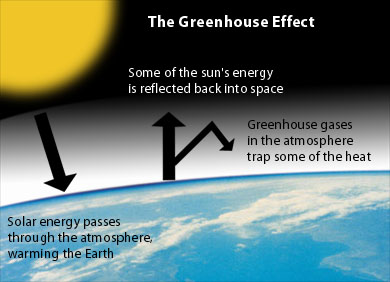 Figure 1
Short wavelength light energy from the sun comes in, is absorbed, and is re-emitted at far longer wavelengths. Basic physics as determined by Planck, a very long time ago. No argument here right!
Figure 2 below has several absorption curves. On the vertical axis, 100 is high absorption. The gas curves are verified from dozens of other links and the Planck curves are verified by my calcs here. There shouldn’t be any disagreement here either – I hope.
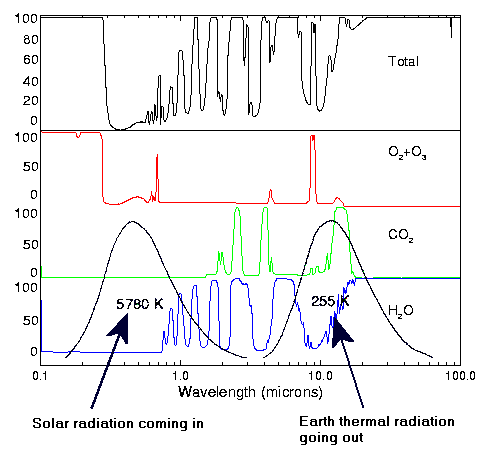 Figure 2 – Absorption curves of various molecules in the atmosphere and Planck curve overlay.
What is nice about this plot though is that the unknown author has overlaid the Planck spectrums of both incoming and outgoing radiation on top of the absorption curves. You can see by looking at the graph (or the sun) that most of the incoming curve passes through the atmosphere with little impediment. The outgoing curve however is blocked – mostly by moisture in the air – with a little tiny sliver of CO2 (green curve) effective at absorption at about 15 micrometers wavelength (the black arrow tip on the right side is at about 15um wavelength). From this figure we can see that CO2 has almost no absorption for incoming radiation (left curve), yet absorbs some outgoing radiation (right curve). No disagreement with that either – I hope. Tom Vonk’s recent post agrees with what I’ve written here.
Energy in from the Sun equals energy out from the Earth’s perspective — at least over extended time periods and without considering the relatively small amount of energy projecting from the earth’s core. If you add CO2 to our air, this simple fact of equilibrium over extended time periods does not change.
So what causes the atmospheric warming?
Air temperature is a measure of the energy stored as kinetic velocity in the atoms and molecules of the atmosphere. It’s the movement of the air! Nothing fancy, just a lot of little tiny electrically charged balls bouncing off each other and against the various forces which hold them together.
Air temperature is an expression of the kinetic energy stored in the air. Wiki has a couple of good videos at this link.
“Warming” is an increase in that kinetic energy.
So, to prove that CO2 causes warming for those who are unconvinced so far, I attempted a thought experiment yesterday morning on Tom Vonk’s thread. Unfortunately, it didn’t gain much attention. DeWitt Payne came up with a better example anyway which he left at tAV in the comments. I’ve modified it for this post.
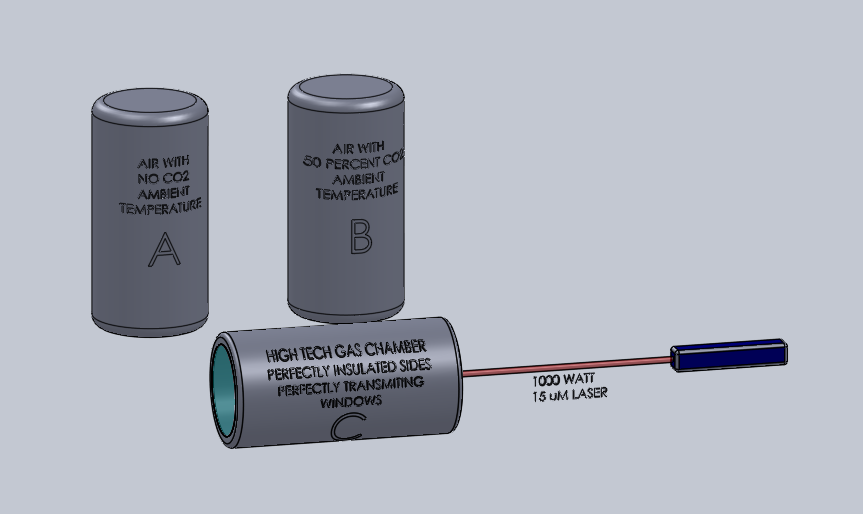 Figure 3- Experimental setup. A – gas can of air with all CO2 removed at ambient temp and standard pressure. B – gas can of air diluted by 50 percent CO2, also at ambient temp and standard pressure. C ultra insulated laser chamber with perfectly transparent end window and a tiny input window on the back to allow light in from the laser. Heat exit’s the single large window and cannot exit the sides of the chamber.
Figure 4 is a depiction of what happens when C contains a vacuum.
 Figure 4 – Laser passes straight through the chamber unimpeded and a full 1000 Watt beam exits our perfect window.
The example in Figure 5 is filling tank C with air from tank A air (zero CO2) at the equilibrium state.
 Figure 5 – Equilibrium of hypothetical system filled with zero CO2 air from canister A.
Minor absorption of the main beam causes infrared absorption and re-emission from the gas reducing the main beam from the laser. This small amount of energy is re-emitted from the gas through the end window and scattered over a full 180 degree hemisphere.
What happens when we instantly replace the no-CO2 air in chamber C with the 50% CO2 air mixture in B?
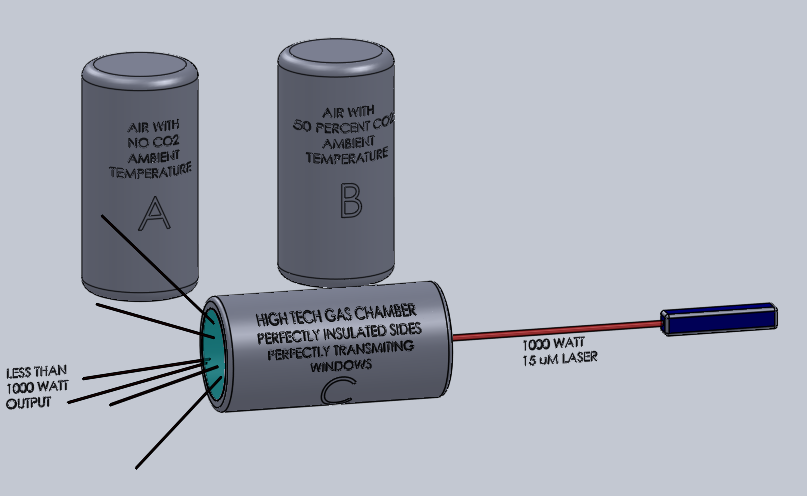 Figure 6 – Air in C is replaced instantly with gas from reservoir B
From the perspective of 15 micrometer wavelength infrared laser, the CO2 filled air is black stuff. The laser cannot penetrate it. At the moment the gas is switched, the laser beam stops penetrating and the 1000 watts (or energy per time) is added to the gas. At the moment of the switch, the gas still emits the same random energy as is shown in Figure 5 based on its ambient temperature, but the gas is now absorbing 1000 watts of laser light.
Since the beam cannot pass through, the CO2 gains vibrational energy which is then turned into translational energy and is passed back and forth between the other air molecules building greater and greater translational and vibrational velocities. —- It heats up.
As it heats, emissions from the window increase in energy according to Planck’s blackbody equation. Eventually the system reaches a new equilibrium temperature where the output from our window is exactly equal to the input from our laser – 1000 watts. Equilibrium! – (Figure 7)
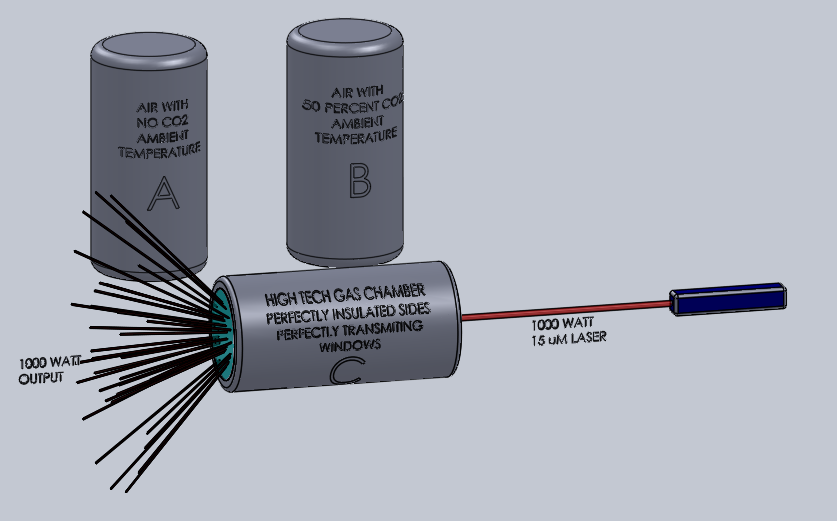 Figure 7 – Equilibrium reached when gas inside chamber C heats up to a temperature sufficient to balance incoming light energy..
The delay time between the instant the air in C is switched from A type air to B air to the time when C warms to equilibrium temperature is sometimes stated as a trapping of energy in the atmosphere.
“CO2 traps part of the infrared radiation between ground and the upper part of the atmosphere”
So from a few simple concepts, two gasses at the same temp, one transparent the other black (at infrared wavelengths), we’ve demonstrated that different absorption gasses heat differently when exposed to an energy source.
How does that apply to AGW?
The difference between this result and Tom Vonk’s recent post, is that he confuses equilibrium with zero energy flow. In his examples and equations, he has a net energy flow through the system of zero, which is fine. Where he goes wrong is equating that assumption to AGW.
What we have on Earth, is a source of 15micrometer radiation (the ground) projecting energy upward through the atmosphere, exiting through a perfect window (space) – sound familiar? Incoming solar energy passes through the atmosphere so we can ignore it when considering the most basic concepts of CO2 based warming (this post), but it is also an energy flow. In our planet, the upwelling light at IR wavelengths is a unidirectional net IR energy flow (figure 2 – outgoing radiation), like the laser in the example here.
Of course adding CO2 to our atmosphere causes some of the outgoing energy to be absorbed rather than transmitted uninterrupted to space (as shown in the example), this absorption is converted into vibrational and translational modes (heating). Yes, Tom is right, these conversions go in both directions. The energy moves in and out of CO2 and other molecules, but as shown in cavity C above, the gas takes finite measurable time to warm up and reach equilibrium with space (the window), creating a warming effect in the atmosphere.
None of the statements in this post violate any of Tom’s equations; the difference between this post and his, is only in the assumption of energy flow from the Sun to Earth and from Earth back to space. His post confused equilibrium with zero flow and his conclusions were based on the assumed zero energy flow. The math and physics were fine, but his conclusion that insulating an energy flow doesn’t cause warming is non-physical and absolutely incorrect.
Oddly enough, if you’ve ever seen an infrared CO2 laser cut steel, you have seen the same effect on an extreme scale.
————-
So finally, as a formal skeptic of AGW extremism, NONE of this should create any alarm. Sure CO2 can cause warming (a little) but warmer air holds more moisture, which changes clouds, which will cause feedbacks to the temperature. If the feedback is low or negative (as Roy Spencer recently demonstrated), none of the IPCC predictions come true, and none of the certainly exaggerated damage occurs. The CO2 then, can be considered nothing but plant food, and we can keep our tax money and take our good sweet time building the currently non-existent cleaner energy sources the enviro’s will demand anyway. If feedback is high and positive as the models predict, then the temperature measurements have some catching up to do.
Even a slight change in the amount of measured warming would send the IPCC back to the drawing board, which is what makes true and high quality results from Anthony’s surfacestations project so critically important.
This is where the AGW discussion is unsettled.
====================================
My thanks to Jeff for offering this guest post – Anthony
Jeff,
You and Willis are ‘the men’! Thanks for the post and comments.
Jeff,
I think I see the problem.
So we have a perfectly insulated chamber with windows at the ends to let radiation in and out, and I will add that it is surrounded by a vaccuum.
A 15um laser is firing through the gas in the chamber and we’ll consider how this effects the temperature of the gas depending on mix of N2 and CO2. Note: We’ll get to the case of no CO2 at the end.
Scenario 1) 1% CO2: Turn the laser on. With 1% CO2 we’ll assume that the gas does NOT appear completely black to the laser. So some laser light passes right through the chamber. The CO2 absorbs X photons/sec. Before being able to re-emit it gets in millions of collisions and will tend to transfer their vibrational energy to the cooler N2 gas (and also the collisions will result in translational energy of the CO2 molecules as well). So the air heats up. So the air is absorbing X photon/sec but is emitting less than X photon/sec. Eventually the gas will warm up to an equilibrium temperature where it is emitting X photon/sec and absorbing X photons/sec.
Here’s the important part. This only happens at the point when the following collision events are equally probable: CO2* + N2 -> CO2 + N2′, and CO2 + N2′ -> CO2* + N2. If this is not the case then a net amount of absorbed radiation is being translated into heating of the case or vice-versa.
Scenario 2) 2% CO2. Turn the laser on. Still some laser light passes through the gas without being absorbed but now a greater amount is absorbed: Y photons/sec. The same thing happens when the gas is cool, where there are more CO2* + N2 -> CO2 + N2′ than the CO2 + N2′ -> CO2* + N2, and so the CO2 doesn’t get a chance to release photons before transfering it to heating of the gas. We know that it will warm up and reach equilibrium when emitting Y photons/sec.
The problem is you assume this is a higher gas temperature than scenario 1, but it isn’t. In fact it is only when collision event CO2*+N2 -> CO2 + N2′ is equally probable to CO2 + N2′ -> CO2* + N2, which is the same temperature. The CO2 and N2 molecules involved in this collision have no knowledge of gas concentrations surrounding them. There is no reason why N2 suddenly has to be a higher temperature in order to energize CO2 as often as it deenergizes CO2.
Finally Scenario 3) 0% CO2. Turn on laser. Hopefully this helps clear things up. No laser light is absorbed by the gas, and all laser light passes right through. The gas doesn’t heat up.
Question: What’s the gas temperature? Before you say 0 K, remember the gas is in a perfect insulator surrounded by a vaccuum. The truth is the gas temperature could be anything. This illustrates how you’re only considering one side of the problem. In Scenario 1 & 2 we know the gas is cool when we start the laser because the gas contained CO2 which was emitting heat out of the chamber (net CO2 + N2′ -> CO2* + N2) transactions. Without the CO2 this can’t happen.
Where did I go wrong this time?
Re: 0% CO2 case. I forgot to mention. It has been suggested that adding CO2 to the chamber results in warming of the gas. This is not necessarily true since we don’t know what the temperature of the gas is without CO2. Adding CO2 could just as easily result in cooling of the gas, even with the 15um laser running.
I find JeffID’s model quite good for the purpose of illustrating that radiation can be absorbed and converted to kinetic. Vonk examined in detail the mechanism of energy transfer and conversion.
The effect of an energy absorbing molecule is to absorb energy and quickly share it with everything else.
The study of the radiative physics is interesting and educational. It is the determinative property for heating something from above and it is the way heat is given up by a radiator.
In a heat driven system, however, it is really only significant at the end points because phase change and convection completely dominate the system between those terminals.
Neither Vonk nor JeffID are offering any explanation of conduction or convection.
The reason radiation has seized the field as the straw man of the argument is because the only thing that the taxable substance can do that distinguishes it in any way is be darkish in infrared. The fact that is has a profoundly underwhelming effect (and the opposite of what is claimed) on a convective system is obscured by the prestidigitation.
CO2 can’t hold a place on stage with water, but they’ve already got water meters.
You know that privately they are laughing like maniacs that they will tax your air and have succesfully guided the dialectic to elevate a trivial entity to the throne of a demonic pantheon at your expense.
By Avogadro, the ideal gas constant has the same value for all gases, so PVT = PVT regardless of the molecule.
1 mole of gas molecules, any kind = 24.45 litres at 298K ( 24.85C, 76.7F) and 101.325 kPa (14.696 psi, 1 atm)
In 1000 liters of air, at STP there are 1000/24.45 = 40.9 moles. As in a previous illustration, let the water component be 1% = 10 liters = 4.09 moles. It doesn’t matter what the other gases are for this.
At the critical temperature of water vapor, this 10 liters condenses and occupies 4.09 * 18g * 1g/cc = 736.20 cc.
So the 1000 liters of air would now be 990.74 liters.
Insofar as PVT = PVT for gases, if the pressure alone changes, it means (using 24.85C and 1 atm)
PVT start is 14.696 psi*1000*(24.85C+273.15K)
final P is
14.696 psi*0.990.74, or 1% pressure drop
To get a 1% pressure drop by changing the temperature alone you need to do from 298 to 292.04 = 5.96 degrees.
http://img534.imageshack.us/img534/4959/hadleypump.jpg
http://www.engineeringtoolbox.com/spesific-heat-capacity-gases-d_159.html
Gas or Vapor kJ/kg
Air 0.287
Carbon dioxide 0.189
Water Vapor 0.462
Steam 1 psia.
120 – 600 oF
That’s what it takes to change the temperature 1 degree K.
When CO2 changes from 1 to -1 C, a change of 2 degrees C, it radiates 2(0.189 kJ/kg) = 0.378 .
http://en.wikipedia.org/wiki/Enthalpy_of_vaporization
When water vapor changes from 1 to -1 (and condenses) it radiates 2257 kj/kg + 2(0.462 kJ/kg) = 2257.853776 kJ/kg.
It does this every single time you see a cloud.
But CO2 has no phase change so it carries no heat – the numbers:
All gases at the same temperature have the same number of molecules per unit volume. (Avogadro)
Water, being light, masses 18g/mole and CO2 masses 44 g/mole
Using 1 mole of air, just to make math easy:
We lowball the water in the atmosphere at 1% of the molecules
So, in a mole of atmosphere, we have 0.01 moles of water = 0.18g
now we highball the CO2 at 500ppm which is 0.0005, or 1/2000 of a mole of CO2.
1/2000 * 44g/mole = 0.000484 moles of CO2 = 0.021296g
So in our mole of air with but 1% H2O and a generous 500ppm CO2-
the water condensing radiates 0.18g * 2257.853776 kJ/kg = 406.41367968 J
while the CO2 radiates 0.021296g * 0.378 kJ/kg = 0.008049888 J
the ratio of 0.008049888/406.41367968 = .00001980712855516645290496438242332
or as much to say that water vapor in the example carries 50486.873814890343815963650674393 times more heat than the CO2 does.
And that’s just rain. If it turns to snow- multiply by 5-6.
Meanwhile, Venus is a ball of active volcanoes with a dry heat pump to radiate it poorly.
That is why Earth’s climate doesn’t resemble that of Venus.
Forget about CO2.
All things radiate as blackbodies (or maybe a bit grayish) and noting that while water does not change temperature as it changes phase, it radiates many hundreds of times more energy in the process than any other gas.
Therefore, the blackbody spectrum may not change a whit, but –
There are a number of things that water gas does which are scarcely mentioned. It seems to be considered nothing but a personal assistant to CO2.
However there are many things that water does which define the atmosphere, the lapse rate and the thermal equilibrium.
In the first place, it evaporates. When it does, 3.7 teaspoons of liquid becomes one liter of gas. This happens without temperature change. No change occurs in the black body spectrum.
The expansion increases the local pressure above what a dry gas can under the same conditions.
At the same time, water is much lighter than any other gas in our atmosphere (except the traces of He and H), , massing a measly 18g/mole – so it rises straight up, shifted by coriolis effect as it billows wider and wider.
When it finally condenses, at the same temperature as the surrounding gas, it radiates the one spectrum throughout its phase change, indicating no higher temperature while it radiates 406.41367968 J and changes back to 3.7 teaspoons from (a bit less than, now) a liter of gas, producing a local low pressure drop of 1% that draws the atmosphere below up to fill it. (To get a 1% pressure drop by changing the temperature in a dry gas you need to do from 298 to 292.04 = 5.96 degrees.)
If water is but one percent of the volume, (using a sample volume of 100 liters that started at STP) the constituents would radiate their share as well, depending on the specific heat-
um… well, the other gases don’t radiate any more than they gain from below or sideways, or the temperature would actually drop- but for a one degree drop:
N2 (89.3g = 78%) 1.039 kJ/kg = 92.J
O2 (13.1g= 20%) 0.915 kJ/kg = 12.0J
CO2 (0.02g = 500ppm) 0.189 = 0.008J
H2O (18g = 1%) 0.462 kJ/kg = 406.41367968J
Water does more work than everything else combined – without having to change its blackbody spectrum.
(Compared to the CO2, water moves 50,000 times more energy from surface to space.)
Increasing the heat carrying capacity of the atmosphere improves the efficiency of the system. Adding CO2 helps convection cool mo bettah. I didn’t make up the physics.
You see, our atmosphere is not in a tube. Any heat on the surface is just at one end of a constantly moving conveyor to the infinite heat sink of space.
It’s not sitting there gaining heat and the more heat you add, the faster the conveyor moves. A bigger differential from source to sink increases the flow rate.
Swapping one non-phase-change gas in the working fluid will only infinitesimally affect the heat capacity and flow rate.
It all ends up in space at the end of the conveyor unless it’s stored in the mass of the planet.
You have to actually increase input to warm the convection fluid. Everything is wrung out of it in a matter of days.
Kevin Kilyy – thanks for sticking with my questions.
I tend to agree when you say the suggested machine would be a violation of the second law.
But I also want to test the consequences of the argument that GHG has a resistive medium to LWR, and (on that argument) what we might do if we allow SWR to enter a chamber with free passage, then resist the passage of outgoing LWR.
The empty/transparent tube is only included to drive this thought experiment to an extreme. To show that there is either something very different happening in the two chambers, or there is not.
I appreciate that the concept is highly idealised, but I wanted to remove confounding factors in order to test the principle when I described it here.
Please note the windows are only for containment. Your point about perfect tranmission is well made, but I did not wish to create the impression that the windows have any bearing on the tranmission of radiation. When I mentioned an emitting surface at the window of the chamber containing CO2 I meant the outer boundary of the CO2, not the window itself.
The main reason why I mentioned the window-end of the CO2 chamber is because the last molecules are the emitting surface for that chamber due to its optical depth to LWR. I mentioned it to emphasise the notion of a possible temperature gradient in that tube which would not exist in the non-GHG or empty space in the other tube.
I accept your comment about equilibrium temperature on the surface of the moon. But I was thinking more in terms of what SB would demand for incoming solar radiation at circa 1500 W/sqm. Even in the closed chambers mentioned and where the image of the sun fills the apeture (that’s a good point which I failed to mention), I did not expect this to cause a rise to the same temperatire of the surface of the sun becuase of the 1/r^2 “dilution” of solar flux. Doesn’t SB suggest something more like 400K?
I understand that there are some awful ambiguities in reaching for the idealised physics. And the machine does seem to be a viloation of the second law. But these points leave little room for the argument that CO2 is a resistive medium, which could result in a potential difference at the closed ends of the tubes.
It is also important to mention that the engine does not permit the CO2 filled tube to reach its own equilibrium. If there is a temperature difference at the closed ends, it uses that potentital to remove energy from the CO2 filled tube.
I’m not trying to deny the physics – just testing them. And thanks for the discusson, please stick with it.
Stephen Wilde says: Hello, Mike. Your post shows that you’ve got my point and that you see some of the implications.
As regards CO2 specifically though the fact is that we see quite large circulation changes from natural climate variability so any effect from CO2 is likely to be unmeasurable particularly since the response of the hydro cycle is highly scaleable
Stephen, whenever I see these radiation transmission graphs, I really should come down like a tonne of bricks on the idea that there is ONE such graph. Cloud cover is by far the biggest factor effecting heat loss. This is so patently obvious to anyone who has gone out on a cloudless night – for heaven’s sake even the Romans knew this as they used to use the clearness of the night sky in the Sahara to make ice in massive insulated pits they would open up on clear, still nights to let it freeze.
Anyone can check out the massive change in radiative properties by buying a cheap IR thermometer, going out on a cloudy and sunny day/starry night and noting the difference. The sky’s radiative temperature (as measured by the emissivity curve of the IR thermometer) about (winter) 4C and -40C. In fact it is so cold on clear nights it goes off the end of the scale (-40C).
Quite obviously, and never admitted by the global warmers, the single biggest factor effecting the climate is the extent of cloud cover.
What goes up comes down
By the laws of physics clouds should not exist. Afterall, water is heavier than air and so it will fall down to earth. Therefore, in a static model of the atmosphere there can be no cloud, because if the air were static, the water would fall out of it.
So, clouds are by their very nature part of the dynamic convective cooling system of the world. They are also have a dramatic effect on temperature. It’s not difficult to prove that if that effect were to cause temperatures to drift from “normal” then, we’d already have had run-away global warming or global cooling and none of us would be here.
So, clouds are part of the heat regulatory system of the atmosphere, and so the key measurement I personally would use to monitor so called “climate change” (yuck) would be the extent of cloud cover.
That is to say, that in a self-regulatory system like the atmosphere, the best way to measure a change is not in the variables being regulated (temperature), but in the variable doing the regulation (cloud cover). Depending on the quality of that regulation, you could have imperceptible changes in temperature but the system could be under huge stress, because the regulation was highly effective. So, the place to look is at the thing doing the regulation of temperature not the temperature itself.
And, then when you start to think about human’s influence of the cloud cover, you begin to see where the real problems can lie:
1. Soot and dust from smoke
2. Aircraft con trails
3. And the level of high energy ionising particles which can form the nucleus on which water droplets can form.
And where is the biggest change? It has been the dramatic rise in smoke levels during the industrial revolution, followed by dramatic reductions in smoke levels from clean air legislation in the 1970s.
I would strongly suggest that the main reason for “global warming” is the environmentalists who (rightly) insisted that we stop pouring so much soot into the air in the 1970s – after which we appear to see a clear rise in temperature which so scared the warmers
Ironic isn’t it. We are all suffering from this global warming hysteria because the world had the good sense to remove smoke from the atmosphere which appears to have resulted in apparent warming.
And, If you want proof that dust can cool the planet, JUST MENTION TO A GLOBAL WARMER THEIR LAST SCARE REGARDING THE NUCLEAR WINTER!
From Wilson Flood;
http://www.rsc.org/Education/EiC/issues/2006May/endpoint.asp
Ouch! Sorry for the typo, that last post from me should have been to Kevin Kilty
http://pielkeclimatesci.wordpress.com/2010/08/06/comments-on-a-new-paper-on-climate-sensitivity-by-lin-et-al-2010/
“Until the climate community moves away from the surface temperature trends, with its inaccuracy and unnecessary complexity, and replaces it with the diagnosis of ocean heat content changes in Joules over time, the policy community will continue to be misled as to the actual warming and cooling of the climate system.”
At tAV, (comment 47) Pat Frank calculated the decay half life for radiative emission as 30 milliseconds, and the collision time between molecules at 10^-8 seconds – so almost none of the gas decays and re-emits (sorry to those who don’t like the word).
Presumably at 1ATMOs
This has been the best thread on any site for some long time. Very few trolls have bothered to contribute so the flow of the thread has been maintained and the contributions have been intelligent, informed and very useful.
Thanks from an old physicist.
WHEN a known greenhouse gas whose percentage can and does vary daily and weekly and with that variance _does_ cause noticeable local, overnight and daily temperature variances which vary proportional to that GHG, a veritable living experiment observable with minimal cost, time or equipment avails itself and supports the above JI statement.
What? Has no one else has observed basic outdoor temperatures in a meteorological context while also observing humidity/moisture/water content of the surrounding air mass and noted some correlation? … and now I have to ask the question, would these conditions in the longer term affect an observed average?
There is also another concept simply involving energy ‘flux density’ as it relates to the electromagnetic exchange of incoming (solar) energy to outgoing (earth LWIR) energy; the introduction of any mechanism which delays, temporarily ‘stores’ via low percentage reflection or re-radiation or ‘back’ radiation or ‘back’ scatter to use a radio/RADAR term is going to necessarily increase the ‘energy flux’ density in said system, and, in this case, it will cause some small increase in a metric we call temperature …
No?
.
This is a great post and I thank Jeff and Tom for presenting things so clearly. To me the whole human-caused warming theme boils down to Figure 5 which is filled with oxygen. Clearly, the tank case will get warmer due to convection and radiation (photons scattering as shown at the exit). There should be a Figure 5b where 390PPM of CO2 is added and allowed to displace some oxygen. Now, will the case get warmer still? Yes, it will. Will the warming be measurable? I very much doubt it…even with extremely accurate equipment and very careful procedures. If you can’t measure it in this lab experiment, then you’ll never measure it in our atmosphere. Sorry, Dr. Mann, this case is closed.
As a correction to John Marshall above, it’s Kevin ‘Travesty’ Trenberth (not Mann).
Henry@Mike Haseler
I must say, I liked your last post. It is good. It is what I had been thinking also. Can I quote you?
Henry@wintercorn
Due to the elimination of CFC’s and many human activities, there has been an increase in ozone. Ozone eliminates a large portion of UV radiaton, where the sun’s intensity is very high.
So, don’t you think global cooling is imminent?
Only if all the energy isn’t already being absorbed. The effective optical depth of the troposphere at 15um is far less than the actual depth so it is indeed all being absorbed. It can’t absorb more than 100% of the emission.
Atmospheric transmission at sea level (1000mb) of 15um is nearly 0% across a distance of just one meter. At 20 kilometers (100mb) across 1 meter of air transmisson rises to 50%. textbook reference: http://www.sundogpublishing.com/fig9-13.pdf
Now compare to zenith transmission (entire CO2 column from sea level to 20 kilometers) where absorption is 100% across a much broader swath centered on 15um.
http://www.sundogpublishing.com/fig9-12.pdf
This is the “shoulder broadening” that is often talked about that happens with increased CO2.
Now, near as I can tell from actual observations, if we accept those and accept the correlations as causations, each CO2 doubling beginning at 280ppm effectively raises the average temperature at the surface (absent positive or negative feedbacks) pretty darn near to the IPCC published number of 1.1c.
While I can’t prove it, because correlation is not causation, it appears to be credible enough. CO2 does act as an insulator. That’s just basic classical mechanics. Explaining the exact mechanism at the quantum scale is interesting, evidently quite controversial, but ultimately irrelevant because we’re dealing with scales far outside the quantum realm and at that scale classical mechanics explains things quite well.
So if, for the sake of argument, if we accept the 1880-2000 data:
1) temperature rise of 0.8c
2) CO2 rise of 75ppm
then accept
3) the CO2 increase was due to anthopogenic emission
4) correlation between more CO2 and rising temp is actually causation
and then note (H/T to Vonk)
5) the temperature rise was 0.4c for the first 25ppm added from 1880 to 1940
6) the temperature rise was 0.4c for the next 50ppm added from 1940 to 2000
then it is reasonable to reach a tentative conclusion that the shoulder broadening effect of adding more CO2 follows (like many other energy distribution phenomenon) and inverse square law – i.e. for each incremental temp increase of 0.4c it requires twice as much additional CO2 as the previous increment.
This makes sense in many different ways from the basic physics of insulators straight on through to the observations of increasing CO2 correlating with rising temperature through in inverse square rule.
Whatever positive or negative feedbacks are associated with rising or falling CO2 must be presumed to have been operating over the entire period of 1880 to 2000 so while arguing about them might be interesting the net effect is included in the actual observations.
We can also look much further back in history when atmospheric CO2 was 10 to 20 times greater than today yet temperatures during those periods was only several degrees C higher. This is yet more observational evidence that we have an inverse square law governing the relationship between CO2 and temperature.
We can’t possibly burn enough CO2 to reach those prehistoric levels and even if we could it would only make the earth green from pole to pole as it was during the Eocene thermal optimum 50 million years ago. I prefer plants and animals to rocks and ice so when it comes to fossil fuels I say “Burn baby, burn! And in the meantime have a plan to find and develop an economical alternative energy source for day when the fossil reserves become economically unrecoverable”.
I wish I could edit these things. Where I referred to CO2/temp correlation following an inverse square rule I should have written that was an exponential rule. Double the CO2 ppm to get the same incremental rise in temperature not square the ppm.
Even if it does re-emit it’s irrelevant because near total absorption of 15um at 1ATMOS occurs in a distance of 1 meter. Even at 0.1ATMOS absorption is 50% across a distance of 1 meter:
http://www.sundogpublishing.com/fig9-13.pdf
Jeff,
great explanation. Also hats off to Dewitt P and his contributions to your effort. He was of great help to me a couple of years back while getting my feet wet.
I think though that the problem with Tom’s explanation was a little different, having to do with difference of temperatures of the BB curve versus the temperature of the LTE example. In any case, it leads to a conclusion that is problematic in that if co2 did not transfer energy to other molecules in the sample after and change in conditions, then the LTE condition would become lost and one could end up with different temperatures for the various types of molecules present. I think part of Tom’s purpose for writing the post was that there seems to be a delusion among some CAGW fanatics that there is some big energy reservoir in the sky just like the oceans where energy is sucked up over time and getting ready to pop out in some deluge of heat.
PJP says:
August 6, 2010 at 10:22 am
Other questions, to which the answer almost certainly exists, but I have no idea where to look:
The absorption spectrum of CO2 shown indicates some maximum absorption (attenuation of the 15 micrometer radiation). How does this change as the concentration of CO2 increases?
——————–
Actual attenuation is going to be directly related to the total number of the co2 molecules in the air column. Other effects are going to be secondary and involve the width of each spectral line and that is controlled by such things as the concentration of co2 in the gas (co2 partial pressure), temperature of the gas and pressure of the gas. As the total pressure drops, one has narrower line widths. The line width and height can be thought of as the effect at each wavelength and in order to capture any significant amount it must be over some range of wavelength. The 15 um band is composed of thousands of individual lines that overlap. At much lower pressures there may be little to no overlap and one winds up with portions of the band that are transparent.
Scott says:
August 6, 2010 at 10:24 am
Can some back-of-the-envelope numbers using Beer’s Law and molar absorptivities/extinction coefficients be provided in this analysis? If not, where can I find something like that? That is where part of my skepticism lies, as anyone who’s run IR in organic chemistry can tell you that it doesn’t take a long pathlength before the CO2 absorption at 2350 wavenumbers (cm-1, around 4.25 microns) becomes saturated. Another fun thing I just realized is that CO2′s other main absorption band maxes out right around 666 cm-1…interesting.
Anyway, the main point of my comment is that I want someone to direct me to where I can get molar absorptivities for CO2 and hopefully water too. If no one has run the actual numbers with respect to saturation, I can start working on that (lots of numerical integrations, I know).
—————————————
Something like the HITRAN database can provide raw information but it’s a tremendous effort to get something fairly complete out of that. One can also get fair mileage out of Archer’s online modtran calculator. Some lines will have extinction path lengths measured in the cm distances. A short distance away in the wavelength, one can have path lengths of 1km or more.
This area tends to not be where the problems and arguments (and errors of the warmers) with the warmers resides. It is also only valid for clear sky conditions which is less than half of the Earth’s surface at any one time. The problem lie in the nature of cloud effects, albedo and absorption, in the total sensitivity effect present today in the amount of how much change in power results in how great a change in temperature, and ultimately, just how much change in temperature get’s conveyed into feedback that affects the amount of power getting through the atmosphere. There’s plenty there to indicate in a fairly robust fashion just how little effect occurs and there’s plenty there to suggest where the errors and fallacies of the co2 warmers exist.
Wow, it seems only yesterday this site was promoting G&T’s alleged refutation of CO2 as a GHG. I guess this is how blog science works – baby steps towards what most everyone already knows.
Doug McGee says
‘Wow, it seems only yesterday this site was promoting G&T’s alleged refutation of CO2 as a GHG. ‘
This site does not promote points of view. It allows discussion. There are plenty of contributers, including me, who agree with G and T. There are those who disagree with them.
No consensus here, thankfully, only civilised debate. Join the fun.
I see it like this: Diluting the atmosphere H2O with a minimal green house gas as is CO2, then the concentration of retained heat should therefore decline with the declinge H2O concentration.