By Steve Goddard
The Arctic is proud to have been listed as one of many “fastest warming places on earth.”
The GISS 250km Arctic image below shows temperature trends from 1880-2009. Areas in black represent regions with no data.

In most fields of science, data is considered an essential element of historical analysis. But climate science gets a pass, because it involves “saving the planet.” Antarctic coverage is equally as impressive. The image below looks right through the earth to the Arctic hole.

Temperatures in the high Arctic have been running well below normal and have started their annual decline. There are only about 30 days left of possible melt above 80N.

http://ocean.dmi.dk/arctic/meant80n.uk.php
This can be seen in North Pole webcams which show the ice frozen solid.

http://psc.apl.washington.edu/northpole/webphotos/noaa2.jpg

As forecast in last week’s sea ice news, ice loss accelerated during the past week over the East Siberian Sea due to above normal temperatures.

http://ocean.dmi.dk/arctic/icecover.uk.php
The modified NSIDC map below shows (in red) regions of the Arctic that have lost ice over the past week.

The modified NSIDC map below shows (in red) ice loss since early April.

The modified NSIDC map below shows (in red) ice loss since July 1. The Beaufort Sea has actually gained ice (green.) Looks like a Northwest Passage traverse is quite possible (by helicopter.)

Ice loss from July 1 through July 23 has been the slowest on record in the JAXA database. Ice loss during July has been about one half that of 2007.

The graph below shows the difference between 2010 and 2007 melt. 2010 started the month half a million km² behind 2007, and is now half a million km² ahead of 2007.

The modified NSIDC image below shows the difference between 2007 ice and 2010 ice. Green indicates more ice in 2010, red indicates less.

“Climate expert” Joe Romm reported in May
Arctic sea ice shrinks faster than 2007, NSIDC director Serreze says, “I think it’s quite possible” we could “break another record this year.” Watts and Goddard seem in denial
Average ice thickness continues to follow a track below 2006 and above 2009, hinting that my prediction of a 5.5 million km² minimum continues to be correct.

During July, ice movement has been quite different from 2007 – which had strong winds compressing the ice towards the pole. By contrast, July 2010 has seen winds generally pushing away from the pole. Thus the ice edge on the Pacific side is further from the pole. No rocket science there, and a pretty strong indication that the alleged 2007 record summer melt was primarily due to wind.
Cryosphere Today showed two days ago that Arctic Basin ice is nearly identical to 20 years ago, but unfortunately their web site is down and I can’t generate any images.
NCEP forecasts warm temperatures in the East Siberian, Chukchi and Beaufort Seas for the next week, so I expect that melt will continue around the edges of the Arctic Basin.
Meanwhile, Antarctic ice continues well above normal. Antarctica is also the fastest warming place on the planet.
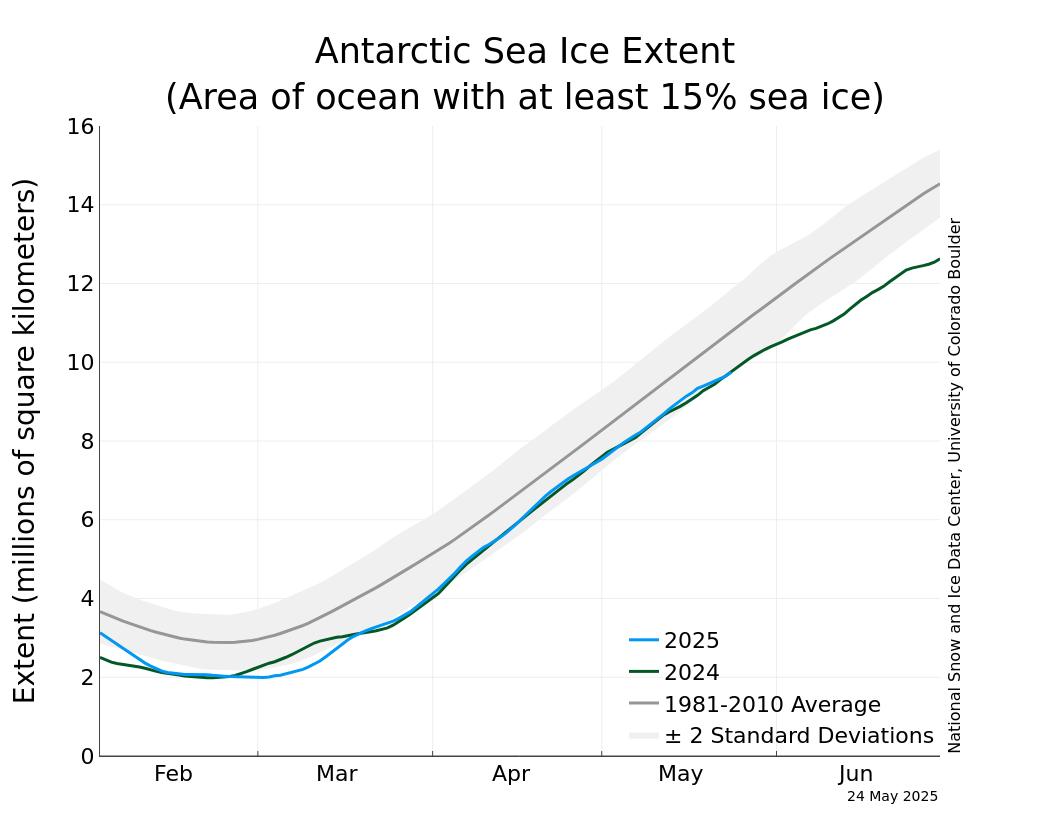

Conclusion: There is no polar meltdown at either pole.
Next week we start comparing PIOMASS forecasts vs. reality. PIOMASS claims that Arctic ice is the thinnest on record.

============================================
Don’t forget to bookmark WUWT’s new Sea Ice Page
Sponsored IT training links:
Subscribe for 350-030 training and get up to date 70-649 materials with 100% success guarantee plus get free demos for 220-701 exam.
Thanks phlogiston for setting R. Gates straight. R. Gates: you said “Indeed, the steep drop off in 2007′s summer sea ice extent may very well be one of those little chaotic landslides.”
I can’t claim knowledge of chaos theory, but please explain how rising CO2 caused the wind patterns seen in 2007 and how that relates to chaos theory.
stevengoddard says:
July 26, 2010 at 6:18 am
Bill the Frog
The difference in baseline is much too small to account for the differences between GISS and DMI.
A much simpler explanation is that GISS does not have any data points above 80N, and that they generate imaginary temperatures there.
———————————————————————
Mr Goddard (Steven), thank you for your speedy response to my query.
I, on the other hand, must now apologise for the delay in following this up. The problem was that I went out for a one hour run yesterday afternoon. Thirty-odd years ago, this had no material effect: these days, I fall asleep on the couch.
As you may remember, I had asked if the differing baseline periods used to calculate mean temperatures could (at least partially) explain how GISS show a positive anomaly in the Arctic, whilst the corresponding DMI figures show up negative.
The mean GISS global temperature anomaly over 1958-2009 works out at about +0.19C, and, as you rightly say, this figure is too small to have more than a second or third order effect on the observed discrepancy between GISS and DMI in the Arctic.
However, and I apologise again for not phrasing this better in my first post, I expected that the Arctic regional (or zonal, or latitudinal – whatever the correct term is) baselines might show a more pronounced variation than the 0.19C global figure.
As you know your way round the various datasets far better than most, I thought that you may have been able to shed some light on this. I attempted yesterday to download the 2 metre dataset from the DMI facility, but a warning popped up indicating that this represented a very large file. As my PC is on its last legs (it’s not the only one) I chickened out of proceeding.
I can certainly relate to your suggestion that the GISS/DMI discrepancy is an artefact of the approach that GISS adopt to “in-fill” grid areas that do not have primary data available. My (very limited) understanding is that this singular approach accounts for the majority of the differences between the GISStemp and HadCRUt anomalies.
You will not be surprised in the least to learn that, whenever I have attempted to explain the GISS “in-fill” technique to people, they have – without exception – thought that it sounded dubious.
I am quite happy to do number crunching myself, but would be obliged if you could point me in the correct direction by suggesting a source file that provides the necessary temperature information over as much of the 50+ year period as possible.
Finally, from a purely personal perspective, I wish you had avoided the use of the word “imaginary” in your response. I thought I had finally managed to get over all those nightmares that began with “Z = X + iY”.
Thanks … BTF
RE: Phil: (July 26, 2010 at 8:56 pm) “Theoretically it would make more sense to fit to log([CO2]/[CO2]o) where [CO2]o is the reference value, at the above 7200 ppm mark again theoretically the expectation is that the fit would be to sqrt([CO2]).”
I have looked at the results returned by the online MODTRAN line-by-line atmospheric radiation calculation tool for the default settings in clear tropical air over a very wide range of CO2 concentration levels for the surface temperature required to maintain an observed energy flow (Iout) of 292.993 W/m2 at 70 km altitude.
Ref:
http://geoflop.uchicago.edu/forecast/docs/Projects/modtran.html
To make the logarithmic results linear at very low CO2 concentrations I found it necessary to introduce a rather complicated, ad hock, Zero function of the form:
Z=1.2*CO2 + ((3.648 + 0.587*CO2^(2/3))/(1.0 + 0.106*CO2^(4/3))) – 2.648
This reduces to
Z=1.2*CO2 + 1 for very small CO2 concentrations and
Z=1.2*CO2 – 2.648 for very large CO2 concentrations.
Using the Microsoft Excel Solver utility I have found that my Modtran results for the surface temperature required to force a 292.993 W/m2 value for Iout appear to be predicted by the formula:
T=293.565 + 2.8192*Log10(Z) + 6.8673E-5*(log10(Z))^7 degrees K
with very high accuracy for CO2 concentrations up to 100,000 ppm. I have plotted the data and formula calculations on a nominal Log10(CO2 + 1) scale.
RE: Chaos Theory
A fair number of earlier posts on this thread have made reference to aspects of Chaos Theory. At the risk of sounding rude or patronising, I suspect that most people’s awareness of this topic is limited to a few throwaway lines spoken by Jeff Goldblum in the movie “Jurassic Park”. (WARNING! For those who enjoy working on their own automobile engines, on NO account should you attempt to fit a Sierpinski gasket.)
However, if any readers are remotely interested in learning about rudimentary Chaos Theory, then, for what it is worth, I would fully endorse the reading recommendation made above by Phlogiston.
Several years ago, when I was attempting to bone up on Chaos Theory, my original starting point was a text by James Gleik entitled “CHAOS: Making a New Science”. To say that I struggled with this tome is something of an understatement.
However, I already owned 5 or 6 books by John (and Mary) Gribben, so when I found out that he (they) had penned an introduction to Chaos Theory – “Deep Simplicity” – I wasted no time in purchasing this as well.
As with all their books, it was written in a clear and understandable (even for me)fashion. After reading Deep Simplicity twice, I found myself suitably equipped to successfully tackle the more formidable work by James Gleik.
P.S. If either of the Gribbens happen to read this, and find themselves requiring the services of a proof reader for their next offering…
P.P.S. Regarding the somewhat confusing authorship (John/John & Mary?) of Deep Simplicity, this is explained in the first paragraph of the Acknowledgements. It seems that the editor has a downer on co-authorship. One cannot help wonder if this issue would have arisen had the co-author been another male.
“However, I already owned 5 or 6 books by John (and Mary) Gribben, so when I found out that he (they) had penned an introduction to Chaos Theory – “Deep Simplicity” – I wasted no time in purchasing this as well.”
________
Most highly recommended!
RE: David Gould: (July 26, 2010 at 9:22 pm) “No-one is saying that the earth will be destroyed by global warming. So, no matter how bad it gets, the planet will survive. But many species will not survive. Humans will, because our technology and intelligence enable rapid adaption. But it is going to hurt; and in fact it already is hurting.”
There are those, I recall, who maintain that our current climate is balanced on the knife-edge of an irreversible chaos that would cause the oceans to boil and give this planet a Venus-like atmosphere. However, it appears that we have only made a six percent increase in the secondary effect that CO2 has on global temperatures. Clear-air dissolved water vapor, I believe, is the primary greenhouse gas that controls our atmosphere.
Most of the harm we have done to other animal species, I believe, is by directly interfering with their life-cycles or habitat. I doubt that anyone has documented any harm caused by anthropogenic climate modification.
Spector says:
July 26, 2010 at 8:48 pm
RE: R. Gates: (July 26, 2010 at 5:52 pm ) “Each grain of sand added is less as a percentage of the overall mass of the sandpile, yet at some point, one single grain of sand will cause a small landslide on the pile.”
I believe the primary argument against the incipient catastrophe theory is the long record of disastrous events that our planet has already survived. This includes a prolonged series of huge volcanic trap eruptions in Siberia that may have caused vast deposits of ocean-bottom methane to enter the atmosphere. Right now, our weather does appear to be operating well within the bounds of known recent history.
_____________
Hence the great unknown about the rapid increase in CO2. When each yearly addition of a “grain” or ppm of CO2, it will appear that all is well with the sandpile. There will be no warning that the pile is about to collapse. We’ve learned recently that the climate can change very abruptly, with very little warning. Of course, there doesn’t appear to be any real warning out there that such a rapid change in upon us now, and we could go on adding our little CO2 grains to the atmospheric sandpile for centuries without effect. But perhaps the steep downturn in the Arctic sea ice summer minimum over the past few years is a sign of a collapse…and I suspect we’ll know for certain within a few years. And even if we do see an ice free Arctic by 2020 or 2030…I would hesitate to use the word “catastrophe” for some species may benefit and some may not.
Eric (skeptic) says:
July 27, 2010 at 2:46 am
Thanks phlogiston for setting R. Gates straight. R. Gates: you said “Indeed, the steep drop off in 2007′s summer sea ice extent may very well be one of those little chaotic landslides.”
I can’t claim knowledge of chaos theory, but please explain how rising CO2 caused the wind patterns seen in 2007 and how that relates to chaos theory.
_______________
The wind patterns of 2007 were part of the Arctic Dipole Anomaly. This wind pattern, though not unheard of before 2000, was relatively rare, and hence the term “anomaly”. The DA has been increasing in frequency over the past 10 years, and was a in place in 2007’s great melt. The increasing frequency of the DA may be a characteristic of polar amplification of AGW as it seems to be at least somewhat related to more expanses of open water in the Arctic.
Repsonse phlogiston:
July 27, 2010 at 12:11 am
“For instance you earlier suggested that the concentration of CO2 in the atmosphere could be an attractor.”
______
Please show me where I made this suggestion. CO2 (in the atmosphere) is a forcing agent, not a region of phase space for the climate. The rapid addition of CO2 to the atmosphere creates a new set of conditons for the climate, or a new phase space, but it is not a region of phase space in itself. My whole point about CO2 (and the sandpile analogy, which is quite appropriate when discussing climate) is that it can be a forcing agent. Fortunately for humans, the climate has been in a state of relative equalibrium for much of human history, though there have been episodes where our species was probably near extinction as the climate oscillated toward an extreme. A sandpile is a system of sand grains, friction, gravity, etc., (assuming you’re building in a windless room). A sandpile, in a windless room with no vibrations etc, is a stable system in equalibrium, far from the edge of chaos. Start adding new grains of sand, and things change. It becomes a dynamic system, with new inputs– it’s phase space is changing. This is no different than the climate system, which is a system of oceans, clouds, sunlight, etc. All systems can be pushed to the edge of chaos, at which point they might, with the tiniest of shoves, change into a different mode. We saw this with our own climate system with the onset of the Younger Dryas period, when the North Atlantic thermohaline circulation shut down suddenly (in a decade or less!) and the climate that had been warming suddenly went back into a deep freeze. The climate was “pushed” to the edge of chaos, where suddenly jumped into an entirely new regime. This is exactly like the anaology of the sandpile collapsing with the addition of just one grain of sand.
I don’t claim to be an expert (far from) on Chaos theory, but I know enough to know my analogies are generally valid.
You also said:
“The sandpile you refer to is a poor analogy to CO2 added to the atmosphere – the sandpile tends to disequilibrium, the atmosphere does not.”
And
“How do you know that rate of CO2 change has been always slow?
The longer term theromstat on the climate and control of the equalibrium of the atmosphere seems to geological in nature as in the weathering of rock which controls the amount of carbon dioxide in the atmosphere. The weathering of rock generally proceeds very slowly, (millions of years) but during warm periods, the hydrological cycle speeds up, rock weathers faster, more carbon is taken out of the atmosphere, and the climate cools in response, hence acting a long term thermostat. The resent surge in CO2, up 40% in just a few hundred years, is unique in the past 400,000 years at least:
http://climate.nasa.gov/images/evidence_CO2.jpg
This fact is not in dispute, and I hold to my analogy that the rise in CO2 over the past few hundred years is not unlike the sudden addition of grains of sand to an otherwise stable sand pile. When a sand pile collapses, it is system seeking a new point of equalibrium.
Phil. said
July 25, 2010 at 2:35 pm
“Most of the yachts that have sailed through there make it through in Aug/Sept, I can’t see there’ll be any problem with that this year. For example the two Royal Marines set sail from Inuvik on July 24th last year. Apparently they’re going to rejoin their boat in Gjoa Havn on the 11th Aug to complete their journey”
Excellent news Phil! They had to stop their summer holiday last year to go back to fight in Afghanistan so it is really nice to see them completing it this year.
I know Steve G says it is cold up their, but they were wearing flip flops on their feet last year during their journey, so it can’t be that cold! Or perhaps it is just royal Marines for you 😉
Andy
Meanwhile down in the Antarctic
http://arctic.atmos.uiuc.edu/cryosphere/IMAGES/seaice.recent.antarctic.png
The increased ice gain due to the ozone hole and wind patterns in the Antarctic runs up against the buffers of the Southern Ocean winds as I said it would to Just the Facts about 2 months ago. Steve G’s claims of record global ice anomaly come September are now as shaky as his claims of Arctic melt ponds freezing up. Wishful thinking once again I am afraid.
Andy
From: R. Gates on July 26, 2010 at 6:03 pm
A mere extent graph? Where did all the talk go about the great significance of the volume of ice, how the volume is a better measure than mere extent? Has the terrifying PIOMAS Arctic Sea Ice Volume Anomaly chart fallen out of favor?
I think everyone should be clear as to what the DMI data is that Steve shows for regions north of 80N.
Here is what their website says:
The daily mean temperature of the Arctic area north of the 80th northern parallel is estimated from the average of the 00z and 12z analysis for all model grid points inside that area. The ERA40 reanalysis data set from ECMWF, has been applied to calculate daily mean temperatures for the period from 1958 to 2002, from 2002 to 2006 data from the global NWP model T511 is used and from 2006 to present the T799 model data are used.
The ERA40 reanalysis data, has been applied to calculation of daily climate values that are plotted along with the daily analysis values in all plots. The data used to determine climate values is the full ERA40 data set, from 1958 to 2002.
Thus, the DMI graph is based on modeled air temperatures, not actual data. What limited actual data exists is assimilated into the numerical model and then the model simulates what the temperatures are at other grid points. Note also that they use a different model for 2002-onwards. It is unclear what bias is imposed by a switch in the model.
It is unclear what bias is imposed by a switch in the model.
Julienne, might this switch be causing the below average summer temperatures (the green trend called ‘climate’) that seem to start somewhere around 2000-2002?
kadaka (KD Knoebel) says:
July 27, 2010 at 2:30 pm
From: R. Gates on July 26, 2010 at 6:03 pm
This is the only chart that matters when trying to look at the longer term climate trends in Arctic sea ice:
http://arctic.atmos.uiuc.edu/cryosphere/IMAGES/seaice.anomaly.arctic.png
A mere extent graph? Where did all the talk go about the great significance of the volume of ice, how the volume is a better measure than mere extent? Has the terrifying PIOMAS Arctic Sea Ice Volume Anomaly chart fallen out of favor?
___________
PIOMAS is a model, but the anomaly graph is data. I only brought up PIOMAS months ago when Steve was raging on and on about PIPS 2.0 MODEL. Both are models, and so can’t indicate real trends. The chart referenced above is a real data trend. The Arctic has not had a positive sea ice anomaly since 2004…that’s factual data, not model output.
Spector,
Even if we got to a Venus-like atmosphere (impossible, as far as I know, but hey …), the planet would still not be destroyed, so we need to be careful about what exactly we are claiming.
Things like the Siberian traps cause mass extinction events. With ecosystems already under stress from human activity outside AGW, any further stress may be significant. And I believe that we are already seeing that stress – for example, ocean acidification (or reducing baseness).
Günther,
I haven’t looked into detail what DMI is doing, but I do know that there is a bias in the ERA-40 time-series of air temperature as shown by responses to the Graverson paper published in Nature a couple of years ago.
In addition Grant et al. (2008) state:
However, the ERA-40 reanalysis may not be suitable for trend analysis as it incorporates information from different observing systems such as satellite and radiosonde, which might be inconsistent, in particular with respect to trends. Radiosonde measurements provide vertically resolved temperature profiles in the troposphere, whereas satellites provide information on a weighted average over a thick layer. Furthermore, the ERA-40 assimilation system extrapolates information from data-rich to data-sparse areas, which is less reliable than observations. The ERA-40 reanalysis in the polar region has not been sufficiently validated by in situ observations and documented problems with satellite radiance assimilations over the Arctic Ocean could lead to spurious trends.
Further reading of their paper shows that trends poleward of 75N suffer from unrealistic values compared to observations.
R. Gates says : … real data.
No. It’s a “PROXY” when it’s not what you want – – and Ice is 3-dimensional. Not 2.
The Mann Curve went Crazy because trees did not grow faster when it got warmer . . . it seems the Bristlecone Pine in the Rockies rarely see deer – – except when it is REALLY warm – – then they get higher than normal & eat the bark off. Instant Ice Age … by Proxy.
Piomas “Assimilates” – – that is what the AS in the name is, it means “adds” – – MEASUREMENTS of thickness.
Unfortunately there are not a lot of these, and mostly near the shore. So WHy do I like Piomas ?
a. It does have TRUE measurements.
b. It is VERIFIABLE beacause it agrees with ICESAT to 1% – – except once.
c. We KNOW what the Flaw is – – the Center relies on the “Model” part to fill the gaps, & in the 2007 melt:
Piomas = 7,300 km3
ICESAT = 6,000 km3
… so if Piomas says there is More Ice, it’s right – – Usual Ice = right – – LOW Ice – – right … but NOW ??
VERY LOW ICE = translated = It’s even WORSE than PIOMAS says.
Look at the Holes in the Center atrea: http://polar.ncep.noaa.gov/sst/ophi/color_anomaly_NPS_ophi0.png
But while Ice-loss will pick up, & PIPS predicts strong Ice-flow – – it is still rotating the “wrong” direction:
http://www7320.nrlssc.navy.mil/pips2/archive/retrievepic.html?filetype=Displacement&year=2010&month=7&day=28
Reason ?? those big Pacific Highs are still barely at the Alaska Coast – – likely a week away. Pressure Map: http://www.esrl.noaa.gov/psd/map/images/fnl/mslp_01.fnl.html
Topaz also shows holes http://topaz.nersc.no/topazVisual/matlab_static_image.php?action=NA_ARC_NWA_Function&file_prefix=ARC&match_date=20100727&depth=0005&variable_name=hice
Similar to 2007: http://www7320.nrlssc.navy.mil/pips2/archive/retrievepic.html?filetype=Thickness&year=2007&month=8&day=19
And then the Melt surged to meet the hole: http://www7320.nrlssc.navy.mil/pips2/archive/retrievepic.html?filetype=Thickness&year=2007&month=8&day=29
Comparing _______2007___ to___ 2010_______&________2009
Ahead June 28______ no________ 679,531 Sq. Km (km2)___no__
Ahead July 25____542,500_________no________________5,312
Ahead July 26____548,906_________no_________________no__
2010 again ahead of 2009 by__6,857 (80156 tomorrow)___________
Daily: ___________2007_________2010__
July25-26 ______ – 92,656 _____- 73,594
July26-27 ______ – 93,750 _____ ? ? ?
Next 5days @ur momisugly 55__then: __4@ur momisugly 107__4@ur momisugly 80__12 @ur momisugly 50__ 4@ur momisugly 33__ 5@ur momisugly 55__24 @ur momisugly 14.5 K (K= 1,000)
… As the JAXA revision was UP (if small) I predict a slight more melt tomorrow – – say, ahead of 2009 (80K) but behing 2007’s.
2010 passes 2009 for the 2nd time, but again, its a prelim value.
Lots of blabbing going on here like the last two years about bad news and possible death spirals and “long term trends” (which is based off of a 30 year graph). Its pretty clear that 2007 is long gone and probably 2008 too due to its massive late melt that is unlikely this year.
The numbers will be in only 6 weeks from now. So we’ll know. Pretty obvious at this point that the race is between 2009 and 2010 (and 2005 too).
JAXA has updated their July 27th (final) value and indeed 2010 has passed 2009 by 4844 km^2.
My current estimate for 2010 Arctic sea ice extent = 4.58E6 km^2 (standard deviation = 0.33E6 km^2).
On your Arctic Sea Ice page, what’s happened with the 2007/2010 side by side cryosphere comparison graphics? The current one is for 7/22.
R. Gates says:
July 27, 2010 at 11:50 am
Repsonse phlogiston:
July 27, 2010 at 12:11 am
Re-reading your earlier posting (July 5), you appeared at first sight to be suggesting that CO2 levels were themselves an attractor, but indeed your actual suggestion was that rising CO2 pushes the system across valleys or saddles in the phase space topography into new attractors. So I did misinterpret your suggestion.
R. Gates says:
July 5, 2010 at 8:06 am
The 30% or so increase in CO2 since the start of the industrial revolution, up to around 390 ppm now, after 10,000 years or more of being in the range of 270-280 ppm is no trivial change in this GH gas. The climate regime that existed under the 270-280 ppm was its own attractor, and despite changes in the sun, which certainly created periods of warmer or cooler climate (i.e. the Maunder minimum or MWP), the CO2 remained constant. Now that we’ve seen an such a relatively large increase in CO2 over such a short period, one would have to expect a chaotic climate system to seek a new attractor, and since CO2 continues to rise, there may be several attractors along the way to wherever the final leveling off point is for CO2.
However moving to the present discussion.
CO2 (in the atmosphere) is a forcing agent, not a region of phase space for the climate. The rapid addition of CO2 to the atmosphere creates a new set of conditons for the climate, or a new phase space, but it is not a region of phase space in itself. My whole point about CO2 (and the sandpile analogy, which is quite appropriate when discussing climate) is that it can be a forcing agent.
You propose that the magnitude and the rate of CO2 increase represent a forcing agent. But my point is that you are taking this argument “out of the air” and not backing it up with any evidence. There are well-studied physical and chemical systems exhibiting non-equilibrium pattern dynamics, such as the Belousov-Zhabotinsky reaction, and since these are lab chemistry experiments they can be well controlled with parameters understood sufficiently to model and simulate them. Of course our knowledge of climate parameters is far too sparse to allow such a level of analysis. However that does not mean we have to give up on any hope of meaningful analysis and confine ourselves to speculative arm-waving about attractors and phase space topography. Instead you can find a well understood physical system exhibiting nonequilibrium pattern behaviour, and draw a credible analysis between such a system and the climate analogy that you are making.
Can you find a nonequilibrium pattern system in which addition of a gas, progressively increasing its concentration causes a tipping point and transition to a new attractor? The only published system I can think of where gas concentrations are involved is the platinum-catalysed oxidation of CO (the reaction that happens in your car’s catalytic convertor). This was one of the main parts of Matthias Bertram’s thesis (linked in the above post) and some subsequent published papers. Here changing the gas concentrations resulted in an increase in feedback in the system. Well fine – so perhaps here we have a CO2 analogy – CO2 is supposed to cause positive heat forcing feedback via atmospheric water and clouds. So maybe rising CO2 concentrations are an analogy of this system. But the problem is that the result that you get in this system is the opposite of what you are arguing – the increasing feedback, far from promoting non-equilibrium pattern behaviour, instead kills it off; the increasing gas-forced feedback changes the system from exhibiting complex emergent non-equilibrium patterns to simple monotonous periodic behaviour. Nonequilibrium pattern changes are not promoted – they are suppressed.
A sandpile, in a windless room with no vibrations etc, is a stable system in equalibrium, far from the edge of chaos. Start adding new grains of sand, and things change. It becomes a dynamic system, with new inputs– it’s phase space is changing. This is no different than the climate system, which is a system of oceans, clouds, sunlight, etc. All systems can be pushed to the edge of chaos, at which point they might, with the tiniest of shoves, change into a different mode.
So you do appreciate that a system must be driven to the edge of equilibrium for nonlinear emergent pattern to appear. However the analogy with climate contains a flaw – your sandpile analogy assumes a system at equilibrium that is driven by CO2 addition towards and eventually over the edge of equilibrium. But the climate is never at equilibrium. That is why we have winds, clouds and weather – heat is constantly trying to equilibriate between heating equator and cold poles and never getting anywhere close. (I would hate to live in a stagnant world at equilibrium with no winds and dead anoxic seas!) This has always been happening through earth’s history regardless of CO2 concentrations over a wide range (I’ll return to this point).
I suggest you need to find a different analogy to the sand grains, one in which addition of gas to a continually nonequilibrium quasi-chaotic system changes for instance a feedback parameter. However one such studied system, the Pt-catalysed CO oxidation, gives the opposite result – suppression, not promotion, of nonlinear pattern and attractor behaviour.
I don’t claim to be an expert (far from) on Chaos theory, but I know enough to know my analogies are generally valid.
I’m not either, but from what I understand your analogy is inappropriate and a new one should be found.
The resent surge in CO2, up 40% in just a few hundred years, is unique in the past 400,000 years at least:
Your central point that the rate of increase of CO2 from 280 to 370 ppm in a half century or so is likely to force instability. But you give no evidence for this. Your emphasis on rate is probably due to the very obvious problem for AGW of very much higher CO2 concentrations in earth’s history – looking much further back than 400 k years to the Cambrian and before – with no associated runaway warming and catastrophe. Concentrations of 5000 ppm and higher were never associated with any evidence of forcing over any system thresholds and transition to quasi-chaotic behaviour. The system has always been quasi-chaotic with CO2 exerting little if any discernible effect on this. If you look at the published palaeoclimate record of temperature and CO2, on the scale of a billion years they both decline, but looking at scales of tens of million years there is no correlation, sometimes CO2 and temperatures move in sharply opposite directions. Note the global ice ages in the preCambrian and end-Ordovician with CO2 levels of 2000-5000 ppm. If CO2 was supposed to be directly forcing and controlling temperature, a much more intimate correlation would be required.
Another important category of forcing in nonequilibrium pattern systems is periodic forcing of oscillatory systems. OK CO2 does oscillate if you look at the Mauna Loa record, but this trivial annual fluctuation is unlikely to be a player. An oscillatory and periodically forced nonequilibrium pattern system – such as the Belousov-Zhabotinsky reaction, is in fact a more credible climate analogy. Bertram uses the term “reactive medium” as a condition for nonlinear pattern in a periodically forced system. Annual CO2 variation is probably too fast (and far too small an effect) for the climate to be able to meaningfully react. The Milankovich cycles of tens of thousands of years or 100 k years may be too slow (except possibly for ocean cycles). However more likely candidates for periodic forcers of climate are the various solar variations. The 11 year sunspot cycle might be a possible periodic forcing. The 87 year Gleissberg cycle and the 210 year Suess cycles are also likely to have climate traction – and an interference product of the 87 and 210 year cycles is the 1470 year “Bond event” cycle. Such cycles have the potential to be periodic forcers of climate. And experimental systems such as the BZ reaction provide a credible analogy.
phlogiston says:
July 28, 2010 at 10:07 pm
Can you find a nonequilibrium pattern system in which addition of a gas, progressively increasing its concentration causes a tipping point and transition to a new attractor?
Yes, the thermokinetic oscillating reactions often known as ‘cool flames’. In the case of the atmosphere the effect of CO2 occurs via modification of the heat transfer. In the case of cool flames a very small change in the the heat transfer causes a bifurcation to a new ‘attractor’. For example the system could be at a stable node with a small temperature excess of about 10ºC at an reactor temperature of ~300ºC, an increase of reactor temperature of ~0.1ºC you’d get a jump to a limit cycle oscillation with an amplitude of a couple of hundred degrees.
Phil. says:
July 29, 2010 at 6:43 am
Now that’s the spirit!
Interesting – I wasn’t aware of the “cool flame” nonlinear model system (acetaldehyde oxidation in a continuously stirred tank reactor). From a which internet search I get the impression it is a system of rapid flux and relatively unstable, such that “in the immediate region of this bifurcation the system shows “indecision” or interspersed flames of each type for a short period” – so kind of hopping from one attractor to another quite readily. Also “in the regions of oscillatory cool flames the steady state is unstable”, although steady states appear possible by adjusting vessel residence times. These are quotes from the following paper:
http://www.sciencedirect.com/science?_ob=ArticleURL&_udi=B6V2B-497YTR1-6H&_user=6224571&_coverDate=07/31/1984&_rdoc=1&_fmt=high&_orig=search&_sort=d&_docanchor=&view=c&_searchStrId=1416242803&_rerunOrigin=google&_acct=C000050221&_version=1&_urlVersion=0&_userid=6224571&md5=0e6daf463d89b814c9087928912efdc0
This would be more analogous to atmospheric dynamics if the residence time of air was very short – i.e. the atmosphere was constantly outgassing from the earth and being lost by diffusion out into space. But I think it is a stretch to argue that the radiative heat balances in the atmosphere linked to CO2 content, which show slow changes and equilibrium like properties, can be modeled by such a dynamic and unstable system as the “cool flame”.
The argument against AGW essentially is that while CO2 may change radiative balance by an Arrhenius type effect (depending on a subtle balance of IR and CO2 radiation, absorption and whether or not saturation occurs, or if the effect is linear or logarithmic), the effect of clouds and the hydrological cycle is (a) much more significant and of larger magnitude than the CO2 effect, and (b) exerts a negative feedback on small CO2 driven changes. If clouds and the hydrological cycle are a feedback to CO2 forcing, then the system cannot be modelled as if it was being driven by one forcing agent alone.
One factor that one has to work against in trying to push a system to a new attractor is the nonlinear phenomenon – or law – of Lyapunov stability, an interesting kind of emergent equilibrium from nonequilibrium, which states that in a nonlinear pattern system where an attractor is established, the attractor will remain stable to perturbations of the system and changes to the forcing.
http://en.wikipedia.org/wiki/Lyapunov_stability
A published example of Lyapunov stability can be found here:
http://www.sciencedirect.com/science?_ob=ArticleURL&_udi=B6TJ2-47TWRJN-1&_user=6224571&_coverDate=06/30/2004&_rdoc=1&_fmt=high&_orig=search&_sort=d&_docanchor=&view=c&_searchStrId=1416218771&_rerunOrigin=google&_acct=C000050221&_version=1&_urlVersion=0&_userid=6224571&md5=1a9dee2358b569d03b4f819722ac8345
You are however correct that nonlinear pattern systems can transition between attractors due to changed parameters. Indeed some such systems have two or more attractors and periodically jump between them. A reference about a bistable system is:
http://www.citeulike.org/article/7508611
This author describes something called a “boundary crisis” or “basin crisis” at which the attractor set is changed. I guess what you are alluding to is something like this. BTW the current epoch of alternation between glacial and interglacial states in the earth’s climate seems very likely to be a bistable twin-attractor nonlinear pattern system. It is possible that the climate system might have a hierarchy of fractal like attractors (this is pure speculation) – the major two are glacial and interglacial, but within an interglacial temperature jumps between smaller scale closer attractors. Looking at the global troposphere or SST temperature curve, there is the appearance of jumping at discreet times between different levels. Bob Tisdale shows that a single ENSO cycle can push the global temperature up or down to a different “micro-regime”. These could be attractors of a sort. But – again – we need to find a more adequate model analogy – hard to find for something as complex and multifactorial as our climate.
R Gates …… Now that it is late July, as you state at the end of your comment from July 5 can we have your ‘final forecast’ please ?
R. Gates says:
July 5, 2010 at 7:26 am
Curious Yellow says:
July 5, 2010 at 6:37 am
The average melt for July over 2003-2009 rounded to nearest thousand was 92000 KM2 p/d. For August this was 53000 KM2. (No full month for September, so not calculated)
The average melt for the 2 months July+August was 66,000 KM2.
Using just the averages and adding an adjustment for for September, I anticipate the minimum extent for 2010 to be be 4.34 million KM2. Even though 2006 and 2007 were unusual years, my bet is on just the simple averages, not anticipating another unusual year
________________
Very logical, and probably a decent estimate. I’m currently sticking with my 4.5 million sq. km, that I’ve been putting out since March, but will make a final forecast later in July when I see how the Arctic Dipole Anomaly is behaving.