By Steve Goddard
The Arctic is proud to have been listed as one of many “fastest warming places on earth.”
The GISS 250km Arctic image below shows temperature trends from 1880-2009. Areas in black represent regions with no data.

In most fields of science, data is considered an essential element of historical analysis. But climate science gets a pass, because it involves “saving the planet.” Antarctic coverage is equally as impressive. The image below looks right through the earth to the Arctic hole.

Temperatures in the high Arctic have been running well below normal and have started their annual decline. There are only about 30 days left of possible melt above 80N.

http://ocean.dmi.dk/arctic/meant80n.uk.php
This can be seen in North Pole webcams which show the ice frozen solid.

http://psc.apl.washington.edu/northpole/webphotos/noaa2.jpg

As forecast in last week’s sea ice news, ice loss accelerated during the past week over the East Siberian Sea due to above normal temperatures.

http://ocean.dmi.dk/arctic/icecover.uk.php
The modified NSIDC map below shows (in red) regions of the Arctic that have lost ice over the past week.

The modified NSIDC map below shows (in red) ice loss since early April.

The modified NSIDC map below shows (in red) ice loss since July 1. The Beaufort Sea has actually gained ice (green.) Looks like a Northwest Passage traverse is quite possible (by helicopter.)

Ice loss from July 1 through July 23 has been the slowest on record in the JAXA database. Ice loss during July has been about one half that of 2007.

The graph below shows the difference between 2010 and 2007 melt. 2010 started the month half a million km² behind 2007, and is now half a million km² ahead of 2007.

The modified NSIDC image below shows the difference between 2007 ice and 2010 ice. Green indicates more ice in 2010, red indicates less.

“Climate expert” Joe Romm reported in May
Arctic sea ice shrinks faster than 2007, NSIDC director Serreze says, “I think it’s quite possible” we could “break another record this year.” Watts and Goddard seem in denial
Average ice thickness continues to follow a track below 2006 and above 2009, hinting that my prediction of a 5.5 million km² minimum continues to be correct.

During July, ice movement has been quite different from 2007 – which had strong winds compressing the ice towards the pole. By contrast, July 2010 has seen winds generally pushing away from the pole. Thus the ice edge on the Pacific side is further from the pole. No rocket science there, and a pretty strong indication that the alleged 2007 record summer melt was primarily due to wind.
Cryosphere Today showed two days ago that Arctic Basin ice is nearly identical to 20 years ago, but unfortunately their web site is down and I can’t generate any images.
NCEP forecasts warm temperatures in the East Siberian, Chukchi and Beaufort Seas for the next week, so I expect that melt will continue around the edges of the Arctic Basin.
Meanwhile, Antarctic ice continues well above normal. Antarctica is also the fastest warming place on the planet.
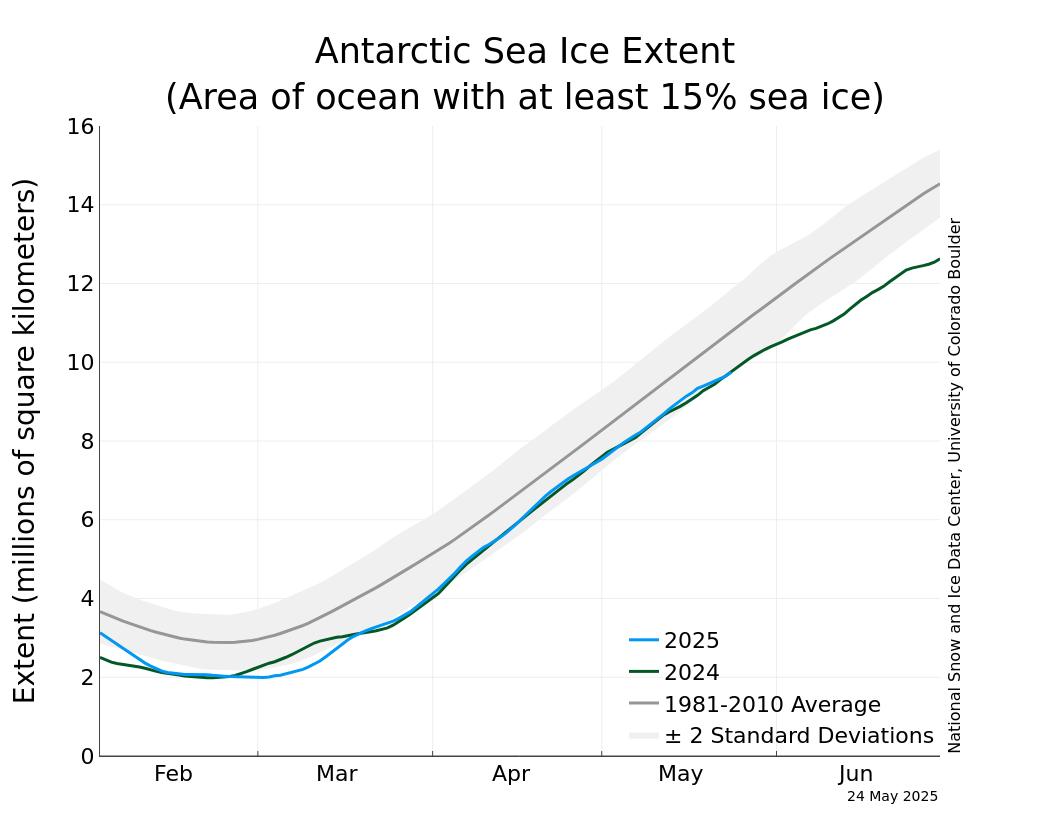

Conclusion: There is no polar meltdown at either pole.
Next week we start comparing PIOMASS forecasts vs. reality. PIOMASS claims that Arctic ice is the thinnest on record.

============================================
Don’t forget to bookmark WUWT’s new Sea Ice Page
Sponsored IT training links:
Subscribe for 350-030 training and get up to date 70-649 materials with 100% success guarantee plus get free demos for 220-701 exam.
EFS_Junior says:
July 26, 2010 at 12:54 pm
Roger Knights says:
July 26, 2010 at 12:09 pm
EFS_Junior says:
July 26, 2010 at 8:57 am
Oops, it looks like JAXA changed their minds, like they always do 1-2 times per day, and 2010 has not crossed 2009 YET.
JAXA uses a five-day moving average, so each daily figure will be adjusted four times (I think).
____________________________________________________________
I don’t doubt that AFAIK, as that is what their website states, if I’m not mistaken.
However, over these past few months, the final previous day’s estimate has always occured (posted) before the next day’s estimate has been posted (In the CDT timezone shortly after 10:00PM).
So far 2010 has chosen it’s own path, irrespective of previous year’s paths, my expectation, is that it will continue to chose it’s own path (although, if 2010 crosses 2005, 2008, and 2009, then my expectation would be for a greater Arctic sea ice extent than my current expectation, statistically speaking, of course).
The satellite makes two passes a day the final value for the day is posted midmorning EDT.
You’ve a very subtle jump there, the ‘speed of the hand deceives the eye’, you’d need to know that the [CO2], solar irradiance, Earth’s albedo and distribution of the continents and oceans have been the same before without ill effects, not just one of the parameters. If you did show that and at that time there were no polar icecaps would you be so sanguine?
___________
True enough Phil, we don’t know if the Earth has ever been in the current state before, or if some catastrophic bifurcation will happen when CO2 hits 400ppm. But given all we know about CO2 – it’s an extremely weak parameter at best – swamped by the effect of water vapour and its various feedback mechanisms. If the Sun increased its output by 50% in 100 years, I would be worried. But CO2? Nah! I’m far more worried about paying my mortgage.
Cryosphere’s comparo tool and archives seem to be broken links today. Could be a technical issue, I suppose. . .but I’m wondering if they don’t appreciate having those as part of the Sea Ice page here, and hosted elsewhere (to create the comparo image, presumably).
Joe Bastardi conecting the dots and WUWT.
http://www.accuweather.com/video.asp?channel=vblog_bastardi
Some of this “phase-time-space-chaos-dimension” speak needs a bit of musical background.
To wit: “When the moon is in the 7th house, and jupiter aligns with Mars…”
With that music going on in your head read on: Some of the posts above reminds me of this dead serious quote from a blogger on another website who reads all kinds of things into that song.
“When the Moon is in the seventh house and Jupiter aligns with Mars, the famous song from the musical ‘Hair’ asks us to believe we will witness the dawning of a new age – the Age of Aquarius. The composers of this song obviously didn’t mean us to take their lyrics too literally however because, as all astrologers know, Jupiter and Mars align so frequently, and the Moon travels through the 7th house once every day, that we would have been through innumerable ‘dawning’s’ since the 1960’s if we were to follow them to the letter.
When, however, we look for the times when Jupiter aligns with Mars in the sign of Aquarius, it becomes an entirely different matter, especially if we are also looking for the Moon to be in the sign of Libra which holds sway over the seventh house, at the same time. Furthermore if we were to be entering a New Age we would hope for some additional, unmistakable cosmic pointers.”
I think I’m getting the hang of this. If I don’t mind the forest, I can pay attention to the trees. Or is it, if I don’t mind the trees, I can pay attention to the forest. Or something like that.
All this is to let R. Gates know:
Ya lost me.
R. Gates says:
July 26, 2010 at 11:45 am
but it is interesting to note that we are seeing an increase in the overall species extinction rates around the globe, but beyond that basic fact, I’ve not studied it too much. It may be more related to loss of habitat from other human activities rather than specific to AGW.
===========================================================
The truth is, for the most part, no we’re not.
People that say this as fact are lying.
When you “discover” more obscure species, when you divide and re-classify species, and when you name discovered species as new species that shouldn’t be…
Gates, it has more to do with how the numbers are giggled and of course money.
Take giraffes. A few years ago all giraffes were considered one species.
As one species they were in no danger, no real threats of any kind.
Recently giraffes have been divided into at least 7 different species.
Because of that re-classification, now all giraffes are considered endangered,
and of course the people that study them are now eligible for more money.
Some birds are a huge problem. If an population of a certain species of bird develops a few more white feathers, is it a new species because of selective breeding?
I say no, but people that study that population had better say yes, say it’s endangered, or they are broke.
An example of the other extreme would be orangutans. Cutting down their forests to grow palms for palm oil.
Rhinos, and gorillas.
That’s not to say that some things do not make bad evolutionary choices.
That’s part of it too.
But no, we are not really seeing an increase in the overall species extinction rates around the globe, at least not the way it’s played up.
R. Gates says:
July 26, 2010 at 7:29 am
Gates, is that terrible anxiety about CO2 is overwhelming you often? I hope not.
But when it does, there is a trick that may help!
Just think of Smokeys list here;
http://c3headlines.typepad.com/.a/6a010536b58035970c0120a5e507c9970c-pi
hehe.
RE: R. Gates: (July 26, 2010 at 7:29 am) “What we currently don’t know (and is the essential issue of AGW) is how sensitive the climate truly is to a 40% increase (and rising) of CO2 over a geologically short time period.”
I think this all depends on how we measure numbers. According to the MODTRAN online absorption calculator results, the raw effect of CO2 on increasing the surface temperature of the Earth is proportional to the log base ten of one plus the CO2 concentration in ppm (Log10(1+CO2)) over a range from about 0.3 (1 ppm) to about 3.9 (7,944 ppm) within one degree C.
On this basis, we are only talking about of about 5.9 percent logarithmic CO2effect increase: ((log10(391)/log10(281))-1)*100%.
The raw (no feedback effects or compensation) logarithmic scale factor indicated by the MODTRAN tool appears to be about 2.8 degrees C per factor of *ten* increase in the CO2 concentration in the atmosphere.
Note: Above about 7200 ppm a new unexplained factor proportional to the seventh power of the log of the CO2 concentration gradually appears to become significant. (Log10(1+CO2))^7
Steve – your list of “North Pole” temperature data appears to be from the JAMSTEC Buoy which is now at 86.405N and 2.791E. The “North Pole” readings that would accompany your web photograph are from the IABP PAWS Buoy at 87.832N and 6.381W. While data for the 26th of July is not available as of this writing, the temperature at the PAWS site has been, on average, above the sea water freezing point for the last week. These temperatures allow the possibility of both open water and hard frozen ice.
Phil. says:
The satellite makes two passes a day the final value for the day is posted midmorning EDT.
____________________________________________________________
Aqua (MODIS imagery fame) carries the AMSE-R sensor;
http://en.wikipedia.org/wiki/Aqua_(satellite)
Orbital period is ~98 minutes, it takes several passes to complete an Arctic map-of-the-day, as it were.
Thus, for their 2-day average, I have to assume a centered average, with some data from the previous day, some data from the current day, and some data from the next day (tomorrow for us, today for them).
The date on the map must be JST time and includes data for tomorrow (their time versus our time here in the USA, as Japan is ahead of us by 15 hours (CDT)).
Also, I’ve seen changes in the JAXA data in the PM (my time CDT), I don’t know that I’ve ever seen in changes after the late afternoon (my time CDT).
Anyway, I think the latest JAXA value is by now locked for today (my time CDT) and 2010 has not crossed 2009 YET.
Ah, these sea ice posts continue to be entertaining.
They accuse Steve of deception, of cherry picking locations and times, of passing off weather as climate…
Then they point to a possible short 3 to 4 year stretch of the Northwest Passage being something like open for about a week or so a year as if it had some great significance indicating something important relevant to long-term climate trends!
LMAO!
GeoFlynx
The surface of the ice is freshwater. The melting point is 0C.
kadaka
I would be much more credible in their eyes if I forecast an ice free Arctic in 2008, or 2013 – like the experts did.
Spector says:
July 26, 2010 at 2:49 pm
RE: R. Gates: (July 26, 2010 at 7:29 am) “What we currently don’t know (and is the essential issue of AGW) is how sensitive the climate truly is to a 40% increase (and rising) of CO2 over a geologically short time period.”
I think this all depends on how we measure numbers. According to the MODTRAN online absorption calculator results, the raw effect of CO2 on increasing the surface temperature of the Earth is proportional to the log base ten of one plus the CO2 concentration in ppm (Log10(1+CO2)) over a range from about 0.3 (1 ppm) to about 3.9 (7,944 ppm) within one degree C.
On this basis, we are only talking about of about 5.9 percent logarithmic CO2effect increase: ((log10(391)/log10(281))-1)*100%.
The raw (no feedback effects or compensation) logarithmic scale factor indicated by the MODTRAN tool appears to be about 2.8 degrees C per factor of *ten* increase in the CO2 concentration in the atmosphere.
Note: Above about 7200 ppm a new unexplained factor proportional to the seventh power of the log of the CO2 concentration gradually appears to become significant. (Log10(1+CO2))^7
____________
The additional ppm each year of CO2 that is being added is indeed logarithmic in scale, but this doesn’t stop the cumulative effect, nor the possibility of a tipping point. The simple sandpile example can be used here where single grains of sand are added one at a time to a pile. Each grain of sand added is less as a percentage of the overall mass of the sandpile, yet at some point, one single grain of sand will cause a small landslide on the pile. This point is unpredictable but deterministic, and therefore the toppling of the sandpile is chaotic by nature, witht the frequency of landslides on the pile matching any 1 over F noise log-log spectrum (http://www.scholarpedia.org/article/1/f_noise)
This kind of 1 over f noise chaotic behavior is seen throughout nature, from earthquakes to the formation of clouds. It would not be surprizing if the additional CO2 being added at a relatively (geologically speaking) rapid rate will follow with its own “landslide” tipping points as the “grains” of CO2 continue to be added to the sandpile of the atmosphere. Indeed, the steep drop off in 2007’s summer sea ice extent may very well be one of those little chaotic landslides.
stevengoddard says:
July 26, 2010 at 3:41 pm
GeoFlynx
The surface of the ice is freshwater. The melting point is 0C.
GeoFlynx – Yes, that is true, but “open water” is sea water and that freezes at ~ minus 1.8C, allowing both open water and hard frozen ice in the same location. The temperatures you gave (list form) are not from where the ice photo was taken and incorrectly indicate somewhat cooler temperatures.
kadaka (KD Knoebel) says:
July 26, 2010 at 3:38 pm
Ah, these sea ice posts continue to be entertaining.
They accuse Steve of deception, of cherry picking locations and times, of passing off weather as climate…
Then they point to a possible short 3 to 4 year stretch of the Northwest Passage being something like open for about a week or so a year as if it had some great significance indicating something important relevant to long-term climate trends!
LMAO!
________________
This is the only chart that matters when trying to look at the longer term climate trends in Arctic sea ice:
http://arctic.atmos.uiuc.edu/cryosphere/IMAGES/seaice.anomaly.arctic.png
Everything else is truly just weather, but entertaining none the less. We’ve not had a positive Arctic Sea ice extent anomaly since 2004. This is far more important a fact in climate discussion related to Arctic Sea ice then whether or not a few melt ponds are freezing over or when Pt. Barrow is free of shore fast ice. Steve gives an excellent analysis of short term fluctuations (i.e. weather).
Of those that attempted the NW passage last year, as a percentage…
1) How many succeeded?
2) Of those that succeeded, how many followed in the wake of an icebreaker?
DaveE.
Here’s what the JAXA site says that (mis?)led me into thinking it used a five-day moving average. Apparently they were obliquely alluding to the way that OTHER organizations operate:
RE: R. Gates: (July 26, 2010 at 5:52 pm ) “Each grain of sand added is less as a percentage of the overall mass of the sandpile, yet at some point, one single grain of sand will cause a small landslide on the pile.”
I believe the primary argument against the incipient catastrophe theory is the long record of disastrous events that our planet has already survived. This includes a prolonged series of huge volcanic trap eruptions in Siberia that may have caused vast deposits of ocean-bottom methane to enter the atmosphere. Right now, our weather does appear to be operating well within the bounds of known recent history.
R. Gates says:
July 26, 2010 at 5:52 pm
Spector says:
July 26, 2010 at 2:49 pm
RE: R. Gates: (July 26, 2010 at 7:29 am) “What we currently don’t know (and is the essential issue of AGW) is how sensitive the climate truly is to a 40% increase (and rising) of CO2 over a geologically short time period.”
I think this all depends on how we measure numbers. According to the MODTRAN online absorption calculator results, the raw effect of CO2 on increasing the surface temperature of the Earth is proportional to the log base ten of one plus the CO2 concentration in ppm (Log10(1+CO2)) over a range from about 0.3 (1 ppm) to about 3.9 (7,944 ppm) within one degree C.
On this basis, we are only talking about of about 5.9 percent logarithmic CO2effect increase: ((log10(391)/log10(281))-1)*100%.
The raw (no feedback effects or compensation) logarithmic scale factor indicated by the MODTRAN tool appears to be about 2.8 degrees C per factor of *ten* increase in the CO2 concentration in the atmosphere.
Note: Above about 7200 ppm a new unexplained factor proportional to the seventh power of the log of the CO2 concentration gradually appears to become significant. (Log10(1+CO2))^7
Theoretically it would make more sense to fit to log([CO2]/[CO2]o) where [CO2]o is the reference value, at the above 7200 ppm mark again theoretically the expectation is that the fit would be to sqrt([CO2]).
David A. Evans says:
July 26, 2010 at 6:40 pm
Of those that attempted the NW passage last year, as a percentage…
1) How many succeeded?
That I know of 80+% , the only one I know that didn’t make it was the 13′ open boat that the two Royal Marines were in which was sail and oar powered, they got to Gjoa Havn and the way ahead was clear but they’d lost too much time having to row into headwinds etc., they’re going to restart next month. It’s a good cause they’re raising money for a fund to support wounded servicemen (Toe in the Water). There was another yacht (German?) that was expected to make an attempt but didn’t seem to get started.
2) Of those that succeeded, how many followed in the wake of an icebreaker?
None
Spector,
There is a difference between ‘the planet has already survived’ and ‘species X survived’.
No-one is saying that the earth will be destroyed by global warming. So, no matter how bad it gets, the planet will survive. But many species will not survive. Humans will, because our technology and intelligence enable rapid adaption. But it is going to hurt; and in fact it already is hurting.
There is a great movie of the “melt water pond” from the North Pole camera at this site. Note the ripples in the wind and what may be more open water in the distance. Whatever your perspective this is an amazing animation.
http://www.arctic.noaa.gov/np2010/cam2-2010.mov
The movie plays with QuickTime.
People can blog and talk and rant all they want, but it isn’t going to make the ice melt.
R. Gates says:
July 26, 2010 at 11:45 am
dr chaos says:
July 26, 2010 at 11:04 am
@R Gates
I would argue that from a geological perspective, it has been anything but a “gentle ramping” in CO2. The 40% rise in the past few hundred years is virtually instant from a historical geological perspective…a sharp spike upward as it were. This “spike” is yet another dimension in the phase space of the climate system…in other words, raise CO2 from 280 to 390 ppm over 2 million years and you get one set of attractors, but raise it virtually instantly, and you get an entirely different set or topograph of phase space.
The religious fervour of your apparent conversion to chaos and non-linearity are striking and at first sight might be welcomed: unfortunately you are talking pure 100% bullshit. You give no evidence in any of your postings of having the slightest idea what conditions are required for non-linear spontaneous pattern formation and confuse this with turbulent chaos which is unrelated. Chaos theory (lets stay with this convenient abbreviation) is not just a naming convention. It is not enough just to rename any measured parameter as an “attractor” and any scenario as a “phase space”. You sometimes toss in the word “bifurcation” to add to the impression that you understand this field. But it is only a trick aimed at giving the impression you understand what you clearly do not.
For instance you earlier suggested that the concentration of CO2 in the atmosphere could be an attractor. This is impossible, and makes it clear that you are just using these words without any understanding. Having recommended others to read up on the subject, a good starting point for you might be “Deep Simplicity” by John Gribben, Random House, NY. The starting point of bifurcations leading to nonlinear spontaneous pattern formation is a far from equilibrium state. How can the composition of the atmosphere be far from equilibrium? There are multiple sources of CO2 all over the globe, and CO2 is removed from the atmosphere over the whole earth surface. Mixing is thorough due to winds. It is a classic near equilibrium situation. No scenario could be less probably for nonlinear pattern dynamics. As I tried to explain to you earlier, climate energy disequilibrium causes atmosphere composition equilibrium. The sandpile you refer to is a poor analogy to CO2 added to the atmosphere – the sandpile tends to disequilibrium, the atmosphere does not.
You focus on the rate of CO2 addition and claim completely with no evidence that this creates a different “phase space”. Just using the words to sound chaos-macho, the words dont mean a thing. To make a serious proposition you need to draw analogies in other systems exhibiting nonlinear pattern and with credible similarities with what you are suggesting. How do you know that rate of CO2 change has been always slow? Are you just wriggling out of the inconvenient fact of CO2 historic concentrations up to 5000 ppm with no climate catastrophe, with your trademark sidestepping to try to argue that rate of change is more important than the absolute concentration. Again with no evidence.
Another reference to get you started on nonlinear pattern formation is a very helpful PhD thesis:
http://docs.google.com/fileview?id=0B9p_cojT-pflY2Y2MmZmMWQtOWQ0Mi00MzJkLTkyYmQtMWQ5Y2ExOTQ3ZDdm&hl=nl
If your forthcoming thesis is as good as this it would be an achievement. Study the subject before filling up blog space with empty use of chaos jargon and stop wasting everyone’s time.