By Steve Goddard
July 4, 2010. Celebrating independence from traditional sources of polar ice news.
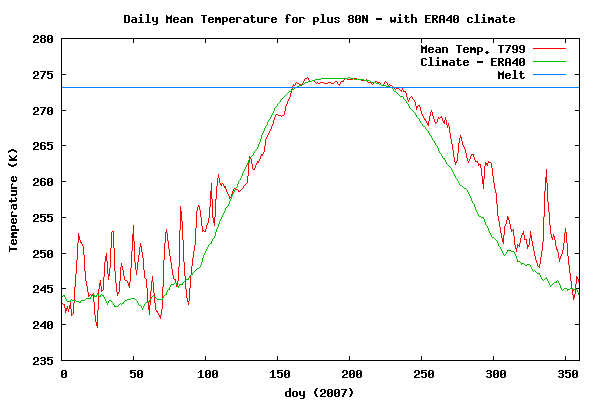
Last week we discussed the importance of wind in determining the summer minimum. In 2007, the winds blew consistently from the south and compacted the ice towards the North Pole. This led to a tremendous amount of news coverage claiming that the Arctic was heating and melting. In fact – the spring and summer of 2007 was slightly cooler than normal for about half of the melt period north of 80°N, according to DMI (below)

http://ocean.dmi.dk/arctic/plots/meanTarchive/meanT_2007.png
Around mid-June of this year, the winds in the Arctic set up in a similar pattern – spiraling inwards and pulling the ice away from the coast. This led to an early decline in ice extent inside the Arctic Basin.

Towards the end of June, this pattern reversed and now the winds are circulating counter clockwise – pushing the ice towards the coasts. As a result, there has been very little change in extent inside the Arctic Basin over the last week.

You can see the changes in extent in the modified NSIDC map below. Areas marked in red show extent loss since June 27, and green shows extent gain.

Most of the ice loss over the last week has been in the Hudson Bay, which nearly melted out a few days ago. As a result of the Hudson Bay being depleted of ice and the changes in wind, we have seen the JAXA and DMI graphs take a break in slope.

http://ocean.dmi.dk/arctic/icecover.uk.php

http://www.ijis.iarc.uaf.edu/seaice/extent/AMSRE_Sea_Ice_Extent.png

Since July 1, there has been almost no ice loss in the Arctic Basin, as seen in the modified NSIDC image below.

The video below shows the wind and ice patterns over the last two weeks, culminating in a strong counterclockwise flow.
The modified NSIDC image below show differences between 2010 and 2007. NSIDC still shows 2007 ahead of 2010, but the differences are mainly in the Hudson Bay and other areas that normally have little or no ice in September. In the Arctic interior 2010 has more ice (green.)

Last week I made the forecast below for the remainder of the summer.
The image below shows current JAXA in pink vs. my forecast. So far, the forecast is right on track.

Temperatures north of 80N have been running slightly below normal for several weeks. The summer melt season is nearly half over. There are less than 60 days remaining of possible melt in the high Arctic.

http://ocean.dmi.dk/arctic/meant80n.uk.php
Temperatures in Barrow have also been running below normal. It appears quite possible that the landfast ice breakup date at Point Barrow will beat the record for the latest ever (July 10.)
Meanwhile down south, as Anthony pointed out, Antarctic sea ice is at a record high for the date.

Global sea ice is close normal.

http://arctic.atmos.uiuc.edu/cryosphere/IMAGES/global.daily.ice.area.withtrend.jpg

So what do the experts tell us?
The North Pole has become an island for the first time in human history.
Leading ice expert says entire Arctic Ocean sea ice may be gone sometime between August 8th and September of this year. (H/T to Tom Moriarity.)
Hopefully Lewis Pugh is waxing up his kayak to take advantage of the clear paddling to the North Pole next month.
On this July 4th, we celebrate the freedom provided by the Internet to propagate the accurate information which governments apparently don’t want us to know.
Icebreakers are not an instance of the Heisenberg uncertainty principle. This being said, it is true that the ice extent operator does not commute with the Hamiltonian, so if it is measured twice with unitary time evolution in between there could (in principle) be some effect but it would be miniscule given the scales of the system…
“Here is a more informed overview of Antarctic climate”
I wouldn’t call anything out of Pew to be “more informed”. Pew doesn’t take any pains to disguise that they are a “progressive” institution and their output can be relied upon to promote that “angle”.
Nightvid Cole
Your message was quite unintelligible, but if you look at satellite images of the Arctic it is very easy to see the cracks in the ice, because they are dark and therefore absorb more sunlight.
Each time a ship breaks up the ice, it contributes significantly to melt in that region.
NSIDC 2010 will cross over 2007 tomorrow or Wednesday. Make a note!
bubbagyro says: “…I would caution anyone who is wont to compare Steve with James Hansen. Hansen is motivated by greed and power, not scientific inquiry…”
I disagree. I don’t doubt his sincerity at all. I wouldn’t rule out a Messiah Complex.
stevengoddard says: “…if you look at satellite images of the Arctic it is very easy to see the cracks in the ice, because they are dark and therefore absorb more sunlight….”
Yes, obviously they are dark when viewed from 90° above. What do they look like viewed from a 23.5° angle?
jorgekafkazar
Barrow is at 71N. The sun is currently 42 degrees above the horizon.
One of the NOAA polar webcams caught a shot of a rainbow with one of their instrument domes looking like the pot of gold at the end.
http://www.arctic.noaa.gov/latest/noaa1.jpg
A pot of gold? Aha, so that is why those greedy scientists are so interested in the Arctic sea ice!
Elizabeth says:
July 5, 2010 at 9:48 am
Speaking of icebreakers, this $10 million NASA, “ICESCAPE,” study is noteworthy:
http://www.nasa.gov/home/hqnews/2010/jun/HQ_10-135_NASA_ICEBREAKER_Voyage_Begins_June_15.html
In regard to Robert E. Phelan’s question (July 4, 2010 at 12:23 pm), perhaps we could write and request they also study the impact their presence in the Arctic has on ice extent. It is a question that deserves further investigation.
____________________________________________________________
Yes I have often wonder about the effects of ice breakers on the sea ice extent. Crushed ice melts a heck of a lot faster than a quart container size lump in my ice chest. (1/2 day vs 2 days)
REPLY: Arrgh. Next we’ll have the chemtrail people looking at sat photos of icebreaker paths. 😉 – A
Günther Kirschbaum says:
July 5, 2010 at 1:02 pm
A pot of gold? Aha, so that is why those greedy scientists are so interested in the Arctic sea ice!
********
VILLABOLO:
Ah, yes. Brilliant! Those greedy Arctic specialists whom, by predicting the meltdown of the Arctic Ice Cap, are putting themselves out of a job. Most brilliant!
jorgekafkazar says:
July 5, 2010 at 12:26 pm
stevengoddard says: “…if you look at satellite images of the Arctic it is very easy to see the cracks in the ice, because they are dark and therefore absorb more sunlight….”
Yes, obviously they are dark when viewed from 90° above. What do they look like viewed from a 23.5° angle?
***********************************************************************
VILLABOLO:
Ice reflects light you know.
Curious Yellow says:
July 5, 2010 at 6:37 am
The average melt for July over 2003-2009 rounded to nearest thousand was 92000 KM2 p/d. For August this was 53000 KM2. (No full month for September, so not calculated)
The average melt for the 2 months July+August was 66,000 KM2.
Using just the averages and adding an adjustment for for September, I anticipate the minimum extent for 2010 to be be 4.34 million KM2. Even though 2006 and 2007 were unusual years, my bet is on just the simple averages, not anticipating another unusual year.”
You really need to take a closer look at how previous season melts have gone to spot the flaw in this argument. The bottom line is that where there has been a high early season ice loss, the ice loss from July onwards is always far lower. This year we have seen a very large early season ice loss so I predict a much slower rate of loss for the rest of the year.
It wouldn’t surprise me if the average daily ice loss for the remainder of the season is well below the 2003-2009 average and the minimum extent in the 5-5.3 million sq km range.
My prediction for 2010 Arctic sea ice extent minimum;
p (probability of exceedance) = 0.5 (50%), minimum area = 3.9E+6 km^2, sigma (standard deviation) = 0.51E+6, date of minimum = 9/19
The CDF looks like this;
0.0032%,0.13%,2.3%,16%,50%,84%,97.7%,99.87%,99.9968% p (probability of exceedance)
5.9E+6,5.4E+6,4.9E+6,4.4E+6,3.9E+6,3.4E+6,2.9E+6,2.4E+6,1.9E+6 minimum area
9/13,9/14,9/15,9/17,9/19,9/21,9/22,9/24,9/26 date of minimum
EFS_Junior
I think there is 100% probability that the minimum will be >= 0.
Now how about producing an actual prediction?
From: Gail Combs on July 5, 2010 at 1:20 pm
Almost makes one think surface area has something to do with how much thermal energy a given mass can absorb over a certain period of time, eh? 😉
The link I provided for the north pole webcam photo of the rainbow in my comment above has updated to the current photo. This link to the archived photo should work
http://www.arctic.noaa.gov/npole/2010/images/noaa1-2010-0705-144824.jpg
Joe Bastardi is forecasting below normal cold for the first 1/4 of next year. Also that Arctic ice melt next summer (2011) will not surpass 2009. He does think 2010 will be between 2007 and 2009.
video about 1/4 of next year:
http://www.accuweather.com/video/103968440001/major-cooling-on-the-way-worldwide.asp?channel=vbbastaj
video of 2010 being between 2007 and 2009:
http://www.accuweather.com/video/89017432001/colder-pdo-thickening-ice.asp?channel=vbbastaj
He has said he thinks it’s because of warm Atlantic waters that this year will drop below 2009, and I remember Steven Goddard noted that somewhere on WUWT.
I wonder if he has read this thread and would like to update his 2010 prediction?
stevengoddard says:
July 5, 2010 at 9:55 am
Elizabeth
“Those icebreakers are a classic case of the Heisenberg principle. The process of measurement alters what is being measured.”
*************************************************************************
VILLABOLO:
Steven, the Heisenberg principle refers to quantum physics concerning subatomic particles.
If there were a parallel to it in the Macro world why would we be measuring Sea Ice Extent or for that matter anything else?
brace for impact:
http://www.ijis.iarc.uaf.edu/en/home/seaice_extent.htm
Villabolo, you need to get up to speed on Physics. It’s been demonstrated that the Uncertainty Principle is not limited to subatomic particles.
Smokey says:
July 5, 2010 at 5:32 pm
Villabolo, you need to get up to speed on Physics. It’s been demonstrated that the Uncertainty Principle is not limited to subatomic particles.
VILLABOLO:
Assuming that applies to the “icebreaker situation” then that leaves my second statement unanswered. Why should we measure anything, including the Sea Ice anything?
By the way, even though Physics is not my forte, I have a sneaking suspicion that if the Uncertainty Principle applies to the Macroscopic world it is under certain limitations that would make the “ice breaker” situation very trivial. If one disagrees, please go back to the first sentence of my response.
villabolo says:
“…Physics is not my forte…”
So, you were just winging it?? Do you do that often?
What is your specialty? P.E.? Spanish? Writing blog comments? Sociology? Some kind of “Studies”?☺
The Heisenberg Principle is often used in a less literal form to mean that you perturb the system by measuring it.
stevengoddard,
Are you certain about that?
°
☺