And we thought we knew Earth’s mountains. Nope.

Radar imagery
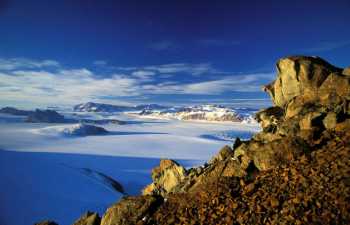
Scientists at the International Polar Year conference in Norway this week revealed startling new images of the Gamburtsev Mountain Range of Antarctica, a huge and mysterious “ghost range” buried beneath more than a mile of ice.
The images are the result of radar technology, and reveal a dramatic landscape of rocky summits, deep river valleys, and liquid, not frozen, lakes, all hidden beneath the ice. The range itself rivals the Alps in size and cover an area that is roughly the size of New York State.
“What we’d shown before was an estimate based on gravity data — a little bit of a coarse resolution tool,” said Robin Bell, a senior research scientist at Columbia’s Lamont-Doherty Earth Observatory in New York. “What we showed at this meeting was the radar data. It’s like going from using a big, fat sharpie to using a fine-tipped pencil.”
Flying twin-engine light aircraft the equivalent of several trips around the globe and establishing a network of seismic instruments across an area the size of Texas, a U.S.-led, international team of scientists in 2009 not only verified the existence of the mountain range, which is thought is to have caused the massive East Antarctic Ice Sheet to form, but also has created a detailed picture of the rugged landscape.
Read the rest of the story here
Discover more from Watts Up With That?
Subscribe to get the latest posts sent to your email.
Well gosh darn it.
Now how are we going to explain just how all that Antarctic ice sheet is going to slide off inot the southern ocean; when it is all pinned to the bottom with all that mountainous stickups.
I wonder about the CO2 emissions generated by the extended flights. Done in the name of science it is acceptable, no?
“”” David L says:
June 12, 2010 at 4:01 am
Who can’t wait for global warming to melt
all the Antarctic ice? Imagine the fun of being the first person to climb those virgin mountains? “””
Well I suspect that the first person to “lclimb” those mountains will simply step into a small hole he has scooped out on top of the highest peak; just as soon as the ice melts down that far; so no great feat; a mere child could do it.