By Steve Goddard

The sea ice concentration game.

Arctic Ice is more concentrated in 2010 than in past years
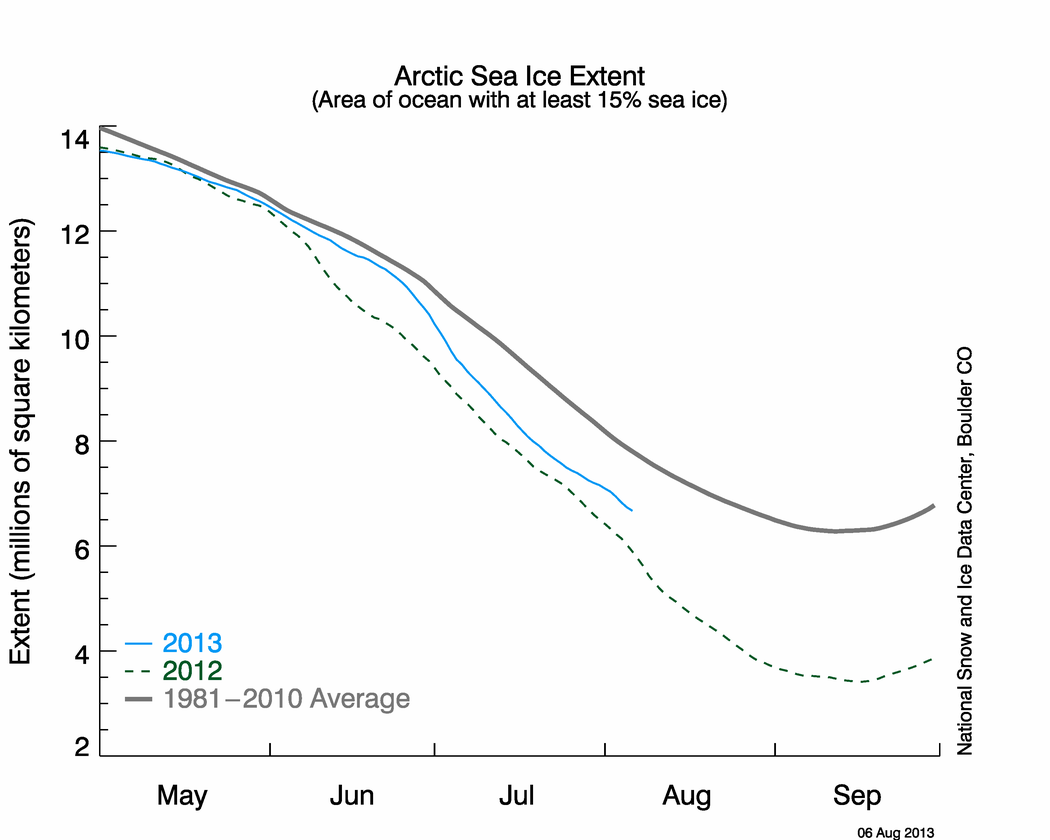
The record low Arctic Oscillation during the past winter led to a very tightly compacted central Arctic ice mass – which is clearly evident in the UIUC images above. Some commentors have found this confusing because according to NSIDC, extent is slightly lower this year than previous years. (NORSEX disagrees with the NISDC assessment, but that is a topic of a separate discussion.)

Is it possible to have higher concentration and lower extent? Of course, it is expected. If you put a 10 kg block of ice in a swimming pool, the ice will occupy a much smaller extent (and area) of the pool than a 10kg bag of ice cubes poured into the pool. Which one would melt faster? The bag of ice cubes would, because it has more surface area exposed to the water. We have an analogous situation with Arctic ice in 2010. The ice (by some measures) occupies a smaller area than the past three years – but is more concentrated.This bodes well for less melt later in the summer.
Now, let’s look at the current stats for the Arctic Basin, measured from PIPS maps.

2010 ice volume is above 2007-2009 and just below 2006.

2010 average ice thickness is approximately the same as 2006 and 2007. It is higher than “rotten ice” 2008 and 2009.

2010 Arctic Basin ice area is just below 2006 and 2007. It is higher than 2008 and 2009. When I refer to the Arctic Basin, I am considering only the region below – which corresponds approximately to the maximum September extent in the NSIDC records.
 ‘
‘
Below is yesterday’s Arctic satellite photo. The ice is very concentrated.

Conclusion : Current conditions continue to indicate a larger minimum ice extent than 2007-2009. This could change if the weather is very warm, windy or sunny during July. The ice has started to melt offshore at Barrow.

http://seaice.alaska.edu/gi/observatories/barrow_webcam
Comparison of June 10, 2008 with June 10, 2010 below. There is a lot more thick ice this year.
Discover more from Watts Up With That?
Subscribe to get the latest posts sent to your email.
Anu says:
June 11, 2010 at 7:59 pm
I don’t know if this summer will be the new record minimum,
but if it is, it will be hilarious listening to you and others trying to “explain” it away…
Not nearly as hilarious as it will be listening to you and your fellow travelers try to explain away a further increase in minimum ice extent. I can just hear it now – “it was La Nina, or just the typical hand waving like “who cares, it’s the overall trend that matters, and it’s still down over the past 30 years”, “it’s the ice concentration that matters”, “that ice is all rotten”, “don’t worry, next year will be the biggest ice melt off EVAH” etc. etc.
The difference between skeptics and Warmists is that you need to see the ice decline because you think it bolsters your Warmist beliefs. It does help the propaganda campaign, I give you that.
For those who imagine that the Arctic ice is melting down rapidly, here is an animation of UIUC maps since May 1
BTW
There’s hot like hell:
FNL 00Z – 2010/06/11 Fri Jun 11 18:55:34 2010 – UTC
http://www.esrl.noaa.gov/psd/map/images/fnl/sfctmp_01.fnl.html
Regards
PPPPS: I once tried to bet, on a different matter, with a large British bookmaker, William Hill, and learned that it wouldn’t accept bets from Americans. I suspect this is the policy of other foreign bookies as well. Intrade is an exception, I guess because they aren’t a bookie (oddsmaker), but just a marketplace, and because they consider themselves an “event-prediction site.”
Every time I look at these satelite pictures of Greenland it appears that the Glaciers on Greenland are actually getting bigger. Look at the comparison provided. It looks like Greenland has increased in area in the last ten years. Is there anyone who can confirm/refute this?
stevengoddard says:
June 12, 2010 at 7:30 am
For those who imagine that the Arctic ice is melting down rapidly, here is an animation of UIUC maps since May 1
_____________
We don’t have to imagine Steve, nor do we need to rely on low res maps or outdated PIPS 2.0 models. The real data speak for themselves, and May saw a very rapid decline, as the National Ice Snow and Ice Data Center summed with this succinctly accurate quote:
“This rate of loss is the highest for the month of May during the satellite record.”
View the complete report from them here:
http://nsidc.org/arcticseaicenews/index.html
You’re sure trying hard to convince us otherwise Steve, but the Arctic simply isn’t behaving as you might have thought it should with all that “thick ice” that PIPS 2.0 model is telling you is there. I’ll trust the experts on this one and the actual satellite data.
R. Gates,
Here is a video showing the massive meltdown in the Arctic since May 1. If you look really close, you might be able to find some ice loss.
Roger Knights says:
June 12, 2010 at 7:59 am
PPPPS: I once tried to bet, on a different matter, with a large British bookmaker, William Hill, and learned that it wouldn’t accept bets from Americans. I suspect this is the policy of other foreign bookies as well. Intrade is an exception, I guess because they aren’t a bookie (oddsmaker), but just a marketplace, and because they consider themselves an “event-prediction site.”
That’s because the US government uses the tactics of arresting CEOs of companies that take bets from US citizens, if they transit through US territories. Usually results in jail time and huge fines for ‘Racketeering’.
“This rate of loss is the highest for the month of May during the satellite record.”
Try measuring a 15 day moving average on sea ice loss using the IARC-JAXA data back to 2003 then tell me May 2010 was anything exceptional and I’ll straight out say your full of it. I’ve seen a number of cases where we lost more ice at earlier and later stages of the year. It might be the biggest ice loss during may over a very limited measurement period but it means jack.
Looking at a single month and saying it means anything, if your someone who claims to be an expert in this area, I would have to believe is being deliberately misleading or evasive.
We were always going to lose a lot of the late ice that we got at the end of winter this year. The 15 day moving average is now sitting pretty much where it always does and trending up ( towards less ice loss).
I can’t understand why you cant look at the data and figure this out unless deliberately choose not to.
Lets see what ice we lose in July.
Incidentally try running each year since 2003 on a 120 day moving average for daily ice loss. Quite interesting when you smooth out the daily/monthly locailised variables.
R. Gates
If PIOMAS is correct, we should see a huge meltdown this summer. They show the current anomaly double that in 2007. Based on that, we should have a huge new record minimum.
If you really believe in PIOMAS, then you are going to have to get firmly behind the idea of shattering the record low this summer. You can’t have it both ways, though no doubt you will try.
In your side by side comparison of Arctic sea ice from 06/09/1990 and 06/09/2010 you neglegted to mention that the later dated diagram includes historic snow cover data (in white) whereas the earlier photo does not (not white). This oversight gives the false impression, to the less informed, that there is much more “ice” in the 2010 cryosphere than there was in 2009. May I suggest that these diagrams be relabeled so that a misrepresentation does not occur?
Ignoring my first request for information (twice) and going directly to my request for a citaion, R. Gates says:
June 12, 2010 at 6:34 am
Well, Steve may know, but we don’t, and this is science. Either come up with a citation or not, but don’t try to say it’s a secret known only to the initiated. That doesn’t cut it.
And yes, we are aware that you don’t care much about citations either way … however, we do.
stevengoddard says:
June 12, 2010 at 9:39 am
R. Gates
If PIOMAS is correct, we should see a huge meltdown this summer. They show the current anomaly double that in 2007. Based on that, we should have a huge new record minimum.
If you really believe in PIOMAS, then you are going to have to get firmly behind the idea of shattering the record low this summer. You can’t have it both ways, though no doubt you will try
____________________
Steve,
I was projecting summer minimum of 4.5 million sq. km. back in March, during the much touted “bump up” in sea ice extent, when all the skeptics were saying “see, it’s recovering!”. I knew it was “thin ice” at best, more related to the negative AO, and had to melt fast, and so it did. PIOMAS is saying 4.7 million sq. km., so I’ve go no problem be firmly behind both their and my projections.
David said-June 12, 2010 at 9:36 am
“We were always going to lose a lot of the late ice that we got at the end of winter this year”
Well that’s always true every year, but why so fast this year?
Andy
We do have a regular poster from NSIDC, who (like me) is skeptical of PIOMAS graphs showing a record volume anomaly in 2010.
R. Gates says:
June 12, 2010 at 12:28 pm
“I was projecting summer minimum of 4.5 million sq. km. back in March…”
So if you are wrong what are you going to do/say on this site besides eat crow and feet?
Harsh! (Thanks for the info. I suspected there was some int’l. legal issue involved.)
Argh! That means the outcome will be a “draw” (especially if the result is “close” to 2009) and there will thus be intense efforts to spin its meaning in a warmist or coolist direction. But I suspect this is indeed the likeliest outcome, because it will deliver the maximum amount of aggravation. (This heuristic works for the stock market too.)
“David said-June 12, 2010 at 9:36 am
“We were always going to lose a lot of the late ice that we got at the end of winter this year”
Well that’s always true every year, but why so fast this year?
Andy”
Its not true that we get ice growth so late in the season every year. Again, download the data file from the IARC-JAXA site that Anthony has linked on the home page and put it in a spreadsheet
Then calculate daily ice loss, put in 15 day moving average to smooth out variables and then tell me that you cant see other years which had similar rates of ice loss at differing periods.
The ice is not going to melt at the same times at the same rates year in year out because the distribution of the thickness of the ice will vary. Examine the data a little more closely and you will see that very clearly. (and it make simple common sense too)
I would simply say this winter put down a lot of thinner ice late in the season which naturally was the first to go heading into spring and summer. The rate of loss has now slowed to around 60,000 square kilometers a day on a 15 day moving average which is in alignment with other years since 2003.
Again, the damage in 2007 occurred during July. Lets see if we see it “dropping like a rock” at this time.
R. Gates says:
June 12, 2010 at 12:28 pm
“I was projecting summer minimum of 4.5 million sq. km. back in March….”
Gates, have you seen the movie “Click”?
The guy with the remote control that can fast forward life?
Its almost like I wish I had a remote like that now, and could fast forward to September. But I dont want to miss the summer.
I hope you loose this competition, and Steve wins with a clear margin.
Everybody’s just taking for granted the image that Stephen posted is real. I went to the UIUC Cryosphere Today website and the images look nothing like the one Stephen posted above. Unless there was a rapid “de-concentration” of ice in the past three days, I’m inclined to say that image was doctored. Here are the actual images that tell a much different story:
http://arctic.atmos.uiuc.edu/cryosphere/NEWIMAGES/arctic.seaice.color.000.png
http://arctic.atmos.uiuc.edu/cryosphere/NEWIMAGES/arctic.seaice.color.004.png
http://arctic.atmos.uiuc.edu/cryosphere/NEWIMAGES/arctic.seaice.color.002.png
J.J.
Stephen used the low res pic for the comparison, because there is no hi-res pics available for 1990. In your lust to convict Stephen of wrong doing you managed to make yourself look quite foolish and an avid kool-aid drinker. I’m laughing at you right now.
J.J.
The “high resolution” pictures on the UIUC website are not very accurate. I’m writing it up for this week’s sea ice news.
stevengoddard says:
June 13, 2010 at 12:28 pm
J.J.
The “high resolution” pictures on the UIUC website are not very accurate. I’m writing it up for this week’s sea ice news.
I think this site has better pictures.
http://www.iup.physik.uni-bremen.de:8084/amsr/arctic_AMSRE_nic.png
stevengoddard says:
June 13, 2010 at 12:28 pm
J.J.
The “high resolution” pictures on the UIUC website are not very accurate. I’m writing it up for this week’s sea ice news.
That should be amusing,
stevengoddard says:
June 12, 2010 at 9:39 am
R. Gates
If PIOMAS is correct, we should see a huge meltdown this summer. They show the current anomaly double that in 2007. Based on that, we should have a huge new record minimum.
Let’s look at what PIOMAS actually shows, shall we ?
http://psc.apl.washington.edu/ArcticSeaiceVolume/images/BPIOMASIceVolumeAnomalyCurrent.png
The vertical scale is the Ice Volume Anomaly relative to 1979-2009, in units of 1000 km³
Comparing 5/30/10 with 5/30/07 (eyeballing the chart on the computer screen with the straight edge of printer paper), the anomaly is -9.8 and -7.3
I don’t know where Steve gets “they show the current anomaly double that in 2007”.
The increase in the anomaly since May 30, 2007 till May 30, 2010 is about 2.5
This represents 2,500 km³ of sea ice volume difference.
Now, look at the difference in sea ice area, since it is the area times the thickness that makes the volume – not the “extent”.
http://www.ijis.iarc.uaf.edu/seaice/extent/AMSRE_Sea_Ice_Extent.png
http://www.ijis.iarc.uaf.edu/seaice/extent/AMSRE_Sea_Ice_Area.png
The difference in area for this date in 2007 and 2010 is about 250,000 km²
At an average thickness of 2 meters, that would be 500 km³ of volume.
From the Sea_Ice_Area chart, the area for 5/30/10 is 9,900,000 km²
How much thinner would this sea ice have to be than it was in 2007 to make up for the other 2000 km³ of the sea ice volume difference ?
It comes to 20.2 centimeters thinner.
In the PIPS 2.0 thickness maps, the ColorBar breaks down thickness into 25 centimeter layers. Making the entire Arctic sea ice 20.2 centimeters thinner might not even change half the pixels – and the rest might go from one subtle shade of green to a slightly different subtle shade of green, for instance.
(It would be nice to see PIOMAS images of sea ice thickness, rather than just a single “anomaly” value for one date. Even if PIPS 2.0 is an older, less accurate model of ice thickness, they win extra points for supplying fun data to look at.)
If you really believe in PIOMAS, then you are going to have to get firmly behind the idea of shattering the record low this summer. You can’t have it both ways, though no doubt you will try.
Nice try, Steve. Nobody here is “predicting” a record shattering summer minimum. R. Gates is predicting 4.5 million sq. km of sea ice extent
I’m predicting less than in 2009 – which would be enough to show that the summer minimum “recovery” since 2007 is over.
The IARC-JAXA minimums are as follows:
Lowest point in 2007 – 4,267,656 sq km
Lowest point in 2008 – 4,718,594 sq km
Lowest point in 2009 – 5,249,844 sq km
Remember, you are on record:
http://wattsupwiththat.com/2010/06/06/wuwt-arctic-sea-ice-news-8/
Conclusion : Based on current ice thickness, we should expect September extent/area to come in near the top of the JAXA rankings (near 2003 and 2006.)However, unusual weather conditions like those from the summer of 2007 could dramatically change this. There is no guarantee, because weather is very variable.
Ah yes, the instant disclaimer. Sounds like Uncertainty and Doubt to me – maybe even Fear.
Still, your “prediction” is that the summer minimum will be near 2003 and 2006 – about 6 million sq km.
http://nsidc.org/data/seaice_index/images/daily_images/N_stddev_timeseries.png
You better hope you’re right about that 20.2 centimeters of ice thickness, because in September, I predict lots of grief for the “losers”.