By Steve Goddard

The sea ice concentration game.

Arctic Ice is more concentrated in 2010 than in past years
The record low Arctic Oscillation during the past winter led to a very tightly compacted central Arctic ice mass – which is clearly evident in the UIUC images above. Some commentors have found this confusing because according to NSIDC, extent is slightly lower this year than previous years. (NORSEX disagrees with the NISDC assessment, but that is a topic of a separate discussion.)
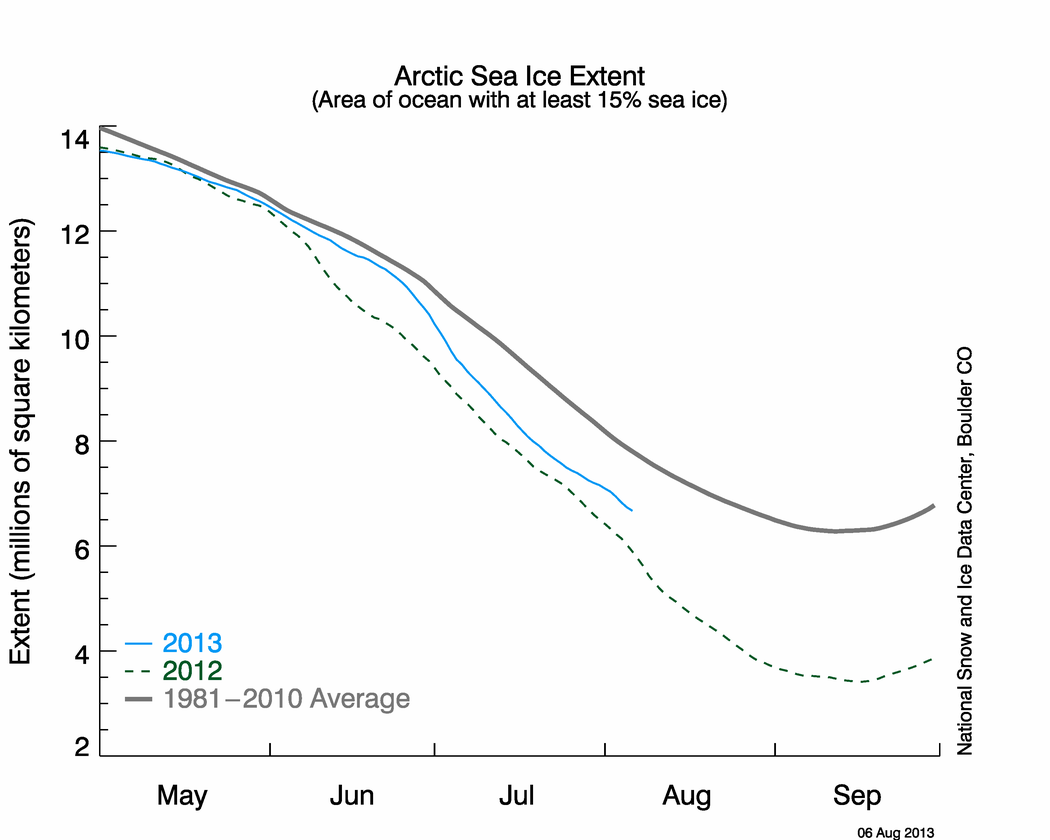

Is it possible to have higher concentration and lower extent? Of course, it is expected. If you put a 10 kg block of ice in a swimming pool, the ice will occupy a much smaller extent (and area) of the pool than a 10kg bag of ice cubes poured into the pool. Which one would melt faster? The bag of ice cubes would, because it has more surface area exposed to the water. We have an analogous situation with Arctic ice in 2010. The ice (by some measures) occupies a smaller area than the past three years – but is more concentrated.This bodes well for less melt later in the summer.
Now, let’s look at the current stats for the Arctic Basin, measured from PIPS maps.

2010 ice volume is above 2007-2009 and just below 2006.

2010 average ice thickness is approximately the same as 2006 and 2007. It is higher than “rotten ice” 2008 and 2009.

2010 Arctic Basin ice area is just below 2006 and 2007. It is higher than 2008 and 2009. When I refer to the Arctic Basin, I am considering only the region below – which corresponds approximately to the maximum September extent in the NSIDC records.
 ‘
‘
Below is yesterday’s Arctic satellite photo. The ice is very concentrated.

Conclusion : Current conditions continue to indicate a larger minimum ice extent than 2007-2009. This could change if the weather is very warm, windy or sunny during July. The ice has started to melt offshore at Barrow.

http://seaice.alaska.edu/gi/observatories/barrow_webcam
Comparison of June 10, 2008 with June 10, 2010 below. There is a lot more thick ice this year.
Tom P
What excuse are you going to hide behind come September?
R. Gates
The CryoSat data will be nice, but unfortunately won’t provide any historical reference.
AndyW says:
June 11, 2010 at 3:16 pm
As an interesting aside, the very high “wind shear” to the North of Canada has made the NW passage being possible by the northern direct route an interesting possibility this year. So far considering this it is not looking too far fetched,
http://iup.physik.uni-bremen.de:8084/amsr/arctic_AMSRE_nic.png
Ironically considering the thin new ice in the archipelago the southern route might not open up for the first time in 4 years due to the increased mobility of the old ice pieces drifting down from the north.
stevengoddard says:
June 11, 2010 at 4:12 pm
Phil,
PIPS is the most accurate available historical source of thickness data, it does calculate and correct for concentration, and the numbers I present are accurate representations of their maps.
It’s not thickness data it’s model results, the most accurate data would be the Navy data from the ‘Gore box’ and Icesat (with which PIOMAS has been crosschecked).
There is no evidence that your method provides an accurate representation of the PIPS data) in fact to the contrary).
Your claims are inaccurate and baseless.
The only way for my claims would be baseless would be if you had actually made a calibration of your method against PIPS own calculation of volume and posted it here, however you haven’t.
stevengoddard says:
June 11, 2010 at 5:47 pm
Tom P
Since you are probably measuring a different region of the Arctic than me, I would say that your comparison is completely meaningless.
Since he’s testing your calculation method against his and PIPS it doesn’t matter if it isn’t the exact same region. If you want to prove your method it’s time for you to step up to the plate.
Phil. says:
June 11, 2010 at 10:22 am
Here you go, full sized images made from the same imager comparing 2007 and 2010 from a couple of weeks ago (I rotated one of them to give you the same orientation):
http://i302.photobucket.com/albums/nn107/Sprintstar400/20102007comp.gif
You could always check any date for yourself .
++++
Hey, I appreciate the effort you put into that re the rotation. I really do. I’m always willing to give props to any evidence of good will in an effort to have a meeting of the minds. So props there, seriously.
I have to note there is no color scale on the pics. I’m left to guess what the colors mean re concentration. If I have to guess, they look pretty similar. Some less concentration in greater areas on 2010 and some even lesser concentration in somewhat smaller areas on the other.
As I’ve said many times since the middle of April, I’m really waiting for July 1, as at that point we get to some metrics I’m familiar with and trust as to their relevance. Others have other metrics, and that’s fine. The ones I trust start having relevance again starting around July 1. This current period from May 1-July 1, in my opinion, are very thin gruel indeed as to relevance re eventual minimum in September.
Steve has felt it relevant and appropriate it to continue to show why during this period he still sees what he sees. That’s fine. It’s a blog. Saying “See you in 2.5 months!” isn’t appropriate to the form. I get that. But from my perspective the argument he’s making hasn’t changed in any significant regards since the middle of April. To the degree the points he is making have relevance in this period, it is in trying thru repeititon to make it clear what the original argument was based on and why nothing since has changed it. Nothing wrong with repetition; some people need to read the same basic idea in multiple forms to “get” the gist (including me sometimes).
I’m actually pretty excited by this summer (July-September), as I think some theories will be proven or consigned to the dust heap of history. If you really believe in science, you are more interested in doing that than the actual results of which way it goes. I know I am.
R. Gates says:
June 11, 2010 at 10:23 am
R., do you have a citation for that claim? I couldn’t find confirmation … which means very little …
kadaka (KD Knoebel) says:
June 11, 2010 at 3:19 pm
You’re quite right – I had done a quick ‘Inspect element’ within my new browser (Chrome), and mistakenly wrote down img – width: 1296px, height: 1296 px, rather than Metrics->Properties->HTMLImageElement, NaturalHeight: 900 and NaturalWidth: 900.
My bad.
You get a ☆
The points about insight gained by higher resolution data remain, however.
Downsampling to compare to data from 3 decades ago is useful for some purposes:
http://igloo.atmos.uiuc.edu/cgi-bin/test/print.sh?fm=06&fd=10&fy=1979&sm=06&sd=10&sy=2010
But to see the current state of Arctic ice, I prefer all the resolution they have:
http://arctic.atmos.uiuc.edu/cryosphere/NEWIMAGES/arctic.seaice.color.000.png
There is significant open water in large parts of the Arctic Basin already.
Willis,
People are spreading complete nonsense here :
https://www1.cmos.ca/Amsoft%20Web%20Data/upload/abstracts115/7052archive.html
stevengoddard says:
June 11, 2010 at 8:38 am
Phil & cohorts
I expect a full apology from you in September for wasting everybody’s time with your perpetual FUD.
I don’t know if this summer will be the new record minimum,
but if it is,
it will be hilarious listening to you and others trying to “explain” it away…
Even beating 2009 or 2008 is going to require some quick talking and hand waving on your part. “Very sunny during July” isn’t going to cut it after all your “thick ice” claims.
I have no interest in the company, I have placed bets there, and my motive is as I have stated–i.e., to cool tempers here, and to get satisfaction from punishing the wrong side. (Non-monetary bets don’t do that.) I’ve been mightily annoyed at the know-it-all tone of many warmists and want to take them down a peg.
I would also like to attract more warmers over there, so I can bet against them. At present, the liquidity is thin, especially for the long-term bets.
PS: The only reason I plug Intrade is that it’s the only site I know of that takes climate bets. (Not that I’m at all conversant with what may be available on other sites.) If or anyone knows of such sites, please give their names and I’ll mention them as well.
Benjamin P brings up volume… an inconvenient truth.
Evan dismisses the comment because area effects albedo. Typical apples and oranges comparison one would expect from alarmists.
Any geologist will tell you that area=BS and volume = $$$$
But hey, just change the lingo to “concentration”
Anthony, your site is starting to make realclimate look better all the time. The denialist comments were one thing. Now that the denialists postings dominate, you are hurting the skeptical “cause” . Are the hits really worth it? The only thing that keeps me coming back are the comments from Lief… which get fewer and fewer…
PPS: Oops :”If YOU or anyone …”
Another reason for mentioning Intrade from time to time is to quote their current odds on various bets, which is a matter of general interest, as it indicates what people really (sincerely) think — i.e., what odds they’re willing to take a real risk on.
For something that we’ve been told isn’t really important and not worth blogging about this topic certainly is emotionally charged.
Global warming believers tell us continually to only look at long term effects. But they don’t act like they do that themselves.
PPPS: One of the reasons I like Intrade is that it involves directly betting against someone on the other side, which makes it moreinteresting. (More satisfying to win.)
There have been several long online explorations of many aspects of climate-betting, including reasons why it’s an important part of the climate debate. Here are links to the more important ones I’m aware of, all on warmist sites:
http://julesandjames.blogspot.com/2005/06/betting-summary.html
(Site of James Annan, a warmist scientist. He has a wikipedia entry. Lots of links there.)
http://www.realclimate.org/index.php?p=161
(Huge thread with lots of twists.)
http://backseatdriving.blogspot.com/2007/04/new-global-warming-bet-for-7-10.html
(A recent article in a long series; click on his “betting” keyword to find links to his other posts.)
I might mention that I’ve been posting regularly here for 20 months and only started posting about Intrade about 8 (?) months ago. It’s not the reason I’m here.
Howard,
Well, not exactly.
The reason there are so many global warmers commenting in this thread is because the data from Arctic shows their PIOMAS graph is wrong. That graph is one of the last linchpins of global warming they think is still pristine. But the real data seen in real graphs, and real images, show that PIOMAS is wrong. (I wonder if global warming believers have spent any time at Cryosphere Today looking at images from the last 3 years…..just asking…..they probably don’t, they probably just gawk at the PIOMAS graph)
The PIOMAS graph shows a continual downturn in Arctic ice up to the present. So the prediction by Al Gore of an ice free North Pole by 2013, and Mark Surreze’s prediction of Arctic ice being in a ‘death spiral’, could still be true.
But the data, oh that rascally data, show there has been an increase in Arctic ice over the last three years. So Al Gore is wrong, Mark Surreze is wrong—and so is the PIOMAS graph.
So the global warming believers will fight because what else do they have? They’re clinging to the PIOMAS graph because they don’t have anything else to hang on to. It’s PIOMAS for North Pole ice or nothing for them.
Must suck to be them.
Anu,
Based on the voluminous and bizarre responses from the AGW faithful, it seems pretty clear that I have struck a nerve with this topic.
If you are correct and ice volume really is at a record low as PIOMAS suggests, then we should see the Arctic Basin severely depleted of ice within a few weeks. I will remind you of your untenable and thoughtless claims at that time.
Howard
Real Climate awaits you. With the record low ice volume PIOMAS reports, the Arctic should collapse any day now.
Here is a comparison of the ice volumes calculated from PIPS (properly including the concentration) and PIOMAS:
http://img811.imageshack.us/img811/5835/pipsvspiomas.png
Although there is obvious disagreement in the the first three years, since 2005 they match quite closely to each other as well as to the IceSat measurements. It certainly looks like validation of the recent performance of two independently derived ice volume models, quite contrary to what Steve has stated.
stevengoddard says:
June 11, 2010 at 7:42 pm
Yes, I’ve asked R. Gates two questions on the thread. He had claimed huge differences between three images, and I couldn’t find them. I asked him where the differences were …
…
Then he said the NIC didn’t use PIPS2.0. I asked for a citation …
…
I sure love the sound of crickets.
Here is a the full history of volumes and thickness as correctly derived from the PIPS model output:
http://img810.imageshack.us/img810/949/pipsallb.png
2010 so far in terms of both ice volume and thickness most closely matches 2007, except the previous year’s minimum volume is lower and the ice thickness appears to have peaked a couple weeks earlier this year. Hence we have a smaller average ice thickness, with a greater proportion of single year ice compared to 2007 as we enter the months of maximum melt, at least according to PIPS.
Phil. says:
June 11, 2010 at 8:15 am
~Polynyas confirmed:
http://rapidfire.sci.gsfc.nasa.gov/realtime/single.php?T101621620
http://rapidfire.sci.gsfc.nasa.gov/realtime/single.php?T101621440
from MODIS HQ:
http://rapidfire.sci.gsfc.nasa.gov/
from Near-Real-Time Level-2 Browse:
http://rapidfire.sci.gsfc.nasa.gov/realtime/2010163/
Regards
One caveat to the earlier plots. It is evident that PIPS changed the way they presented their maps of the model data at the beginning of 2002. Hence my calculated results up to that point are not directly comparable with more recent values.
Willis said:
“Then he said the NIC didn’t use PIPS2.0. I asked for a citation …”
____________________
Willis, Steve knows to whom I refer and I won’t get into the personal identities of posters on this site. If this person wants to reveal themselves they can, or you can just continue on with your drivel. I don’t much care either way. My whole basis in regards to Steve’s use of the PIPS 2.0 MODEL is that it is just that…a model, and not some actual measured amount, and that the CICE + HYCOM (or PIPS 3.0) model the more current version of what the Navy is using. The fact that NAVOCEANO has not released some scaled down version of PIPS 3.0 yet for public consumption is also none of my concern, as I’ve previously provided plenty of links that shows that this newer and more precise version of PIPS is what the Navy now uses at least internally. In short, my biggest issue is that Steve parades the PIPS 2.0 off as being data, when it is an old MODEL, and even we’ve heard from someone right on here WUWT (who would be in a position to know) that the NIC doesn’t put much credibility in the PIPS 2.0 data, though they specifically mentioned PIOMAS in their June update.
Ok Roger Nights explanation on the betting firm accepted, though you seem to have done another 4 posts on the subject, you must really enjoy it !
Getting back to the main topics I’m not convinced we will get a higher extent than 2009 as suggested but I think it even more unlikely we will be getting anything lower than 2007 unless the same factors in 2007 happen again, which will be unlikely. I think the minima will be between 2009 and 2008, the chances it being lower are greater than it being higher due to the warm weather over the Arctic over the winter meaning ice thicknesses are not as great as thought from models/data Steve has been kind enough to post.
This is pure gut feeling though, so likely to have a high level of leeway D
Andy