By Steve Goddard

The sea ice concentration game.

Arctic Ice is more concentrated in 2010 than in past years
The record low Arctic Oscillation during the past winter led to a very tightly compacted central Arctic ice mass – which is clearly evident in the UIUC images above. Some commentors have found this confusing because according to NSIDC, extent is slightly lower this year than previous years. (NORSEX disagrees with the NISDC assessment, but that is a topic of a separate discussion.)
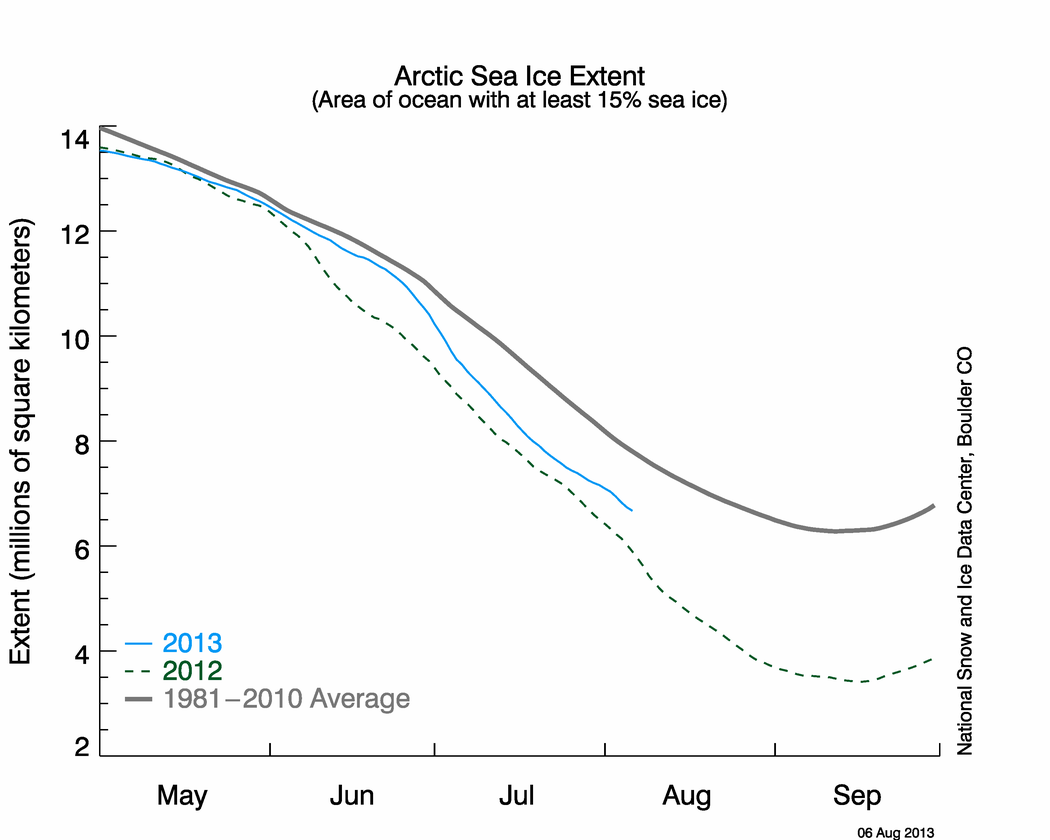

Is it possible to have higher concentration and lower extent? Of course, it is expected. If you put a 10 kg block of ice in a swimming pool, the ice will occupy a much smaller extent (and area) of the pool than a 10kg bag of ice cubes poured into the pool. Which one would melt faster? The bag of ice cubes would, because it has more surface area exposed to the water. We have an analogous situation with Arctic ice in 2010. The ice (by some measures) occupies a smaller area than the past three years – but is more concentrated.This bodes well for less melt later in the summer.
Now, let’s look at the current stats for the Arctic Basin, measured from PIPS maps.

2010 ice volume is above 2007-2009 and just below 2006.

2010 average ice thickness is approximately the same as 2006 and 2007. It is higher than “rotten ice” 2008 and 2009.

2010 Arctic Basin ice area is just below 2006 and 2007. It is higher than 2008 and 2009. When I refer to the Arctic Basin, I am considering only the region below – which corresponds approximately to the maximum September extent in the NSIDC records.
 ‘
‘
Below is yesterday’s Arctic satellite photo. The ice is very concentrated.

Conclusion : Current conditions continue to indicate a larger minimum ice extent than 2007-2009. This could change if the weather is very warm, windy or sunny during July. The ice has started to melt offshore at Barrow.

http://seaice.alaska.edu/gi/observatories/barrow_webcam
Comparison of June 10, 2008 with June 10, 2010 below. There is a lot more thick ice this year.
Discover more from Watts Up With That?
Subscribe to get the latest posts sent to your email.
Steve Keohane says:
June 11, 2010 at 7:18 am
stevengoddard says: June 10, 2010 at 9:50 pm
R Gates
The PIPS map shows the same region of ice being blown out of the Beaufort Sea as the UIUC maps. PIPS2 is the best available source of thickness data. Your claims are inaccurate.
I agree Steve, here is a blink of CT & PIPS2.
http://i49.tinypic.com/t6w9hv.jpg
____________
Thanks for that…I think it shows quite the opposite..that the PIPS 2.0 MODEL is even more in error, and clearly shows 2.5 meter thick ice when there is open water or low concentration. It does not surprize me at all that the NIC discounts the PIPS 2.0 Model…and hence, why the great need for CryoSat 2.
Steven,
Hmmm! The ninth (or more) in a series with the same argumentative respondents. Tell us the truth, you’re not that concerned with the NH sea ice, you just really enjoy goading them don’t you. ;~P
That will change the wobbling of the earth. Is Gaia having a headache or is she getting dizzy?
“Below is yesterday’s Arctic satellite photo. The ice is very concentrated.”
Wow, what a difference going there and zooming in on the images makes though! http://ice-map.appspot.com/
Steve,
Although I know you are loathe to admit your calculations have a problem, here is a comparison between processing the PIPS images with and without including the concentration. I’ve plotted for the average September figures as reported by Posey, when I have little doubt the area of ice coverage would be considered “Central Arctic”.
http://img576.imageshack.us/img576/7138/volumecfposey.png
It is obvious that not including ice concentration produces pulls down the correlation with the published data, but I doubt that will stop you basing your conclusions on miscalculated values from an obsolete model.
Rapid ice melt is always a function of regional weather pattern variation, not Arctic-wide parameters. It matters more what weather patterns are at play directly related to the GPS of the melt occuring, than any talk of total area or extent. If we focused our attention sea by sea, we would all have a better understanding of what is occurring and why. Looking at an average data point over the entire Arctic is meaningless.
We have such a myopic view of the globe because we always see it at about the size of a baseball. A single Arctic wide data point of area or extent is data rich, information poor. The discussion that matters should change to the GPS of the melt and why that area is melting.
Phil. says:
June 11, 2010 at 8:15 am (Edit)
What does that have to do with R. Gates claim, or my counterclaim, about the specific images in question? I said nothing about the images you are talking about, what does it have to do with me? Please address your comments to someone who is talking about whatever it is you are discussing.
Personally I just want summer to arrive anytime soon, preferably before summers end.
lol a few weeks ago there was a couple of days with above normal temperatures, and the greenies screamed global warming, climate change, doh! Now we’re going on the second month of below normal, which is quite normal every few years around these parts anyway, and has been for several decades, but now it’s the horrible climate change due to man(n) at work.
A sea-ice concentration site in Norway with nice maps:
http://saf.met.no/p/ice/nh/conc/conc.shtml
I enjoy reading these updates and thoughts, as well as the comments. It will be interesting to see how things turn out, but in the long run I question how important one year’s minimum is. Honestly, we could set a record low minimum this year and I wouldn’t be convinced of AGW, or we could set a record high minimum this year and I wouldn’t be convinced against AGW. Following it this year is just a curiousity for me and the only major relevance it has is to show how alarmists comments of an ice-free 2008 or 2013 are a bit extreme.
However, because of these analyses I’m really looking forward to seeing how a dated (PIPS 2.0) model performs for a prediction like this. PIPS 2.0 may be inferior, but apparently it’s the best that’s publicly available, so I commend Steve for using it since we can’t do better. Even if it is erroneous, it’s systematic deviations year-to-year should be somewhat consistent and this self-consistency should result in a least moderate predictive power (as Steve pointed out in a previous post…RSQ of 0.65 IIRC).
Perhaps the most fun comes from reading the comments: small vs big maps, concentration affecting volume, etc. It’s amazing how critical people can be of others when their own analyzes/comments make the same errors. My personal favorite so far is R. Gates on June 11 @ur momisugly 7:07am versus his first sentence in the June 10 9:08 am post.
That said, I await the September minimum with interest, but won’t put too much stock in the final number either way. If it’s low, skeptics will say it’s only one year, and if it’s high, warmists will say the same.
-Scott
Willis Eschenbach says: June 11, 2010 at 11:42 am
Phil. says:
June 11, 2010 at 8:15 am (Edit)
Willis, it appears an obtuse but prevalent tactic is what I label as a ‘tangental argument’. That is, their answer does not directly, if at all, address the question, rather more issues are raised and any resemblance of an answer is to some other issue.
Phil,
So you think you might have found a pixel or two that you don’t understand. That must prove that the PIPS data is worthless. You better call up the Navy and tell them about it.
Tom P
What is obvious is that PIPS2 already corrects for concentration, and that whatever procedures you are suggesting are incorrect.
http://www.tos.org/oceanography/issues/issue_archive/issue_pdfs/15_1/15_1_preller_et_al.pdf
https://www1.cmos.ca/Amsoft%20Web%20Data/upload/abstracts115/7052archive.html
One of the reasons I harp on the availability of Intrade as a betting mechanism is to cool tempers on this matter and avoid the impulse to demand apologies, etc. If one can punish the other side by taking their money, that’s “satisfaction” enough.
Steve,
Your ice volumes, r2 0.67 t0 published data. Mine, r2 0.92. Who do you think is presenting misleading data?
Archonix says:
June 11, 2010 at 6:20 am
Anu says: June 10, 2010 at 11:42 pm
Are you looking at the same image, Anu? I just brought it up (conveniently from the link you linked and from the link in that “tiny” picture Goddard posted and I can’t see what you’re talking about. The pole is solid. There’s plenty of holes and open water around the coasts of Russia and Canada, nortehrn Scandinavia, and Iceland, but the actual geographic (and indeed magnetic) pole is solid as can be. I’m honestly stumped about this open water you’re claiming to see. It’s pretty plainly solid from 70 degrees north.
http://arctic.atmos.uiuc.edu/cryosphere/NEWIMAGES/arctic.seaice.color.000.png
Sea ice concentration refers to the fraction of ice within each image pixel. The images are color-coded to show varying levels of ice concentration. A pixel colored the yellow which signifies 85% sea ice concentration indicates, by definition, that there is 15% open water in that pixel.
(remember to click on the image – some browsers automatically shrink the image to try and fit it to your window)
Even north of Greenland there are yellow pixels, which means about 15% open water in that pixel. That’s what the colors ‘mean’. Even the pink pixels directly adjacent to the black “pole hole” (where the satellites cannot measure) signify about 3% open water.
Open water is very significant for Arctic sea ice melt – once the insulating layer of ice is broken, the much warmer waters below heat up the air temperatures along the margins of the open water, and the open water absorbs the suns rays, heats up, and this warm water attacks the sea ice from beneath. This “heat pincer” of both warmer water below and warmer air above, along the margins of open water, is the “crack in the armor” of Arctic sea ice. Open water is the catalyst for sea ice melt. I saw a paper a few weeks ago which had measured ocean temperatures below the sea ice, near open margins, and the warmth spreads underneath for some miles.
As an interesting aside, the very high “wind shear” to the North of Canada has made the NW passage being possible by the northern direct route an interesting possibility this year. So far considering this it is not looking too far fetched,
http://iup.physik.uni-bremen.de:8084/amsr/arctic_AMSRE_nic.png
“Wind shear” on the Siberian side is causing the Northern Passage to be once again a viable option so that is also interesting.
Andy
From: Anu on June 11, 2010 at 8:03 am
Image Properties, as it was downloaded on my computer in a separate browser tab:
900 x 900 is not 1296 x 1296.
Fail.
Roger Knights says @ur momisugly June 11, 2010 at 2:08 pm
“One of the reasons I harp on the availability of Intrade as a betting mechanism is to cool tempers on this matter and avoid the impulse to demand apologies, etc. If one can punish the other side by taking their money, that’s “satisfaction” enough.”
Are you one of the owners of that company? If not can you stop doing viral advertising? If you want to put your money where your mouth is simply go to Lucia’s site and “wager” a guess there. Total cost = zero. Enough of this trying to pump one specific gambling firm repetively. Away with you.
Andy
Andy
phlogiston says:
June 11, 2010 at 2:56 am
Although some image processing might benefit from lower resolution images, there is no substitute for higher resolution data. Once you have that, you can subsample and smooth all you want – but you can’t go in the reverse direction.
Hence the acceptance of multi-billion dollar costs for the Hubble Space Telescope, for instance – higher resolution means new phenomena can be studied:
http://en.wikipedia.org/wiki/Hubble_Space_Telescope
http://preposterousuniverse.com/writings/cosmologyprimer/images/HubbleDeepBig.jpg
Phil,
PIPS is the most accurate available historical source of thickness data, it does calculate and correct for concentration, and the numbers I present are accurate representations of their maps.
Your claims are inaccurate and baseless.
Steve Goddard said (regarding PIPS 2.0):
“The system produces a 120-hour forecast of ice fields which are sent to the National Ice Center (NIC) to be used in their daily ice forecasts.”
____________
Though as we’ve heard from someone from the NIC– they don’t tend to take the PIPS 2.0 MODEL very seriously and/or think it that accurate. Though the NIC did mention PIOMAS in their June update, and PIOMAS is painting quite a different picture of Arctic sea ice volume than one might gather from PIPS 2.0.
It will be nice when that CryoSat 2 DATA starts to flow in– won’t it!
Anu says:
June 11, 2010 at 3:46 pm
I love the Hubble images, thanks for the links.
Tom P
Since you are probably measuring a different region of the Arctic than me, I would say that your comparison is completely meaningless.