By Steve Goddard

The sea ice concentration game.

Arctic Ice is more concentrated in 2010 than in past years
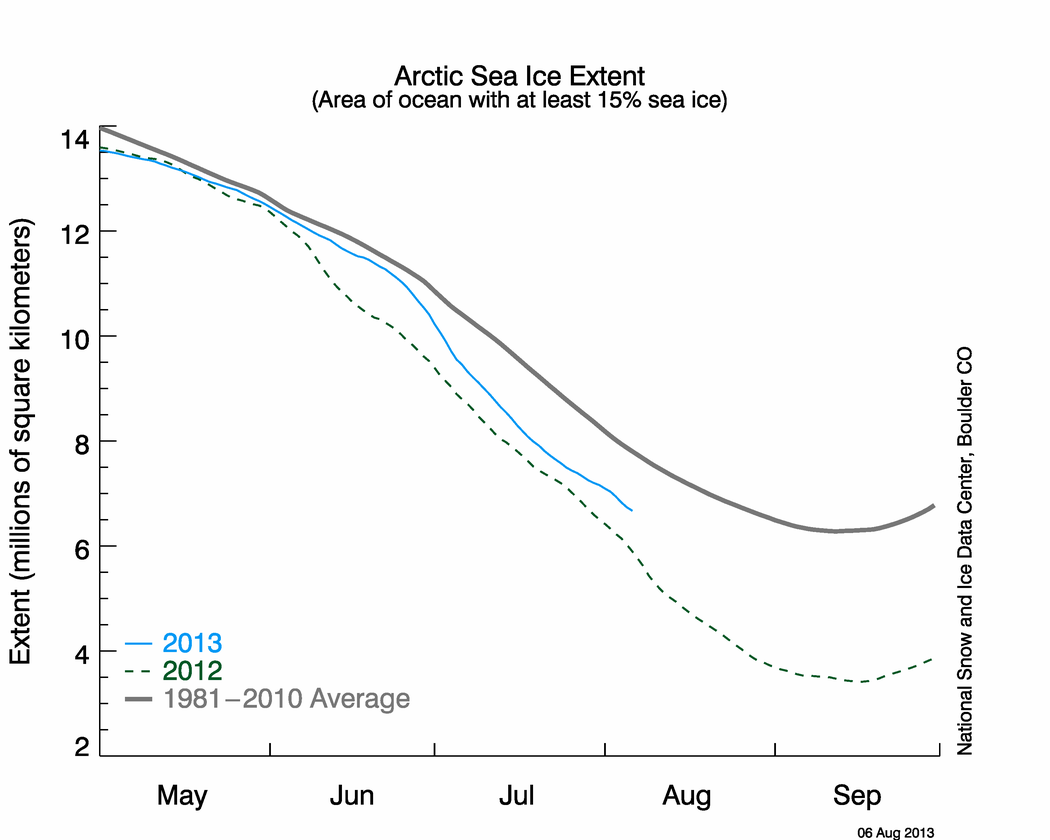
The record low Arctic Oscillation during the past winter led to a very tightly compacted central Arctic ice mass – which is clearly evident in the UIUC images above. Some commentors have found this confusing because according to NSIDC, extent is slightly lower this year than previous years. (NORSEX disagrees with the NISDC assessment, but that is a topic of a separate discussion.)

Is it possible to have higher concentration and lower extent? Of course, it is expected. If you put a 10 kg block of ice in a swimming pool, the ice will occupy a much smaller extent (and area) of the pool than a 10kg bag of ice cubes poured into the pool. Which one would melt faster? The bag of ice cubes would, because it has more surface area exposed to the water. We have an analogous situation with Arctic ice in 2010. The ice (by some measures) occupies a smaller area than the past three years – but is more concentrated.This bodes well for less melt later in the summer.
Now, let’s look at the current stats for the Arctic Basin, measured from PIPS maps.

2010 ice volume is above 2007-2009 and just below 2006.

2010 average ice thickness is approximately the same as 2006 and 2007. It is higher than “rotten ice” 2008 and 2009.

2010 Arctic Basin ice area is just below 2006 and 2007. It is higher than 2008 and 2009. When I refer to the Arctic Basin, I am considering only the region below – which corresponds approximately to the maximum September extent in the NSIDC records.
 ‘
‘
Below is yesterday’s Arctic satellite photo. The ice is very concentrated.

Conclusion : Current conditions continue to indicate a larger minimum ice extent than 2007-2009. This could change if the weather is very warm, windy or sunny during July. The ice has started to melt offshore at Barrow.

http://seaice.alaska.edu/gi/observatories/barrow_webcam
Comparison of June 10, 2008 with June 10, 2010 below. There is a lot more thick ice this year.
What about the volcanoes in that area? Any effect?
http://www.nature.com/nature/journal/v409/n6822/full/409808a0.html
Well, he can double his money by betting on that, at https://www.intrade.com
goddard said:
“I don’t believe there has been any significant melt in the Arctic Basin so far this year, as temperatures have been too cold.”
Well then you disagree with NOAA: they showed that we had quite large anomalies in the acrtic basin
http://nsidc.org/images/arcticseaicenews/20100608_Figure4.png
Temperatures were 2 to 5 degrees Celsius (4 to 9 degrees Fahrenheit) above average across much of the Arctic Ocean. Of course I know it’s cold, but stating it has been “too cold” is not consistent with anomalies.
Anu says: June 10, 2010 at 11:42 pm
Are you looking at the same image, Anu? I just brought it up (conveniently from the link you linked and from the link in that “tiny” picture Goddard posted and I can’t see what you’re talking about. The pole is solid. There’s plenty of holes and open water around the coasts of Russia and Canada, nortehrn Scandinavia, and Iceland, but the actual geographic (and indeed magnetic) pole is solid as can be. I’m honestly stumped about this open water you’re claiming to see. It’s pretty plainly solid from 70 degrees north.
HQ Video of the Melting from Day 50 to 158 this year:
Same stuff last year:
Not suitable for qualitative analysis due to video composition in time. However, the centering effect is noticable.
Steve,
A few months ago, it all seemed so simple–Flash up the NSIDC ice extent chart and point out the 2010 blue line was about to go above the average for the first time in years and bingo, AGW was busted. Yet sadly the blue line ran out of steam and now when the NSIDC chart shows ice extent has gone into a downward tail spin and looks set to show a reocrd low minimum extent, your posts on Arctic ice have become a confusing mess of data and charts to hide the decline in extent. The new argument about volume, concentration v. extent is a classic smoke screen.
P.S Keep It Simple:
http://nsidc.org/data/seaice_index/images/daily_images/N_stddev_timeseries.png
MJK.
Steve Goddard says:
“PIPS2 is the best available source of thickness data.”
—————-
Except that PIPS 2.0 is NOT data…it is a model, just as PIOMAS is. Your insistance that it is data is the most misleading thing of all.
stevengoddard says: June 10, 2010 at 9:50 pm
R Gates
The PIPS map shows the same region of ice being blown out of the Beaufort Sea as the UIUC maps. PIPS2 is the best available source of thickness data. Your claims are inaccurate.
I agree Steve, here is a blink of CT & PIPS2.
http://i49.tinypic.com/t6w9hv.jpg
stevengoddard says:
June 10, 2010 at 10:52 pm
I don’t believe there has been any significant melt in the Arctic Basin so far this year, as temperatures have been too cold. The areas of open water are primarily the result of wind.
In which case your calculations of volume for that region (if accurate) would show no change in volume whereas they actually show a drop from ~80,000 to ~65,000.
DMI show that the daily mean temperature north of 80ºN is warm enough to melt seaice. You’ve read so much of your own propaganda that you’re starting to believe it, each post over the last few weeks has seen more desperate clutching at straws, you should heed Leif’s advice given to another poster: “when in a hole stop digging”.
Arctic/Antarctic “see-saw”:
I think the globe is in for a plummeting temperature because, during the past 50 years, we have experienced the seesaw, when one pole has increased, the other has shrunk in ice content.
Now it appears ice is growing at both poles and not oscillating. This looks like we are headed for an ice age for which mankind is ill prepared due to the “prophets” of the warm-earth cult.
For people unfamiliar with Arctic Climate Research at the University of Illinois here’s some links:
http://arctic.atmos.uiuc.edu/cryosphere/NEWIMAGES/arctic.seaice.color.000.png
1296 x 1296 image of Arctic sea ice concentration
http://arctic.atmos.uiuc.edu/
Recent research related to Arctic climate and climate change at the Department of Atmospheric Sciences at the University of Illinois.
http://arctic.atmos.uiuc.edu/cryosphere/
Current sea ice and snow conditions
Willis Eschenbach says:
June 10, 2010 at 10:41 pm
But in short, I have looked where you asked us to look, and I have not seen a single one of the differences you claim are there. Expand the pips map until it fills your screen (to the same scale as the other images), remember that white = open ocean, and look again.
Willis I pointed out some discrepancies regarding the thick ice predictions of PIPS vs the satellite imagery a fer days ago. Here’s one of the more glaring examples, PIPS predicts 4-5m thick ice right where there’s a polynyna! (red on PIPS vs blue on AMSR-E)
http://i302.photobucket.com/albums/nn107/Sprintstar400/pipsASMR.gif
Amino Acids in Meteorites says:
June 11, 2010 at 3:29 am
i see there are people in comments here still trying to convince us that there has been no increase in ice since 2007
they don’t want us to believe our eyes?
What do your eyes tell you about this:
http://www.ijis.iarc.uaf.edu/seaice/extent/AMSRE_Sea_Ice_Extent_L.png
If you’re having trouble distinguishing red lines from green lines, take a look at the numbers:
http://www.ijis.iarc.uaf.edu/seaice/extent/plot.csv
2010 is 269,219 km² less Arctic sea ice than 2007.
Earth’s climate doesn’t care if people are “convinced” about anything.
The warmists have updated their story.
http://www.sciencedaily.com/releases/2010/06/100611093710.htm
Still waiting to see the slope of melt from July 1-July 15. While August will be decisive (as it usually is), those first two weeks of July could be an early indicator.
Surely if 2007’s record is in play, as some continue to insist may be in the cards, it should become apparent in those two weeks.
Likewise, if a 2006-like year is in the cards, I would expect to see significant flattening of the current trend by then.
2006 vs 2008 vs 2009 did not really separate from each other until Aug 1 tho, which shows the imporantance of thickness.
But if we’re going to have another 2007 or its near cousin, we should see it by July 15.
kadaka (KD Knoebel) says:
June 11, 2010 at 3:47 am
Excerpted from: Anu on June 10, 2010 at 11:42 pm
“Looking at the exact same data in 1296 x 1296 resolution…”
Whoa now, that would be some trick. The entire UIUC image is only 1709 x 856 pixels, same as the copy used here. If you’re blowing it up from an 856 height to a 1296 then you’re “creating” data where none exists. Are you using the James Hansen method of image processing?
Actually you have it backwards that UIUC image you refer to is the result of compressing the original image so as to compare it with an earlier image taken with a different imager. Both have somewhat different color palettes so the recent one always looks more concentrated. If you look at the original image with it’s natural color palette you’ll see what Anu is referring to. Of course Steve wants to preserve the illusion that the Arctic Basin is a dense region of compressed ice so he shows you the comparator one.
Phil & cohorts
I expect a full apology from you in September for wasting everybody’s time with your perpetual FUD.
Steve Keohane
Nice map, thanks. I continue to be astonished by the amount of BS being thrown around by some FUDsters here.
Here is my version:
Murray Duffin
I am taking names and numbers, thanks ;^)
Marc77
Thanks for the snow link. How many clueless columns have Romm and Tamino written, attacking me for simply pointing out the now acknowledged increase in winter snow?
http://www.sciencedaily.com/releases/2010/06/100611093710.htm
Phil. says:
Actually you have it backwards that UIUC image you refer to is the result of compressing the original image so as to compare it with an earlier image taken with a different imager. Both have somewhat different color palettes so the recent one always looks more concentrated. If you look at the original image with it’s natural color palette you’ll see what Anu is referring to. Of course Steve wants to preserve the illusion that the Arctic Basin is a dense region of compressed ice so he shows you the comparator one.
++++
You’re still trying to insist on the importance of comparing apples to oranges as the appropriate scientific method?
If you had the larger images for 2008 vs 2010 from UIUC, what makes you think they’d show anything different compared to each other, than what the smaller images from 2008 vs 2010 show compared to each other?
So volume matters now? When I asked that last year when AREA was higher everyone said volume did not matter. Now it does when area is lower.
Got it.
[REPLY – Area matters more because that directly affects albedo. But both matter. ~ Evan]
stevengoddard says:
June 11, 2010 at 8:38 am
Phil & cohorts
I expect a full apology from you in September for wasting everybody’s time with your perpetual FUD.
Actually we should expect an apology from you for all the FUD you produce and when challenged on the errors you just run away and hide. All the criticism about your use of PIPS could have been addressed by a single post showing the comparison of your method with volume data from PIPS itself as I suggested several times. However you have so far not even acknowledged that possibility. As I’ve shown above PIPS is putting thick ice where none exists so the results would be questionable even if you calculated them correctly. The correctness or otherwise of your method won’t be addressed by September unless you take steps to calibrate it. Your use of compressed images to demonstrate ‘very concentrated’ ice is disingenuous when you must know that at full resolution they show very fragmented ice (this has been pointed out to you several times but as usual you ignore it). Sadly this is a pattern that you have followed before so I don’t expect anything to change.
Benjamin P.
That is funny. Last year the AGW big concern was about ice volume, and this year the hysteria is about a minor deviation in extent in the annual ice of the Barents Sea.
geo says:
June 11, 2010 at 8:55 am
Phil. says:
Actually you have it backwards that UIUC image you refer to is the result of compressing the original image so as to compare it with an earlier image taken with a different imager. Both have somewhat different color palettes so the recent one always looks more concentrated. If you look at the original image with it’s natural color palette you’ll see what Anu is referring to. Of course Steve wants to preserve the illusion that the Arctic Basin is a dense region of compressed ice so he shows you the comparator one.
++++
You’re still trying to insist on the importance of comparing apples to oranges as the appropriate scientific method?
No that’s what I’m criticizing Steve for.
If you had the larger images for 2008 vs 2010 from UIUC, what makes you think they’d show anything different compared to each other, than what the smaller images from 2008 vs 2010 show compared to each other?
Here you go, full sized images made from the same imager comparing 2007 and 2010 from a couple of weeks ago (I rotated one of them to give you the same orientation):
http://i302.photobucket.com/albums/nn107/Sprintstar400/20102007comp.gif
You could always check any date for yourself .