By Steve Goddard

The sea ice concentration game.

Arctic Ice is more concentrated in 2010 than in past years
The record low Arctic Oscillation during the past winter led to a very tightly compacted central Arctic ice mass – which is clearly evident in the UIUC images above. Some commentors have found this confusing because according to NSIDC, extent is slightly lower this year than previous years. (NORSEX disagrees with the NISDC assessment, but that is a topic of a separate discussion.)
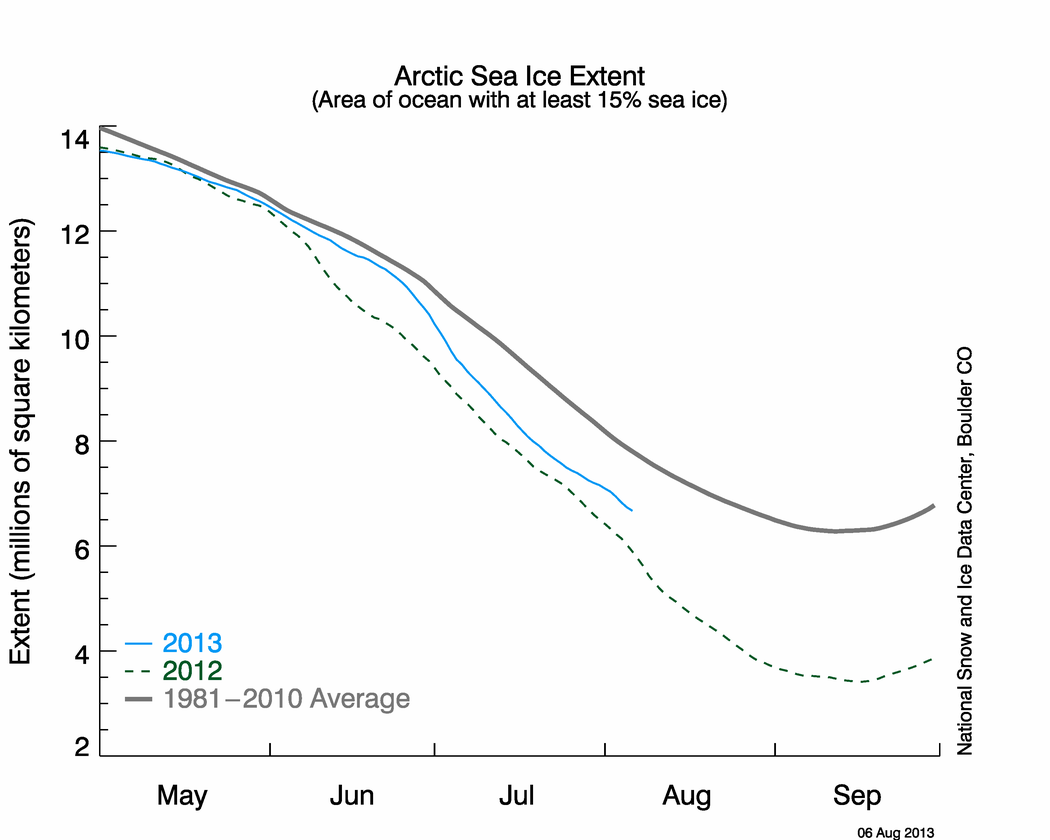

Is it possible to have higher concentration and lower extent? Of course, it is expected. If you put a 10 kg block of ice in a swimming pool, the ice will occupy a much smaller extent (and area) of the pool than a 10kg bag of ice cubes poured into the pool. Which one would melt faster? The bag of ice cubes would, because it has more surface area exposed to the water. We have an analogous situation with Arctic ice in 2010. The ice (by some measures) occupies a smaller area than the past three years – but is more concentrated.This bodes well for less melt later in the summer.
Now, let’s look at the current stats for the Arctic Basin, measured from PIPS maps.

2010 ice volume is above 2007-2009 and just below 2006.

2010 average ice thickness is approximately the same as 2006 and 2007. It is higher than “rotten ice” 2008 and 2009.

2010 Arctic Basin ice area is just below 2006 and 2007. It is higher than 2008 and 2009. When I refer to the Arctic Basin, I am considering only the region below – which corresponds approximately to the maximum September extent in the NSIDC records.
 ‘
‘
Below is yesterday’s Arctic satellite photo. The ice is very concentrated.

Conclusion : Current conditions continue to indicate a larger minimum ice extent than 2007-2009. This could change if the weather is very warm, windy or sunny during July. The ice has started to melt offshore at Barrow.

http://seaice.alaska.edu/gi/observatories/barrow_webcam
Comparison of June 10, 2008 with June 10, 2010 below. There is a lot more thick ice this year.
Discover more from Watts Up With That?
Subscribe to get the latest posts sent to your email.
MODERATOR :
There is supposed to be a youtube video below the last sentence. Please add this text:
[youtube=http://www.youtube.com/watch?v=762CMOmZ4jE&feature=player_embedded]
good stuff..i am very curious to see how this year shapes up and i am also hopeful that Bastardi is right beginning this winter!
For the period 2003 to 2009 based on JAXA data, the greatest loss on a daily basis occurs during the month of July. It was during this time that 2007 saw the worst of its loss.
I think the next 4-6 weeks will pretty much tell the story of this years minimum extent but my money is on an improvement over the 2009 result. I think we got a lot of late ice at the end of winter that melted (or broke off) very quickly leading to the falls in extent we saw in May. I think the thicker ice will be a bit more resilient.
Look at the daily ice loss on a 15 day moving average and you can already see the rate of loss levelling out when the long term trend seems to be for the rate of loss to increase until late July or August.
Having said this, my understanding is that localised conditions can always override global ones in the short term so there will always be a fair degree of uncertainty in any prediction for a single locality for a limited timeframe.
Time will tell. A solid core will likely generate faster and ultimately more extensive ice down time. Regional cold is still that.
Of course, I think Steve and everyone else knows what I (and the NIC) think of his PIPS 2.0 data, but he continues to weave in throughout his interesting tale of the current Arctic conditions. Let’s take a look at his PIPS 2.0 map for June 10, 2010 for a second, to see how severely flawed it is. Look at this map:
http://www7320.nrlssc.navy.mil/pips2/archive/retrievepic.html?filetype=Thickness&year=2010&month=6&day=10
And then compare it to these two very detailed maps:
http://arctic.atmos.uiuc.edu/cryosphere/NEWIMAGES/arctic.seaice.color.000.png
http://iup.physik.uni-bremen.de:8084/amsr/arctic_AMSRE_nic.png
And you see some major melting going on now in the Beaufort sea and out into the Arctic Basin and over into the Chuckchi Sea. Yet the PIPS 2.0 model doesn’t seem to even recognize this break up and rapidly lowering concentration of ice. Though the PIOMAS model seems to show that melt occuring:
http://psc.apl.washington.edu/zhang/IDAO/seasonal_outlook.html
In short, the PIPS 2.0 model would seem to show ice that is anywhere from one to 2.5 meters thick, where there is actually concentration falling down into the 50% range, meaning that there could even be open ocean, and in fact, if we look at this high res satellite image of the region, we can see that in fact there is a large break up of ice that is not the “shearing” that Steve was pushing as the cause of such a rapid ice extent loss just a week or so ago:
http://ice-map.appspot.com/?map=Arc&sat=ter&lvl=7&lat=73.190674&lon=-137.618661&yir=2010&day=161
Clearly this ice is melting, and concentration is falling, yet the PIPS 2.0 model misses a great part of that.
WUWT? Maybe another sign that PIOMAS has it right, and the Navy and the NIC are right in not putting much credance in the PIPS 2.0 model data?
Watch what happens in July-the melt will slow way down. Plus I feel a Nina’s coming on,
further cooling….
At the risk of Mr. Goddard sending me globe with the poles clearly identified in 100 point font, let me point out that current Antarctic sea ice concentration is significantly higher today;
http://arctic.atmos.uiuc.edu/cryosphere/IMAGES/ANT-ARCHIVE/ant.20100610.jpg
than it was in 2009;
http://arctic.atmos.uiuc.edu/cryosphere/IMAGES/ANT-ARCHIVE/ant.20090610.jpg
2008;
http://arctic.atmos.uiuc.edu/cryosphere/IMAGES/ANT-ARCHIVE/ant.20080610.jpg
or 2007:
http://arctic.atmos.uiuc.edu/cryosphere/IMAGES/ANT-ARCHIVE/antarctic.0.2007061010.jpg
Antarctic Sea Ice Extent is also currently very high and exceeds NCIDC’s misleadingly narrow normal range (misleadingly narrow due to NSIDC’s choice to exclude 2001 – 2010 data in order to make their Arctic chart look scarier/abnormal):
http://nsidc.org/data/seaice_index/images/daily_images/S_stddev_timeseries.png
With high concentration in both the Antarctic and Arctic, Global Sea Ice Area;
http://arctic.atmos.uiuc.edu/cryosphere/IMAGES/global.daily.ice.area.withtrend.jpg
may be on its way up…
A frequently overlooked factor is that the arctic ice is geographically constrained. Note that the downslope (melting) and upslope (freezing) curves tend to cluster in narrow bands. Studies of extent growth/shrinkage are complicated not only by the ice concentration, but by where the extent lies relative to shorelines.
R Gates
The PIPS map shows the same region of ice being blown out of the Beaufort Sea as the UIUC maps. PIPS2 is the best available source of thickness data. Your claims are inaccurate.
Steve Goddard said in the original piece
“The record low Arctic Oscillation during the past winter led to a very tightly compacted central Arctic ice mass ”
Can you tell me why that is, my assumption was that the negative AO led to higher temperatures at higher lattitudes which would tend to make it less. Winds?
Andy
Actually, looking at June 1989 in comparison
http://igloo.atmos.uiuc.edu/cgi-bin/test/print.sh?fm=06&fd=10&fy=2010&sm=06&sd=10&sy=1989
the ice is less concentrated in 1989, however that had a very large positive AO of 1.679 3.106 3.279 for December, January and February and so that is puzzling. 1990 has lower AO, but is less concentrated. An interesting topic in itself.
Andy
I hope Steve’s right that there’ll be a large minimum this year, but I have trouble squaring this extra thick ice with AMSR-E showing the fastest April-to-June extent reduction since records started in 2002.
R. Gates says:June 10, 2010 at 9:08 pm
R. Gates, I took a look at all three of the images (PIPS, Cryosphere Today, and AMSRE). I see very little difference between them. You need to expand the PIPS map first, but once you do, the melting in the Beaufort Sea and the Chukchi are both clearly visible, and of a comparable size to the other two images. It is perhaps a bit confusing because the PIPS map shows open ocean as white, while the other two maps show it as black.
But in short, I have looked where you asked us to look, and I have not seen a single one of the differences you claim are there. Expand the pips map until it fills your screen (to the same scale as the other images), remember that white = open ocean, and look again.
I had to read this in todays paper (both the National Post and the Vancouver Sun) …
a senior climatologist with Environment Canada “… expects to see a record retreat of the Arctic ice this summer”
Read more: http://www.nationalpost.com/todays-paper/Despite+record+rains+flurries+2010+warmest+record/3134476/story.html#ixzz0qWKR8OHV
I don’t believe there has been any significant melt in the Arctic Basin so far this year, as temperatures have been too cold. The areas of open water are primarily the result of wind.
Yeah, looks pretty tightly compacted in those tiny 270 x 270 images – which include the entire earth, plus room to spare.
Zooming in – slightly – we see:
http://climateinsiders.files.wordpress.com/2010/06/uiucjune91990vs2010.png
Ah, now a full 641 x 641 pixels are used to show the data, plus the entire northern hemisphere, plus a nice, framing starry sky. Must be almost 200 x 300 data pixels there…
Looking at the exact same data in 1296 x 1296 resolution, we see that “tightly compacted central Arctic ice mass” has a lot of open water, absorbing those always-on spring/summer rays… Lots of pinks and reds, even by the ‘pole hole’, meaning 3% to 10% open water. Yellow means about 15% open water, green about 30%, and look at those light blues – that means about 70% open water.
Also note that each “pixel” does not have the same area – they are on a sphere. To get total sea ice volume (even for the Arctic Basin), you’d need to multiply sea ice thickness for that pixel by the varying area of each pixel by the amount of that pixel covered in sea ice (concentration). And hope that your model has given you accurate sea ice thickness estimates.
══════════════════════
The importance of high resolution:
Low resolution: picket fence looks almost solid
http://tinyurl.com/2fajczo
High resolution: hey, you can see right through it
http://henbogle.files.wordpress.com/2008/05/picket-fence.jpg
“Watts Up With That?” has been included in this weeks Sites To See. I hope you like the image I featured, and I hope this helps to attract many new visitors here.
http://asthecrackerheadcrumbles.blogspot.com/2010/06/sites-to-see_11.html
A few more Arctic Sea Ice maps.
1.
http://www.weatheroffice.gc.ca/analysis/index_e.html
see Surface Analysis : Snow, Ice, SST:
http://www.weatheroffice.gc.ca/data/analysis/350_100.gif
2.
http://www.ec.gc.ca/glaces-ice/default.asp?lang=eng&n=D32C361E-1
see Western Arctic area then Regional Ice Chart – Departure from Normal Concentration:
http://ice-glaces.ec.gc.ca/prods/WIS56DPTCT/20100607180000_WIS56DPTCT_0005022692.gif
3.
http://iup.physik.uni-bremen.de:8084/amsr/regions.html
see North West Passage:
http://iup.physik.uni-bremen.de:8084/amsr/NorthWestPassage_visual.png
4.
http://www.ifm.zmaw.de/forschung/fernerkundung/meereis/amsre-sea-ice/
see Daily updated AMSR-E sea ice concentration maps:
ftp://ftp-projects.zmaw.de/seaice/NEAR_REAL_TIME/Arc_latest_large.png
5.
http://www.arcus.org/search/seaiceoutlook/2009_outlook/2009_pan-arctic_summary.php
see Figure 7 and 8:
6.
Daily Tracks with NCEP Ice
http://iabp.apl.washington.edu/maps_daily_trackncep.html
http://iabp.apl.washington.edu/maps_daily_arcticbasin.html
7.
http://polar.ncep.noaa.gov/seaice/Analyses.html
see MMAB Sea Ice Concentration — Northern Hemisphere high resolution
http://polar.ncep.noaa.gov/seaice/hires/nh.xml
Regards
Anu says:
June 10, 2010 at 11:42 pm
It is natural to think that high resolution will always give you more information than low resolution, and it is also a sign that you do not have much experience or any of quantitative image analysis in either 2D or 3D. We are talking about measuring differences between two images / datasets. What you find in the real world, as I have discussed earlier with R Gates, is that, somewhat counter-intuitively, if you take images of two samples (or groups of samples) with fine spatial structure, and image them at a set of different resolutions, the ability of image analysis so measure differences between the two samples is surprisingly well preserved with decreasing resolution. In some cases the ability to measure difference is oddly strengthened by decreased spatial resolution. This is related to signal to noise ratio.
As I said before, I’m not arguing that low is better than high – everyone involved in image analysis (which is my day job at present) likes the highest resolution and best images. But it definitely is not a general truth that lower resolution means decreased or no ability to see differences. Often the reality is very little change.
What adds to this is if the structures in question have fractal pattern – similar architecture repeating at different spatial scales. A snowflake is a fractal object. Many coastlines are also, and Arctic ice probably is also fractal to some degree.
So this resolution argument wont work as a way of refuting the conclusion from the images posted above that the Arctic ice currently does have a high concentration.
i see there are people in comments here still trying to convince us that there has been no increase in ice since 2007
they don’t want us to believe our eyes?
Why not wait a few months and try not to get too excited?
Yes, what’s happening to ice is of continuing general interest, especially the teasing out of all the reasons for ice cover changes – winds, water currents, insolation – with the attendant difficulty of reading long term climate signals from ice cover.
But whether the earth has warmed a bit/is still warming/may be on a plateau/is beginning to cool, doesn’t speak directly to the “CA” bit of CAGW/CACG. Well, I suppose cooling would! But I’m always seeing/arguing about confusion between climate shifts as such, and “warming from man made CO2”: to accept there may have been a little warming isn’t to accept that it’s all CO2 driven via positive feedbacks. Or that warmer = catastrophe.
But, darn it, I forget that the Media don’t care about logic so loads of ice would help off set the poor furry wurry poley bear argument…
Thanks to ALL you informed types who blog here, it really helps us less informed ones, and to Anthony & mods for running it.
Not ignoring that many alarmists used 2007 to sell horror stories but if as is widely accepted on both sides that 2007 was an extraordinary low due to weather (winds) and if 2008 and 2009 represent a recovery from that extraordinary event then what can we say?
Well it looks like 2010 is going to have a lower extent than 2006. The recent downward trend as measured by satellites is continuing. I still accept that this time period is short (1979 to present) and what happened in the 30’s and 40’s is important but that downward trend still needs to be explained.
You seem to have ignored any analysis of temperature in many of your recent posts, which ultimately is what we are concerned with here.
Excerpted from: Anu on June 10, 2010 at 11:42 pm
Whoa now, that would be some trick. The entire UIUC image is only 1709 x 856 pixels, same as the copy used here. If you’re blowing it up from an 856 height to a 1296 then you’re “creating” data where none exists. Are you using the James Hansen method of image processing?
The importance of using the same data. That is not the same fence, the slat and space widths are not known, we don’t know if the ratios are the same… They weren’t even taken from the same angle or distance. Heck, if you want to see through a picket fence all you have to do is get close to it, and the second picture is clearly taken closer than the first. If that second picture had been taken at that distance but at the same resolution as the first, you still would see lots of detail right through it.
Now let’s see some real analyses of the same data. If you don’t mind, of course. 🙂
Does anyone have access to a chart showing water temperatures in the Arctic (surface and 2 metres below) once the ice has melted? Presumably this will be substantially different according to location, so specific locations rather than an avberage would be useful.
Tonyb
Mr. Gates, also look at where the ice is. The western Alaska/Siberia area is where the ice went away in 2007, and its where the ice is most concentrated this year. That PIOMASS model for late August looks most unlikely, even to the point of absurdity. Mr. Goddard, please bookmark that model so we can see a comparison with actual at end August. Hopefully the result of such a comparison will put the subject to rest in only about 2&1/2 months. Murray