By Steve Goddard

The last piece of ice remaining in the Arctic

The death spiral continues, with Arctic ice extent and thickness nearly identical to what it was 10 years ago.


The graph above shows superimposed volume data (calculated from PIPS) for 2010, on top of the NSIDC extent data. Interesting to note that volume continued to increase for about a month after extent started to decline. This is because the Arctic Basin has remained below freezing, while the lower latitudes have been melting.
In the video of 2010 ice below, you can see how ice has been piling up to a depth of nearly five metres (red) on the windward side of Wrangel Island, the New Siberian Islands, and the Taymyr Peninsula.
Ice thickness in Barrow, AK seems to have reached it’s maximum this week, at about 4.3 metres feet.

University of Alaska – Barrow Ice Sensor
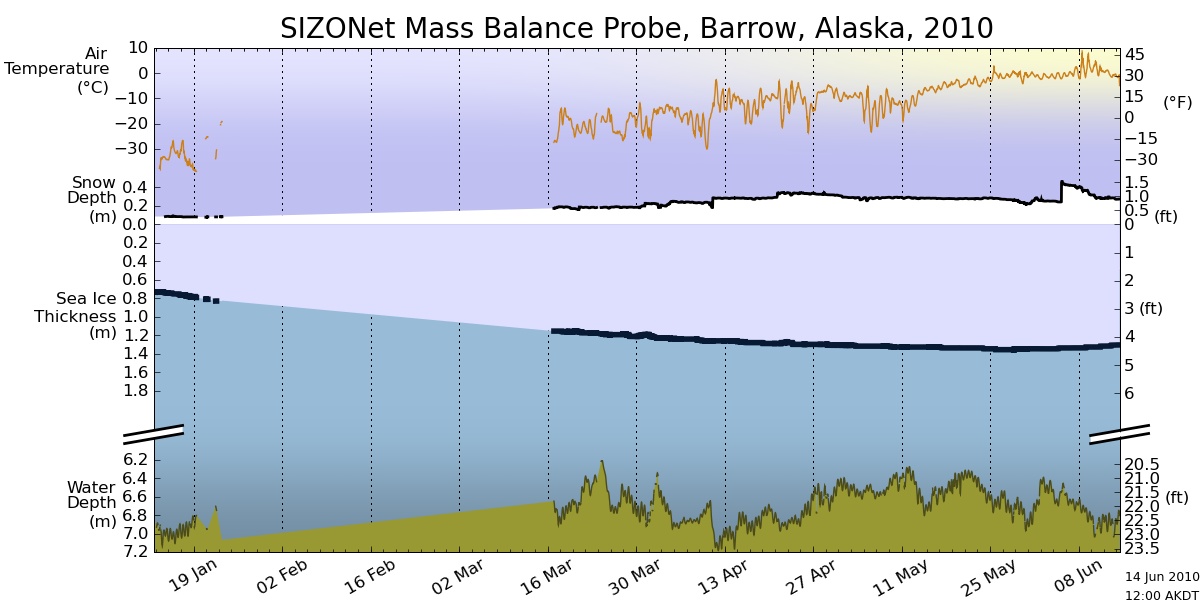
Temperatures in the Arctic interior have remained cold, and well below freezing. Not much opportunity for melt.

http://ocean.dmi.dk/arctic/meant80n.uk.php
You can see the Arctic temperature anomalies over the last 30 days in the video below:

The four major extent indices continue to diverge, with the next couple of weeks showing almost no year over year variability.

http://ocean.dmi.dk/arctic/plots/icecover/icecover_2010.png

The modified NSIDC image below shows in red where ice has disappeared since early April.

The modified NSIDC image below shows in red where ice has disappeared in the last week.

The modified NSIDC image below shows a comparison between 2010 and 2007. Areas in green have more ice than 2007. Areas in red have less ice than 2007.

The modified NSIDC image below shows in red areas of ice deficiency relative to the 30 year mean, with areas of excess shown in green. The cold Pacific side has excess ice, while the warmer Atlantic side has a deficiency..

This corresponds quite closely with sea surface temperature anomalies seen below.

http://weather.unisys.com/surface/sst_anom.html
The image below from September 15, 2007 is the one which most interests me this week. After the big “melt” of 2007, it was widely reported that researchers expected the ice to be gone by 2013, and that “in the end, it will just melt away quite suddenly.”


How is five metre thick ice supposed to “just melt away quite suddenly?”
————————————————————————————-
From the linear predictions department :
Temperatures in Colorado have warmed up 20 degrees in the last two weeks. If that trend continues, it will become hot enough to boil water before Christmas. And the Arctic will be ice free by 2013.

Sources:
http://seaice.alaska.edu/gi/observatories/barrow_sealevel/brw2010/BRW_MBS10_overview_complete.png
http://seaice.alaska.edu/gi/observatories/barrow_sealevel/brw2010/BRW_MBS10_overview_complete.png
And finally, GLOBAL sea ice has returned to normal:

Discover more from Watts Up With That?
Subscribe to get the latest posts sent to your email.
Al Gore accurately quoted Maslowski
https://docs.google.com/fileview?id=0B3Kz9p_7fMvBMDU5ZjkxMjQtMDhhNy00ZDM1LThhYzgtM2QxOWI3ZGQ4MjU1&hl=en
It’s amazing how you’ve superimposed the ice volume line onto the ice extent graph as if to suggest that it’s way, way, WAY above statistical average, whereas in actual fact Arctic sea ice volume has been declining steadily over the past years, and is currently at its lowest level ever.
I wonder what you’re going to do to persuade yourself it’s still business as usual when all that summer ice is gone.
The linear predictions model is clearly shown to be quite stupendously accurate in that most important arena of human reproduction, isn’t it?
Don’t these folks know what hysterisis loops are??
I don’t care what conspiracy of “global governance” there was behind the metric system — that fact is, metric is so much easier to work with than imperial measurements. How anyone can possibly defend the use of the imperial system, especially if they’re a scientist, is absolutely beyond me. At what temperature does water freeze on the Celsius scale? Why, zero! At what temperature does it boil? Why, 100! (assuming STP of course). It is contradictory for any first-world developed country to continue to use imperial in this day and age and yet call themselves modern.
The discussion about soot made me wonder if anyone knows of any research into the nett effect on the global energy budget of melting ice? I do not mean models I mean actual measurements (sorry I know its a bit old fashioned!). It seems that the current model is a knee jerk assumption that ice reflects sunlight so if it melts the sea will absorb more and therefore warm. However it seems to me that the following model could also be true.
Ice melts on the surface and once a film of water has formed this will absorb energy at a similar rate to open sea. Of course if there are soot particles it will definitely absorb at or above the rate of open sea. On the other hand the energy radiated from the surface of water on top of ice will be less than that radiated from open sea because the temperature will be lower. Thus ice is a nett warmer rather than a net cooler. It is equivalent to going out on a sunny but icy winter’s day with or without a thick but shiny hat. I think the shiny hat would still keep my head warm rather than cool it down.
This would also address rbatemen’s view that if carbon particles were the cause of the ice age ending another ice age would never reform. If open water at the poles actually increases the nett loss to space one would see a slow warming as the ice got thinner and thinner and then a dramatic cooling as soon as the ice vanished completely. Although the regular periodicity of the ice ages makes an external forcing the only plausible explanation for them ( Milankovich cycles) it is possible that such a feedback mechanism might alter the actual timings by a thousand years or so.
Does anyone know if either model has been PROVEN to be correct?
Steve, it appears from this posting that you are deliberately trying to hide the ice extent decline. Many sources are now showing the ice extent right now to be the lowest observed during the satellite data record at this time of year, yet you continue to try to find other distractions so as not to mention this fact.
It is very misleading to show an ice volume (with no units) on top of sea ice extent, and to show volume for 1 year without putting it into context of several years. Nor is it scientifically correct to pick two years (i.e. cherry picking) to try to make a point. It is long-term trends that are of importance, not individual years. Even so, stating that the ice is the same as it was 10 years ago simply is not true, there is no data supporting this claim.
It is also incorrect to state that melt is not occuring in the Arctic. Solar radiation penetrates just below the surface of snow, causing melt to happen in the snow pack even if surface air temperatures have not yet reached 0 deg celsius. When melt is active in summer, the energy from the sun is used to melt the ice, keeping near surface air temperatures near 0 deg celsius. In addition, the southern reaches of the Arctic already observe air temperatures of 0 deg celsius, which is the normal progression (melt happens first in the souther latitudes, moving further northward as summer progresses). Thus, surface melt has already started in the Arctic. You can look the MODIS imagery yourself to see surface melt occuring.
There is only 1 scientist stating ice-free summers by 2014, and that’s who Gore has relied on for his statements. It is unfortunate that Gore does that, he obviously likes drama, but that’s politics and media, not science.
I think you lose credibility by not focusing on good data analysis and instead resorting to cherry-picking, false display of data and erroneous statements. There are some valid points to debate, but you seem to miss those.
JJB
All of the information in this article is accurate. But nice FUD on your part.
barry says:
May 31, 2010 at 10:08 pm
As much authority was vested in the US Navy’s sea ice data in the last post on the subject, it might be worth posting an actual study from that institution.
http://soa.arcus.org/sites/soa.arcus.org/files/sessions/1-1-advances-understanding-arctic-system-components/pdf/1-1-7-maslowski-wieslaw.pdf
(5.6 MB download)
Their projection is a possible ice-free Arctic in fall by 2016. Strangely, they looked at a range of data sets over a long period, rather than picking out a couple of data points, but perhaps the Navy doesn’t know what it’s doing.
_______________
Thanks for that link Barry. Excellent post, and excellent counterpoint to Steve’s insistance that sea ice volume has increased 25%. And BTW, some of the charts used in that report come from the PIPS 3.0 data.
One brief follow-up to the previous post, which come from the conclusion section of the report. It says:
“The rate of decrease of sea ice thickness and volume appears to be much greater than that of sea ice extent…”
This is exactly what the PIOMAS model is showing as well, and some of the reasoning behind my suggestion that we’ll see a lower summer minimum this year than 2008-2009.
http://igloo.atmos.uiuc.edu/cgi-bin/test/print.sh?fm=05&fd=31&fy=2010&sm=05&sd=31&sy=1979
Extent is less, but concentration is higher. Depending on how much is blown out of the arctic, I think the melt will not set a record this summer.
R Gates,
You are correct. Volume hasn’t increased by 25% since 2008. A more accurate number is 36%.
We need to stop making the argument that sea ice cannot melt if air temps are below zero (C). It can – provided there is water under the ice. A gradient of ice temperature exists between the ice-water interface (always around 0) decreasing toward the top surface air interface. The colder the air, the colder and thicker the ice.
But its still going to recover in September 🙂
Not much ice drift forcasted for (actually none that I can see) Fram Strait. We should be seeing an upturn in our graph, reflecting the lack of flush, and instead melting in place based on Sun power.
http://www.aari.nw.ru/clgmi/forecast/show_drift.asp?fign=0&lang=0
Freaks.
“It was invented by the French Revolution in its effort to de-sacralize reality, it was part of a wider secularizing project, to deny human ethics and moral principles. The STATE should replace GOD.”
And that is why they drive on the right.
(Sorry – totally O/T)
BO says:
June 1, 2010 at 9:14 pm
Problem with BO? I find that Dove for men roll-on is a good solution, neutral pH, doesn’t pinch the hairs like some roll-ons, lasts longer than a stick.
stevengoddard says:
June 1, 2010 at 2:05 pm
R Gates,
You are correct. Volume hasn’t increased by 25% since 2008. A more accurate number is 36%.
——————————-
Steve, you are basing this on a model, which is not reality. Please only use real data to make such assessments.
Real data would likely show an increase in ice volume since you have more of the old ice today in the Arctic Basin than you had in 2008. So it is very likely that thickness did increase somewhat in the last 2 years, but you can’t put a number to it because you don’t actually have the thickness data to do that. Maybe you can find a scientist to process ENVISAT data for you so that you can at least have some thickness observations for part of the Arctic. That would help you to make your point, using model data to make your point is pointless.
And I do disagree with you, nothing in your post was accurately stated. It seems you are afraid of letting the data speak for itself. Me thinks you are scared that your predictions are way off base so you are trying hard to divert attention to what the data are actually showing. But there are many of us on this site you can see through your attempts.
JJB
You claimed that everything in this post is inaccurate, and failed to cite a single example. Pretty lame.
Based on the Vostok Antarctic core analysis it would appear to me that earth is overdue for an ice age.
http://wattsupwiththat.com/2009/12/09/hockey-stick-observed-in-noaa-ice-core-data
In geography, do we know what the current position of earth is as regards to the Milankovitch cycles? Looking at the Vostok record, there does seem to be a progressive increase in time spans between previous 3 interglacials, i.e. ca. 87000, 110000, 120000 years but I have no idea as to whether this is linear, logarithmic or exponential. Any ideas/ Any one/?
stevengoddard says:
June 2, 2010 at 9:23 am
JJB
You claimed that everything in this post is inaccurate, and failed to cite a single example. Pretty lame.
Well apart from the obviously false first sentence (an attempt at humor), there are quite a few, the most obvious:
Temperatures in the Arctic interior have remained cold, and well below freezing. Not much opportunity for melt.
An average of -3 to -4ºC north of 80ºN isn’t “well below freezing”, which for sea ice is about -2ºC.
“Ice out” in Gulf of Bothnia at about May 29.
SMHI last ice report for the season by May 27 show very little ice left:
http://www.smhi.se/oceanografi/istjanst/produkter/sstcolor.pdf
SST report May 31 show no ice but some floebits still hanging around at 65 0N.
A heat wave from Russia during 8 days in the middle of May with 25-28 0C 🙂 perhaps had some effect. Today about 10 deg C. 🙁
NSIDC sea ice images still show some ice left in the Riga Bay and in the Finnish Bay.
There remains no ice and hasn´t been any for several weeks. Something is clearly wrong with the images.
Well, we’ve had three days in a row of new IJIS arctic low ice extent records.
The North-West Passage is not about to be re-opened for business!