By Steve Goddard

The last piece of ice remaining in the Arctic

The death spiral continues, with Arctic ice extent and thickness nearly identical to what it was 10 years ago.


The graph above shows superimposed volume data (calculated from PIPS) for 2010, on top of the NSIDC extent data. Interesting to note that volume continued to increase for about a month after extent started to decline. This is because the Arctic Basin has remained below freezing, while the lower latitudes have been melting.
In the video of 2010 ice below, you can see how ice has been piling up to a depth of nearly five metres (red) on the windward side of Wrangel Island, the New Siberian Islands, and the Taymyr Peninsula.
Ice thickness in Barrow, AK seems to have reached it’s maximum this week, at about 4.3 metres feet.

University of Alaska – Barrow Ice Sensor
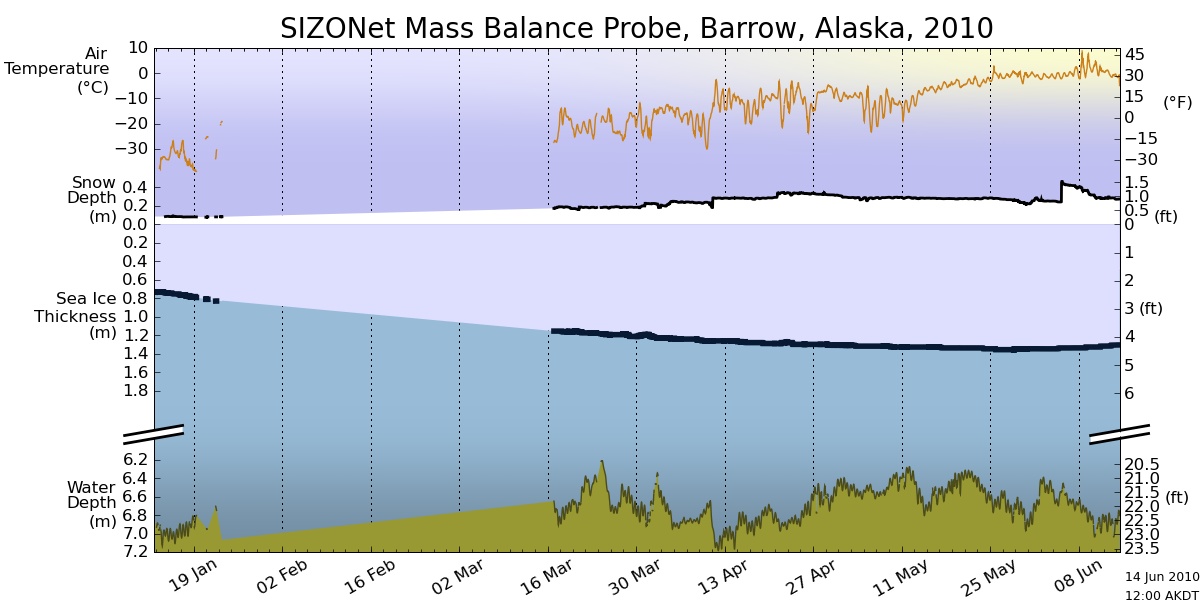
Temperatures in the Arctic interior have remained cold, and well below freezing. Not much opportunity for melt.

http://ocean.dmi.dk/arctic/meant80n.uk.php
You can see the Arctic temperature anomalies over the last 30 days in the video below:

The four major extent indices continue to diverge, with the next couple of weeks showing almost no year over year variability.

http://ocean.dmi.dk/arctic/plots/icecover/icecover_2010.png

The modified NSIDC image below shows in red where ice has disappeared since early April.

The modified NSIDC image below shows in red where ice has disappeared in the last week.

The modified NSIDC image below shows a comparison between 2010 and 2007. Areas in green have more ice than 2007. Areas in red have less ice than 2007.

The modified NSIDC image below shows in red areas of ice deficiency relative to the 30 year mean, with areas of excess shown in green. The cold Pacific side has excess ice, while the warmer Atlantic side has a deficiency..

This corresponds quite closely with sea surface temperature anomalies seen below.

http://weather.unisys.com/surface/sst_anom.html
The image below from September 15, 2007 is the one which most interests me this week. After the big “melt” of 2007, it was widely reported that researchers expected the ice to be gone by 2013, and that “in the end, it will just melt away quite suddenly.”


How is five metre thick ice supposed to “just melt away quite suddenly?”
————————————————————————————-
From the linear predictions department :
Temperatures in Colorado have warmed up 20 degrees in the last two weeks. If that trend continues, it will become hot enough to boil water before Christmas. And the Arctic will be ice free by 2013.

Sources:
http://seaice.alaska.edu/gi/observatories/barrow_sealevel/brw2010/BRW_MBS10_overview_complete.png
http://seaice.alaska.edu/gi/observatories/barrow_sealevel/brw2010/BRW_MBS10_overview_complete.png
And finally, GLOBAL sea ice has returned to normal:

How can I get Dr. Bill to put me on his mailing list?
[snip]
Permanent arctic sea ice is melting. The remaining ice is thinner and moving more freely sooner in the season. If you have a pond three quarters covered with ice, you have 75% ice extent. If you break that ice into tiny fragments spread over the entire pond, you have 100% extent of ice cover. The degree of that cover, fairly obviously, is still 75%. The area of actual ice is still 75% of the pond area. Extent and area are not the same thing.
The fact that the arctic has broken up sooner than normal is not good.
It’s not a hard thing to grasp. The arctic will be essentially ice free during the summer. Not sure if it when it will happen, but the trend is clear enough for all to consider.
How should we define an ice free arctic:
Less than 100,000 km^2 ice in the entire basin?
Open water (>7,000,000 km^2) with less than 5% ice?
No multi-year ice?
Will iceburgs count?
Icarus says:
Given that Arctic temperature continues to rise (quite substantially in recent decades)
– as it did around 70 years ago. The recent warming is probably not any more exceptional than the previous Arctic warming period.
and that this rise can only reasonably be attributed to anthropogenic influences,
Or not. See e.g. this, posted by Roy Spencer today: http://www.drroyspencer.com/2010/05/misinterpreting-natural-climate-change-as-manmade/
can anyone honestly expect the current long-term decline of Arctic sea ice to slow down, stop or reverse?
Please. You must have understood by now that the graph you’re pointing to shows the output of a model that has not been verified since 2007.
“How is five metre thick ice supposed to “just melt away quite suddenly?”
Well, looking at the 2010 situation you might notice that the 5-meter zones close to Greenland and North Canada (theonly ones surviving by the end of September) almost vanished. We’ll talk this over in 5 years or so.
What is the official WUWT prediction for this Sep minimum? 500k more than 2009?
Lee Kington says:
May 31, 2010 at 9:43 am
Lee offers the following quote concerning the Antarctic ice record:
“Overlooked in climate projections until recently, carbon black is a powerful warming agent. The soot, scientists speculate, came from giant wildfires that likely occurred in Australia and South America. So much soot could have raised temperatures.”
This begs a question: Does soot cause warming or does warming cause more soot? If warming causes increased botanical/biosphere growth, this would provide more source material for soot. These darned feedback loops are so annoying! Is it a causative agent or merely an indicator material?
rbateman says:
May 31, 2010 at 11:09 am
How much warming can soot cause when it’s buried under another meter of fresh ice?
Minimal precipitation at the WAIS Divide. Annual layers in the ice at about 1 cm thick. How many years to build up that meter of ‘fresh’ ice? How much soot deposited yearly?
I would say that a significant amount of warming could occur for a prolonged period of time. But then… that is just a guess.
Seems by that map even the Atlantic as a whole has cooled compared to the last few months. What’s up with that? Think the excess heat from the 80’s, 90’s and early 00’s is finally running bit low?
Peter Foster says:
May 31, 2010 at 10:34 am
Ah, but metric is so nineteenth century. We’re in the digital age, now. Imperial volume measures were based on halves and doubling—in other words, computer friendly powers of two.
The same halving and doubling exists for dry measures, e.g. bushels pecks, and quarts.
I didn’t remember all the name values, but what I did should look familiar. 🙂
cheers,
gary
What exactly is that polar bear doing to that last piece of ice?
And why does that ice look like Al Gore’s head?
rbateman says:
May 31, 2010 at 11:09 am
How much warming can soot cause when it’s buried under another meter of fresh ice?
— —
You are touching something that has been in the back of my mind for quite a while. The answer is not much if any at all. And if the next year is similar with more snow, not much again.
But when a warmer period comes along the top layers melt which concentrates the soot at lower levels. Many years of this would cause all the multi-year soot to now be concentrated at the bottom thin layer. Presto, complete melt.
In other words, is that mechanism partially at fault in the 2007 melt? Was it temperature driven at all?
Richard G writes,
“This begs a question: Does soot cause warming or does warming cause more soot? If warming causes increased botanical/biosphere growth, this would provide more source material for soot. These darned feedback loops are so annoying! Is it a causative agent or merely an indicator material?”
June issue of National Geographic has a nice, typically well illustrated cover story about Greenland. The most dramatic photos show recent melting on the surface of the ice sheet east of Illulissat. There we see another of those positive feedbacks in action, as warming temperatures cause more melting that leaves more of the ice surface covered with a black residue from particles formerly dispersed through many layers of ice, but now concentrating at the surface where they soak up more heat and speed melting further….
http://ngm.nationalgeographic.com/2010/06/table-of-contents
I forgot to blame CO2 for more soot: Increased aerial CO2 results directly in increased biomass production in plants leading to more biofuels leading to more soot leading to more warming leading to…AURGH… ANOTHER FEEDBACK LOOP…I wish you guys could keep all these independent variables corralled. One at a time here. Dependent, independent. Egg, meet Mrs. Chicken. Chicken, meet Mr. Egg.
Sea ice forms from the bottom. Fresh ice won’t cover dirty old ice.
It’s always amazing how polar bears can make a diving board out of most anything!
I remember watching some polar bears at the zoo, really playful, they would climb up this stack of bolders to get a great high enterance into the pool below, splash a huge amount of water out as they dived in. Looks like the one pictured above has found a good one. Look closely, that bear is thanking Al and WWF for his new playset!
Steve Goddard says:
May 31, 2010 at 2:57 pm
Sea ice forms from the bottom. Fresh ice won’t cover dirty old ice.
— —
But snow will! It does snow in the Arctic doesn’t it? 🙂
Andrew Xnn
There is no such thing as permanent Arctic sea ice. After a few years it always gets flushed out in the North Atlantic.
wayne,
You can see that the snow has started to melt over the last few days.
http://seaice.alaska.edu/gi/observatories/barrow_sealevel/brw2010/BRW_MBS10_overview_complete.png
wayne says:
May 31, 2010 at 2:39 pm
In other words, is that mechanism partially at fault in the 2007 melt? Was it temperature driven at all?
According to the DMI temp >80N graph for 2007, no.
I’m not even sure that the angle of insolation at those latitudes is sufficient to make a difference.
The wind explanation still wins, and NASA’s wind model results for Mars Arctic Cap looks like a winner too.
Gneiss says:
May 31, 2010 at 2:46 pm
If that was the case, the 1st forest fire that came along in an Ice Age would doom it to an early end.
Not going to get 80,000 yrs of Ice Age out of 100,000 .
Gneiss says:
May 31, 2010 at 2:46 pm
There is no question soot on snow increases sublimation/melting/wasting/consolidation. I typically sprinkle wood ash from my stove on my snowbound garden and walkways. I can coax the snow to melt and the soil temperature up to planting temps 30 or more days ahead of untreated areas by doing so. But it is NOT increasing air temperatures past the boundary layer until the snow is gone, and then only on the microclimate level.
The common fallacy in the climate debate is that global temperature averages equate to climate. I maintain that all climate is local, not global, and is described by biome (i.e. Mediterranean, Alpine, Taiga, Sonoran, …) not temperature. Deserts are defined by moisture, not temperature. Rain forests are defined by… (rimshot) Rainfall… not temperature. Temperature is a component but does not wag the dog. Available water in all it’s phases is the 800 lb (400 kg) gorilla in the climate debate. May I introduce you to King Kong?
Many question why this weekly update exists.
I would say that the MSM supplies a pretty constant message that the ‘ice is melting’, and these threads go some way to providing a constant message that everything is pretty much within normal variability.
You don’t see that constant message anywhere else (I may be wrong, sorry), so it is therefore valuable.
Have you never noticed that in just about *every* ‘debate’ on TV between warmist and a skeptic there is a constant background montage of mainly calving icebergs and melting ice (ie what happens every year). Do we not have some obligation to counter that erroneous message in some way?
rbateman says:
May 31, 2010 at 3:40 pm
According to the DMI temp >80N graph for 2007, no.
I’m not even sure that the angle of insolation at those latitudes is sufficient to make a difference.
The wind explanation still wins, and NASA’s wind model results for Mars Arctic Cap looks like a winner too.
The winds, ah the winds, I would agree they have at least a magnitudes larger effect.
Good point. I just keep that “soot” effect in my mind having watched what a very thin sprinkling of fireplace ash does to my driveway in the winter. I never shovel. And if that layering up and down over the decades is there, I can see how that would, at some time, after years of accumulation, cause a total melt to flush the soot back to the sea, starting a new decadal cycle. That was my comment, a smaller seconary effect.
rbateman writes,
“If that was the case, the 1st forest fire that came along in an Ice Age would doom it to an early end.”
If what was the case? You took some kind of leap and lost me there.
Lee Kington says:
May 31, 2010 at 9:43 am
Anthony…. Ice news , of a different nature, from the other end of the globe…….
” The first samples already reveal intriguing evidence of climate complexity. In ice layers attributed to the Middle Ages, when Europe was unusually warm, the team found surprisingly high levels of carbon black particles, or soot. Levels were found to be twice as high as during the more heavily populated and industrialized 20th century, says geochemist Ross Edwards at the Desert Research Institute in Reno, Nev.
Overlooked in climate projections until recently, carbon black is a powerful warming agent. The soot, scientists speculate, came from giant wildfires that likely occurred in Australia and South America. So much soot could have raised temperatures.
Preliminary tests also showed that soot levels dropped during the cooler centuries after the Middle Ages, a period known as the Little Ice Age. “
http://online.wsj.com/article/SB10001424052748704655004575114010457906340.html?mod=wsj_india_main
___________________________________________________________________________
Note how the Klimate Psychientists are working hard to blame anything but the sun for climate changes.
Earlier research reported by NASA
The Sun’s Chilly Impact on Earth
“The paper, “Solar forcing of regional climate change during the Maunder Minimum,” by authors Drew Shindell, Gavin Schmidt, and David Rind, from NASA’s Goddard Institute for Space Studies and co-authors Michael Mann and Anne Waple, from the Universities of Virginia and Massachusetts respectively, appears in the Dec. 7 issue of Science
text
Skepshasa: May 31, 2010 at 1:32 pm
How can I get Dr. Bill to put me on his mailing list?
It isn’t a public list, Skepshasa; they’re just some people that I know. You might consider doing the same yourself – the ‘act locally’ paradigm. If you are reasonably well-respected by your friends and the people you work with, and take pains to be realistic, you can have an effect. Not taking yourself too seriously, and including a bit of levity, doesn’t hurt either. ☺
/dr.bill