By Steve Goddard

The last piece of ice remaining in the Arctic

The death spiral continues, with Arctic ice extent and thickness nearly identical to what it was 10 years ago.


The graph above shows superimposed volume data (calculated from PIPS) for 2010, on top of the NSIDC extent data. Interesting to note that volume continued to increase for about a month after extent started to decline. This is because the Arctic Basin has remained below freezing, while the lower latitudes have been melting.
In the video of 2010 ice below, you can see how ice has been piling up to a depth of nearly five metres (red) on the windward side of Wrangel Island, the New Siberian Islands, and the Taymyr Peninsula.
Ice thickness in Barrow, AK seems to have reached it’s maximum this week, at about 4.3 metres feet.

University of Alaska – Barrow Ice Sensor
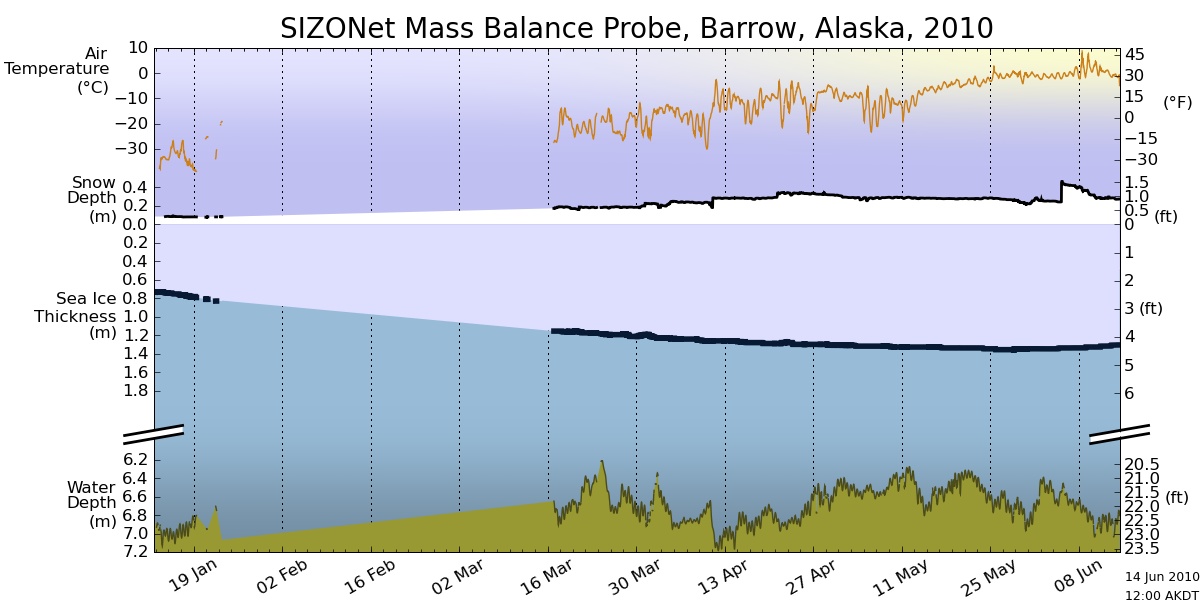
Temperatures in the Arctic interior have remained cold, and well below freezing. Not much opportunity for melt.

http://ocean.dmi.dk/arctic/meant80n.uk.php
You can see the Arctic temperature anomalies over the last 30 days in the video below:

The four major extent indices continue to diverge, with the next couple of weeks showing almost no year over year variability.

http://ocean.dmi.dk/arctic/plots/icecover/icecover_2010.png

The modified NSIDC image below shows in red where ice has disappeared since early April.

The modified NSIDC image below shows in red where ice has disappeared in the last week.

The modified NSIDC image below shows a comparison between 2010 and 2007. Areas in green have more ice than 2007. Areas in red have less ice than 2007.

The modified NSIDC image below shows in red areas of ice deficiency relative to the 30 year mean, with areas of excess shown in green. The cold Pacific side has excess ice, while the warmer Atlantic side has a deficiency..

This corresponds quite closely with sea surface temperature anomalies seen below.

http://weather.unisys.com/surface/sst_anom.html
The image below from September 15, 2007 is the one which most interests me this week. After the big “melt” of 2007, it was widely reported that researchers expected the ice to be gone by 2013, and that “in the end, it will just melt away quite suddenly.”


How is five metre thick ice supposed to “just melt away quite suddenly?”
————————————————————————————-
From the linear predictions department :
Temperatures in Colorado have warmed up 20 degrees in the last two weeks. If that trend continues, it will become hot enough to boil water before Christmas. And the Arctic will be ice free by 2013.

Sources:
http://seaice.alaska.edu/gi/observatories/barrow_sealevel/brw2010/BRW_MBS10_overview_complete.png
http://seaice.alaska.edu/gi/observatories/barrow_sealevel/brw2010/BRW_MBS10_overview_complete.png
And finally, GLOBAL sea ice has returned to normal:

Discover more from Watts Up With That?
Subscribe to get the latest posts sent to your email.
Question (OT) : Perhaps I’ve been misreading the colors on the anomoly chart , but the sea surface temps off the Southeastern coast don’t appear to be unusually warm , but I have heard repeatedly on the Weather Channel that these waters are experiencing record warmth . Can anyone tell me what gives ?
I appreciate these weekly postings, but I hate how you put the most positive face possible on the data, in direct contradiction to the AGW-ers, but with no less of a bias.
In April it was all, woohoo, we’re almost to their definition of normal, we’re better than 2002-2009, but in May it wasn’t, okay we dropped below all of 2002-2009 and are well below their definition of normal BUT it’s still fine because of this, this, and this… in May it was just, hey we’re still doing great because of this, this, and this.
There’s a lot of data to cherry-pick around; don’t cite certain comparisons when they support us if you’re not going to cite them when they don’t. The truth can speak for itself either way.
Richard M says:
May 31, 2010 at 9:51 am
Excellent! I think the gov’t will pony up a few million for you to add one more variable to your model, CO2, since CO2 causing everything, you stand to make millions! Can i jump on your team? oh, you forgot rotten ice too…
P Walker says:
May 31, 2010 at 11:25 am
Can anyone tell me what gives ?
Here you are:
http://www.vukcevic.talktalk.net/AT-GMF.gif
Peter Foster,
You forgot metric time – a year of 100 days, with 100 hours in each day. Of course, the start and end of each day would rarely coincide with the rising and setting of the sun, but not much in metric corresponds to anything in nature anyway, so why not.
Steven mosher says:
May 31, 2010 at 10:49 am
The focus on arctic ice is a debate mistake…
I’m not really sure what this debate is supposed to be. The average person doesn’t know about albedo, non-warming in the troposphere, the Hockey Stick, normal variation, etc . They’ve heard about rising sea levels, melting ice, polar bears dying, disappearing glaciers, extinctions, disease, etc. So for them if those things aren’t happening then global warming isn’t happening.
If predictions coming from global warming scientists are failing then global warming is failing. The science will always be over most peoples heads and will just be blah, blah, blah.
Although air temperature in the Arctic basin is below freezing, the Sun’s radiation heats and melts ice. It’s up 24/7 you know, except when cloudy.
I’d like to see comparisons with the record high-ice conditions as well as the average or 2000-era ice conditions. Where, exactly, was the ‘extra ice’ in the record high years? And it highlights the relative size of the loss compared to the extant ice.
joshuahedlund says:
May 31, 2010 at 11:26 am
It is all just fine because of this, this and this. Why? Because nobody ever proved it wasn’t.
It’s called the Null Hypothesis.
If your assertion that this site or topic is biased were true, we would be blasting that everything is all messed up and headed towards Global Freezing. And that is equally unproven. AGW is going the same route as The Coming Ice Age, which wasn’t.
Null & Void.
Steven mosher says:
May 31, 2010 at 10:49 am
The focus on arctic ice is a debate mistake of the first order. Since it’s a secondary line of evidence for AGW, there is nothing much to be gained in questioning it and being right, and everything to lose in questioning it and being wrong.
The advantage with focusing on sea ice is that the data is excellent. The alarmist predictions about sea ice will be subjected to accurate, unassailable fact. The failure of Al Gore’s prediction of no sea ice in 2013 will be undeniable.
Given that Arctic temperature continues to rise (quite substantially in recent decades), and that this rise can only reasonably be attributed to anthropogenic influences, can anyone honestly expect the current long-term decline of Arctic sea ice to slow down, stop or reverse?
Soot. In the MWP. Could the wildfires that produced the soot come from drought? As in … 1930’s style dustbowl drought or worse?
Well, There’s one thing that was forgotten in the calculation for the temperature projection for Colorado. We’re at altitude so water boils at about 206 not 212, so it would be Christmas Eve not Christmas Day. LOL! Getting back to the point of the article, the variances I saw were within the error limits for the data. Which by definition variances are.
One minor problem with the sea ice graphs; they show mid-may sea ice in the mouth of the St. Lawrence river!
I sailed down that a few weeks ago, and there was no ice there. Not one bit.
My guess: a glitch of some kind. I don’t think it’s statistically relevant, but I hope it’s looked into. Otherwise, the warmists will surely use it as “proof” that out data is off.
There is truth in your contention, but I would submit that it only applies to those who take an actively objective look at these matters, and who spend time trying to understand the issues. One of the reasons so many people believe in CAGW is precisely that they have been inundated with a non-stop barrage of ‘cherry picks’. People in general don’t read much beyond the headlines (if they read at all), and as you know, erroneous attributions are rarely retracted, and seldom with as much fanfare as their promulgation. Cherry-picked truth, in sufficient quantity and variety, will have, and already is having, a salutary counter-effect.
Not one person in (some large number) really has a clue about the details of ClimateGate, and they don’t really want to put much effort into finding out. They just know that a bunch of people were caught cheating, and that a lot of other people have been making a big deal about it, and lots of enquiries have been initiated, and so on. The result, in only six months, has been a remarkable decrease in belief in the warmologists’ dogma. Not nearly as many people are scared witless any more.
I have my own mailing list of about 400 people (friends, colleagues, and acquaintances) to whom I regularly distribute selected ‘cherry picks’. I make them short, topical, and punchy, and often in the form of images and short videos that require little effort to assimilate. But I never lie. They are always factual, and they are having an effect. Many of the more devoted ‘believers’ undoubtedly just delete the messages, but they still see the titles, or click on the attached images, and after enough time they can’t help but feel that things might not really be ‘as advertised’. All of them know that I believe that the CO2 and CAGW issues are utter bull[snip], but they also know, for other reasons, that I am not a raving idiot, and thus it has an effect, if for no other reason than that they are reminded.
/dr.bill
“The advantage with focusing on sea ice is that the data is excellent. The alarmist predictions about sea ice will be subjected to accurate, unassailable fact. The failure of Al Gore’s prediction of no sea ice in 2013 will be undeniable.”
on the contrary. The comeback would simply be that:
1. Gore is no scientist
2. Science makes flawed predictions all the time.
3. They will point to other predictions that were no as Dire.
4. They will argue that the trend is still down and that the tipping point is just around the corner.
5. The fact that the ice doesnt disappear doesnt directly contradict the theory of global warming.
6. That the ice retreat slowed because of some other reason.
Blah blah blah.
But if it proves correct, or even if the decline continues and 2007 is matched or exceeded, then you will probably regret the fact that you made it such a big issue.
Its far better to focus on the uncertainties of the causation RATHER THAN the actual figures. cause you know, the ice could just disappear for other reasons, soot, winds, and SST patterns. Then, you’d be in a tougher position in the debate.. having made such an ICON out of the issue. basically, the CAGW types made the ice into an ICON. I judge accepting that ICON as the field of engagement to be a risky strategy.
never let your opponent select the battle field. That’s just some friendly advice. Heck I told them to stop using the polar bear as an ICON. Looks like they are listening to that advice now.
BiilyBob says:
May 31, 2010 at 12:40 pm
Soot. In the MWP. Could the wildfires that produced the soot come from drought? As in … 1930′s style dustbowl drought or worse?
Note that Lee Kington says:
May 31, 2010 at 9:43 am
“The soot, scientists speculate, came from giant wildfires that likely occurred in Australia and South America.”
Just at first glance… if that was the case, these giant wildlifes were probably caused by aboriginal burning, as usual, but perhaps with drier conditions making them more widespread once lit. But I must emphasize that I do not know if it was drier in South America during the MWP… or if conditions then would have increased those human pops.
But I do know that fire was the primary land management tool of those people, and prior to European contact the Amazon – like the rest of South America – was home to many people. The use of fire in Australia is well documented, and the true state of the Pre-contact Amazon is just being uncovered.
The reason wildfires are now so severe in Australia, and California, is that with aboriginal people/burning regimes removed too much fuel now builds up.
Lots of info on this topic here: http://westinstenv.org/news/
rbateman says:
May 31, 2010 at 11:09 am
How much warming can soot cause when it’s buried under another meter of fresh ice?
Loads. This is carbon you know: It can warm things hotter than itself, it has an emissivity of greater than one – it is in fact the most powerful thing in the universe. Sucking the heat out of sunshine while buried under snow is a mere trifling thing.
We’re doomed in the face of that much power. Only taxes and vegetarianism can save us now.
What is the scale for superimposed Volume data curve?
BiilyBob says:
May 31, 2010 at 12:40 pm
Soot. In the MWP. Could the wildfires that produced the soot come from drought? As in … 1930′s style dustbowl drought or worse?
Fires tend not to happen when it’s raining, so I’d say that’s pretty much the chief suspect. However it does depend on the distribution of the soot. A fire pretty much consumes everything flammable on the first go, and a *prolonged* drought would stop fuel from growing back.
Fiery Hun in CO says:
May 31, 2010 at 12:42 pm
Some one gets it. When we are talking about means, we must be talking standard deviations, so we can get an idea for what “normal” is. “Normal” means within 2 standard deviations of the mean, where 95% of points fall. Normal does not mean right on the mean line. Staying right on the mean line would be abnormal, actually.
BTW, I have stated in other threads that the govt. agencies and QUANGOs (Quasi Non-Governmental Organizations) do not use a true standard deviation. At each time point, each mean point should have a sd that reflects that time point based on the totality of measurements at that point. I see that the warm-earthers usually use a number that reflects the sd of all points taken together, a fixed sd. Error bars, in order to reflect trends, must be based on individual points on the x-axis. They should be represented by large and small bars depending on the variance at each time. May, when ice varies more than in December, as an example, should have a much larger error bar than does December, reflecting the larger swings year-on-year for May.
Also, some scientists erroneously use standard error. This is a cop-out which deflates the error! SE is the SD divided by the square root of the number of measurements, so it is much smaller than sd when significant measurements are made.
Enneagram – Thanks , but I was referring to the southeast coast of the US . ( It was an OT question ). I was jusy wondering if anyone could explain why the Weather Channel keeps claiming that the ssts in that area are at record highs when , according to the anomaly maps , nothing is out of the ordinary .
dr.bill says:
May 31, 2010 at 12:55 pm
There is truth in your contention, but I would submit that it only applies to those who take an actively objective look at these matters, and who spend time trying to understand the issues. One of the reasons so many people believe in CAGW is precisely that they have been inundated with a non-stop barrage of ‘cherry picks’. People in general don’t read much beyond the headlines (if they read at all), and as you know, erroneous attributions are rarely retracted, and seldom with as much fanfare as their promulgation. Cherry-picked truth, in sufficient quantity and variety, will have, and already is having, a salutary counter-effect.
I would say only a fraction of people want to know the science, and the rest are either just emotionally manipulated into the “polar bears are cute” mindset, or view it as a “belonging” – something they can do to get approval without having to think too much. A bit like wearing a Che Guevara T-shirt.
Take a look at this http://comixed.com/2010/01/04/the-science-is-settled/ The comments are interesting in places.
Icarus says:
May 31, 2010 at 12:34 pm
Yes, I do expect the highest probability will be for the current Arctic temp leveling off to turn into a decline.
It was, after all, an El Nino year, so the warming was not unexpected nor was it unusual for an El Nino. So, when the El Nino heat is exhausted, the opposite or neutral conditions sets in, with alarming regularity.
Do you expect the current Antarctic Sea Ice Anomaly growth to continue unabated to the tip of S. America, cutting off the flow of water & commerce between Pacific and Atlantic Oceans? And if the PDO, AMO and AO are cyclic oscillations, why would anyone suppose that Arctic/Antarctic Sea Ice Extents/Areas are also not cyclic oscillations?
They have been in harmonious Ying-Yang balance since 1979.
I defer to Rod Serling’s Twilght Zone episode, where the Earth, upon reaching apogee, kept on hurtling further into space, growing dim and cold. The nightmare was the Earth reaching perigee and getting closer to the Sun, with killer heat waves. Mrs. Bronson was attending to the young lady, who was suffering from severe cold-induced fever. The former was the reality, the latter was the fevered imagination seeking respite.
Vincent says:
May 31, 2010 at 11:37 am
‘… but not much in metric corresponds to anything in nature anyway, so why not.’
A metre is about 1/10,000,000th of the distance from the equator to the pole and a newton is about the weight of an apple!