NOTE: there are some animated GIF’s in this post that may take time to fully load. Patience please.
By Steve Goddard
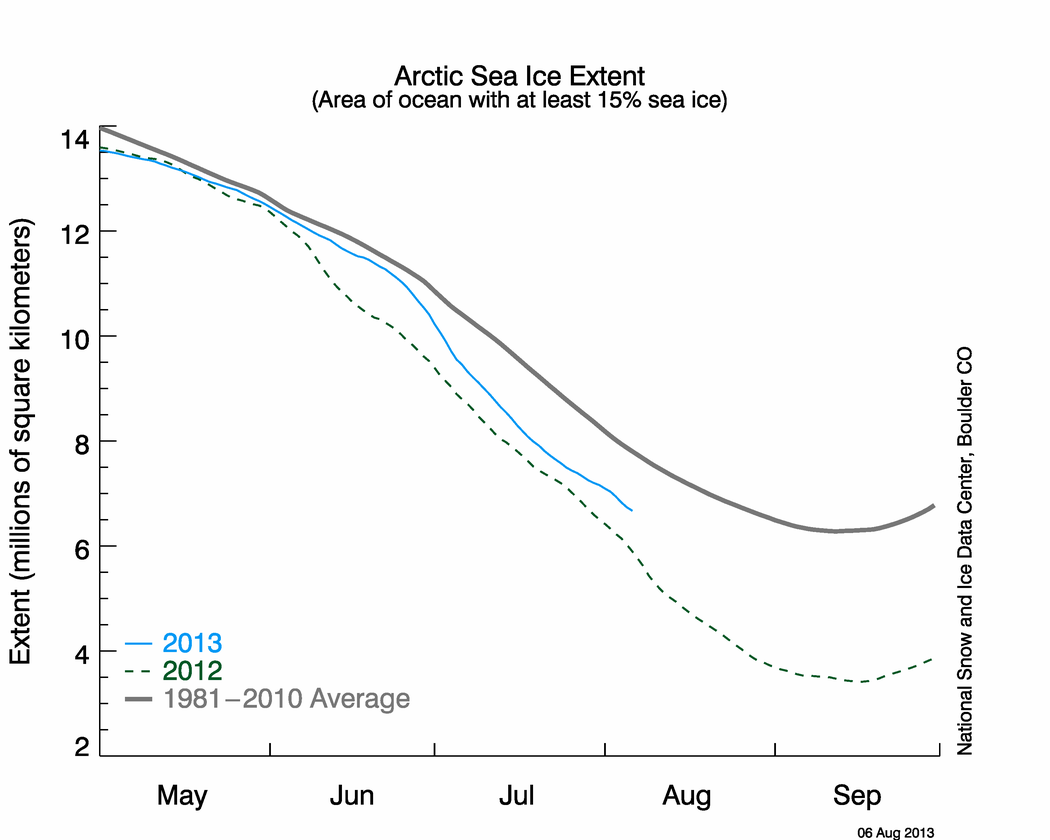
Monday’s NSIDC Arctic ice extent graph took a turn downwards, and is now showing 2010 a little more than 500,000 km2 higher than 2007. The animation below shows the change from May 1 to May 2.

By contrast, NORSEX shows something very different for May 2. They have no downwards turn, their ice extent measurement is right at the 1979-2006 average, and they show 2010 extent more than 1,000,000 km2 above 2007.


In order to look at this closer up, I superimposed the NORSEX 2010 data (red) on the NSIDC 2010 data (blue) at the same scale, and normalised to 2010, and saw some interesting things. The first problem is that they started to diverge right around the first of April, and as of May 2 they disagree by nearly 500,000 km2.

The next image shows that the X-Y scaling is identical (but normalised) in the two graphs. The grid is from NORSEX. Other colors (besides red) have been removed through chroma keying.

The second discrepancy is that the two sources show a large difference in growth since 2007. The image below normalizes the 2007 data – with identical horizontal and vertical scales. Using this view, NORSEX shows twice as much ice growth as NSIDC since 2007.

The animation below begins normalised to 2010 and finishes normalized to 2007. This technique does not show that either source is in error or has changed their data, rather the animation is done by me to enhance visualization.What it does show is the significant differences between the two records.

I believe that both groups use SSMI so it is difficult to understand what the problem is. Last year we saw something similar. NORSEX has a history of making adjustments in mid-season, so my sense is that NSIDC is probably more accurate. Any ideas from readers?
bubbagyro says:
May 6, 2010 at 9:22 am
For instance, the rate of melt is not linear with respect to ice thickness, but is higher order polynomial because of the tremendous heat capacity of ice. In other words, it takes a great deal more than three times the heat input to melt a three foot thick slab of ice than a one foot slab.
Assuming you meant an ice slab of the same area, a slab three feet thick would need only three times the heat of a slab one foot thick to melt (it has three times the mass):
Q = mL
Q is the amount of energy released or absorbed during the change of phase of the substance (in kJ or in BTU),
m is the mass of the substance (in kg or in lb), and
L is the specific latent heat for a particular substance (kJ-kgm−1 or in BTU-lbm−1); substituted as Lf to represent as the specific latent heat of fusion, Lv as specific latent heat of vaporization.
http://en.wikipedia.org/wiki/Latent_heat
The rate of summer “heat input” should be roughly the same for both slabs of ice – sunlight/air temperature on the top, heat from warmer water on the bottom. But yes, it should take about three times longer for that rate of heat input to melt the three foot thick slab – hence thicker ice often survives the summer melt, thinner ice might accumulate enough heat to melt completely.
Given a volume of ice, a small, thick lump should survive longer in the summer than a large, thin slab of the same mass – the energy required to melt both pieces of ice will be the same, but the ‘heat input’ will be higher for the ice with more surface area exposed to sunlight and underneath water.
Just looked at NSIDC and NORSEX, and they’re virtually the same. NSIDC is at about 13.75m sq/km extent, and NORSEX is about 13.5m sq/km – a little bit lower than NSIDC. And NORSEX is usually a day or two behind with their updates.