By Steven Goddard

Break out the Speedos and Bikinis. Springtime has finally arrived in the Arctic!

Temperatures have risen about 15C, and are now averaging a balmy -15C (5F) north of latitude 80N – with sunshine 24 hours a day. Under those conditions, you can get frostbite and a tan at the same time.

http://ocean.dmi.dk/arctic/meant80n.uk.php
But despite the balmy weather, NORSEX ice area continues to run above the 1979-2006 mean – as it has for the entire month of April.

http://arctic-roos.org/observations/satellite-data/sea-ice/observation_images/ssmi1_ice_area.png

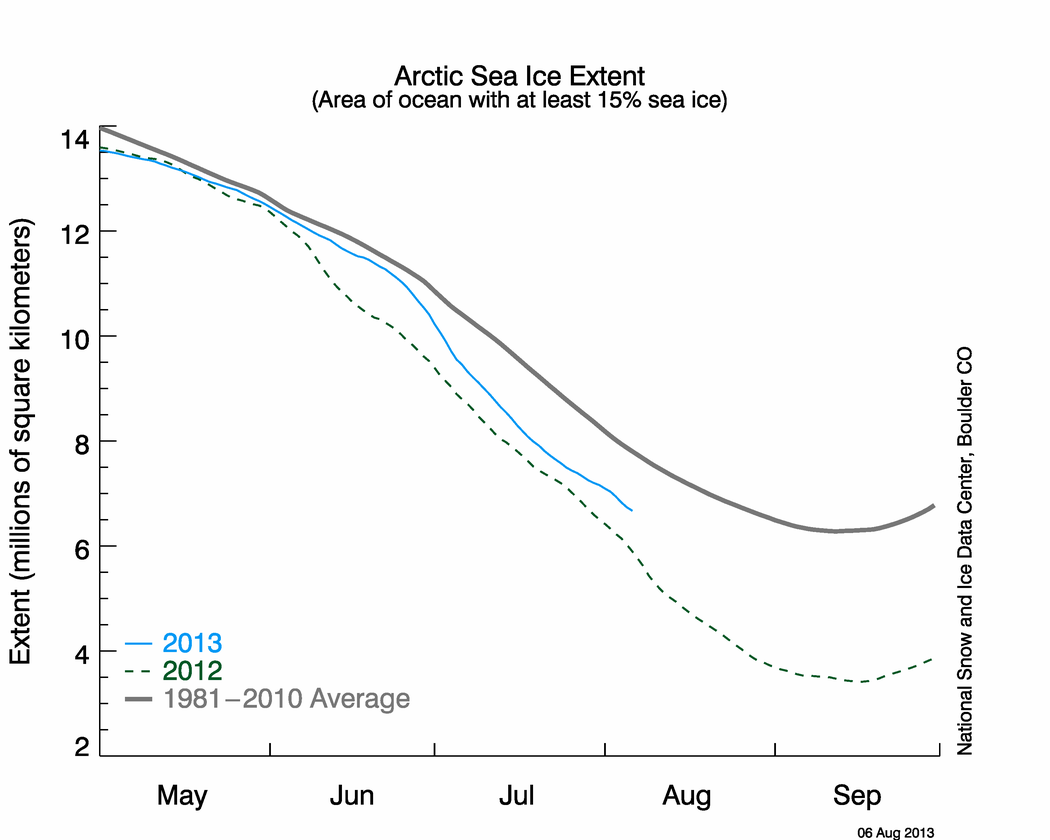
Since the melt season started, the Arctic has lost about one million km2 of sea ice. Below is a composite graph showing all of the popular (NSIDC, JAXA, NORSEX, DMI) extent measurements, superimposed on the NSIDC mean and two standard deviation region. The thin blue line is NSIDC extent from 2009. Note that all measurements have been nudging up against the mean line – for the entire month of April.


Disclaimer: All maps below are taken from NSIDC maps, and modified by the “breathtakingly ignorant” writers at WUWT.
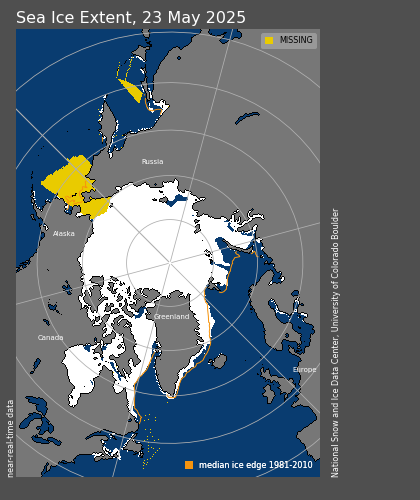
During the last three weeks ice has melted mainly at lower latitudes, as seen below in red. Areas in green have actually increased in extent, due to drift. Ice is probably still getting thicker in much of the Arctic, because temperatures remain well below freezing.

The map below shows changes over the past week.

And the map below shows changes since the same date in 2007. Green indicates ice growth.

The next map shows current areas of deficient ice (relative to the median) in red, and excess ice in green. The total amount of excess minus deficient ice is close to zero. In other words – Arctic ice extent is normal.

The Arctic Oscillation remains negative, so circulation is clockwise – as seen below in the buoy drift map. This pattern is keeping older, thicker ice from the Canadian side inside the Arctic Basin, and bodes well for another summer of increased ice thickness and extent – relative to the record melt of 2007.


http://iabp.apl.washington.edu/maps_daily_track-map.html
People counting on bad news from the Arctic to keep their agenda alive are staring at a long, (rhetorically) cold summer……. The good news is that they can keep raising the red flags about Montana glaciers, if the Arctic refuses to melt.
It has now been over 41 years since the New York Times headlined “Expert Says Arctic Ocean Will Soon Be an Open Sea.” triggering the Arctic Death Spiral. After 41 years of dangerous and increasing melt, ice area is again above normal.
My failure to understand this is surely a sign of “breathtaking ignorance.” But don’t call me Shirley.
O/T (about the ‘other’ pole)
“Whale excrement could help fight climate change”
Yep, you read that right!
http://www.telegraph.co.uk/earth/earthnews/7639614/Whale-excrement-could-help-fight-climate-change.html
“His findings come as the International Whaling Commission prepares to meet to update the law on the protection of whales”
I do not think that there is any reason to hunt whales, but trying to link whale hunting to Global Warming is way, way, way out there.
Is there a company that keeps buys all these ‘studies’ and sells them to interest groups when the time is right. If not it could be an opportunity.
http://www.NeedAnUnpublishedStudy.com
The Baltic Ice Map does not show any ice around Denmark.
http://portal.fma.fi/sivu/www/baltice/ice_map
A friend sent me this link with some stunning photos of Iceland’s Eyjafjallajokull volcano.
http://www.boston.com/bigpicture/2010/04/more_from_eyjafjallajokull.html
Enjoy
KimW :
Yes, it might be rain in the Arctic, but it’s also another cold blast on the Pacific Northwest.
More snowpack & rain for us, more fresh water to freeze @ur momisugly -15C up there on the Hadlow Ice Follies.
Arctic ice extent is normal.
That’s only because of global warming.
DMi is my favorite flavor.
KimW says: April 27, 2010 at 10:21 pm
“The rain fell on the team’s ice base off Ellef Rignes island, about 3,900 km (2,420 miles) north of the Canadian capital, Ottawa. ”
Meanwhile 20 Km. South of Ottawa, it snowed last night and all day today. Green grass yesterday 2 cm. on the ground right now.
Forcast for tonight, more snow:
http://www.wunderground.com/cgi-bin/findweather/hdfForecast?query=YOW&searchType=WEATHER
Forecast for CITY OF OTTAWA
Updated: 7:53 PM EDT on April 27, 2010
No Active Advisories
Tonight
Periods of wet snow ending late this evening then cloudy. Wind northwest 20 km/h (12 mph) gusting to 40 km/h (25 mph). Low 0C(32F).
Note: “It’s definitely a shocker … the general feeling within the temperate community is that snowfall in the Canadian Capital in late April is a freak event”
So, what?
Leif is right, there is NO ice in danish waters and temperatures are aproaching 15 degrees celcius. There has been NO ice in danish waters the last month at the least, I also noticed that satelites showed ice in danish waters in november and december, there was NO ice in danish waters in november as the temperatures here had not even dipped below freezing in noveber.
The Arctic Oscillation remains negative, so circulation is clockwise – as seen below in the buoy drift map. This pattern is keeping older, thicker ice from the Canadian side inside the Arctic Basin, and bodes well for another summer of increased ice thickness and extent – relative to the record melt of 2007.
More like counter clockwise!
http://i302.photobucket.com/albums/nn107/Sprintstar400/20100412-20100418.jpg
Ice is probably still getting thicker in much of the Arctic, because temperatures remain well below freezing.
Here’s an example of the ‘thickening ice’ near the North Pole from a few days ago:
http://www.explorersweb.com/polar/news.php?id=19271
Experiments??? Observations???
Sine when did these have anything to do with climate science? The half-dozen trees that we needed to measure were done years ago. And now we have super-fast computers that have taken away any necessity to do ‘experiments’ or ‘observe’ anything.
After all, where would we have been in the Volcanic Ash Crisis if people had wasted their time making actual observations to find out how much of the ash there was, and where it might be dangerous to fly? That might have delayed the closure of European airspace for days…and then what would have happened? People would have been flying planes all over the place as if nothing significant had occurred! There was absolutely no point in doing such experiments since our computer models are perfect and from them we knew exactly what Nature should have been doing.
Big Oil funded ‘Sceptics’ try to say that Reality doesn’t always match the models and therefore that the models aren’t complete!. This is of course heresy and they should be executed on the spot. And in the next round of the inter-governmental talks we will be passing very stiff regulations with extremely severe penalties for any recalcitrant bit of the real world that wilfully fails to comply with our models. Penalties will be deliberately harsh to deter any backsliding. Nature must be taught how to behave correctly.
So, please, no more talk of such outdated and retrograde concepts as ‘experiment’ or ‘observation’. We left these behind years ago in climate science, and see absolutely no reason to return to the primitive thinking of the pre-Revelation Medieval Experimental Period (c. 1500-1998).
We have moved on…we have seen the light. We know that we are right. It is only evil-minded and slush-funded Deniers who naysay the Truths. Banish these evil words Experiment and Observation from the scientific vocabulary now!
kuhnkat> I only claim that at present there is no ice in the waters around Denmark. I am in Denmark now, its a lovely spring day, temperature around 6 degrees. I can see the sea from my window, no ice anywhere…:) This does not agree with the the nsdic map, which seem to be derived from satellite pictures. It does make you wonder about the general accuracy of this method.
This got me looking closer at the maps, there seems to be several places (like around the Disco bay in Greenland, also around the eastern coast of Greenland) where the nsdic reports less ice cover than normal, but Steve’s map shows normal cover (no red markings). Maybe I’m just misreading, the nsdic map is not entirely clear.
Rain is weather, Ice Extent is Climate.
Except when you support AGW
The Danish Navy ice reports are here;
http://forsvaret.dk/SOK/Nationalt/Istjenesten/Pages/default.aspx
and one can go back, using the calendar at the bottom, to see when it all melted.
Phil,
You cherry picked a six day period when the AO was positive. Nice picking.
http://www.cpc.noaa.gov/products/precip/CWlink/daily_ao_index/ao.sprd2.gif
As far as the open water goes, I suspect that you do understand the difference between a mechanical fracture (known as a “lead”) and melting?
Ice doesn’t melt at -12C.
http://psc.apl.washington.edu/northpole/66275_atmos_recent.html
Here is an audio link to a weather forecast for the rest of the year by Evelyn Garris that takes in the declining El Nino and the NH volcanic ash clouds. She blames the rebuild of Arctic ice on the volcanoes and covers the effect of NH volcanoes on agriculture. Any farmers out there will get a forecast for their crops. This lady apparently has a good track record on long range forecasting. She talks about Ketla and the Russian volcanoes. Well worth listening to.
Audio:
http://www.netcastdaily.com/broadcast/fsn2010-0424-3.asx
The original link can be found here. Select an audio link on ‘Volcanic Eruptions, Hurricanes, El Nino & Agriculture’ for Saturday, April 24, 2010
Off topic but loonies are off again WWF
http://www.telegraph.co.uk/earth/earthnews/7638972/Rivers-in-England-and-Wales-face-drying-out-because-of-climate-change.html
They should listen to the MET office which says its going to get wetter in the UK due to Climate warming, so in fact the situation would be worse without warming. But that would reduce the alarm.
Here is an audio link to a weather forecast for the rest of the year by Evelyn Garris that takes in the declining El Nino and the NH volcanic ash clouds. She blames the rebuild of Arctic ice on the volcanoes and covers the effect of NH volcanoes on agriculture. Any farmers out there will get a forecast for their crops. This lady apparently has a good track record on long range forecasting. She talks about Ketla and the Russian volcanoes. Well worth listening to.
Audio:
http://www.netcastdaily.com/broadcast/fsn2010-0424-3.asx
The original link can be found here. Select an audio link on ‘Volcanic Eruptions, Hurricanes, El Nino & Agriculture’ for Saturday, April 24, 2010:
http://www.financialsense.com/fsn/main.php
mb,
There are also a few places along the east coast of Greenland which NSIDC shows slightly more ice than the median line. I did not attempt to mark every single above or below pixel, only regions that are of a size worth caring about. As you know, the NSIDC maps are not 100% accurate.
Congrat’s to the new layout.
ctm, I posted a comment that had a couple of links. They disappeared. Can the second one be retrieved from the bin please? I don’t think I’ve done anything to be banned. It’s relevant to the post.
REPLY: It may simply be the way you formatted them. Just type in the URL’s directly
like http://www.google.com
– Anthony
I don’t know whether to be more thrilled or alarmed. Teh good news is that the warmists are having their asses handed to them on a platter and their take-over-the-world through carbon control agenda is getting derailed fast. Teh bad news is that global cooling looks likely and that’s going to cause some serious hurt to civilization that will leave us wishing that anthropogenic global warming had been real.
Here’s an example of the ‘thickening ice’ near the North Pole from a few days ago:
“He said flat pans never last for ever as they turned into an interesting mix of heaved and cracked multi year ice slabs and small pans bordered by wide swaths of jumbled blue block ridges. ”
“We are pushing hard to make miles, but are also fighting against ice that is pushing us south as we sleep and time chewing veers around thin ice, big drifts and huge ice blocks.”
“As a result of the break in the ice, these structures ended up on an ‘island’. A small block of ice that had luckily floated right up to the evacuation site was used to ‘ferry the tents from the ‘island’ to the ‘mainland’.”
It sounds like pack ice, they were lucky that a ‘small’ block of ice was able to ferry them and their equiment. I wonder what they mean by ‘wide swaths of jumbled blue block ridges’, far as the eye can see perhaps?
Do you still require a graphic for Sea Ice News ?
http://www.kane-tv.com/wuwt/Sea Ice News.jpg
That link didn’t format correctly. Try http://www.kane-tv.com/wuwt/ and select the relevent jpeg.
Hi here you say that the air temp is -15c, is that in the shade or out in the sun ?.The ice thats in the sun shine will be melting because the heat from the sun will be warmer than -15c as in the shade. Here when we get =5c and the sun is shining the forst in the sun shine still melts even tho it is -5c and the areas in the shade has on melting.So i would say that the green arears in the map above i would say would be areas that are shaded by hills or it has been clouder their.( sunnier summers at the poles mean more melt).